On this page
- How marketing automation works
- Marketing automation, CRM and AI agents
- Practical examples in the current BrandWell app
- Who should use marketing automation?
- Build your first marketing automation workflow
- Plan for failures and repeated events
- How to measure marketing automation
- What automation does not guarantee
- Frequently asked questions
Marketing automation uses software to carry out repeatable marketing tasks according to defined triggers, rules, schedules and approvals. A form submission might start a welcome sequence; an approved article might start a publishing task. The workflow needs a clear owner, appropriate data and a recorded result.
Automation can reduce repeated manual work and improve consistency. It does not automatically create a sound strategy, qualify every lead or increase conversions. Start with one useful process, verify that it runs correctly, and measure its full cost and outcome.
How marketing automation works
- Trigger: an event, schedule or approved instruction starts the work.
- Context: the system receives relevant customer, account, content or campaign information.
- Rules: eligibility, exclusions and permissions determine what may happen next.
- Action: a supported tool prepares or performs the assigned task.
- Review: an owner approves the output or resolves an exception.
- Result: the destination confirms what happened and the team records the outcome.
A task being queued, an email being accepted for sending and a recipient replying are different events. Preserve those distinctions rather than calling every completed automation a conversion.
Marketing automation, CRM and AI agents
| Component | Role | What to check |
|---|---|---|
| CRM | Stores relationships, ownership and sales activity. | Field definitions, deduplication and who owns each record. |
| Marketing automation | Runs configured sequences and repeatable work. | Entry rules, stops, timing, approvals and delivery status. |
| Analytics | Records events and summarizes observed performance. | Tracking coverage, consistent units and attribution limits. |
| AI agent | Uses supplied context and configured tools to work on an assignment. | Evidence, permissions, output review and actual execution. |
Swipe the table to see all columns.
These components can connect, but one does not guarantee the capabilities of the others. A generated answer is not a verified fact, and a proposed CRM change is not a confirmed write.
Practical examples in the current BrandWell app
Search opportunity to reviewed article
Use Visibility and available search data to identify a useful question or an existing page to improve. Prepare the brief with AIMEE, then use RankWell to organize sources, draft and edit. Review recommendations, media and the search preview before publishing.
In the Content Hub, follow the saved work through its queue and review stages. Inspect the finished page at the configured destination and recheck performance. A higher editor score or a longer article does not prove ranking improvement.
Topic research to an approved conversation
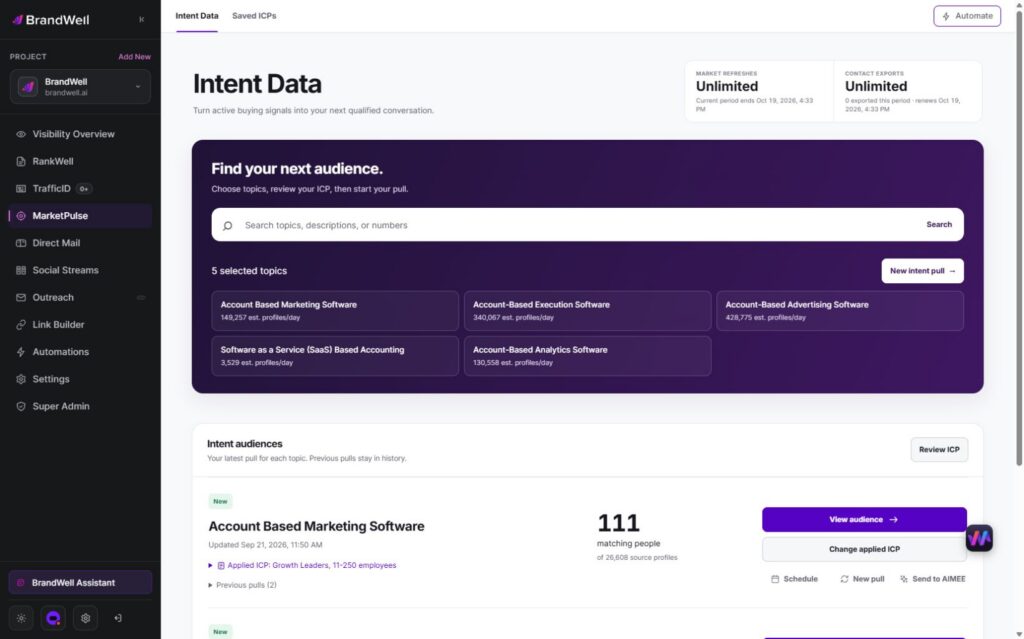
In MarketPulse, select a relevant catalog topic and saved ICP, then inspect actual matches and available fields. Have AIMEE prepare an account brief or reviewed message. Run an eligible sequence through Outreach after the audience and copy are approved.
MarketPulse is starting at $500/mo. This is a product starting-price reference, not a quote for every module, connected service or custom implementation. Topic research provides context; it does not by itself establish a qualified opportunity.
Website visit to account-owner review
TrafficID works with identifiable activity on your website and submitted form identities. Review the actual visitor context, assign an owner and decide whether a next step is appropriate. Keep additional stakeholder contacts distinct from observed visitors.
Identification covers an identifiable portion of activity. An enriched email or mobile number does not establish permission to use every channel. Required consent, suppression and source checks still apply.
Public discussion to useful follow-through
Use SocialStreams to review relevant public discussions. Assign research or a response draft to AIMEE with the original context. Review relevance and channel rules before responding or enrolling someone in a campaign.
Eligible audience to a physical touchpoint
Direct Mail can connect an eligible audience to a reviewed postcard. Verify address eligibility, creative proof and authorized spend, then track fulfillment separately from replies and sales. A contact record does not guarantee a usable mailing address.
Useful page to publisher research
Link Builder supports publisher research, outreach and placement follow-through. Approve the publisher and pitch, record replies, and verify any resulting link. Sending a pitch does not guarantee a placement, ranking or AI citation.
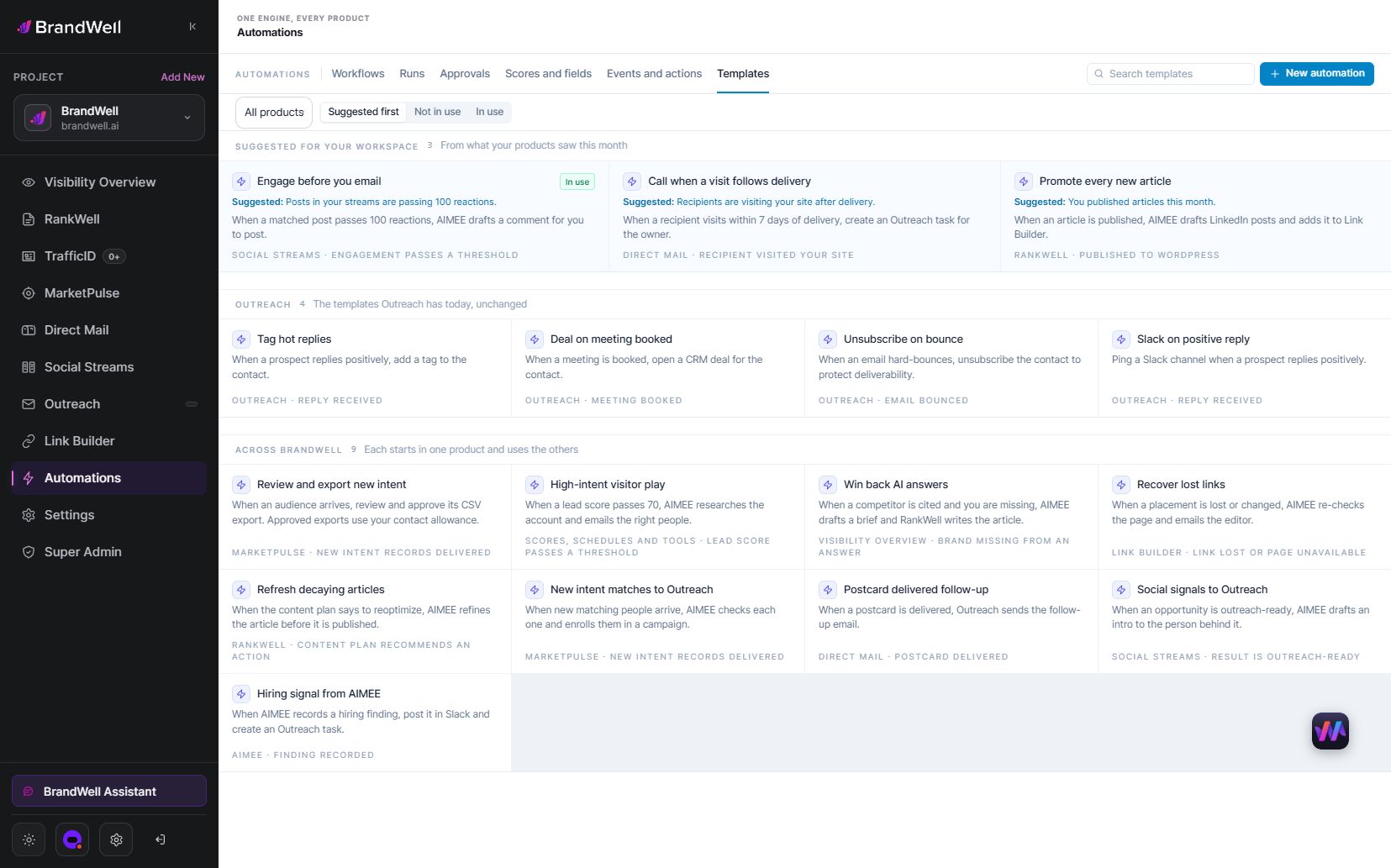
Browse BrandWell’s workflow examples to see how these stages connect. AIMEE works through configured tools and assigned instructions. Confirm actual support, destination access and human ownership for each step.
Who should use marketing automation?
- Small teams: start with a recurring task that has a clear input and a manageable review queue.
- Agencies: define client-specific projects, approvals, access boundaries and deliverables before expanding across accounts.
- Larger teams: standardize ownership, field definitions, suppression and exception handling across departments.
- Nonprofits: consider appropriate donor acknowledgements and follow-up, while separately checking fundraising, privacy and communication requirements.
If the process is unstable, the source data is unreliable or nobody can review exceptions, fix those gaps first. Automation can repeat a mistake as easily as a useful action.
Build your first marketing automation workflow
- Choose the outcome. Define a useful result such as an approved article published correctly or a qualified inquiry acknowledged by its owner.
- Map the existing process. Record the inputs, manual steps, wait time, failure points and actual effort.
- Define entry and stop rules. Include duplicates, existing customers, purchases, unsubscribes, expired offers and unsupported contact channels where relevant.
- Confirm the product and connections. Test the specific action and destination instead of assuming a broad integration label covers the job.
- Write the instructions. Supply the context, permitted actions, tone, evidence requirements, owner and approval points.
- Test a small set. Include normal entries, missing fields, exclusions, duplicates and failed deliveries.
- Review the destination. Confirm actual results and resolve exceptions before increasing volume.
- Measure and refine. Compare observed effort, costs and useful outcomes with a suitable baseline.
Plan for failures and repeated events
As a technical example, AWS documents retry and catch mechanisms for workflow errors. That illustrates why failed actions need an explicit path; it is not a claim that BrandWell uses that service or includes every described mechanism.
For your workflow, distinguish a temporary timeout from a rejection or permission failure. Before retrying a message, charge or CRM write, determine whether the destination already accepted it. Use a stable event identity and destination acknowledgement to avoid duplicate actions. Escalate unresolved cases to the owner.
Recheck stop conditions at execution time. A queued reminder should not go out after a purchase or opt-out simply because the person was eligible when it was scheduled.
How to measure marketing automation
Fictional delivery example: 100 eligible records enter a workflow, 80 receive approval and 72 actions are acknowledged. Approval is 80% of eligible records; acknowledged delivery is 90% of approvals. Eight approved actions remain unresolved. These numbers are not an opportunity or revenue count.
Fictional time example: a manual job takes ten hours. The automated process requires four hours of operation and three hours of review and repairs. The observed saving is three hours, or 30%, before accounting for initial setup. Neither example is a BrandWell performance benchmark.
- Operational measures: completed actions, exceptions, review effort, duplicate actions and time to resolve.
- Audience measures: eligibility, opt-outs, complaints, useful replies and qualified conversations.
- Commercial measures: mature opportunities, realized revenue, contribution and actual total cost.
Attribution and causation are different. A person receiving an automated message before buying does not prove that the message caused the purchase. Choose a suitable comparison and account for timing, audience differences and missing outcomes.
What automation does not guarantee
It does not guarantee legal compliance, accurate lead qualification, higher rankings, more conversions or uninterrupted delivery. Scores and predictions need validation; permission and suppression failures should stop an action rather than merely lower a score.
Keep tool recommendations current. Google confirms that Optimize and Optimize 360 became unavailable on September 30, 2023. Select a currently supported testing setup for the actual job instead of following retired-tool instructions.
Frequently asked questions
Is email marketing the only use of automation?
No. Examples include content production, audience review, account research, publishing, owner handoffs and reporting. Each needs its own scope and controls.
Can AI decide which leads are qualified?
AI can help prepare research and prioritize review. Qualification should use defined business criteria and verified evidence; a score alone does not establish buying intent or permission to contact someone.
Will marketing automation save money?
It may, but measure subscriptions, implementation, review, maintenance and failures as well as manual time saved. A faster draft is not necessarily a cheaper finished job.
Can I automate paid advertising?
Advertising platforms provide their own bidding and audience features. Confirm current eligibility, tracking and settings with the platform. A general BrandWell workflow example is not proof of a native integration for every ad action.
Where should I begin in BrandWell?
Choose one workflow example, confirm the tools and owner, and run a small reviewed test. Keep actual outcomes with the work so the next improvement has evidence behind it.
Reviewed and updated October 6, 2026.

Written by