


On this page
- Why an average can mislead
- Define the reply metric before you send
- A worked example
- Open tracking is not proof of attention
- Check relevance and contact eligibility first
- Follow current sender requirements
- Write a concise message using verified facts
- Plan follow-up with stop conditions
- Use current BrandWell context carefully
- Evaluate a test without declaring a premature winner
- Frequently asked questions
There is no single cold-email response rate that reliably describes every business. Compare rates only when the audience, period, sequence, denominator, and reply definition are clear. Measure your own human replies, positive replies, meetings, and customer outcomes separately rather than treating an unsourced benchmark as a promise.
This guide explains the calculations, provides an original reporting example, and shows how to evaluate a relevant message without invented customer results or a guaranteed sending schedule.
Why an average can mislead
A report may count replies to individual messages or people replying to an entire sequence. It may include negative replies, out-of-office messages, or automated responses. The audience might be existing customers, inbound inquiries, or unfamiliar contacts. Those measurements are not interchangeable.
Before using a benchmark, check who collected it, the sample size, dates, audience, exclusions, and calculation. A vendor’s customer sample describes that sample; it does not automatically describe your industry. If those details are unavailable, do not turn the percentage into a business target.
Define the reply metric before you send
| Measure | Suggested definition | Important limitation |
|---|---|---|
| Human reply rate | Unique recipients with a human reply divided by unique delivered recipients | Includes negative replies unless separately excluded |
| Positive reply rate | Unique recipients with a reply meeting predefined positive criteria divided by unique delivered recipients | Requires consistent manual or reviewed classification |
| Meeting rate | Unique recipients who book a relevant meeting divided by unique delivered recipients | A booking is not a completed meeting |
| Customer rate | New customers attributed under the stated method divided by the defined outreach cohort | Long sales cycles and other interactions affect attribution |
Swipe the table to see all columns.
These are proposed reporting definitions, not universal standards. Keep the same definitions across comparisons. If you report per-message delivery instead of per-person sequence delivery, label it explicitly.
A worked example
Suppose an illustrative sequence reaches 200 unique delivered recipients. Twelve people reply, including four positive replies, five declines, and three other human responses. Two relevant meetings are booked.
- Human reply rate: 12 ÷ 200 = 6%.
- Positive reply rate: 4 ÷ 200 = 2%.
- Meeting-booking rate: 2 ÷ 200 = 1%.
These numbers are invented solely to demonstrate the arithmetic, not claimed BrandWell or customer results. Count a person replying twice once in a unique-person rate. Exclude automated responses from a metric labeled human replies, and keep opt-outs visible as a separate operational measure.
Open tracking is not proof of attention
Apple’s Mail Privacy Protection documentation explains that remote content can download privately in the background instead of when someone views a message. Consequently, a tracking-pixel load does not establish that the person read your email.
Use opens as a limited technical signal where appropriate, not a reason to declare someone interested or start another channel. Inspect actual replies and relevant downstream actions. Delivery acceptance also does not prove inbox placement or human attention.
Check relevance and contact eligibility first
Document why the contact fits the current offer, where the information came from, and whether the chosen communication is eligible under the applicable rules and provider policies. Apply suppression and honor opt-outs. A valid email address or enriched phone number does not establish consent for every channel.
For US commercial email, the FTC’s CAN-SPAM guide covers truthful sender information and subject lines, required disclosures and postal address, an opt-out mechanism, and honoring opt-outs. It does not mean every provider permits unsolicited campaigns or that every jurisdiction has identical requirements.
Follow current sender requirements
Gmail’s sender guidelines apply to delivery to personal Gmail accounts. They specify authentication and other requirements, with additional rules for bulk senders. At the documented bulk threshold, those include SPF, DKIM, DMARC, alignment requirements, and one-click unsubscribe for applicable marketing or subscribed messages.
Check the live requirements with the person responsible for sending infrastructure. Authentication helps verify the sender; it is not consent, a spam-filter bypass, or an inbox guarantee. Do not rotate through domains or manufacture engagement to evade provider restrictions.
Write a concise message using verified facts
Make the subject match the message. Explain why the topic is relevant, describe one supported benefit or resource, and ask one clear question. Avoid fabricated praise, customer statistics, urgency, or claims that you know the recipient’s private buying intentions.
Subject: Payroll migration checklist
Hi Morgan,
Your website says your team supports payroll migrations for small employers. We have a checklist covering import preparation and validation steps.
Would that resource be useful for your team?
Best,
Casey
This is an illustrative message. Use the website statement only if you have actually verified it, and use the resource only if it exists. Add the required sender, address, and opt-out details in the sending system. The example does not establish eligibility to contact a particular person.
Plan follow-up with stop conditions
Choose a bounded sequence appropriate to the relationship and documented rules. There is no universal best weekday, hour, or number of follow-ups. A recipient’s silence is not permission to escalate to calls or texts. An opt-out, decline, unsuitable fit, or already-completed purchase should stop the applicable sequence.
A follow-up should add a useful answer or clarify the next step. Avoid fake final notices or “closing your file” language unless there is a real process that makes the statement accurate. Do not send a fabricated testimonial as social proof.
Use current BrandWell context carefully
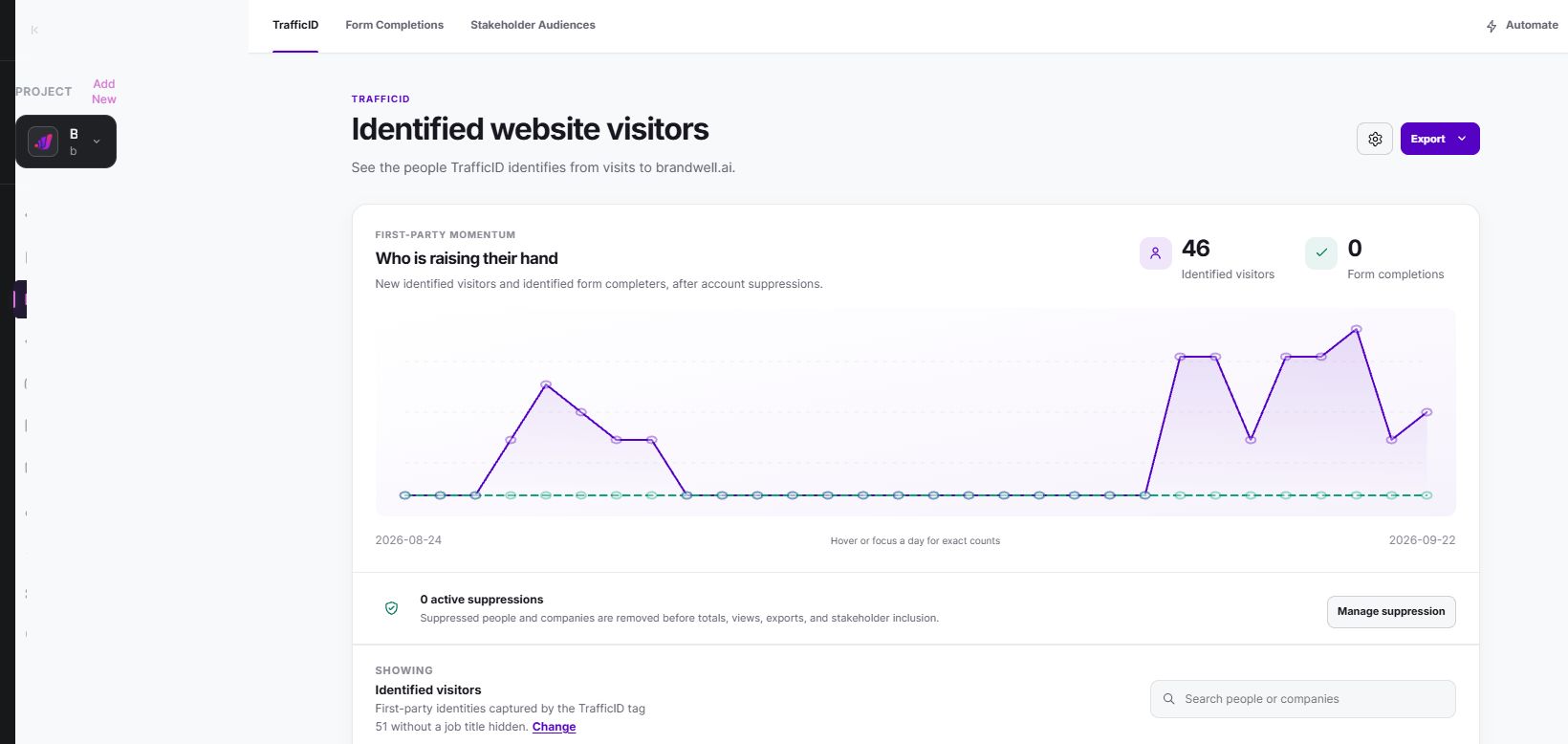
TrafficID can surface identified website visitors and available profile or activity data. Coverage varies. A visit can inform research, but does not confirm a need, budget, or permission to contact someone. MarketPulse provides available topic-research data, with standard plans starting at $500/mo; a topic signal is not a proven intent to buy your product.
In the BrandWell portal, AIMEE can assist with an approved brief and authorized connected tasks. Review generated copy, sources, eligibility, and the final destination before sending. RankWell can support the educational resource used in the message. Neither workflow guarantees replies or customer conversion.
Evaluate a test without declaring a premature winner
Define the audience, primary outcome, measurement window, and classification rules before comparing versions. Keep other conditions comparable and inspect delivery problems, negative responses, and opt-outs alongside positive replies. Small differences based on a few responses may be inconclusive.
Record what you changed, such as the question or resource offered. Improve the conversation based on actual feedback rather than selecting whichever subject appears to have the highest pixel-open rate. Report customer outcomes separately, with the attribution method and limitations.
Frequently asked questions
Is a 5% response rate good or bad?
It depends on the audience, reply definition, cost, and downstream results. Separate positive replies from all replies and compare equivalent cohorts.
How many emails guarantee one reply?
No fixed number guarantees a reply. A cohort’s observed rate is not a promise for the next message.
Does a high open rate prove the subject worked?
No. Privacy features and remote-content handling limit open tracking. Human responses and relevant outcomes provide different evidence.
Is the 30/30/50 rule a reliable benchmark?
No validated breakdown is established here, and those percentages total 110%. Use clearly defined measurements instead.
Reviewed and updated October 2, 2026.

Written by

