


On this page
- What is a content-distribution platform?
- Compare channel types before choosing a tool
- Start with the audience and next action
- Keep one reviewed source resource
- Separate distribution results from SEO claims
- Handle syndication explicitly
- Do not treat Google News as an approval shortcut
- Prepare distribution work in BrandWell
- Test the economics before expanding
- Distribution launch checklist
- Frequently asked questions
Choose content-distribution platforms by audience fit, the content format, the action you want and your ability to maintain the channel. Keep a reliable home for the full resource, then use selected channels to introduce it to relevant readers. Distribution can produce referral traffic and discovery; it does not guarantee search rankings or backlinks.
A dated list of popular apps is a weak substitute for a distribution plan. Platforms, features and submission processes change. Verify the current channel before investing in production or paying to promote a resource.
What is a content-distribution platform?
It is a channel or service through which people encounter content. Some host the full resource, some send readers to your website and some provide paid placement. Those functions have different costs, controls and measurement limits.
Separate three questions: where the content lives, how people discover it and where the intended next action happens. A platform’s audience size does not tell you how many relevant people will see your specific resource.
Compare channel types before choosing a tool
| Channel type | Useful role | What to verify |
|---|---|---|
| Your website or content hub | Maintain the full explanation and product context | Ownership, publishing access, indexability and mobile use |
| Email to an eligible audience | Deliver a requested or relevant resource | Permission, suppression, sender setup and working links |
| Social content | Introduce a focused point and invite discussion | Audience fit, format, response owner and destination |
| Video publishing or hosting | Demonstrate a process or explain a sequence | Captions, embedding, playback, analytics and rights |
| Podcast distribution | Publish an audio explanation or conversation | Feed support, publishing control, transcript and maintenance |
| Community or curated feed | Contribute useful information to a relevant group | Current rules, disclosure and whether links are appropriate |
| Paid content placement | Test a resource with a defined audience and budget | Placement quality, cost, attribution and qualified outcomes |
| Syndication partner | Republish agreed content for another audience | Rights, attribution, updates and indexing expectations |
Swipe the table to see all columns.
These are planning categories, not a ranking of particular vendors. A small channel with relevant readers can be useful, while a large channel may provide little qualified response for your offer.
Start with the audience and next action
Define whom the resource serves, the question it answers and what the reader can do next. Review customer questions and available channel data before assuming a broad audience will fit.
Original hypothetical example: a managed IT provider creates an office-move network checklist. The full article lives on its website. An eligible customer email introduces the checklist, a social post explains one preparation step and a short video demonstrates the information needed before planning begins.
The relevant outcome might be a qualified planning inquiry, not a viral post. Keep the checklist useful to someone who is still evaluating the problem rather than turning every paragraph into a sales pitch.
Keep one reviewed source resource
Maintain the core explanation, sources, product details and important conditions at a clear destination. Check the page’s title, description, heading, navigation and mobile layout before promoting it.
Create adaptations that fit the channel without stripping away necessary qualifications. A short clip can introduce the checklist, but it should not turn “we review the information before planning” into “we guarantee a seamless move.”
Inspect image crops, captions and readable labels. Provide the key information in text when a graphic would otherwise carry the entire instruction. Confirm that the promoted destination actually fulfills the post’s promise.
Separate distribution results from SEO claims
A link can send referral visitors without changing your organic ranking. A paid placement is not a purchased organic ranking improvement. A social post may be discovered by readers, but its impressions do not establish indexing, useful backlinks or business outcomes.
Measure what happened: exposure in the channel, tracked visits, resource interaction and the configured next action. Do not assume every share or profile link passes a particular search benefit.
Choose content length based on the question. A 2,000-word target does not guarantee better results, and a video does not become favored in Search merely because the hosting service is associated with a search company.
Handle syndication explicitly
Before republishing, agree on rights, attribution, edits, update responsibilities and search expectations. A visible source acknowledgment is useful to readers but is not a technical instruction that forces a search engine to select the original page.
Google’s canonicalization troubleshooting guidance says canonical links are not recommended as the solution for avoiding duplication by syndication partners. When the goal is excluding the syndicated copy from Search, review the appropriate indexing controls with the partner.
Do not apply a partner-copy indexing instruction to your own original page. Verify the actual implementation at the intended URL and document the agreement. A partner may have different publishing controls or decline the requested arrangement.
If full republication does not fit your goals, consider a genuinely distinct summary that links to the fuller resource. Make the summary useful rather than simply changing a few words of the original.
Do not treat Google News as an approval shortcut
Google’s publication-page update explains the transition to automatically generated publication pages and automatic consideration of eligible content. The old instructions to add a publication, submit a feed and wait for approval are not a reliable current inclusion process.
Ordinary promotional content does not become newsworthy solely by using a trending keyword. Follow the relevant content policies and make the publication’s authorship, dates and evidence clear. Consideration is not a guarantee of appearance or traffic.
Prepare distribution work in BrandWell
Use Visibility for available keyword research and RankWell to prepare and review the source article. Give the draft an approved brief, reliable evidence and current product details. Publish through a configured connection after editorial review.
Use SocialStreams for configured social-content work available to the workspace. Check each adaptation against the source and current channel requirements.
AIMEE can prepare work through configured tools, access and permissions. Specify the task, intended destination and review requirement. Use available Automations with clear triggers, schedules, owners and exception handling.
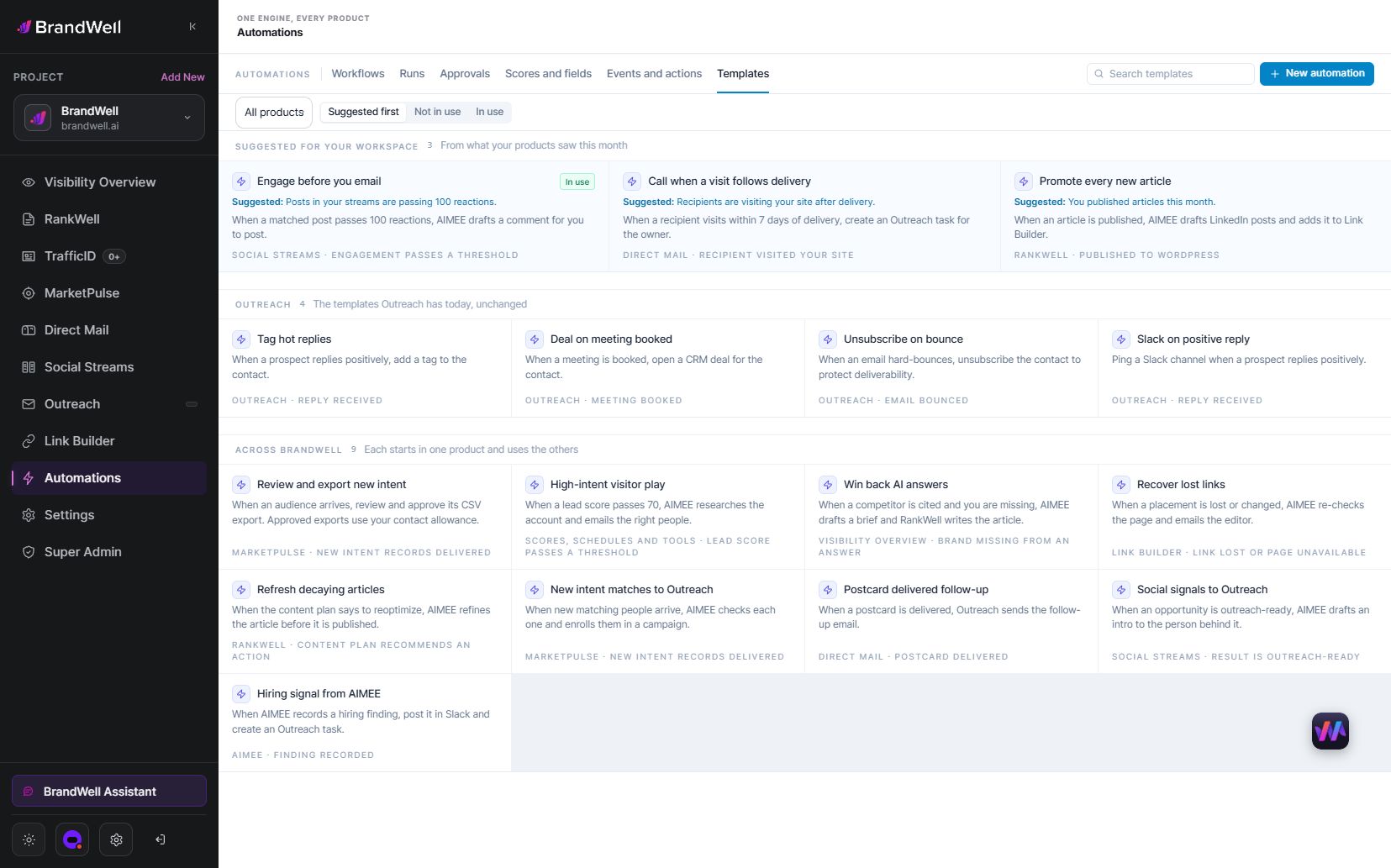
Keep a simple handoff record: source URL, approved version, adaptation, destination, owner, scheduled date and measurement tag. If the product changes, update the source and the adaptations that repeat the changed claim.
Test the economics before expanding
Original hypothetical calculation: a paid content test costs $300 and produces 100 valid tracked visits. Ten visitors submit inquiries and four qualify. The cost is $3 per tracked visit, $30 per inquiry and $75 per qualified inquiry. These illustrative costs are not channel benchmarks or BrandWell results.
Review whether the qualified inquiries progress and whether the resulting value justifies production, placement and follow-up costs. Exclude invalid events and document attribution limits rather than counting every later sale as caused by the placement.
For organic channels, record staff time and production costs as well. “No advertising spend” does not mean distribution is free. Expand when the next channel has a clear audience fit and the team can maintain the existing work.
Distribution launch checklist
- The resource answers a relevant question.
- The source page, facts and product details are current.
- Each adaptation preserves the claim’s conditions.
- Channel rules and permissions are checked.
- Mobile media and destination links work.
- Source tagging is tested without private data in URLs.
- Ownership and update responsibilities are explicit.
- The primary outcome and cost calculation are defined.
Frequently asked questions
Which distribution platform is best for SEO?
No platform guarantees SEO gains. Choose the channel that fits the audience, format and outcome, then measure referral and search results separately.
Should I republish the same article everywhere?
No. Review rights, audience value, updates and indexing expectations. A distinct summary or channel-specific adaptation may serve the goal better.
Do social shares guarantee backlinks?
No. Track the actual referral visits and relevant links acquired rather than assuming every share creates a search benefit.
How many channels should I start with?
Start with the source resource and the channels you can maintain and evaluate. Add another when its audience fit and operational cost are clear.
Reviewed and updated October 3, 2026.

Written by

