


On this page
Ecommerce marketing tools should help shoppers find useful information, evaluate products and complete a purchase. Build the workflow around those tasks and measure accepted outcomes. Installing more software does not establish higher revenue, and no list of tools can promise a fivefold increase.
Start by identifying a specific problem: customers cannot find sizing information, product pages omit important details, opted-in messages are inconsistent or reporting cannot distinguish orders from duplicate events. Address that problem before adding another dashboard.
Eight capabilities to organize around the buyer’s journey
1. Product information and publishing
Maintain approved names, specifications, prices, availability and policies. Assign an owner to update them. A persuasive product description should not contradict the catalog or invent a feature, delivery promise or material claim.
2. Search research and useful content
Investigate the questions shoppers ask before buying: compatibility, dimensions, care, assembly or intended use. Decide whether each answer belongs on a product page, category page or buying guide. In BrandWell, Visibility supports keyword research and opportunity discovery.
3. Drafting and editorial review
Use an approved brief and evidence to prepare a draft. RankWell supports the content workflow. Review factual statements, links and the next step before publishing. An AI draft should not invent testimonials or imply your team tested a product it has not tested.
4. Product imagery and demonstrations
Show the actual product and details shoppers need to evaluate it. Check image rights, color representation, alternative text and mobile display. A diagram can explain dimensions or assembly, but generated imagery should not misrepresent the item being sold.
5. Opted-in messaging and follow-up
Keep the approved offer, recipient permission and current order state together. Stop a sequence when its purpose no longer applies. Decide who reviews exceptions before a workflow sends a refund promise, changed price or personalized commitment.
6. Social content and response ownership
Prepare channel-appropriate content from approved product information. Record who checks the post and who answers questions. Review destination links and promotional terms instead of treating publishing volume as the goal.
7. Website behavior and feedback
Use permitted measurement to find where shoppers struggle. A product-page visit or long session is not proof of purchase intent. Combine behavior with customer questions and confirmed order outcomes before deciding what to change.
8. Order and revenue reporting
Separate orders, revenue, refunds, discounts and fulfillment costs. Define how duplicate events and test purchases are excluded. Marketing attribution explains the reporting rule used to credit a touchpoint; it does not automatically establish incremental sales.
Example: improve one product-family workflow
This is an original planning example for a store selling home-office desks, not a customer case study.
- Collect recurring questions about dimensions, assembly and available finishes.
- Verify answers with the catalog owner and assembly documentation.
- Use Visibility to research relevant search questions, then decide which need an expanded guide.
- Prepare a RankWell brief for a guide explaining how to measure a workspace.
- Add an original measurement diagram and link to the relevant product pages.
- Have the product owner review every dimension and compatibility statement.
- Publish and inspect the page on a phone, including images and purchase links.
- Monitor qualified visits, orders and recurring questions, documenting other changes made during the period.
The content’s contribution is the useful measurement process. It should help a reader choose appropriately rather than claim that every product is right for everyone.
Keep product data accurate in search
Google’s product structured-data documentation distinguishes product snippets from merchant listings and explains eligibility for richer product information. Display is discretionary. Check the requirements for your page type and keep the markup consistent with the actual offer.
Assign technical changes to the person responsible for the store. Adding a content tool does not automatically configure product markup, inventory feeds or checkout reporting.
Evaluate cost and results together
Use total operating cost and contribution, not software fees alone. Include research, creative production, review, maintenance and the effort required to connect systems.
In a hypothetical campaign, $1,000 of advertising generates $2,000 in revenue. Revenue divided by advertising cost is 2x ROAS. If product, fulfillment and payment costs total $1,200, the campaign loses $200 after advertising, before additional overhead. A revenue ratio is not a profit figure.
For content-assisted sales, define the attribution rule and time window. Do not credit every later purchase to a guide merely because the customer viewed it. Use a suitable comparison or experiment when you need to assess incremental impact.
Connect the work in BrandWell
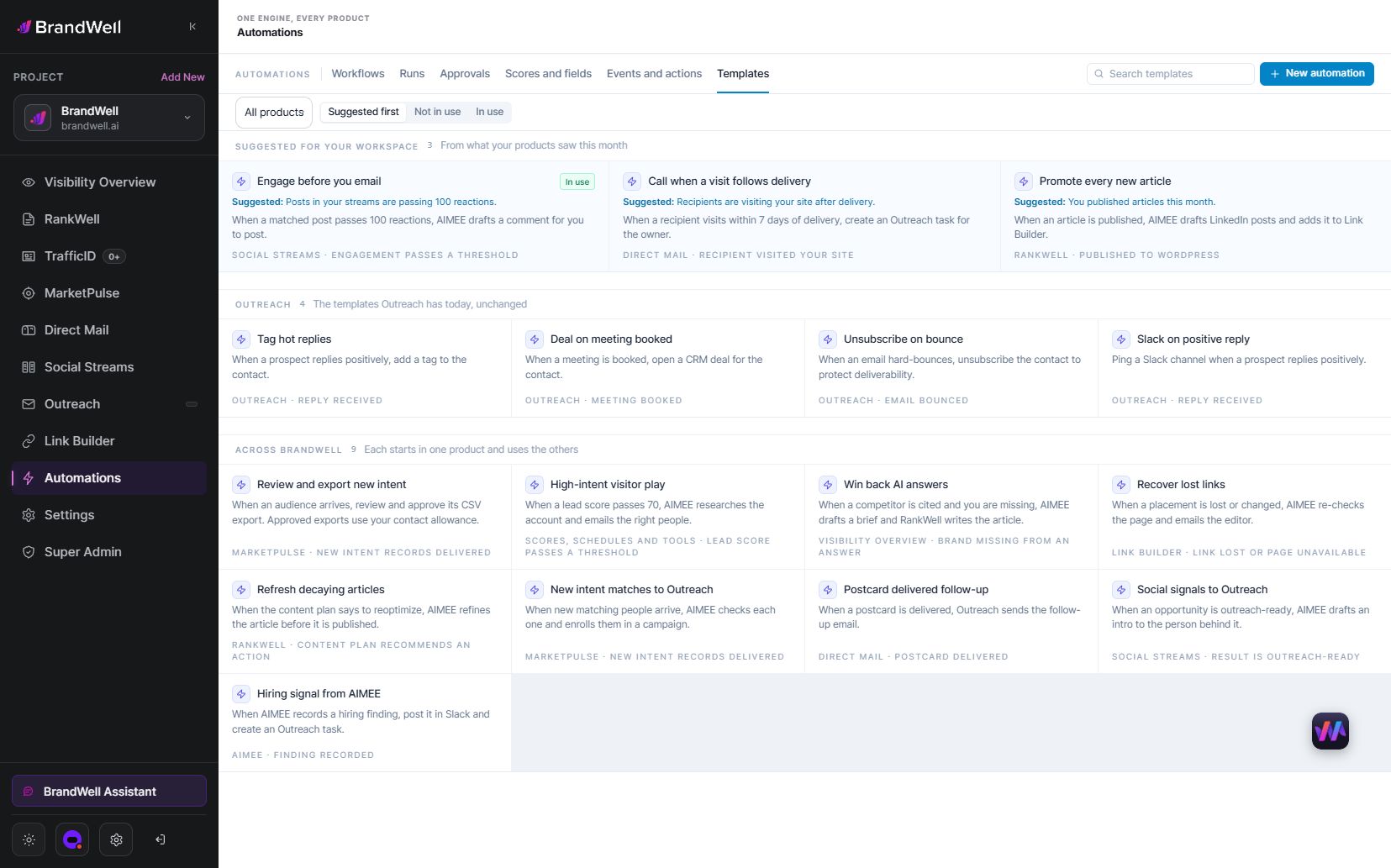
Use Visibility for research, RankWell for drafting and editing, and Automations for configured workflows. AIMEE can help prepare and carry out work through the tools and access you configure. Keep product facts, owners and approval points explicit.
TrafficID can surface identified website visitors where coverage is available. Identification is not permission to contact someone. Use the measurement and messaging permissions appropriate to your setup.
MarketPulse is starting at $500/mo for buyer-intent research. Evaluate topic fit for your market; it does not reveal every individual shopper or replace your order system. That starting price applies to MarketPulse, not the entire ecommerce stack.
Frequently asked questions
Which marketing capability should I improve first?
Start with the most concrete obstacle in the buying journey. If product details are wrong or the mobile page is difficult to use, address those before increasing promotional activity.
Can AI write product descriptions?
It can prepare a draft from approved product data. Have the product owner check specifications, promises and policies before publishing.
Will these tools guarantee higher revenue?
No. Outcomes depend on demand, product fit, pricing, execution and many other factors. Measure the specific workflow and include its total costs.
Explore BrandWell to connect content research and execution around a defined ecommerce task.
Reviewed and updated October 3, 2026.

Written by
Julia McCoy has contributed articles to BrandWell on content marketing, writing, and search engine optimization. This archive retains her original bylines; individual articles may be updated by the BrandWell editorial team.

