


On this page
- Recognize the task behind the words
- Examples and suitable formats
- Distinguish informational and commercial research
- Find questions worth answering
- Research and prepare the article in BrandWell
- Answer first, then develop the explanation
- Give readers an appropriate next step
- Measure the result in context
- Frequently asked questions
Informational keywords are search queries that suggest someone wants to learn, understand, or solve a problem. Examples include “what is buyer intent,” “how to plan a payroll migration,” and “why is my website slow.”
They describe a likely task, not a guaranteed customer stage. An existing customer troubleshooting a product can have informational intent just as a first-time researcher can.
Recognize the task behind the words
Question words can be useful clues, but informational searches do not always contain “how” or “what.” “Payroll migration checklist” can be a request for practical instructions. A short query can also be ambiguous.
Use the phrase, surrounding context, and current result types to form a working interpretation. Do not assume you can see an individual’s search history or infer their identity from aggregate query data.
Examples and suitable formats
- Definition: “what is intent data” calls for a direct explanation, scope, and examples.
- Process: “how to plan a payroll migration” calls for steps, owners, and checks.
- Troubleshooting: “why is my website slow” calls for diagnostic steps and causes to investigate.
- Reference: “content brief checklist” calls for something practical to use.
- Explanation: “how does visitor identification work” calls for the mechanism and limitations.
These are editorial examples. They do not imply a measured search volume or that a particular format will rank.
Distinguish informational and commercial research
“What is payroll software?” primarily asks for an explanation. “Payroll software implementation costs” may combine education and purchase evaluation. “Buy payroll software” suggests an action, while a named product’s login query seeks a destination.
These labels help plan content, but real searches can have mixed intent. Avoid forcing a comparison guide into an informational definition just because it contains a question.
A local result does not automatically mean navigational intent, and a People Also Ask box does not prove that every searcher is at the top of a funnel.
Find questions worth answering
Begin with recurring questions from customers, prospects, and your own team. Review Search Console for related queries with impressions and assess the page currently receiving them.
Record whether the problem calls for a new page or a better section in an existing article. If you already have a useful guide, adding the missing step may serve readers better than publishing a near-duplicate post.
Google’s search metric documentation explains how to interpret the data. Use a consistent date range and filters, and do not confuse property impressions with the total number of people searching.
Research and prepare the article in BrandWell
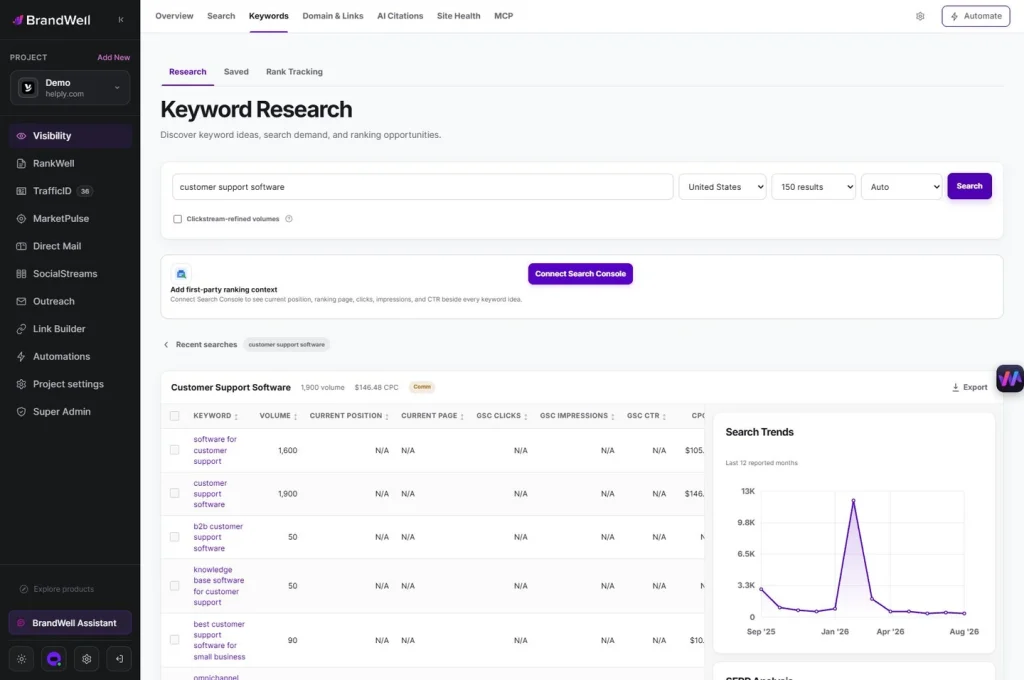
Investigate the topic in BrandWell’s keyword research workflow, then use RankWell to prepare a brief and draft. State the reader’s task, the direct answer, required evidence, and practical example before drafting.
Ask your subject expert what a generic explanation would miss. Add the prerequisite, failure case, decision rule, or worked example that makes the answer usable.
Answer first, then develop the explanation
Open with a clear response to the main question. Follow with steps or examples in the order someone needs them. Define unfamiliar terms, make assumptions explicit, and link factual claims to sources that actually support them.
For a tutorial, show the starting state and how to recognize success. For a calculation, identify the inputs and label hypothetical figures. For a product screen, explain what the reader should notice rather than inserting a decorative screenshot.
Google’s AI search guidance favors useful, original contributions over generic restatements. Readable structure helps people; it is not a guarantee of an AI citation.
Give readers an appropriate next step
A reader learning a definition may need a related example before a sales conversation. Someone finishing an implementation guide may need a checklist or a relevant product workflow.
For an intent-data article, a relevant next step is the MarketPulse product page, where plans are starting at $500/mo. Explain why it relates to the task instead of implying that reading a topic proves purchase readiness.
Keep the main answer accessible. Do not turn every paragraph into a pitch or withhold basic information behind unrelated forms.
Measure the result in context
Track impressions, clicks, CTR, relevant query coverage, and meaningful next actions. Compare similar periods and note changes to the page, promotion, and search environment.
Traffic alone does not establish that the article helped. A short visit may mean the answer was easy to find; a long visit may mean it was confusing. Use behavior alongside the task and outcome.
Frequently asked questions
Are informational keywords always easy to rank for?
No. Competition and usefulness depend on the subject and results. The intent label does not establish difficulty.
Are informational searches only top-of-funnel?
No. They also occur during evaluation, onboarding, troubleshooting, and continued product use.
Should I repeat the exact keyword everywhere?
No. Use clear terminology naturally and answer the task. Repetition does not substitute for useful content.
Reviewed and updated October 2, 2026.

Written by
Julia McCoy has contributed articles to BrandWell on content marketing, writing, and search engine optimization. This archive retains her original bylines; individual articles may be updated by the BrandWell editorial team.

