


On this page
- Agency or freelancer: what should you compare?
- When an SEM agency may fit
- When a paid-search freelancer may fit
- Write the brief before comparing proposals
- Separate advertising spend from management fees
- Keep account access and handoff under your control
- Agree how performance will be measured
- Run a scoped pilot
- How BrandWell can support the content work
- Common hiring questions
Hire an SEM agency when your paid-search program needs coordinated specialist coverage and dependable backup. Hire a freelancer when the scope is narrow enough for one qualified person and you can provide the supporting work. Neither arrangement guarantees better results. Compare the people doing the work, measurement plan, responsibilities and total cost before signing.
This guide uses SEM to mean paid search. SEO, website development and organic content can support the same business goals, but they need separate deliverables if they are part of the contract.
Agency or freelancer: what should you compare?
- Scope: number of accounts, markets, campaigns and landing pages.
- Coverage: who handles strategy, tracking, copy, landing pages and absence cover.
- Experience: relevant examples with dates, starting conditions and the candidate’s actual contribution.
- Measurement: which actions count as conversions and how lead quality is checked.
- Control: account access, spending approvals, reporting and handoff.
- Total cost: management fees, media spend, setup, creative and internal review time.
When an SEM agency may fit
An agency can be useful when several disciplines must work together or one person cannot provide the coverage you need. Ask whether those capabilities are included in your fee and who will actually work on your account. A large agency’s sales presentation does not establish the experience or availability of its assigned team.
Request a named day-to-day contact, the escalation route and an explanation of specialist involvement. If the agency uses contractors, clarify responsibility for deadlines, access and quality. Ask how often account reviews occur and what happens during staff changes.
When a paid-search freelancer may fit
A freelancer may suit a focused account, an audit or a project with clearly defined responsibilities. Direct access to the practitioner can make decisions easier, but availability and backup vary. Do not assume freelancers are always cheaper or that agencies always offer more expertise.
Agree how much time the freelancer can allocate, their response expectations and who covers urgent issues. If your team supplies design, development or sales feedback, name those owners. Remote work itself is not a reason to reject a candidate; unclear responsibilities and poor communication are more useful signals.
Write the brief before comparing proposals
- Describe the offer and audience. Include sales territory, exclusions, capacity and the landing page visitors will see.
- Set the business outcome. Define a qualified inquiry or sale rather than asking only for more traffic.
- List deliverables. Separate account setup, ongoing management, ad copy, tracking, landing-page work and reporting.
- Set approval boundaries. Specify who can launch campaigns, change budgets or publish claims.
- Identify dependencies. Document website access, legal review, sales feedback and the expected handoff.
Send the same brief to each candidate. Otherwise, a low quote for account maintenance can look competitive beside a higher quote that includes conversion setup and landing-page work.
Separate advertising spend from management fees
Ask whether the fee is fixed, hourly, project-based or tied to spend. Confirm setup charges, minimum commitments, taxes, cancellation terms and what triggers additional work. Keep media spend visible as a separate line.
Hypothetical comparison: a $3,000 advertising budget plus a $900 management fee costs $3,900 before other work. Another proposal with a $600 fee and $400 in required landing-page work costs $4,000. These are arithmetic examples, not typical market prices or predictions of performance.
The cheaper management fee therefore does not necessarily mean the lower total cost. Nor does the higher price establish better results. Compare the same scope and the evidence behind each proposal.
Keep account access and handoff under your control
Your business should retain appropriate administrator access to its advertising account and understand who controls billing, tags and connected properties. Use named access rather than sharing passwords. Google Ads documents access levels with different permissions for campaign editing, billing and user management. Choose the permissions required for the work.
Put the handoff in writing: account structure, campaign history, creative files, tracking documentation, reporting definitions and removal of provider access. Clarify ownership and licenses for supplied assets instead of discovering restrictions when the relationship ends.
Agree how performance will be measured
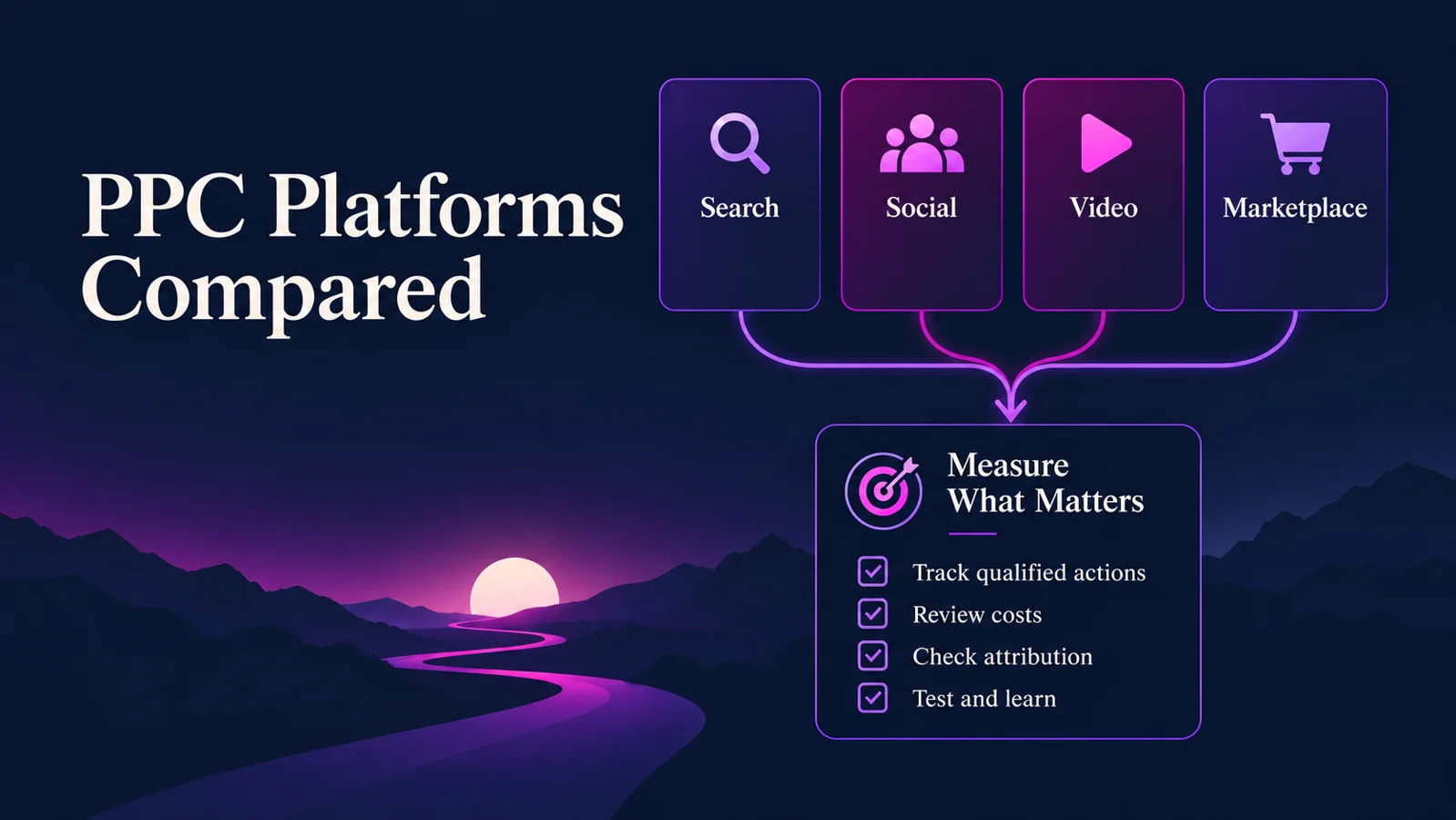
Google Ads conversion measurement lets advertisers define valuable actions such as purchases, signups and calls. Your provider should explain which actions are measured and demonstrate that the setup records them as intended. A button click and a completed sale are different outcomes.
Review spend, recorded conversions, cost per conversion and lead quality together. Ask about duplicate events, reporting periods and attribution assumptions. Compare revenue with advertising spend for ROAS, and include fees and other costs when evaluating profitability.
Hypothetical reporting example: $3,000 in media spend and 30 recorded inquiries produces a $100 cost per inquiry. If sales accepts only six inquiries as qualified, the media cost per qualified inquiry is $500. Neither calculation proves that those inquiries became customers.
Run a scoped pilot
Start with agreed deliverables, a review date and an evaluation plan. Allow for setup and available data rather than demanding an arbitrary guaranteed improvement. Track whether the provider completes the work, explains decisions and resolves measurement problems. Use business outcomes as evidence when there is enough data to interpret them.
How BrandWell can support the content work
RankWell can support briefs and drafts for the organic content around your offer. Editors still need to check sources, claims and relevance before publishing. Keep that content workflow separate from the contracted paid-search responsibilities.
BrandWell does not replace your advertising account’s bidding, billing or conversion configuration. A sensible division is to prepare reviewed content in BrandWell and have the responsible paid-search practitioner manage campaigns and measurement in the advertising platform.
Common hiring questions
Is an agency always better for a large budget?
No. Complexity, required coverage and the assigned team’s experience matter alongside budget. A specialist can handle a defined scope, while an agency may provide coordinated coverage across several tasks.
Should SEO be included in an SEM contract?
Only if you want it and the deliverables are explicit. Separate organic research, writing and technical work from paid-search management so each can be assessed properly.
What is the most useful question to ask a candidate?
Ask who will do each task, what evidence will show it worked and what your business retains when the engagement ends. A clear answer is more useful than a blanket promise of cheaper clicks or more sales.
Reviewed and updated October 3, 2026.

Written by
Julia McCoy has contributed articles to BrandWell on content marketing, writing, and search engine optimization. This archive retains her original bylines; individual articles may be updated by the BrandWell editorial team.

