On this page
- Rich text, structured data and rich results: the differences
- Start with an answer worth displaying
- Format the page for reading and checking
- Choose markup that represents the actual page
- Test the implementation before and after publication
- Measure results without inventing an uplift
- Prepare and review the content in BrandWell
- Frequently asked questions
SEO-rich text usually means useful, well-organized website copy that answers a searcher’s question. It is not the same as a rich result. Rich text describes formatting, such as headings and lists; structured data describes information in machine-readable markup; a rich result is an enhanced search appearance that Google may display for an eligible page.
Separating these concepts helps you improve the article itself and evaluate its markup without expecting formatting alone to produce ratings, images or higher rankings.
Rich text, structured data and rich results: the differences
- Rich text: formatted content people read, including headings, emphasis, links and lists.
- Structured data: markup that describes the page’s information, such as an article, recipe or product.
- Rich result: a search presentation with additional features beyond a standard text listing.
- Featured snippet: an extracted answer shown in search. Adding structured data does not buy or reserve this placement.
Google’s structured data introduction explains how markup helps describe page content and how supported types can make pages eligible for particular search appearances. Eligibility is not a promise that a feature will appear.
Start with an answer worth displaying
For a page about a specific task, write a direct answer near the beginning. Explain the important conditions and give the reader enough detail to act. Add a clear title that describes the question rather than promising a ranking improvement.
Here is an original hypothetical example for a payroll software company. A page titled “How to Prepare Payroll Data for a Migration” could start with this answer:
Before a payroll migration, reconcile employee records, pay schedules, year-to-date totals and account mappings. Confirm the destination system’s required fields, document unresolved differences and agree on who approves the test import.
The rest of the page can show a field checklist, an anonymized sample mapping and the approval process. Those details serve the person carrying out the task. Repeating “payroll migration” in every heading would add less value.
Format the page for reading and checking
- Use descriptive headings for separate questions or steps.
- Keep related instructions together in short paragraphs or lists.
- Label original examples and explain their assumptions.
- Link factual claims to the responsible organization or original research.
- Use relevant images with useful alternative text and readable captions.
- Test tables, code examples and images on a narrow screen.
Make important information available as text. A screenshot can illustrate a workflow, but the instructions should still make sense to someone who cannot read the image.
Choose markup that represents the actual page
Ask what the page genuinely contains before choosing a structured data type. An editorial article, a product offer and an event listing have different purposes. Check the current documentation for the specific feature, its required properties and its eligibility rules.
Google’s general structured data guidelines require markup to represent visible, relevant page content. Do not add fabricated reviews, unrelated entities or expired details. Images referenced in markup must also be relevant and accessible to Google.
For the hypothetical payroll migration guide, the article’s headline, author, dates and relevant image should agree with the published page. Do not turn the guide into a fake product review or invent a five-star score to make its search listing more noticeable.
Do not expect every schema type to create a search feature
A vocabulary may describe information that does not have a supported Google rich result. Check the current feature guide rather than relying on an old list of schema types.
For example, Google stopped displaying FAQ rich results in May 2026 and removed their documentation in June. Questions and answers can still help readers, but adding FAQ markup is not a route to that retired search appearance.
Review markup also has restrictions. Google’s review snippet documentation excludes self-serving reviews of an Organization or LocalBusiness from review-star eligibility. Publishing testimonials on your own business site does not automatically qualify those pages for stars.
Test the implementation before and after publication
Use Google’s Rich Results Test to check supported markup. Resolve critical errors and inspect the actual published URL, not only a draft code sample.
- Compare markup values with the visible page.
- Check required properties against the current feature documentation.
- Test the rendered page and relevant images.
- Check that the URL can be accessed without a login or unintended indexing restriction.
- Review Search Console reports available for the implemented feature.
- Recheck after changes to the page template, offer, dates or media.
A passing code test does not prove an improvement in ranking, click-through rate or sales. It is one implementation check.
Measure results without inventing an uplift
Preserve a baseline for the same page and compare impressions, clicks, click-through rate, query mix, device and position over appropriate periods. Record other changes, such as a new title or a change in demand, that could affect the comparison.
Original hypothetical calculation: 2,000 impressions and 40 clicks produce a 2% click-through rate. A later period with 2,500 impressions and 75 clicks has a 3% rate. That is a one-percentage-point increase. It does not establish that structured data caused the difference.
Also measure useful actions on the page, such as a qualified inquiry or a completed resource request. More clicks are not automatically more customers.
Prepare and review the content in BrandWell
Use Keyword Research in Visibility to explore the question and related opportunities. Turn the chosen topic into a focused brief, then use RankWell to work on the draft and editorial review in the current BrandWell portal.
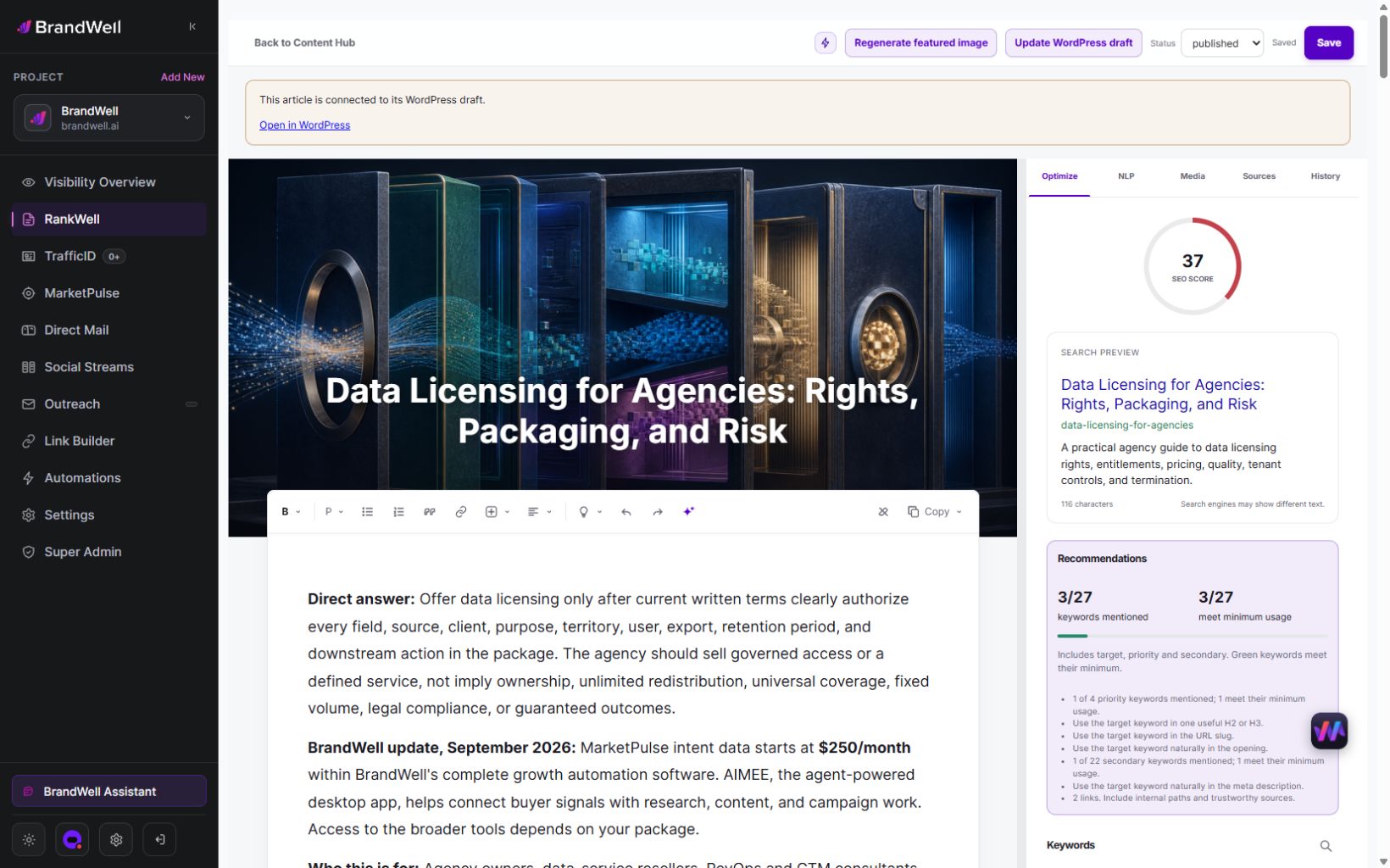
Assign a person to verify factual claims, product details and the finished page. Separately check the structured data produced by your publishing setup. A writing workflow does not replace markup validation or guarantee a search feature.
Frequently asked questions
Is SEO-rich text an official Google feature?
It is a loose description of search-focused copy. Use the more precise terms rich text, structured data and rich results when discussing formatting, markup and search appearance.
Does bold text produce a rich result?
No. Bold text can help readers locate important information, but it does not create ratings or other rich-result features.
Should a useful article still include FAQs?
Yes, when they resolve real questions. Include them for their reader value, without promising a retired FAQ rich result.
What should I fix first?
Check that the page answers the intended question accurately. Then improve readability, title clarity, relevant images and the markup appropriate to the page.
Reviewed and updated October 3, 2026.

Written by
Julia McCoy has contributed articles to BrandWell on content marketing, writing, and search engine optimization. This archive retains her original bylines; individual articles may be updated by the BrandWell editorial team.