


On this page
Grow your brand by making a clear promise to a specific audience, delivering that promise consistently, and testing activities against relevant customer outcomes. Awareness, engagement, suitable inquiries, retention, and revenue are different measures. More followers do not by themselves establish business growth.
Below are 20 practical activities and a planning framework. The examples are original suggestions, not claimed results from famous brands, and no tactic guarantees a particular growth rate.
Define the audience and the promise
Write a short description of who you serve, the problem you address, and the evidence behind your offer. For example, an IT services business might explain its supported customer sizes, service region, response arrangements, and onboarding process. Specific, accurate scope is more useful than “we do everything.”
Gather feedback from customers, sales, and support. Identify repeated questions and where the public message differs from the actual product. The government’s market-research guidance connects the research question, methods, findings, and actions. Use that discipline rather than inventing buyer personas from assumptions alone.
20 brand-growth activities to consider
1. Clarify the homepage promise
State the audience, supported problem, and next step in plain language. Check whether a new visitor understands what the business actually sells.
2. Publish a useful implementation guide
Answer a concrete customer task with prerequisites, steps, and limits. Use current product screenshots and reviewed instructions.
3. Refresh an outdated high-impression article
Inspect its queries and rewrite unsupported facts or obsolete product details. Save the baseline before claiming an improvement.
4. Demonstrate the actual workflow
Show a short video or annotated screenshot of the task. Label example data and avoid suggesting that every customer will get the displayed result.
5. Explain pricing and package scope
Help people understand what is included, what is separate, and what affects usage. Accurate limits can prevent unsuitable inquiries.
6. Build an original checklist
Turn a repeated implementation or buying question into a practical resource. Make it usable without requiring readers to decode a sales pitch.
7. Share a documented customer example
Obtain permission and state the period, starting point, method, and limits. Do not invent a quotation or attribute all improvement to one tactic.
8. Request honest feedback
Ask relevant customers about their experience, including what needs improvement. Do not ask only people likely to give positive reviews.
9. Improve onboarding answers
Identify common setup failures and clarify the next action. Customer experience is part of the promise, not merely material for promotion.
10. Make mobile pages easier to use
Test navigation, forms, video controls, tables, and key calls to action on a narrow viewport. Check actual devices where possible.
11. Host a focused question session
Choose one audience problem and prepare accurate answers. A small useful session can be preferable to an event with no clear task.
12. Partner around a complementary need
Define responsibilities, customer fit, and any commercial relationship. Track suitable referrals rather than assuming every introduction is qualified.
13. Equip employees with approved facts
Give staff current product information and examples they can explain in their own words. Disclose employment connections when relevant to endorsements.
14. Test a relevant creator collaboration
Choose audience fit and credible use of the product over raw follower count. Agree on truthful claims and clear disclosures.
15. Share customer-created material with permission
Confirm rights to the image, quotation, or story and preserve its context. A public post is not automatic permission to republish it.
16. Run a bounded content-distribution test
Select a suitable channel, audience, budget, and outcome. Distribution can bring readers without demonstrating that the activity increased search rankings.
17. Send relevant lifecycle messages
Use the actual relationship and documented preferences to decide the message. Stop applicable reminders after purchase, opt-out, or completion.
18. Fix a recurring support issue
Review tickets and customer feedback with the product team. Measure whether the change reduces the problem instead of only announcing it.
19. Publish a transparent product reference
Explain current products, intended users, use cases, limits, and canonical links. Clear facts help readers and systems interpret the business; they do not guarantee inclusion in AI answers.
20. Review customer retention
Investigate why suitable customers stay or leave. Distinguish recurring product value from a temporary discount or promotion.
Choose a small set of tests
Do not launch all 20 activities at once. Select a few connected to a documented problem, available evidence, and team capacity. The government business-growth guide emphasizes research, planning, and understanding current performance before expansion.
| Planning field | Illustrative IT services test |
|---|---|
| Audience problem | Prospects do not understand the onboarding process |
| Activity | Publish a supported onboarding checklist and a brief walkthrough |
| Evidence | Current service process and reviewed answers to repeated inquiries |
| Owner | Service lead verifies scope; editor prepares the page |
| Measurement | Relevant visits, useful inquiries, completed onboarding, support issues |
| Review | Compare equivalent periods and inspect feedback before expanding |
Swipe the table to see all columns.
This is a fictional planning example. It does not imply a known uplift or make an onboarding page the sole cause of any later sale.
Use the current BrandWell workflow
In the BrandWell portal, available research tools can help investigate audience questions. Use RankWell’s content workflow to organize a brief, review the draft and sources, and prepare approved content. Keep brand names, product scope, and screenshots current.
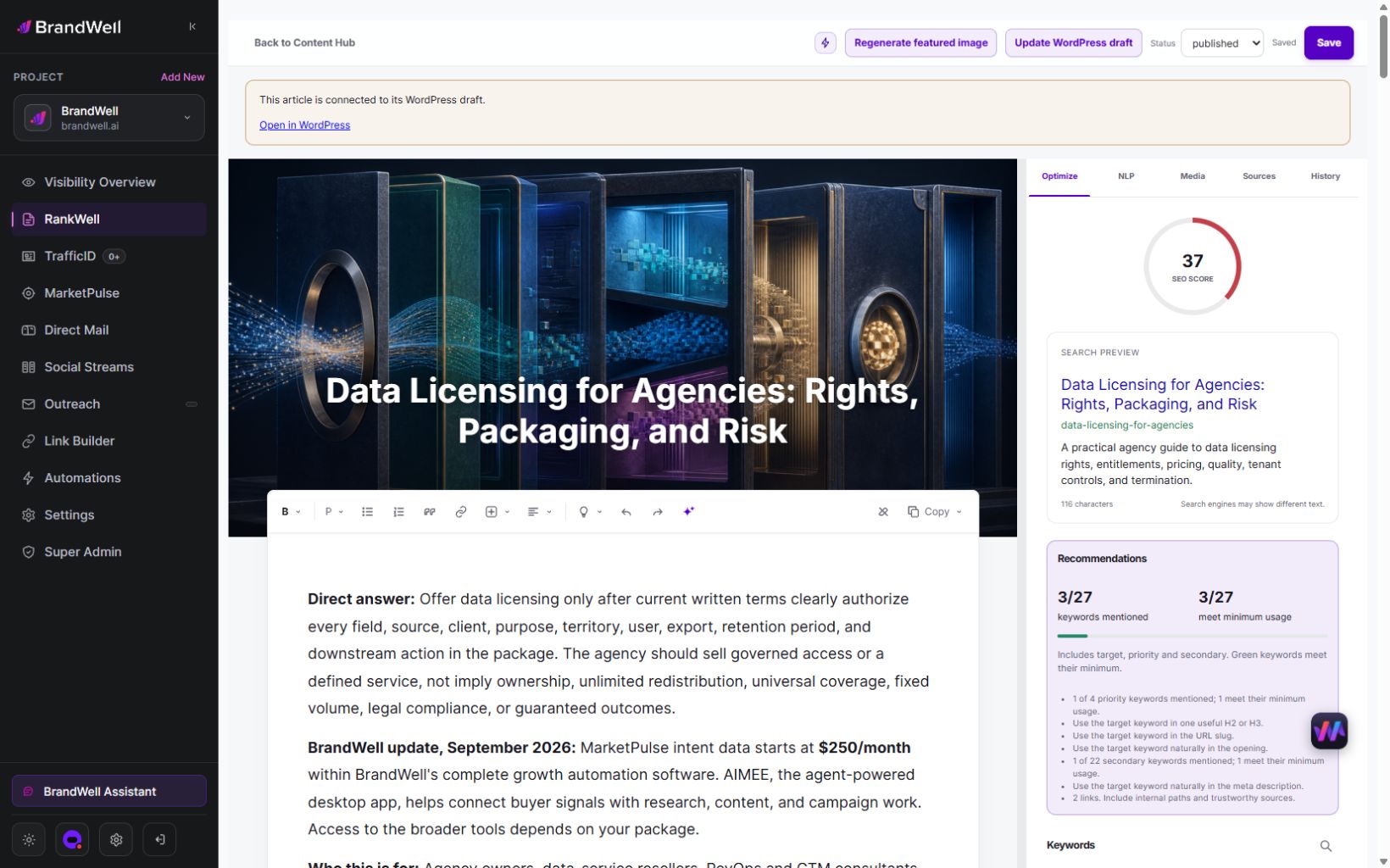
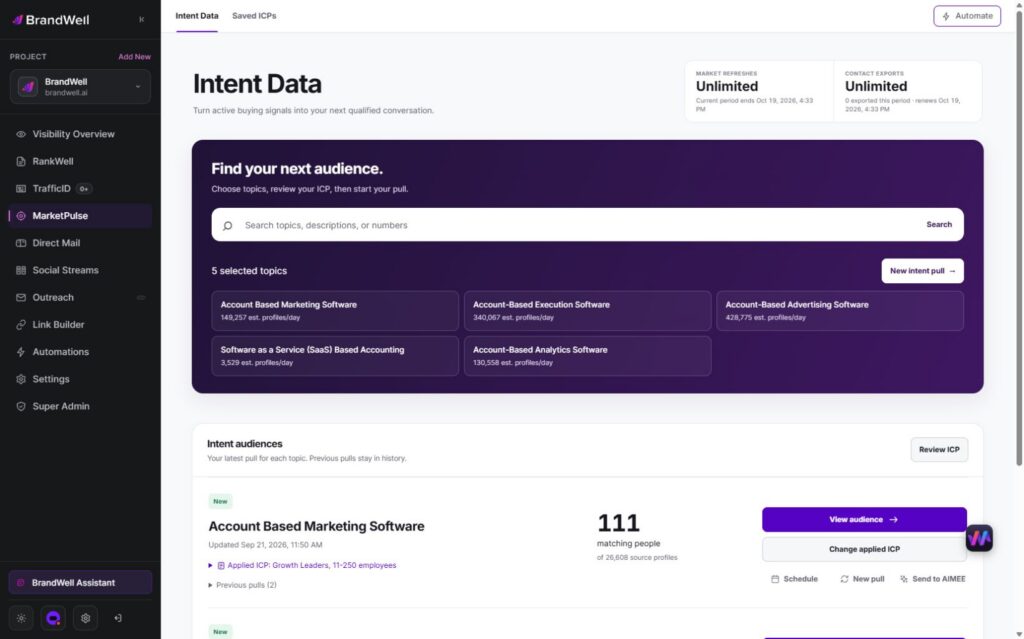
AIMEE can assist with approved briefs and authorized connected work. Review the facts and action before execution. MarketPulse provides available topic-research data, with standard plans starting at $500/mo; TrafficID surfaces available website-visitor information. Use these as discovery and review signals, not proof that a contact wants your product or has authorized every communication channel.
Protect the credibility of the message
The FTC’s endorsement-disclosure guidance addresses material relationships such as payment, employment, or free products. Place a clear disclosure with the endorsement rather than hiding the relationship.
Its review guidance advises against fake reviews and requesting feedback only from customers expected to be positive. Check platform rules, and do not condition a review incentive on favorable sentiment.
Substantiate statistics and outcome claims before using them in a headline, testimonial, or AI-generated draft. If you cannot verify a number’s original source, period, and method, remove the number. An impressive percentage without context is not useful evidence.
Measure outcomes separately
Use Search Console to monitor relevant search queries and pages, analytics to inspect visits and defined actions, and sales records to assess suitable inquiries and customers. Keep the measurement period, denominator, and source visible.
A rise in branded searches can indicate increased search activity, but it does not by itself isolate the effect of a campaign. A video view is not a sale. Compare cohorts carefully and acknowledge other changes, seasonality, and attribution limits.
Frequently asked questions
How can a small business start?
Choose one audience problem, verify the offer, and improve the most relevant page or customer interaction. Run a bounded test with an owner and measurable outcome.
Is the 3-7-27 rule a proven buying formula?
No universal exposure count is established here. Use relevant, permitted communication and actual feedback rather than assuming people buy after a fixed number of impressions.
Can AI grow the brand automatically?
AI can support research organization, drafting, and authorized tasks. People still need to validate evidence, product scope, customer experience, and business decisions.
Reviewed and updated October 2, 2026.

Written by
Justin McGill is the founder of BrandWell, growth automation software for inbound and outbound teams. BrandWell brings together MarketPulse intent data, TrafficID website audiences, RankWell content workflows, Visibility research and AIMEE execution through configured tools.
 Farnaz Kia
