


On this page
Automate lead generation by connecting a defined signal to qualification, an accountable owner and a permitted next action. Start with one workflow and measure it from source record to qualified outcome. Software can repeat a process; it cannot make an unclear offer or unreviewed audience suitable.
The current BrandWell Automations examples show how research, website audiences, content and outreach can connect. Your accounts, instructions, product access and approval rules determine how a configured workflow runs.
Choose the signal before choosing the action
- A submitted inquiry: the person explicitly requested a response through the form.
- A website visit: TrafficID provides available identifiable visitor and company context; coverage varies.
- A topic-research signal: MarketPulse supplies available research around a relevant market topic.
- A public discussion: SocialStreams can inform review of a relevant conversation.
- A search opportunity: content work can address an unanswered reader question through RankWell.
These sources are not interchangeable. A passive visit is not a demo request. An added stakeholder is not necessarily the observed visitor. An enriched phone number is not permission to send a text message.
Define the qualification and exclusion rules
Write the company, role, geography and problem the offer serves. Identify existing customers, duplicates, ineligible contacts and suppressed people before preparing the next action.
Keep source, observation window and uncertainty visible. A repeated page visit can justify account research without proving purchase readiness. Do not convert a behavioral score into a claim about a person’s private intention.
Build one workflow in the current BrandWell portal
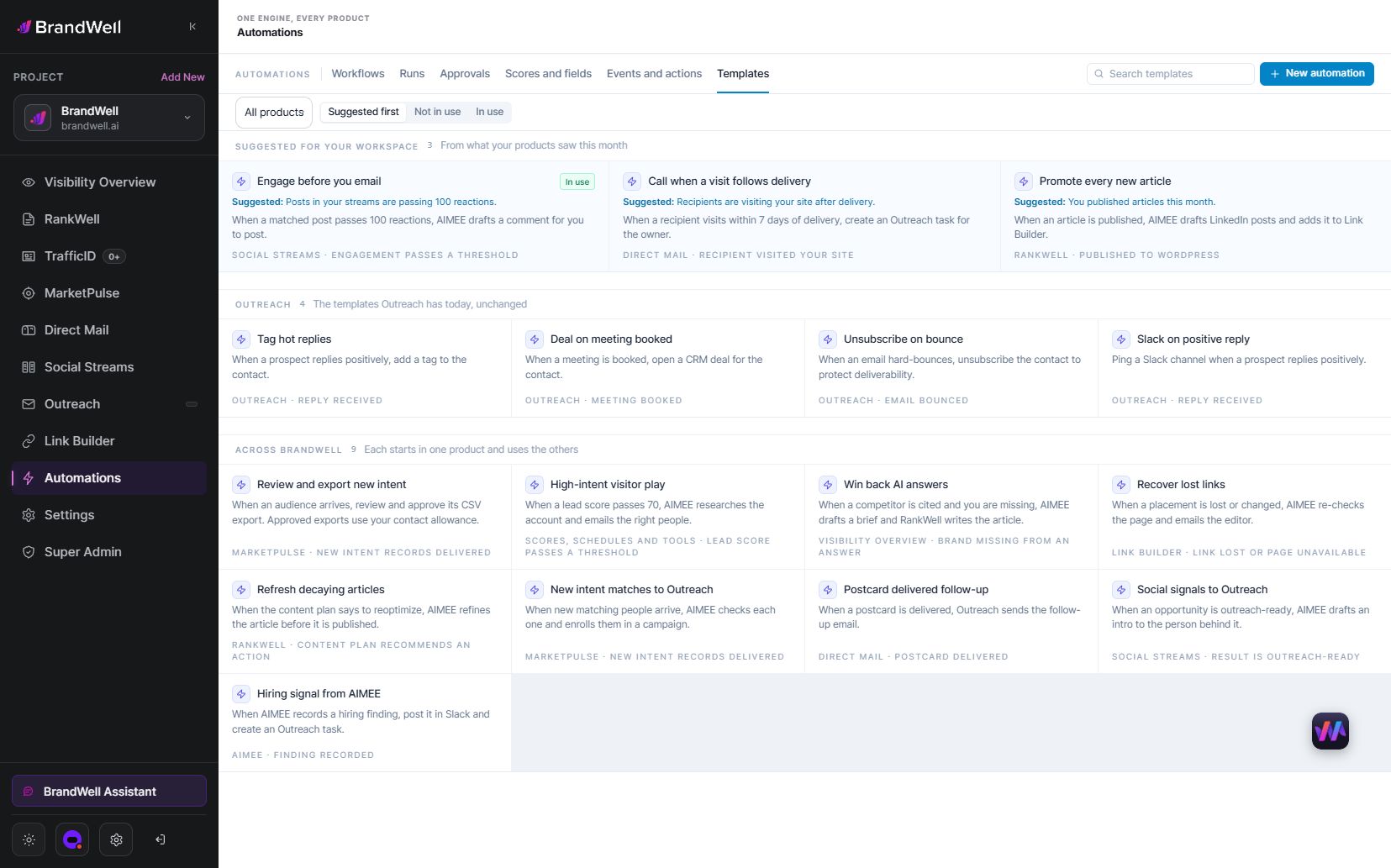
- State the trigger. For example, a suitable returning website visitor becomes eligible for account review.
- Supply the context. Attach the source, company, fit checks, customer status and available activity.
- Assign the work. Give AIMEE a bounded account-research task and identify the human owner.
- Review the output. Confirm factual claims, role relevance and the proposed message.
- Approve the next action. Use the configured Outreach, Direct Mail or task route with its actual requirements.
- Inspect the destination. Record whether the action completed, failed, waited for help or was declined.
- Return the outcome. Track response and qualification, then use that evidence to refine the process.
These are design steps, not a promise that every account has a prebuilt template for every channel. A workflow needs the relevant product, connected tools, permissions and usage. Direct Mail also needs eligible addresses, reviewed creative and authorized spending.
Use the right product for the research
TrafficID helps review identifiable website audiences and submitted forms. Keep additional stakeholders marked separately and apply suppression before acting. Identification is a source for research, not guaranteed conversion.
MarketPulse standard plans are starting at $500/mo for one topic with weekly refreshes and 25,000 monthly contact exports. Growth includes three daily topics and 100,000 exports; Scale includes ten daily topics and unlimited exports. Available audience sizes and fields vary.
Use topic coverage and ICP review to inform the next task. Keep any recipient-specific early-access offer distinct from these standard prices. Connected channel work and fulfillment can add costs.
Improve the content that feeds the workflow
Choose one useful buying question rather than generating every possible format. Prepare evidence, draft the answer in RankWell, review the sources and publish through the configured process. The destination page should make the offer and next step easy to understand on mobile.
AIMEE can help prepare a brief or handoff through connected tools. Your editor remains responsible for the final claims and publication. More pages do not automatically mean more qualified demand.
Keep failures and stop conditions explicit
Define what happens when required fields are missing, an identity is uncertain, a contact is suppressed, a connection fails or an agent needs assistance. A failed step should not silently trigger a different campaign.
Test with synthetic or authorized records. Check duplicates, opt-outs, existing customers and missing permission as well as the successful path. Confirm that a replay will not duplicate the next action.
Measure the whole path
Track source records, eligible records, reviewed actions, completed actions, replies, qualified opportunities and customers. Include labor, software, media and fulfillment costs. Preserve the reason for exclusion or failure.
Hypothetical workflow: 200 source records produce 60 eligible records, 40 completed approved actions and eight agreed qualified opportunities. A $1,200 operating cost is $150 per qualified opportunity. The example does not establish revenue, profit or an expected conversion rate.
Compare with the prior process using consistent definitions. Faster handling may be valuable even when acquisition does not change, but report operational savings separately from sales impact.
Common questions
Can automation qualify every lead automatically?
No. Rules can reduce repetitive work, but ambiguous evidence and consequential actions still need the appropriate review.
Should we trigger follow-up from an email open?
An open alone is weak intent evidence. Apple Mail Privacy Protection obscures whether a recipient opened a message. Prefer an appropriate explicit response, request or reviewed source context.
What should an agency automate first?
Choose a repeatable step with clear inputs, an owner and an inspectable result. Review the current BrandWell workflow examples and configure one bounded pilot before increasing volume.
Reviewed and updated October 3, 2026.

Written by
Jeff Joyce has been helping brands grow online since the Myspace era, when custom HTML layouts were still a competitive advantage. What started in design quickly evolved into a career spanning social media, content strategy, video, agency ownership, and growth marketing. After building his own agency and testing countless AI tools, Jeff joined BrandWell with a clear focus: helping marketers understand how AI can actually improve the way they create, optimize, and scale content. Today, Jeff brings a CMO-level perspective to BrandWell's marketing strategy, blending brand positioning, content, video, customer education, and growth. His work centers on turning complex AI concepts into clear, practical marketing that helps brands move faster, create better content, and stay competitive without losing their voice.

 Farnaz Kia