


On this page
- Define what “sufficient” means
- 1. Verify the source and stage counts
- 2. Make the next step clear and usable
- 3. Answer the audience’s actual questions
- 4. Inspect search opportunities
- 5. Review available visitor context
- 6. Follow up through an eligible channel
- 7. Test paid campaigns with a defined outcome
- 8. Make referrals practical
- 9. Build useful relationships
- Original example: locate the bottleneck
- Connect research and approved work in BrandWell
If you are not getting enough qualified leads, diagnose the gap before adding more traffic. Check audience fit, the offer, page experience, measurement and follow-up. Then test a specific improvement against a defined outcome. Identified visitors, inquiries and qualified opportunities are different stages.
Define what “sufficient” means
Set a target using your actual sales process and capacity. Decide what qualifies a lead, who owns it and which next step is useful. A contact record with no verified fit or appropriate follow-up is not the same as a sales opportunity.
Work backward from your own observed stage rates. If they are not reliable yet, track a baseline first. Do not use a universal anonymous-visitor percentage or response-rate benchmark as proof that your pipeline should behave a certain way.
1. Verify the source and stage counts
Record eligible inquiries, qualified leads, appointments and purchases separately, by a consistent period and source. Check for duplicate submissions, tests and missing attribution. A recorded email open is not reliable proof of interest, especially with Mail Privacy Protection.
2. Make the next step clear and usable
State who the offer is for, what happens next and any important conditions. Test the form on a phone, including validation and the success state. Avoid requiring information you do not need for the next step.
Use PageSpeed Insights to investigate the page experience. Distinguish available field data from a single lab test, and verify the form yourself. A better lab score alone does not establish more qualified leads.
3. Answer the audience’s actual questions
Use inquiries, interviews and search evidence to choose useful content. Explain setup, scope, pricing and limitations where they affect a decision. Add your own practical examples and supported facts rather than treating a longer article as inherently better.
Google’s helpful-content guidance emphasizes useful, reliable information. Content quality is a review task, not a guarantee that every draft will rank.
4. Inspect search opportunities
Use Search Console to examine the relevant page and queries. Consider impressions, clicks, CTR and position together. A page with weak CTR may need clearer search presentation or a better answer to the query; diagnose it before changing the title.
5. Review available visitor context
TrafficID shows identified visitors and available profile or activity fields. Identification and field coverage vary. Review fit, suppression and evidence before deciding on a next action.
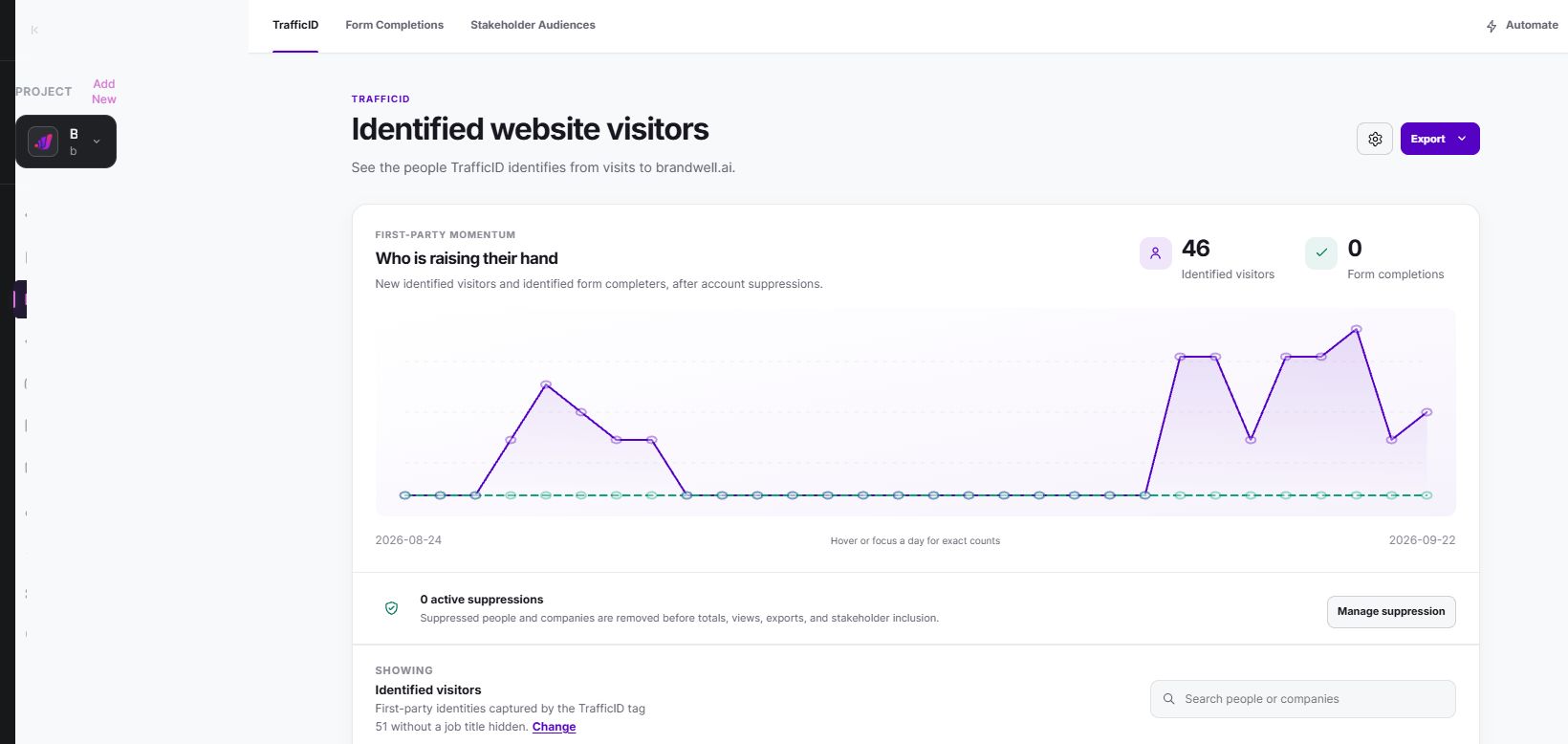
A pricing-page visit does not establish a buying decision. Avoid messages that announce a person’s browsing history. A relevant business question based on verified fit is a better starting point than claiming to know their intention.
6. Follow up through an eligible channel
Prioritize direct requests and the preferences the person actually supplied. Apply suppression and review the destination’s requirements before enrollment. For commercial email, review the FTC’s CAN-SPAM guidance.
For BrandWell’s early-access text reminders, use only the number the person supplied with affirmative reminder opt-in. An enriched mobile number or identified website visit is not that permission. Keep a responsible owner for replies and stop requests.
7. Test paid campaigns with a defined outcome
Choose a bounded campaign, a relevant destination and verified outcome measurement. Compare qualified inquiries and customer revenue where available, not just clicks. Audience activation depends on platform eligibility and configured workflows; exporting contact data does not guarantee that an ad platform will accept or match it.
8. Make referrals practical
Ask customers who have relevant experience whether they know someone with the problem you solve. Provide an accurate description they can share. Keep referral terms clear and review any incentives or endorsements before promotion. Do not import a famous company’s growth statistic as an expected result for your own program.
9. Build useful relationships
Participate in communities and events where you can answer real questions. Follow the community’s rules and avoid turning every interaction into an unsolicited sales pitch. Track the next step when a person requests more information instead of counting every connection as a qualified lead.
Original example: locate the bottleneck
An IT service business receives relevant inquiries but many stall before an appointment. This is a planning example, not a customer case study. The team tests a clearer explanation of the assessment, a simpler booking path and an assigned reply owner before buying more traffic.
It records eligible requests and booked appointments over equivalent periods, noting other changes. If the improvement is unclear, it investigates the missed steps rather than calling the tactic “proven.”
Connect research and approved work in BrandWell
MarketPulse supplies topic-based intent data, with public plans starting at $500/mo. Review topic relevance, available data and your customer criteria before choosing a next action. It adds research context; it does not turn every match into a qualified buyer.
Use Visibility for search research and RankWell to prepare and review the supporting content. Use AIMEE for approved tasks through configured tools. Verify access, destinations and the finished work before activation.
Reviewed and updated October 2, 2026.

Written by
Jeff Joyce has been helping brands grow online since the Myspace era, when custom HTML layouts were still a competitive advantage. What started in design quickly evolved into a career spanning social media, content strategy, video, agency ownership, and growth marketing. After building his own agency and testing countless AI tools, Jeff joined BrandWell with a clear focus: helping marketers understand how AI can actually improve the way they create, optimize, and scale content. Today, Jeff brings a CMO-level perspective to BrandWell's marketing strategy, blending brand positioning, content, video, customer education, and growth. His work centers on turning complex AI concepts into clear, practical marketing that helps brands move faster, create better content, and stay competitive without losing their voice.

 Farnaz Kia