On this page
- Who this is for
- Intent service strategy with the service outcome
- A ten-step implementation plan
- Should you specialize – or remain a freelancer, consultant, or generalist agency?
- Intent service pricing, cost, and revenue targets
- How much should an agency charge clients?
- Intent service ROI, KPIs, and benchmarks
- Which clients are the best fit?
- Signal quality and measurement: the non-negotiable checks
- Privacy and compliance checks before reselling intent data
- Common intent service mistakes
- The intent service decision guide
- Next step
- Validate demand before committing delivery capacity
- Separate price, contribution and client impact
- Begin with a bounded MarketPulse workflow
- Frequently asked questions
One approach to starting an intent research service is to operate a defined signal-to-action workflow. Choose a market, review relevant research against the client’s ICP, agree on permitted actions and report their outcomes. Define setup and recurring work separately. A subscription or dataset alone does not create the client service.
A practical first offer is simple: one client segment, a small topic map, a weekly prioritized opportunity feed, two or three activation plays, and a monthly performance review. Evaluate the workflow with a bounded pilot before adding more clients or channels. Intent is a clue about timing and relevance – not proof that a person wants to buy.
Current MarketPulse offer: intent-data plans start at $500/mo. See the product, demo, and current plans. Updated October 3, 2026.
Who this is for
This guide is for founders, agency owners, consultants, and freelancers who want a differentiated B2B recurring service. It is most useful if you already understand lead generation, demand generation, RevOps, paid media, or outbound and can help a client act on a signal. It is not a shortcut for someone without a clear market, a delivery owner, or a way to measure pipeline.
Intent service strategy with the service outcome
Your client does not need “intent data.” Your client needs a better answer to one of these questions:
- Which accounts deserve attention this week?
- Which people or buying groups are showing relevant activity now?
- What should sales, marketing, or paid media do next?
- Did acting on those signals improve a business outcome?
That distinction determines your positioning. A generic data reseller competes on volume and price. An agency that interprets signals, resolves identity, routes actions, enforces suppression rules, and measures outcomes sells an operating capability.
A clear offer statement is:
We identify in-market accounts or people that match your ICP, explain why they qualified, route each opportunity to an approved play, and show which actions influenced qualified pipeline.
Do not promise a fixed number of leads, meetings, or dollars. Coverage changes by topic, geography, source, time window, and identity method. Promise a defined process, cadence, quality standard, and evidence trail.
A ten-step implementation plan
This ten-step plan is an illustrative implementation structure, not a validated launch timeline. Market knowledge, onboarding, client data quality, integration and required reviews determine the actual schedule.
1. Choose a narrow market and expensive problem
Start with a segment where one qualified opportunity is worth enough to fund the service. Strong starting markets usually have:
- a clear business buyer and buying committee;
- meaningful contract value or repeat purchase value;
- identifiable competitors, categories, problems, or implementation topics;
- a sales team capable of timely follow-up;
- enough website, campaign, or market activity to test;
- a CRM or at least a reliable disposition process.
Avoid “all B2B companies.” A tight niche makes topic selection, messaging, quality review, and proof easier. Your first intent service use cases might be competitor-research monitoring for a SaaS vendor, expansion signals for a service provider, or in-market audience creation for a demand generation client.
2. Define the signal contract
Write down what qualifies before you buy tools. Your signal contract should specify:
- target industries, company sizes, locations, roles, and exclusions;
- approved research topics, competitor categories, and high-value pages;
- source class: first-party website, off-site topic research, review activity, CRM behavior, or business event;
- identity level: account, buying group, or person;
- confidence, frequency, and recency thresholds;
- suppressions for customers, open opportunities, competitors, employees, and opt-outs;
- the action attached to each tier;
- the evidence you will store and show the client.
This intent service framework prevents the vendor’s available fields from becoming your strategy by accident.
3. Select and verify a delivery layer
Choose the smallest delivery layer that supports the actual service. Verify data output, access, reporting, permissions, exports and the integration you need. A standard MarketPulse subscription does not establish white-label infrastructure, a client portal or exclusive topics; additional scope requires explicit verification.
4. Run a bounded proof before building the full service
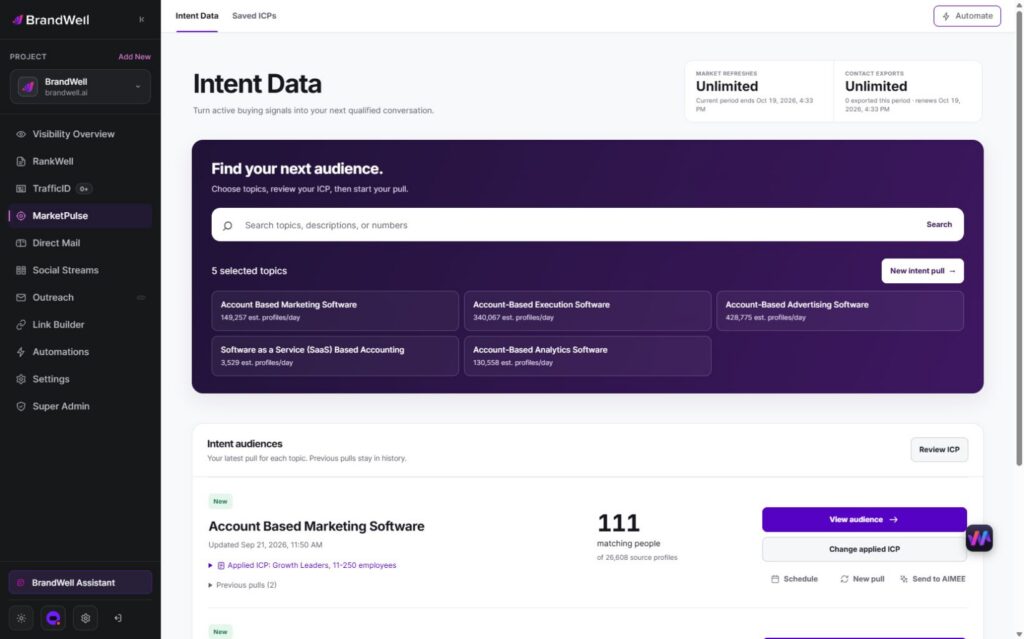
Evaluate MarketPulse with a representative topic and a defined ICP. Review the matching audience, prepare one useful action with BrandWell’s connected tools and AIMEE, and measure the operating effort. MarketPulse plans are starting at $500/mo; agree on the package, evaluation period, and success criteria before expanding.
Your pilot scorecard should answer:
- Were the chosen topics commercially specific?
- What share of records matched the target market?
- What identity level and contactability were available?
- How fresh and explainable were the signals?
- Could the output trigger a useful, permitted action?
- How much manual cleanup was required?
- Would a client understand the report without a data analyst present?
Review a representative MarketPulse topic and ICP output to define the evaluation. Preserve both accepted and rejected examples and operator effort. A prepared sample does not validate a recurring service.
5. Build two or three activation workflows
A signal has no value until it changes a decision. Start with narrow intent service activation workflows:
- High-fit, high-intent account: create a CRM task with the topic, recency, matching evidence, relevant buying roles, approved research steps, and a response SLA.
- High-fit, medium-intent account: add the account to a nurture or advertising audience, suppress existing customers, and watch for a second signal.
- Known website visitor with relevant behavior: enrich only the fields needed, check permission and geography, and route to the owner or an approved sequence.
AIMEE can prepare configured research and workflow briefs through connected tools. Define inputs, permissions and review points. Verify destination behavior; a proposed instruction does not establish a working integration.
6. Create the client operating system
Your minimum stack needs functions, not necessarily many products:
- Intent and identity layer for source signals, matching, enrichment, and provenance.
- System of record for account ownership, lifecycle stage, suppressions, and outcomes.
- Activation layer for sales tasks, email, ads, nurture, or research.
- Automation layer for routing, alerts, quality checks, and agent-ready instructions.
- Evidence layer for coverage, accepted signals, activity, pipeline, and costs.
- Governance layer for permissions, retention, rights requests, and audit logs.
These are the best tools and platforms to help you start a buyer-intent data agency because they describe the required jobs. Buying six brand names without owners and rules will not create the service.
7. Assign owners and SLAs
A lean intent service operational checklist can use four accountable roles, even if one person fills several:
| Workstream | Accountable owner | Output | Example SLA |
|---|---|---|---|
| ICP and topic design | Strategist | Approved market, topics, exclusions | Before pilot begins |
| Data quality and routing | RevOps or operations | Validated records in the right destination | Same day for priority tier |
| Activation | Client sales or campaign owner | Accepted action and disposition | One business day for top tier |
| Measurement and governance | Analyst/owner | Monthly evidence and exception review | Monthly, with urgent privacy escalation |
Swipe the table to see all columns.
The contract should identify who repairs an invalid record, who approves a new topic, who handles an opt-out, and what happens when the client’s team ignores an alert.
8. Sell the pilot before the annual transformation
Your first sales motion should reduce risk. Diagnose the client’s market, show a sample topic report, agree on qualification rules, and sell a paid setup or bounded pilot. A good proposal includes:
- one target segment and agreed topic set;
- baseline data and success criteria;
- signal and identity definitions;
- activation workflow and owners;
- delivery cadence and usage allowance;
- quality review and replacement policy;
- governance responsibilities;
- conversion path to the monthly service.
These are useful intent service templates: discovery brief, topic map, signal contract, activation matrix, SLA sheet, pilot scorecard, monthly report, and renewal memo.
9. Standardize delivery before adding clients
Document the sequence, not just the tools. Create a intent service checklist for onboarding, weekly delivery, monthly review, incident handling, and offboarding. Record intent service implementation examples that show the inputs, decisions, exceptions, and outputs without exposing client data.
The best intent service best practices are operational: one definition per metric, one owner per action, client-specific tenant boundaries, suppression before activation, and a feedback code for every rejected signal.
10. Build a renewal proof loop
Renewal should answer: what changed because the service existed? Report usable coverage, accepted accounts, response time, meetings, opportunities, pipeline, revenue, false positives, complaints, and full program cost. Separate sourced pipeline from influenced pipeline and correlation from incrementality.
Should you specialize – or remain a freelancer, consultant, or generalist agency?
A intent service comparison should include the status quo. Specialization is not automatically better.
| Model | Best when | Revenue pattern | Delivery burden | Main risk |
|---|---|---|---|---|
| Freelancer | Buyers need a skilled operator for a defined task | Project or hourly | Low to moderate | Revenue tied to personal capacity |
| Consultant | Clients need strategy, selection, or transformation | Project plus advisory retainer | Moderate | Advice may not create recurring operational value |
| Generalist agency | Clients want several channels from one team | Broad retainer | High | Positioning and margins can blur |
| Buyer-intent agency | Clients need ongoing signal, activation, and evidence | Setup plus recurring managed service | Moderate to high at first; lower after standardization | Data noise, weak adoption, or overpromised outcomes |
Swipe the table to see all columns.
Choose the specialist model when you can own the signal-to-action loop, have access to viable data, and can serve a market where improved timing has economic value. Remain a consultant when the client should operate the program internally. Stay generalist when intent is one small input to a broader mandate and cannot support a standalone recurring promise.
These are not mutually exclusive intent service alternatives. A consultant can add a managed signal module; a lead generation agency can make it a retainer add-on; a paid media agency can use it to improve audience prioritization.
Intent service pricing, cost, and revenue targets
Your cost model has five layers:
- Platform and data: subscription, usage, identity, enrichment, exports, integrations, and overages.
- Setup: market design, topic configuration, tracking, field mapping, permissions, and testing.
- Operations: weekly review, QA, routing, client communication, and optimization.
- Activation: SDR labor, email infrastructure, advertising media, creative, or direct mail.
- Governance: security review, legal advice, privacy operations, monitoring, and incident handling.
Use formulas instead of market folklore:
monthly delivery cost = platform allocation + data usage + labor + activation tools + governance reserve
minimum client price = monthly delivery cost ÷ (1 − target gross margin)
client break-even opportunities = monthly client fee ÷ expected gross profit per won opportunity ÷ opportunity win rate
For example, if a client’s allocated delivery cost is $2,800 and the agency targets a 60% gross margin, the price floor is $7,000 per month. That is an illustrative model, not an industry benchmark or a recommended quote. Change the inputs to reflect actual usage and labor.
A sensible intent service planning guide sets a revenue target based on capacity. If one operator can manage six standardized clients at an average $7,000 monthly fee, modeled revenue is $42,000 MRR before churn, sales cost, overhead, and taxes. Do not treat capacity or price assumptions as a forecast.
How much should an agency charge clients?
Package by the work and risk transferred, not by a guaranteed lead count.
| Illustrative tier | Included outcome | Typical scope variable | Pricing method |
|---|---|---|---|
| Signal | Prioritized opportunity feed and report | One market, limited topics, weekly delivery | Setup plus monthly fee |
| Activate | Signal plus CRM routing and two channel plays | More workflows, enrichment, alert cadence | Monthly fee plus usage/overages |
| Operate | Managed signal, activation, optimization, and executive review | Multiple segments, clients, or channels | Higher retainer plus pass-through spend |
Swipe the table to see all columns.
Name the variables in every proposal: clients, markets, topics, records, identity level, integrations, cadence, response SLA, support, report, overages, and contract term. Your intent service services page should make exclusions as clear as inclusions.
Intent service ROI, KPIs, and benchmarks
Do not use raw signal volume as the headline. Strong intent service KPIs cover four layers:
- Data quality: eligible coverage, match rate, freshness, duplicate rate, contact validation, false-positive rate.
- Operations: accepted-signal rate, routing success, time to first action, SLA compliance, rep adoption.
- Funnel: replies, meetings, qualified opportunities, stage progression, sales velocity, win rate.
- Economics: cost per accepted signal, cost per meeting, cost per opportunity, sourced and influenced pipeline, revenue, gross margin, retention.
A transparent intent service ROI calculation is:
incremental gross profit = (treatment wins − expected baseline wins) × average gross profit per win
ROI = (incremental gross profit − program cost) ÷ program cost
Estimating the counterfactual is the difficult part. Use a suitable randomized comparison where feasible and retain original assignments. Matched accounts or a pre-pilot period remain assumption-dependent observational evidence; document confounding, maturity and uncertainty rather than labeling a difference incremental by default.
Which clients are the best fit?
Qualify clients as carefully as the signals you intend to review.
Strong fit:
- clear ICP and economically valuable opportunities;
- enough market or site activity to produce a testable sample;
- a functioning CRM and named follow-up owner;
- sales cycles where timing and account research matter;
- willingness to share outcome data and follow governance rules.
Poor fit:
- no defined market or offer;
- very low traffic combined with an extremely narrow market;
- no one can act on alerts;
- the buyer demands guaranteed leads or hidden surveillance tactics;
- the client will not maintain suppressions, consent records, or outcome dispositions.
Additional specialist services may be appropriate when a client has the budget and need but lacks RevOps or activation capacity. Add that labor explicitly rather than hiding it inside a data subscription.
Signal quality and measurement: the non-negotiable checks
Good intent service signal quality and measurement practices separate:
- source behavior from the vendor’s inferred score;
- account-level from person-level identity;
- a match from a verified, contactable record;
- recent activity from stale history;
- relevance from mere frequency;
- activation from delivery;
- influenced pipeline from incremental pipeline.
Require a sample matched to the client’s actual market. Review why records qualified, not just how many arrived. Create exception codes such as wrong geography, wrong subsidiary, stale role, customer, competitor, irrelevant topic, insufficient evidence, no permitted channel, and duplicate.
Privacy and compliance checks before reselling intent data
This is operational guidance, not legal advice. Have qualified counsel review the markets and channels you serve.
Before onboarding a client:
- Document the agency, client, and vendor roles for each processing activity.
- Record source provenance, permitted use, retention, deletion, subprocessors, and security controls.
- Determine the lawful basis, notice, consent, and cookie requirements for each jurisdiction and signal source.
- Create suppression, opt-out, access, correction, and deletion workflows.
- Review email, phone, advertising, and automated-decision rules by location and recipient type.
- Prevent one client’s records, audiences, prompts, and reports from appearing in another tenant.
- Put incident, correction, and offboarding procedures in the contract.
Have qualified reviewers assess the actual source, processing roles, jurisdictions, intended recipients and channels before activation. Keep source permissions, suppressions, retention, correction and client responsibilities documented. Vendor terms are one part of that review.
BrandWell’s privacy policy and terms are starting points for vendor diligence, not substitutes for the agency’s own notices, contracts, and counsel.
Common intent service mistakes
- Selling a CSV instead of an operating loop.
- Choosing broad topics that create noise.
- Calling every signal a lead.
- Mixing account and person identity without confidence labels.
- Automating outreach before suppressions and approvals work.
- Measuring delivery instead of adoption and outcomes.
- Hiding media spend, data overages, or manual labor from the margin model.
- Taking a new geography live without retesting coverage and legal requirements.
- Scaling client count before onboarding and QA are standardized.
- Presenting a seven-day pilot as proof of long-term revenue.
The intent service decision guide
Use this decision rule:
- Start now if you have a narrow B2B market, one or two pilot prospects, a viable signal source, an activation owner, and access to outcome data.
- Start as an add-on if you already run lead generation, paid media, RevOps, or outbound and intent improves an existing retainer.
- Stay advisory first if the client stack or governance model needs repair before automation.
- Do not launch yet if your promise depends on hidden tracking, guaranteed results, or data you have not tested.
The strongest intent service examples will come from a repeatable client decision: which account to work, what action to take, and what happened next.
Next step
Start by reviewing the MarketPulse demo and plans, starting at $500/mo. Choose a relevant topic and ICP, then evaluate audience fit, available contact fields, and the workflow you will use. The first-purchase 3-day satisfaction guarantee requires no data exports and no more than 2 Intent Scans; review the current guarantee terms before testing. A short evaluation can establish fit, but cannot prove future pipeline or revenue.
Validate demand before committing delivery capacity
SBA’s business-planning guidance covers market research, business plans and startup costs.
For a proposed intent service, interview prospective clients about the decision they struggle to make, who can act on research, and what outcomes they can actually report. Check service demand and delivery constraints before purchasing a complex stack. The guide’s package examples are planning options, not market-tested prices.
Separate price, contribution and client impact
The earlier fictional model uses $2,800 in included delivery cost and a 60% target margin. $2,800 / (1 – 0.60) gives a $7,000 fee. The $4,200 difference is before any costs excluded from the definition. A markup is different: increasing $2,800 by 60% would produce $4,480, not $7,000.
Six clients at $7,000 produce $42,000 in modeled recurring invoice value. At $2,800 included cost per client, included cost totals $16,800 and the difference is $25,200 before excluded overhead, selling costs, bad debt and tax. These are hypothetical capacity and pricing assumptions, not earnings results or a forecast.
A separate client break-even model might assume a $7,000 program cost, $10,000 contribution per additional win and a 20% opportunity win rate. That implies $2,000 expected contribution per additional opportunity and 3.5 additional opportunities to cover the cost in expectation. Use four as a whole-opportunity planning threshold under those assumptions; actual outcomes remain uncertain. Existing opportunities cannot simply be counted as additional ones.
Begin with a bounded MarketPulse workflow
- Select a commercially relevant topic and define the ICP.
- Review available people and company output, exclusions and overlap.
- Prepare an approved next action that fits the evidence and the client’s permissions.
- Keep client ownership, review effort and downstream dispositions traceable.
- Expand only after useful output, workload and the service’s constraints are understood.
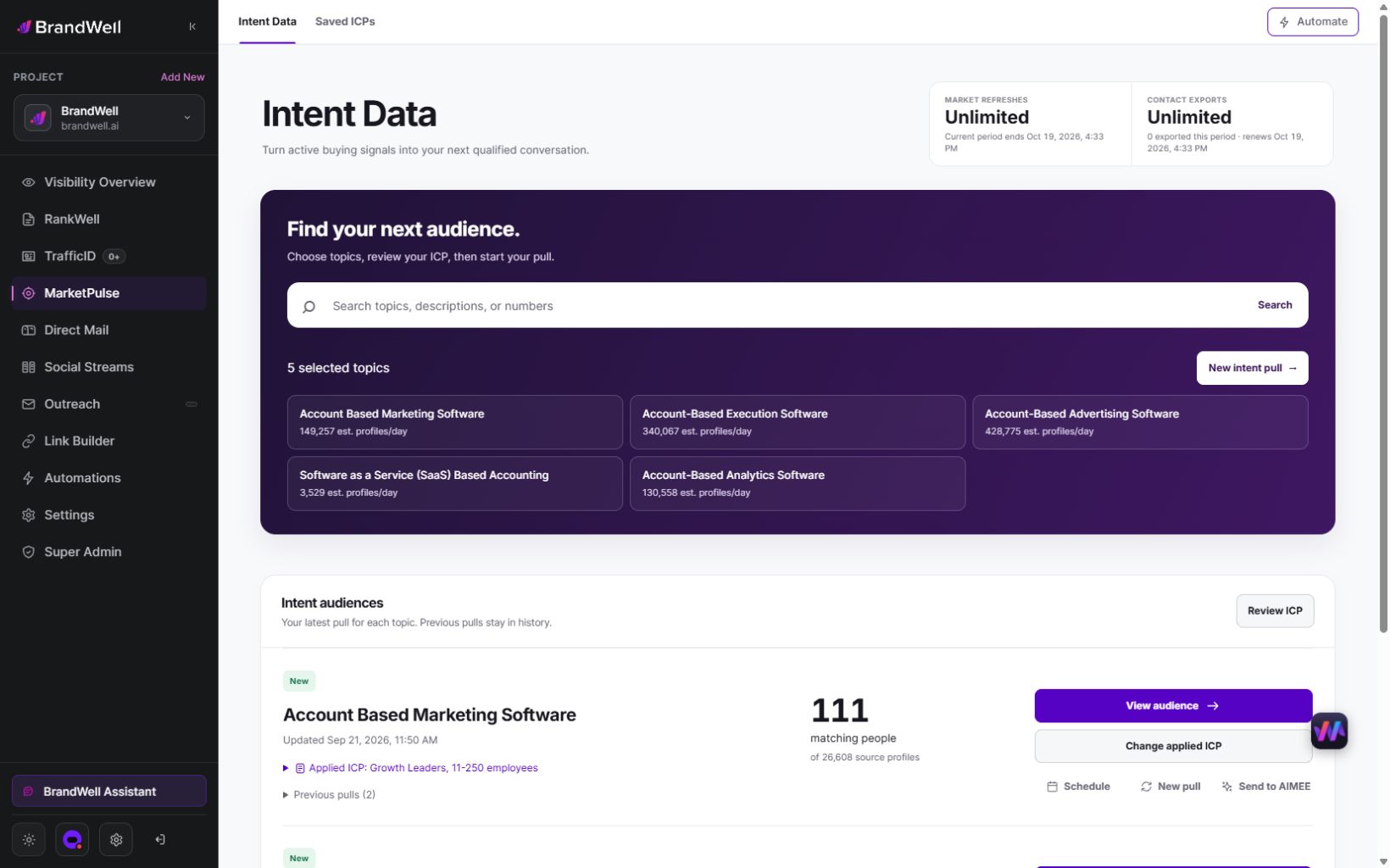
Standard plans are starting at $500/mo for one weekly topic and 25,000 monthly exports. Growth includes three daily topics and 100,000 monthly exports; Scale includes ten daily topics and unlimited exports. Counts and available fields vary; audiences can overlap. Refreshes stop at the plan limit without overage charges.
Watch the MarketPulse demo and compare plans. Include your delivery labor, permitted activation and measurement separately from the software subscription.
Frequently asked questions
What should a first agency offer include?
A defined market, research scope, acceptance rules, named action owner, cadence and a reviewable outcome report.
Does MarketPulse include a white-label agency platform?
Do not assume that entitlement from a standard subscription. Verify any additional portal, integration, managed-service or redistribution scope explicitly.
How much should the agency charge?
Model actual delivery cost and tested capacity, then compare viable service structures. The worked fee is illustrative rather than a recommended market price.
Can a short pilot prove revenue impact?
It can test fit, output and workload. Incremental revenue requires a suitable comparison, mature outcomes and disclosed uncertainty.
Reviewed and updated October 3, 2026.

Written by