On this page
- Who this is for
- Start with the decision, not the identity record
- The ten-step visitor identification to outbound workflow
- Team, integrations, and approval boundaries
- Current BrandWell workflow inputs
- Manual, modular, and full-platform alternatives
- Pricing and total cost
- Measurement and ROI
- Best-fit companies and disqualifiers
- Signal quality, freshness, and downstream evidence
- Mistakes, data-quality problems, and privacy risks
- Package it as a recurring agency service
- Operational checklist
- Frequently asked questions
- Walk through the current TrafficID review
A reliable visitor workflow does not send every identified visitor straight into a sequence. It converts anonymous website activity into a series of controlled decisions:
visit or topic signal → eligible account → identity confidence → enrichment and validation → fit and freshness threshold → approved play → human review where needed → outcome
Use company-level identification to prioritize accounts, audiences, and seller research. Use person-level data only when the match, source, permitted purpose, contactability, jurisdiction, and channel support the action. The signal should improve timing and relevance without telling a prospect that you watched them browse.
Treat this as a testable operating workflow: review relevant observations, qualify the account, approve an appropriate next step and capture the outcome. Identification coverage varies. A visit does not establish that the visitor wants outreach or that the workflow creates incremental pipeline.
Current MarketPulse offer: intent-data plans start at $500/mo. See the product, demo, and current plans. Updated October 6, 2026.
Who this is for
- Demand generation and growth leaders trying to recover value from target-account traffic that never fills out a form.
- RevOps and marketing operations leaders responsible for identity, routing, CRM hygiene, suppression, and measurement.
- Agency owners packaging visitor workflows as a recurring, governed client service.
- Privacy and legal reviewers who need a readable map of sources, uses, recipients, retention, and decision boundaries.
Start with the decision, not the identity record
The strategic question is not “Who visited?” It is “What permitted action becomes more useful because we observed this signal?”
That distinction creates four practical paths:
- Company identified, strong fit, weak person confidence: prioritize account research or account-based advertising.
- Company and role context identified, medium confidence: create a research task; do not auto-send.
- Person identified, contact validated, use approved: route into a reviewed and relevant outreach play.
- Fit, freshness, permission, or identity fails: suppress, aggregate for analytics, or discard under the retention rule.
A visitor workflow strategy should begin with high-value pages and meaningful topics. Pricing, comparison, integration, security, migration, and implementation behavior may support a stronger hypothesis than a general blog visit. Even then, the page does not establish buying intent by itself. Combine it with ICP fit, frequency, recency, account context, and other evidence.
The ten-step visitor identification to outbound workflow
This visitor workflow implementation guide separates signal collection from consequential action.
1. Define the eligible market and outcome
The demand leader approves the ICP, named accounts, excluded industries, geographies, company sizes, customer and competitor suppressions, and target roles. Select one primary outcome such as accepted seller tasks, qualified meetings, or opportunities from treated accounts.
Input: ICP, account universe, offer, sales stages, suppression lists. Output: an eligibility rule that can be tested before enrichment spend.
2. Map pages, events, and topics
Classify first-party behavior by commercial meaning. Document page group, event, timestamp, session count, referrer, campaign context, and consent state. Separately map third-party topic research to the client’s problems, category, alternatives, and implementation questions.
Avoid one global score. A return visit to an implementation page may deserve a different freshness window than a single educational article view.
3. Collect only what the approved use needs
Configure collection for the approved site, purpose, required notices and permission state. Verify actual behavior before using the output. Have the responsible reviewers map website technology and channel requirements for the applicable jurisdictions.
4. Resolve the company first
Match activity to a company or domain and store the method and confidence. Resolve parent-child entities carefully. A visit from a large corporate network should not automatically attach to the subsidiary in your target list.
A supported company association can inform account research. Check ambiguity, purpose and permission separately; company-level processing is not automatically low risk or exempt from review.
5. Enrich only after the account passes fit
Enrichment has a cost and expands the data footprint. Check company fit before requesting people, emails, phones, roles, or technologies. Pull only the fields needed for the approved play.
The RevOps owner should quarantine ambiguous matches, reject disposable or invalid contact details, and log why a record failed. A validated email is evidence of deliverability, not permission or interest.
6. Join topic intent and first-party engagement
Test whether topic research changes an appropriate review decision. A high-value visit and relevant topic observation provide distinct context. Preserve source and time for each rather than treating the combination as proof of buying intent.
Use an explicit rule such as:
Advance only after fit, relevant evidence, freshness, identity level, permitted purpose, suppression and actual destination requirements all pass. Hold unresolved mandatory checks.
Do not call the result an “in-market buyer.” Call it a qualified signal or account hypothesis until downstream behavior supports more.
7. Apply contactability, suppression, and approval checks
Before outreach, check email validation, role relevance, current customer status, open opportunities, prior conversations, global and client suppression, opt-outs, frequency, jurisdiction, and channel rules. Keep the sender’s identity, postal address, subject line, and opt-out process compliant with the applicable requirements.
Map requirements for the actual message and recipients with the responsible reviewers. Review phone and text rules separately from email. Record the required permission and opt-out state before the approved action.
8. Route to the lightest appropriate play
Choose among:
- Add the account to a permitted advertising audience.
- Create a seller research task with the page or topic category, not invasive detail.
- Enroll a known contact in an approved nurture path.
- Draft a relevant email for human review.
- Notify the account owner about a customer expansion or competitive-research hypothesis.
- Suppress because the evidence or permission threshold did not pass.
Configured tools can prepare research and drafts. Separately approve actual writes, messages, uploads and deletion. Confirm the supported destination, permissions, acknowledgement and recovery path.
9. Capture dispositions and outcomes
Record accepted, rejected, duplicated, suppressed, and unrouteable records. Capture reply, meeting, opportunity, stage, pipeline, win, loss, opt-out, and complaint events. Rejection reasons – wrong account, wrong role, stale timing, existing relationship – are training data for the workflow.
10. Review weekly and test incrementality
Review data quality and exceptions every week. Decide on topics, thresholds, and scope monthly. Where feasible, hold out a random set of otherwise eligible accounts. If randomization is impractical, use a matched cohort or pre-pilot baseline and state the limitation.
Team, integrations, and approval boundaries
| Workstream | Accountable owner | System of record | Approval boundary |
|---|---|---|---|
| ICP and topics | Demand generation | Strategy brief and account list | Human approval for market or topic changes |
| Collection and notice | Privacy plus marketing ops | Tag manager, consent system, data map | No unapproved tracker or purpose |
| Identity and enrichment | RevOps or data owner | Identity layer and CRM | Quarantine low-confidence matches |
| Outreach and audiences | Sales or paid-media lead | Engagement or ad platform | Human review for novel person-level outreach |
| Measurement | RevOps or analyst | CRM and warehouse | Predefined stages, costs, and comparison group |
| Client governance | Agency service lead | Runbook and change log | Written change control for scope and channels |
Swipe the table to see all columns.
Core integrations normally include the website or tag manager, consent and preference system, visitor identification, topic intent, enrichment and validation, CRM, sales engagement, advertising destinations, analytics or warehouse, and reporting. A smaller pilot can use exports, but the file still needs access control, retention, and deletion handling.
When automation can act directly
Authorize each configured action by its actual data, recipient and effect. Deduplication, scoring and owner lookup can still alter access or routing. Keep destination writes, uploads, messages and deletion behind the required approval and audit record.
AIMEE can organize supplied context through configured tools. Review the draft, confirm actual permissions and tool support, then verify destination acknowledgement. A workflow instruction does not prove that execution occurred.
Current BrandWell workflow inputs
Review source unit, identity method, available fields, topic context, actual destinations, permissions, implementation effort, costs and outcomes for the same defined use case.
BrandWell publishes this guide about its own products and workflow decisions. This is not an independent provider ranking. Verify actual scope and controls for the planned use.
Separate topic research from website visits
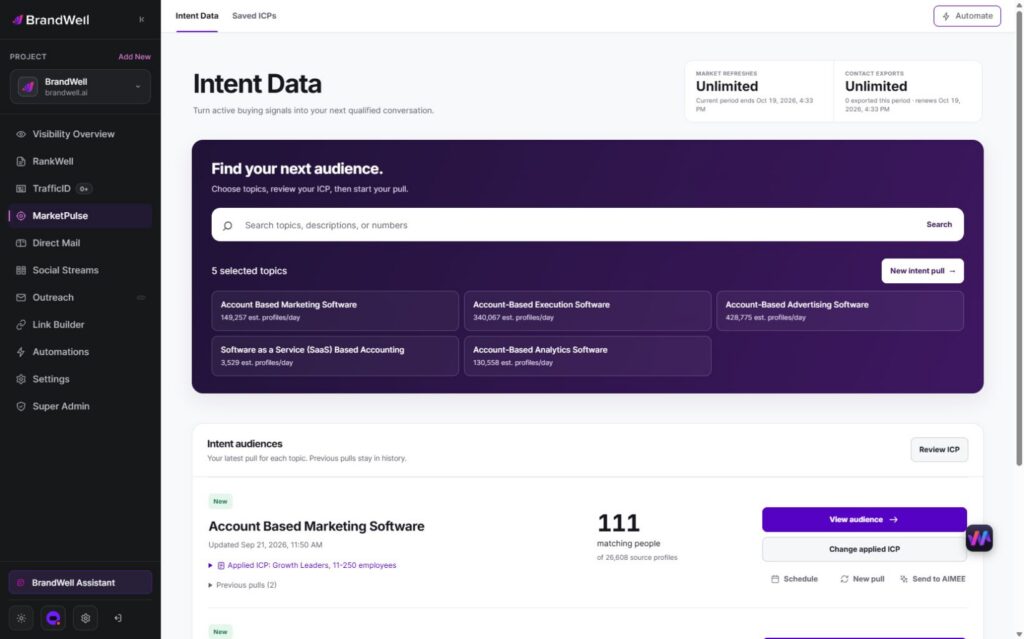
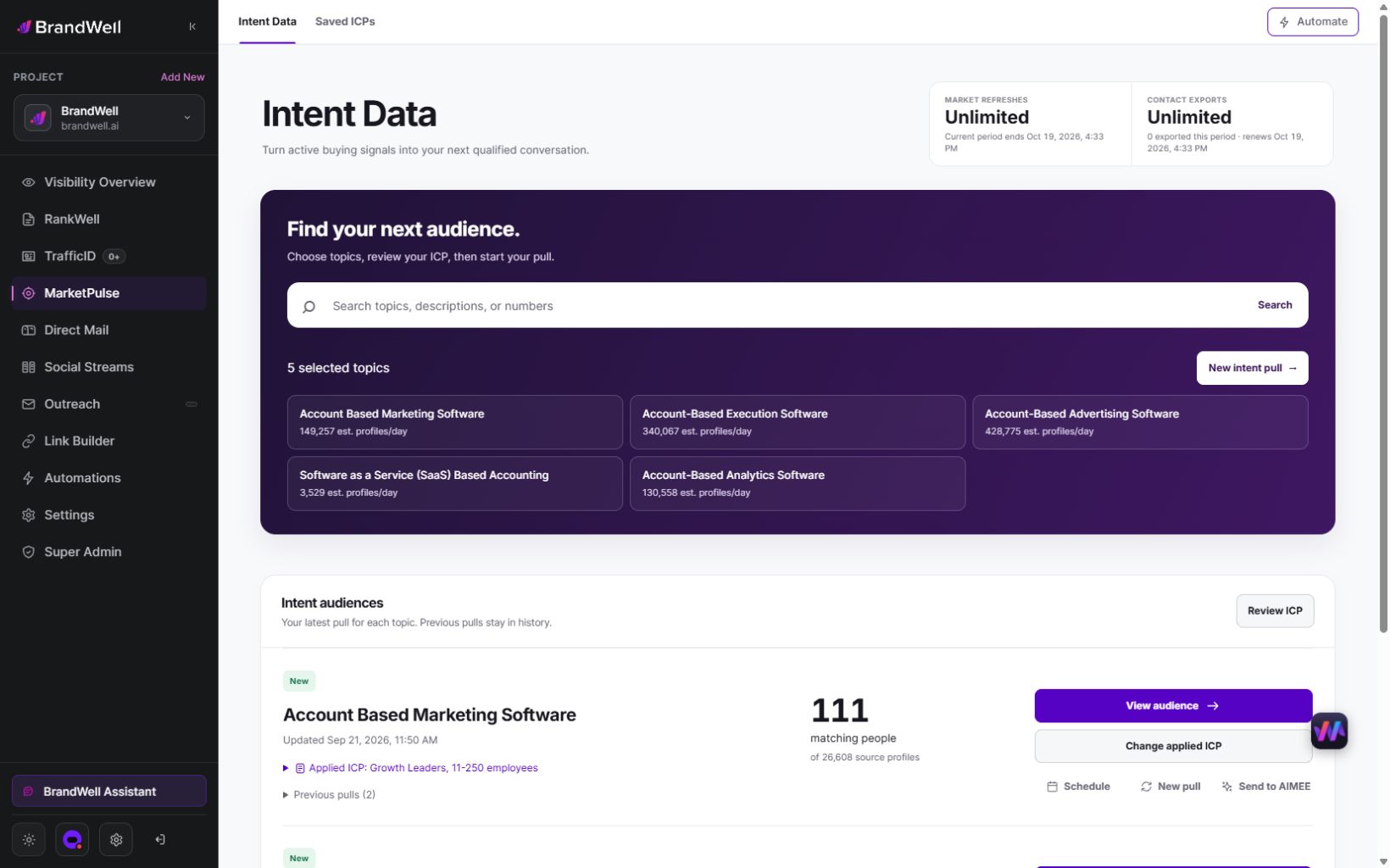
MarketPulse is starting at $500/mo and supplies topic research beyond your own website. TrafficID handles identifiable visits to your site. Keep those sources distinct when reviewing fit, available fields and the next action.
| Plan | Topics and refreshes | Monthly exports |
|---|---|---|
| Starter | 1 topic, weekly | 25,000 contacts |
| Growth | 3 topics, daily | 100,000 contacts |
| Scale | 10 topics, daily | Unlimited contacts |
Swipe the table to see all columns.
A pull retrieves available data from the previous 24 hours for one topic. Daily use across all included topics provides 90 Growth pulls or 300 Scale pulls in a 30-day month. Weekly Starter pulls vary by calendar month. Available audience size and contact fields vary, and audiences may overlap. Refreshes stop at the plan limit without overage charges.
- Find and qualify: search the topic catalog, save your ICP, and review the people and companies that match.
- Act on the research: export qualified contacts or prepare an Outreach or Direct Mail workflow. Connected products, channel usage, and fulfillment may cost extra.
- Get help from AIMEE: Growth and Scale include AIMEE for the initial user to research accounts and prepare the next step through connected tools.
Agencies and other service businesses can build client deliverables around their available Intent Scans and exports. Keep each client’s scope, permissions, and service fees clear. A subscription is not a promise of a white-label platform or exclusive access to a market.
Explore MarketPulse and watch the demo or compare plans starting at $500/mo. Any early-access discount is a separate, time-limited offer shown to an eligible recipient.
Manual, modular, and full-platform alternatives
| Model | What it does well | What the team must supply | When to use it |
|---|---|---|---|
| Manual website and CRM review | Low vendor dependency; easy small test | Research labor, identity, consistency, reporting | A tiny account list or initial process discovery |
| Company-level visitor identification | Adds account visibility with a lower identity claim | Contact strategy, topics, validation, activation | Account advertising and seller research |
| Modular identity + topic + enrichment | Flexible best-of-breed workflow | Integration, governance, scoring, measurement | Existing stack works; timing and routing do not |
| Full enterprise ABM/GTM platform | Broad orchestration and shared workflows | Data cleanup, training, change management, adoption | Mature enterprise program with dedicated owners |
| Separately scoped managed delivery | Repeatable agency packaging and delivery | Client qualification, scope, approvals, value review | Client delivery rights, implementation and effort separately verified |
Swipe the table to see all columns.
Migration should use parallel validation. Freeze the account list, page taxonomy, topics, lookback, identity threshold, suppressions, and outcome definitions. Compare unique eligible accounts, match confidence, usable contacts, routing latency, accepted actions, opt-outs, and cost. Do not compare a provider’s raw match count with another provider’s stricter qualified output.
Pricing and total cost
Visitor workflow pricing often hides in several contracts. Model:
monthly TCO = identification + topic data + enrichment/validation + activation tools + usage/media + agency labor + client labor + compliance/security
MarketPulse is starting at $500/mo. Verify actual topic, refresh and export allowances in the current plan terms. Budget TrafficID, other connected products, implementation, review and campaign delivery separately as applicable.
Build three scenarios:
- Low volume: fewer qualifying accounts, lower enrichment cost, but possibly weak economic proof.
- Expected volume: coverage and response based on the bounded pilot.
- High volume: overages, larger audiences, more seller work, and greater QA requirements.
Scope agency service fees separately from actual research subscription and delivery costs. Verify rights, custom client interfaces and integrations separately; a subscription does not itself establish a wholesale or white-label operating model.
Measurement and ROI
A useful visitor workflow metrics ladder includes:
- Collection health: eligible page events, consent state, tracker uptime.
- Visit-to-account match rate: visits associated with a supported account divided by eligible observed visits in the same period. Report unique matched accounts separately.
- Qualified-account rate: matched accounts passing fit and freshness ÷ matched accounts.
- Approved-contact rate: unique reviewed contacts passing identity, validation, suppression and approval divided by unique reviewed contacts. Report accounts and actions separately.
- Acceptance rate: actions accepted by sales or marketing ÷ actions routed.
- Response and meeting rates: unique contacts replying or meeting divided by unique eligible contacts reached in the same period. Count delivery attempts separately.
- Opportunity rate: qualified opportunities ÷ treated accounts.
- Observed rate difference: treatment outcome rate minus comparator outcome rate. A causal interpretation requires an appropriate design, outcome maturity and assessment of selection and spillover.
- Pipeline efficiency: qualified pipeline under the agreed attribution method ÷ full program cost.
- Agency gross margin: client revenue minus direct delivery cost, divided by client revenue.
A visitor workflow ROI calculation should use contribution margin where available:
Estimated incremental ROI = (estimated additional contribution before program cost minus actual full program cost) divided by actual full program cost. Preserve outcome maturity, comparator assumptions and uncertainty.
Do not count all pipeline touched by an identified account as caused by the workflow. A visit may reflect demand created by another channel, an existing sales conversation, customer support, recruiting, research, or noise.
Best-fit companies and disqualifiers
The workflow fits companies with:
- A high-consideration B2B offer and meaningful value per opportunity.
- A known target market and enough eligible website traffic or topic activity.
- High-value pages and topics that connect to distinct plays.
- Clean account domains, CRM ownership, suppression, and opportunity stages.
- Sales or campaign capacity to respond inside the agreed window.
- A privacy, security, and legal review process for the intended sources and channels.
It is usually a poor fit when traffic is predominantly consumer, the offer is low value and self-serve, the site has little target-account activity, the company has no outreach capacity, or leadership expects a deterministic list of individual buyers.
For agency owners, the best fit is a client willing to buy a recurring system and participate in review. The agency should decline a client that refuses to provide suppressions, demands invasive messaging, or wants to use the data for sensitive eligibility decisions.
Signal quality, freshness, and downstream evidence
Use a field-level signal dictionary:
| Field | Question it must answer | Failure if absent |
|---|---|---|
| Source and event | What happened and where? | No lineage or auditability |
| Timestamp and lookback | Is it still actionable? | Stale prioritization |
| Account match and confidence | Which company is plausible? | Wrong routing |
| Person match and confidence | Is a person-level action supportable? | Invasive or mistaken outreach |
| Fit state | Is the account eligible? | Wasted enrichment and seller time |
| Contact validation | Can the channel technically reach them? | Bounce and quality risk |
| Permission/suppression state | Is the proposed use allowed? | Compliance and trust risk |
| Action and owner | What should happen next? | Dashboard without activation |
| Outcome and disposition | Did the hypothesis help? | No learning or ROI evidence |
Swipe the table to see all columns.
“Real-time intent signals” should mean a defined latency, not a slogan. Measure time from collection to match, qualification, routing, review, and action. A faster wrong match is worse than a slower, auditable one.
Mistakes, data-quality problems, and privacy risks
Common visitor workflow mistakes include:
- Treating a company match as proof of a person.
- Enriching every visitor before checking account fit.
- Ignoring shared networks, VPNs, remote workers, bots, and parent-child entities.
- Sending immediately after one page view.
- Revealing tracked behavior in a way that feels intrusive.
- Failing to suppress customers, open opportunities, opt-outs, competitors, and employees.
- Uploading audience data without documenting platform, contract, and jurisdiction requirements.
- Measuring matches and clicks rather than incremental opportunities.
- Retaining raw events and exports indefinitely.
- Allowing an AI agent to send, delete, or alter records without a scoped permission and review rule.
Verify source, role, jurisdiction, recipient, purpose and channel requirements with the responsible reviewers. Preserve actual permission, suppression, retention, correction and deletion records. An available identity or contact field does not authorize every use.
Package it as a recurring agency service
| Package | Deliverables | Review cadence | Scope control |
|---|---|---|---|
| Identified account report | Eligible company visits, topic summary, branded report, exclusions | Weekly delivery; monthly review | Company-level only unless separately approved |
| Qualified outbound queue | Report plus enrichment, validation, fit, freshness, routing, and play cards | Weekly QA and disposition review | Named channels, limits, and human approval |
| Managed intent activation | Visitor, topic, audiences, seller workflows, experiments, and executive reporting | Continuous monitoring; weekly operations; quarterly strategy | Separate media, usage, legal, and custom-work terms |
Swipe the table to see all columns.
Review identifiable visits and form completions in TrafficID, keeping their origins distinct. A Stakeholder ICP can add relevant decision makers from the same companies. These additional contacts are not observed visitors. Approve relevant exports or a configured next step separately.
The agency controls its own client billing. Agreements should specify monitored properties and topics, signal and identity definitions, included volume, delivery schedule, response SLA, suppressions, allowed uses, retention, reporting, change control, overages, media, and no-guarantee language.
Operational checklist
- Define ICP, accounts, exclusions, pages, topics, and one outcome.
- Map trackers, notice, consent, vendors, fields, systems, users, and retention.
- Choose company- and person-level identity thresholds separately.
- Gate enrichment behind account fit.
- Validate contact data and suppress before routing.
- Connect every threshold to one approved play and owner.
- Require review for person-level, sensitive, new, or irreversible actions.
- Preserve source, timestamp, confidence, and disposition.
- Use a holdout or clearly labeled baseline.
- Review exceptions weekly and business value monthly.
- Put usage, custom work, data roles, and exit rights in the contract.
Frequently asked questions
How should demand leaders approach visitor identification to create qualified pipeline?
Start with a narrow eligible market and one measurable outcome. Identify the company, add relevant topic context, enrich only after fit, apply freshness and permission gates, route to the lightest useful action, and compare treated accounts with a holdout or baseline.
What workflow, data, integrations, and team are required?
The workflow needs website events, topics, identity confidence, enrichment, validation, CRM, suppression, routing, activation, and outcome data. Demand generation owns the use case, RevOps owns identity and routing, channel leaders own action, and privacy/legal reviewers approve data and channel rules.
Which tools and resources are most useful?
Choose tools that expose source, timestamp, confidence, identity level, fields, destinations, usage, and rights handling. Pair them with a signal dictionary, data map, allowed-use matrix, routing map, play cards, exception log, TCO model, and measurement plan.
When should a buyer use a manual or non-intent approach?
Use manual research for a tiny account list or to discover the process. Use company-level visitor identification for account prioritization. Add topic and person-level data only when they change an approved action. Choose a full platform when broad enterprise orchestration justifies the change.
What budget and total cost should a buyer expect?
MarketPulse is starting at $500/mo. Budget the actual TrafficID and topic subscriptions, connected tools, usage, implementation, review and delivery work for the defined scope. Compare actual current terms rather than assuming one product includes every layer.
How should the workflow be tied to revenue?
Track match quality, qualified-account rate, accepted actions, time to action, replies, meetings, opportunities, treatment lift, pipeline efficiency, full cost, and agency margin. Do not treat all influenced pipeline as incremental.
Which companies are the best fit?
High-value B2B companies with a defined ICP, enough relevant activity, clean CRM, response capacity, and governance fit best. Low-ticket, consumer-heavy, low-traffic, or no-owner situations usually do not.
How should fit, identity, freshness, and activation be combined?
Treat them as sequential gates. A record should not advance because a high signal score compensates for wrong fit, weak identity, stale activity, missing permission, or no action owner.
What are the biggest mistakes and privacy risks?
The biggest mistakes are overstating identity, immediate automated outreach, missing suppressions, invasive wording, indefinite retention, unclear data roles, and measuring raw matches instead of incremental outcomes.
How can an agency turn visitor intelligence into recurring revenue?
Scope monitored properties, topics, qualification, review, reporting and approved destinations. Verify actual data rights, client separation, implementation and ongoing delivery effort. Price agency services separately from the subscription; do not imply a native white-label entitlement.
Walk through the current TrafficID review
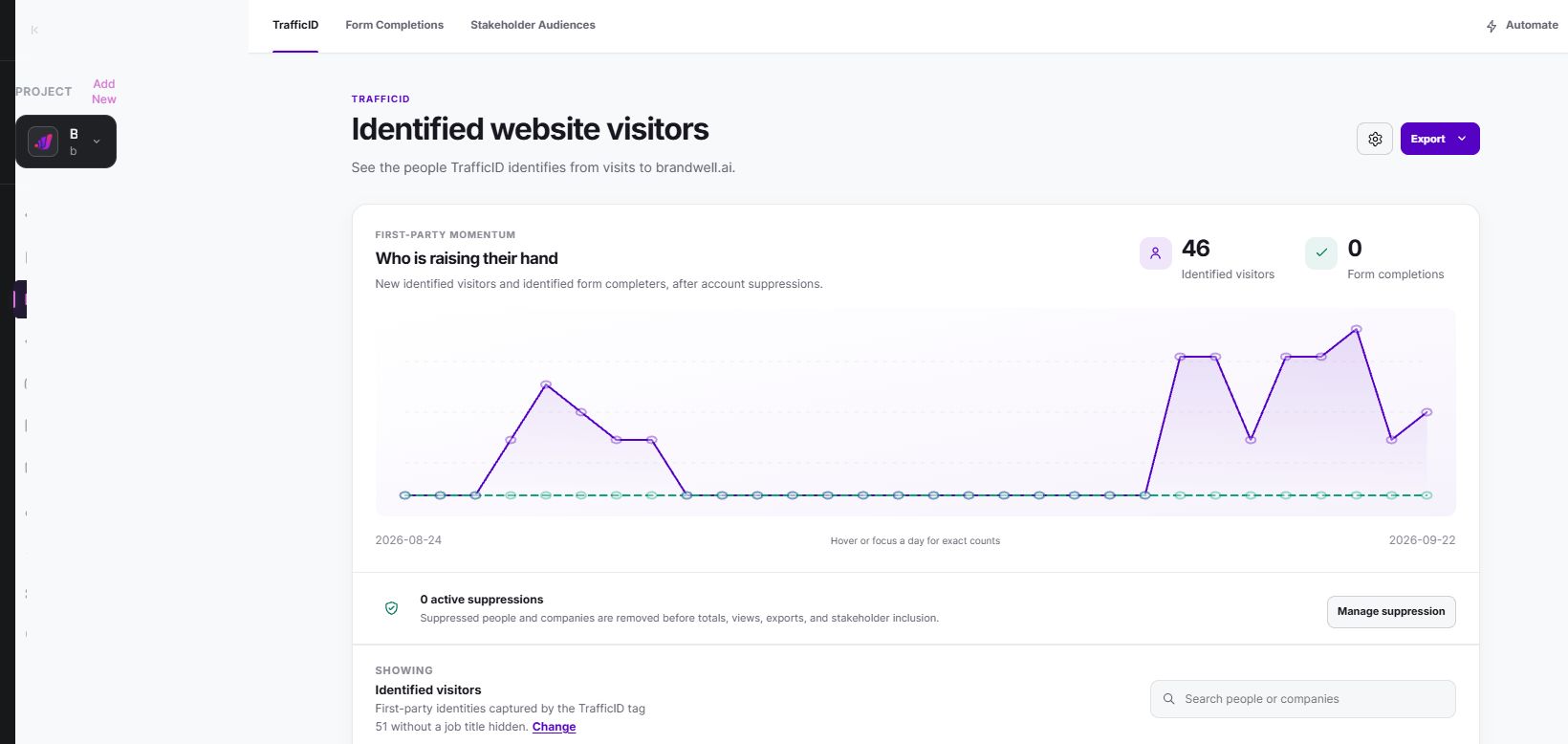
- Check the site tag and reported installation state for the correct Company Project.
- Review identified visitors separately from submitted form identities.
- Apply relevant people and company suppressions before reviewing the audience.
- Review additional Stakeholder ICP contacts separately from observed visitors.
- Approve the relevant export, research brief or configured Outreach or postcard workflow.
- Verify destination acknowledgement, dispositions and mature results.
Visits, people and accounts are different units
Google Analytics documentation distinguishes users, pageviews and sessions. Define the unit and scope of each denominator before comparing analytics with identified records.
A fictional batch contains 1,000 visits, 100 identified people and 60 represented companies. These are three different measures. If a Stakeholder ICP adds 40 contacts, those contacts do not become 40 more observed visitors.
Approved is not the same as acknowledged
A fictional 50 reviewed contacts yield 30 approvals and 24 acknowledged destination records. That is 60% approval of reviewed contacts and 80% acknowledged delivery of approvals. Six approvals remain unresolved. Count later replies by unique contacted people, not by email attempts.
Copyable review record
Origin: [Visit, submitted inquiry, topic research or added stakeholder.] Context: [Observed time, actual fields and fit.] Gates: [Purpose, identity, permissions and suppression.] Action: [Owner, approved destination and acknowledgement.] Outcome: [Unique reply, meeting, opportunity, costs and unknowns.]
Explore TrafficID for your site and MarketPulse for topic research, with MarketPulse starting at $500/mo.
Reviewed and updated October 6, 2026.

Written by