On this page
- What topic intent data is – and is not
- An evaluation framework for signal quality
- Workflow, integrations, and accountable team
- Criteria for comparing topic-intent options
- Current MarketPulse research input
- Topic intent versus fit-only, engagement-only, and broad lists
- Budget and total cost of a topic-intent program
- Measure topic intent from signal to revenue
- Best-fit companies and use cases
- Combine fit, identity, freshness, activation, and evidence
- Data-quality, privacy, and expectation risks
- Turn topic intent into a recurring agency service
- Run a bounded topic-intent proof before scaling
- Frequently asked questions
- Copyable topic evaluation ledger
Topic intent data is most useful as probabilistic evidence that a company or person is researching a business subject, not as proof that a purchase is imminent. Evaluate it by testing relevant signal density, identity confidence, freshness, fit, and incremental value against your existing data. Activate only when a signal passes defined gates and an owner can take a permitted next step. Measure it through the full chain from signal to qualified opportunity and revenue, while stating attribution limits.
Who this is for. This guide is for B2B revenue teams, agencies, demand-generation leaders, sales leaders, and RevOps teams comparing topic-intent providers or designing a service around research signals. It is not legal advice, and it does not treat intent as consent, certainty, or a guaranteed sales outcome.
Current MarketPulse offer: intent-data plans start at $500/mo. See the product, demo, and current plans. Updated October 6, 2026.
What topic intent data is – and is not
Topic intent data groups observed research behavior into named subjects such as a category, problem, product capability, vendor, or competitor. Depending on the source, the output may identify an account, a person, a device, an audience segment, or only an aggregate surge. A provider may infer unusual interest relative to a baseline, report discrete content or comparison activity, or combine multiple signals into a score.
Three distinctions prevent bad decisions:
- Topic versus keyword: A topic can aggregate many related pages or terms. The buyer should understand the taxonomy and how ambiguous language is handled.
- Account versus person: Account-level evidence does not identify which member of a buying group performed the research. Person-level matching adds actionability and additional data-use responsibility.
- Interest versus readiness: Research can reflect a buyer, customer, student, competitor, employee, consultant, or general curiosity. Intent improves prioritization when combined with fit and context; it does not prove budget or authority.
Use topic intent to answer “where should we investigate or allocate attention?” rather than “who is definitely buying?”
An evaluation framework for signal quality
Evaluate a provider with a sample from the actual market. A polished demo using famous accounts is not enough. Freeze the ICP, geography, topics, exclusions, and observation window before reviewing output.
Score six dimensions:
- Relevance: How closely does the topic map to the problem and offer?
- Coverage: How many target accounts or eligible people can the source observe in the required market?
- Freshness: How quickly does the signal arrive, and how should it decay?
- Identity: Is the output account-level or person-level, and what match confidence is available?
- Additional evidence: Does the source add research context absent from existing site, CRM or campaign records? Measure causal outcome improvement separately; information novelty is not incrementality.
- Activation fit: Can the team route the output to a specific, permitted action quickly enough to matter?
Review current MarketPulse topics and plans, starting at $500/mo. Test actual fit, available fields and review effort. Verify current guarantee conditions before testing; a short review does not establish incremental pipeline or revenue.
Workflow, integrations, and accountable team
A workable topic-intent implementation has nine steps:
- Create the topic map. Link each topic to a buyer problem, ICP segment, stage hypothesis, and intended action.
- Set baselines and thresholds. Define what counts as unusual activity and whether one or multiple signals are required.
- Apply freshness. Assign an expiration or decay rule appropriate to the buying cycle.
- Resolve identity. Match to an account or person only where coverage, contracts, and permitted use support it.
- Enrich and qualify. Add firmographic, role, geography, contactability, customer status, and suppression fields.
- Select an action. Route to CRM research, an ad audience, a seller task, a nurture path, or a client report.
- Add approval boundaries. Require human approval for public outreach, sensitive data, material spend, or irreversible changes.
- Capture outcomes. Preserve the original signal, decision, action, and downstream status.
- Review lift and errors. Analyze false positives, missed accounts, latency, rejected records, and changes in opportunity performance.
Marketing or agency strategy should own topics and use cases. RevOps or data operations should own mapping, integrations, governance, and measurement. Sales or media owners should own action SLAs. Privacy and legal owners should review the actual jurisdictions, sources, and channels.
Criteria for comparing topic-intent options
Evaluate source unit, topic meaning, fields, timestamps, match limitations, approvals, operating effort and actual outcomes for the same use case. Custom client delivery and connectors need separate verification.
- topic/source model and evidence granularity;
- account/person identity and confidence;
- freshness, coverage, and testability;
- qualification and activation workflow;
- separately verified custom client delivery, reporting, rights and operating capacity;
- pricing and total operating cost;
- best-fit scenario and meaningful limitation.
Current MarketPulse research input
BrandWell publishes this guide about its own research product and workflow choices. Verify actual feature scope, sources, rights and delivery effort. This is not an independent provider ranking.
Topic and saved ICP research
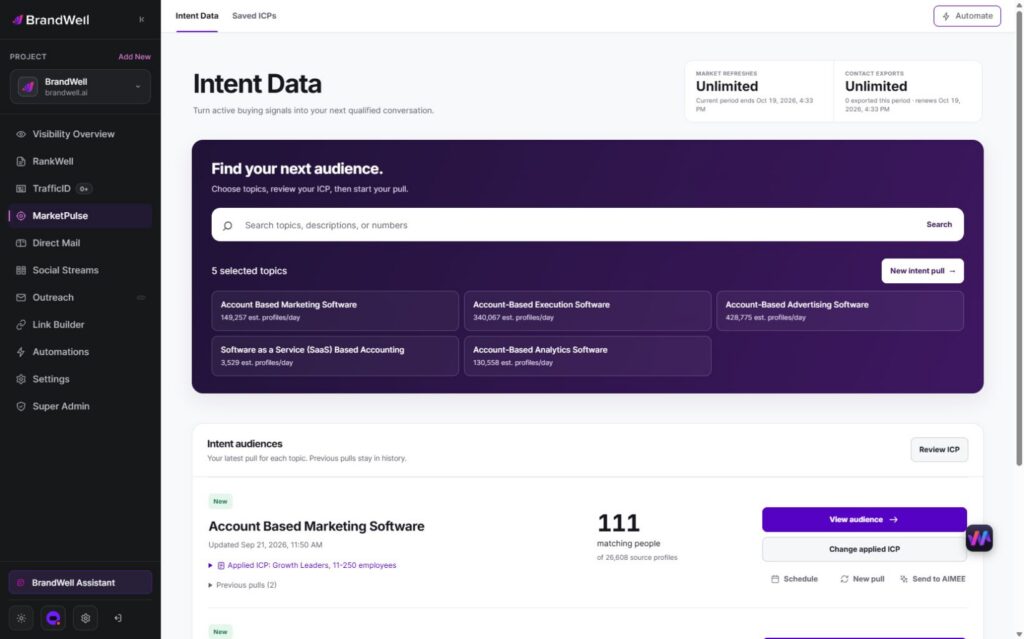
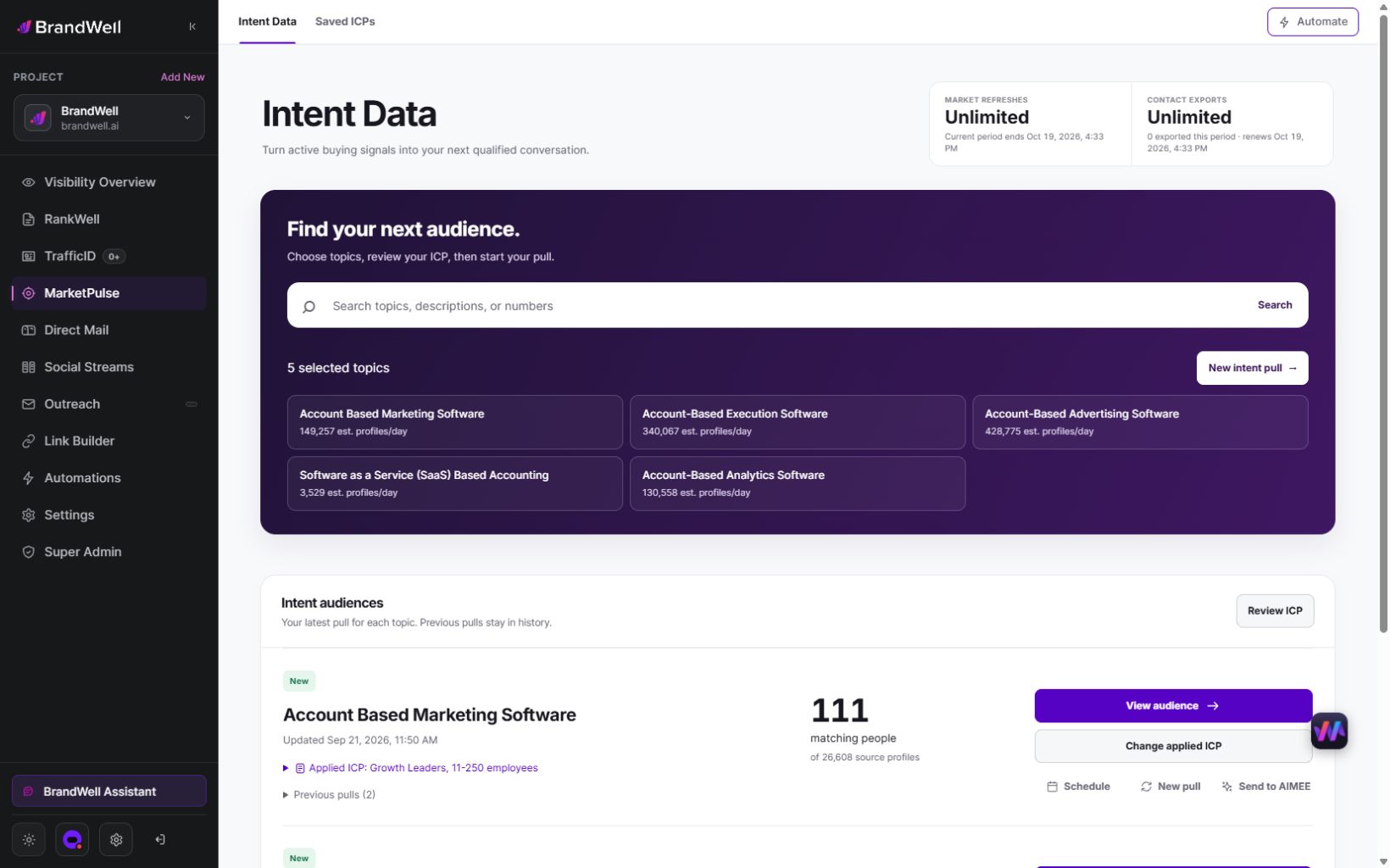
MarketPulse research is starting at $500/mo. Choose an available topic, apply a saved ICP and review actual audience and contact fields. Research context is separate from buyer qualification and permission to act.
| Plan | Topics and refreshes | Monthly exports |
|---|---|---|
| Starter | 1 topic, weekly | 25,000 contacts |
| Growth | 3 topics, daily | 100,000 contacts |
| Scale | 10 topics, daily | Unlimited contacts |
Swipe the table to see all columns.
A pull retrieves available data from the previous 24 hours for one topic. Daily use across all included topics provides 90 Growth pulls or 300 Scale pulls in a 30-day month. Weekly Starter pulls vary by calendar month. Available audience size and contact fields vary, and audiences may overlap. Refreshes stop at the plan limit without overage charges.
- Find and qualify: search the topic catalog, save your ICP, and review the people and companies that match.
- Act on the research: export qualified contacts or prepare an Outreach or Direct Mail workflow. Connected products, channel usage, and fulfillment may cost extra.
- Get help from AIMEE: Growth and Scale include AIMEE for the initial user to research accounts and prepare the next step through connected tools.
Agencies and other service businesses can build client deliverables around their available Intent Scans and exports. Keep each client’s scope, permissions, and service fees clear. A subscription is not a promise of a white-label platform or exclusive access to a market.
Explore MarketPulse and watch the demo or compare plans starting at $500/mo. Any early-access discount is a separate, time-limited offer shown to an eligible recipient.
Topic intent versus fit-only, engagement-only, and broad lists
| Approach | What it tells you | Strength | Limitation | Best use |
|---|---|---|---|---|
| Topic intent | Research evidence around a subject | Can supply research context for a tested review decision | Probabilistic; source and identity vary | Finding accounts worth investigating now |
| Fit-only targeting | Who resembles the ICP | Stable market coverage | Says little about timing | Building the addressable universe |
| First-party engagement | What happened on owned properties | Direct and explainable | Sees only known or visiting demand | Routing inbound and nurturing |
| Broad lists | Contact or company inventory | Reach and simple filtering | Often static and timing-blind | Market mapping and controlled outbound inputs |
| Combined model | Fit plus topic, first-party, identity, and outcomes | Several distinct evidence types; usefulness needs testing | More governance and operations | Repeatable revenue workflows |
Swipe the table to see all columns.
Do not replace fit with intent. A high-signal poor-fit account can waste more time than a low-signal perfect-fit account. Use fit to decide eligibility and intent to influence priority or next action.
Budget and total cost of a topic-intent program
Compare actual written scope for the required topics, fields, users, usage, exports, retention, support and operating work. Verify API access or custom connectors separately; a product description does not establish the entitlement or implemented path.
Add internal cost: taxonomy design, sample validation, account matching, enrichment, routing, seller enablement, report production, privacy review, and measurement. A feed that looks inexpensive can have a high cost per useful action when the agency must build these layers.
Separate the actual research subscription from agency service work. Custom reports, client interfaces, integrations, billing and managed activation need their own verified scope, rights, implementation and fees.
Measure topic intent from signal to revenue
Use one stage model across teams:
- signals observed;
- signals within the ICP;
- accounts or people matched;
- records accepted after enrichment and suppression;
- records activated within SLA;
- positive engagement or qualified meeting;
- opportunity created;
- pipeline and revenue outcome.
Calculate yield between each stage. Leading KPIs include coverage, relevant-signal rate, match rate, qualification rate, freshness, and time to action. Pipeline KPIs include meeting and opportunity rates, pipeline per activated account, and velocity. Revenue KPIs include win rate, sourced or influenced revenue, expansion, and cost per won opportunity.
Use a matched baseline where possible. Compare signaled and non-signaled accounts within the same ICP tier, region, and period. Report selection bias: high-intent accounts may already be more likely to engage. Topic intent should receive credit for a changed prioritization or action only when the operating record supports it.
Best-fit companies and use cases
Topic intent fits markets with enough research volume, a well-defined problem taxonomy, meaningful deal value, and a team that can act quickly. Common use cases include prioritizing target accounts, identifying new market demand, building paid audiences, informing content and offers, and giving agencies a recurring evidence-and-activation service.
It is weaker for tiny markets, offers with no observable research language, short consumer transactions, sensitive categories without an approved data basis, or teams without CRM ownership. It is also a poor fit when the seller plans to mention covert behavior directly to a prospect.
Combine fit, identity, freshness, activation, and evidence
A production rule can be written as:
Approve an action only when every required check passes: fit, source relevance, identity level, freshness, permitted purpose, suppression and the actual destination workflow. Hold unresolved checks.
Different actions should have different thresholds. An aggregate topic report can use lower-confidence evidence than a person-level email. A paid audience may have platform-policy requirements that differ from CRM research. An executive alert can be useful even when the right next step is manual investigation rather than automation.
AIMEE can organize supplied context through configured tools. Named owners approve actual exports, messages, audiences and destination writes. Confirm supported tools, permissions, acknowledgements and recovery; a proposed instruction is not proof of execution.
Data-quality, privacy, and expectation risks
Technical risks include poor taxonomy, bot or irrelevant activity, stale signals, weak account mapping, duplicates, and score drift. Operational risks include slow routing, inconsistent rep use, fragmented status, and over-automation. Commercial risks include custom work, unclear overages, and a client promise based on raw volume.
Verify actual source, identity method, jurisdiction, recipient, purpose and channel requirements before use. Keep provenance, access, suppression, retention, correction and deletion records. Resolve missing approvals rather than treating research as permission.
Turn topic intent into a recurring agency service
A recurring package can include topic strategy, a branded market report, qualification, identity and enrichment where appropriate, a prioritized action queue, activation support, and a monthly learning review. Set included topics, markets, usage, report cadence, action SLA, client duties, overage rules, and change control.
An agency may separately scope insight, approved activation support and managed review. Verify actual implementation, data rights, service responsibilities and fees. Report unknowns and rejection reasons alongside completed work.
Run a bounded topic-intent proof before scaling
Use a pilot to test the weakest assumptions in the operating chain rather than to generate a flattering volume number. Start with one defined market, a small topic set, an explicit ICP, and a fixed freshness window. Record the number of raw signals, matched entities, qualified records, approved activations, and downstream events separately. That exposes where evidence is lost and where additional tooling or labor is required.
Before the pilot starts, freeze the baseline, acceptance rules, exclusions, routing destination, and success threshold. Keep a holdout or matched comparison set where practical. Do not rewrite the topic dictionary, score, message, and activation rule at the same time; otherwise the result cannot explain what worked. Log every exception and workflow change.
The decision at the end is not simply “buy” or “do not buy.” The team may proceed, narrow the topic set, change the identity method, lengthen the observation window, add an integration, or keep the program report-only. A high volume with low qualification is not success, and a small volume of timely, accepted signals may be valuable when the addressable market is narrow.
Assess the audience and the operating cost before expanding the service. Explore MarketPulse with the data, tools, and client delivery scope you need.
Frequently asked questions
How should B2B teams approach topic intent data responsibly?
Use it as probabilistic evidence for prioritization. Validate the topic, source, identity, freshness, fit, permitted action, and downstream outcome before treating a signal as useful.
What workflow and team are required?
Use a topic map, threshold, decay, identity and enrichment step, suppression, routing, approval, outcome logging, and review. Assign strategy, operations, activation, and privacy ownership.
Which tools and resources are most useful?
Shortlist platforms by signal model and operating fit. Use a topic dictionary, sample-data scorecard, signal ledger, routing matrix, outcome dashboard, and data-use checklist.
How does topic intent compare with fit or engagement?
Fit, owned-property observations, topic research and contact inventory answer different questions. Preserve those meanings and test whether a combined review improves the actual decision.
What should a buyer budget?
Budget for the platform or feed plus identity, enrichment, integrations, analyst work, activation, reporting, governance, and adoption. Normalize the same use case across quotes.
How should topic intent be tied to pipeline?
Track stage-by-stage yield and use a matched baseline where practical. Separate leading signal metrics from opportunities and revenue, and state attribution uncertainty.
Which companies are the best fit?
B2B teams with a clear ICP, researchable problems, sufficient market activity, meaningful deal value, and quick follow-up are the strongest fit.
How should intent be combined with fit and freshness?
Require all five gates: fit, signal relevance, identity confidence, freshness, and an approved activation. Preserve the reason for every decision.
What are the biggest mistakes and privacy risks?
The biggest errors are treating intent as certainty or consent, using vague topics, ignoring decay and duplicates, exposing behavior in outreach, and automating without governance.
How should an agency package topic intent?
Sell a recurring decision and activation service: topic strategy, branded reporting, qualification, routing, measurement, and optimization. Define usage, SLA, limitations, and client responsibilities.
Copyable topic evaluation ledger
Observation: [Actual source, unit, topic and time.] Fit: [Saved ICP and reviewed exclusions.] Context: [Information added and unresolved associations.] Gates: [Purpose, permissions, suppression and owner.] Action: [Approved next step and acknowledgement.] Outcome: [Mature result, comparator, attribution and missing feedback.] Cost: [Actual review and delivery effort.]
Preserve origins and transformations
The W3C PROV primer describes entities, transformations and responsible agents. Provenance records do not establish correctness, permissions or incremental revenue.
New information is not causal lift
A fictional topic record adds context absent from the CRM. That establishes an information gap was filled, not that the context caused an opportunity. Evaluate the resulting action and mature outcome against a suitable comparator, preserving selection bias and missing observations.
Account evidence and added contacts are distinct units
A fictional research observation concerns one company. Enrichment adds five possible stakeholders. Report one account observation and five proposed contacts, not five observed researchers. Validate actual associations and permissions before action.
Keep stage denominators and unknown outcomes
A fictional 100-record batch has 80 usable records, 60 approvals and 45 acknowledged actions. That is 80% usable output, 75% approval of usable records and 75% acknowledged action of approvals. Fifteen approvals lack acknowledgement. Four reported opportunities do not establish incremental revenue or outcomes for the unresolved actions.
A threshold update is not new research
A fictional October 3 review re-scores a September 28 observation. Preserve both dates and expire the observation under the actual freshness rule. Changing the score does not restart its age.
Review current research: explore MarketPulse and current plans.
Reviewed and updated October 6, 2026.

Written by