On this page
- The white-label intent-data evaluation framework
- Operational checklist: workflow, data, integrations, and ownership
- Tools and templates to request during evaluation
- Compare white-label platforms with other operating models
- Pricing and total-cost questions for the RFP
- Measure a pilot without overstating ROI
- Best-fit agencies and disqualifiers
- Combine signal, fit, identity, freshness, and action evidence
- Privacy, data-quality, and automation risks
- Package evaluation into a recurring agency service
- Frequently asked questions
- Use mandatory gates before weighted scores
- Check MarketPulse’s actual role
A white-label intent-data platform should be evaluated as an agency operating system, not as a logo-swapped data feed. The right choice must produce relevant signals, resolve and qualify the right buyers, separate clients, support branded delivery, permit the intended resale model, and connect every output to an approved action and measurable outcome. If a vendor cannot demonstrate those elements with your market and workflow, a polished portal is not enough.
This proposed checklist is for agency owners, revenue and operations teams evaluating infrastructure for a recurring intent-data service. Inspect the actual signal and identity method; not every observation or match is probabilistic. Branded delivery does not establish buyer certainty or guaranteed revenue.
Current MarketPulse offer: intent-data plans start at $500/mo. See the product, demo, and current plans. Updated October 3, 2026.
The white-label intent-data evaluation framework
Score each vendor across eight decision areas. Use the same written scenario, sample market, and evidence standard for every option.
- Signal relevance and coverage: Does the source observe the topics, accounts, visitors, or behaviors that matter in the client’s market? Can the vendor show representative coverage rather than a whole-database headline?
- Identity and qualification: Can the signal be matched to a company or person with an appropriate confidence level, enriched, checked against the ICP, deduplicated, and suppressed?
- Freshness and explainability: Are timestamps, decay rules, score inputs, and limitations visible enough for the agency to decide what action is appropriate?
- White-label delivery: Can the agency use its own brand, client-facing portal or reports, domain, permissions, and service language without exposing a confusing vendor experience?
- Multi-client operations: Are client data, access, topics, billing units, configurations, and exports isolated? Can the agency govern conflicts and permissions at scale?
- Activation and automation: Can outputs reach CRM, advertising, research, reporting, or an approved outreach queue with ownership, logs, QA, and human approval where risk warrants it?
- Commercial model: Are reseller rights, wholesale units, retail control, minimums, overages, support, service levels, and renewal mechanics clear in writing?
- Evidence and governance: Can the vendor support a representative pilot, source provenance, permitted-use review, security diligence, retention and deletion rules, and downstream measurement?
Weight the criteria before demonstrations begin. An agency selling branded reports may weight topic coverage and presentation most heavily; a paid-media agency may put greater weight on audience activation and measurement. Do not alter the weights after seeing which vendor scores well.
Operational checklist: workflow, data, integrations, and ownership
A defensible evaluation follows the signal through the whole client service:
- Define the client promise. State the market, ICP, problems or topics, output, cadence, activation channel, SLA, and exclusions. “More leads” is not a testable scope.
- Prepare a representative sample. Use real target accounts, disqualifiers, customers, competitors, regions, and topic language. Include hard cases rather than only obvious matches.
- Inspect the raw signal. Record source class, timestamp, topic or behavior, account or person resolution, confidence, and what the signal does not prove.
- Apply identity and fit gates. Enrich required fields, remove duplicates, score the ICP, check contactability, and suppress customers, opt-outs, employees, and excluded segments.
- Route to one approved action. Send qualified items to a sandbox CRM queue, a report, an ad-audience preparation step, or a human research task. Do not test every channel at once.
- Verify white-label delivery. Review the client portal, report, notification, export, domain, permissions, email sender, terminology, and support path from the client’s perspective.
- Test client isolation. Attempt cross-client search, export, topic, user, webhook, and report access with test accounts. Document who can grant or revoke privileges.
- Measure stage yield. Track raw signals, matched entities, qualified records, accepted records, timely activations, responses, opportunities, and revenue separately.
- Review commercial controls. Reconcile vendor units to the agency’s capacity ledger, client allocation, overage alerts, approval rules, and retail packaging.
- Make a documented decision. Approve, reject, narrow, or extend the test with named evidence gaps and an owner for each condition.
The minimum accountable team includes an agency offer owner, data or RevOps owner, client-success lead, and a privacy or legal reviewer appropriate to the use case. Add a security reviewer when the system connects to client data or production systems. One person may hold several roles in a small agency, but the decisions must still be explicit.
Tools and templates to request during evaluation
Ask every vendor for the same evidence pack:
- representative sample output and field dictionary;
- source, score, timestamp, decay, and identity documentation;
- topic creation and coverage process;
- multi-client architecture and permission matrix;
- branding, custom-domain, report, export, and notification examples;
- reseller, OEM, permitted-use, and end-client terms;
- API, webhook, CRM, advertising, and automation documentation;
- retention, deletion, suppression, incident, and subprocessor information;
- pricing units, capacity definitions, minimums, overages, support, and renewal terms;
- pilot plan, acceptance rubric, known limitations, and escalation path.
Internally, maintain a weighted scorecard, a sample-data rejection log, an integration map, a role-and-approval matrix, a unit-economics model, and a go/no-go memo. A rejection log is particularly useful: it distinguishes “no relevant signal,” “unmatched,” “poor fit,” “stale,” “duplicate,” “not contactable,” “not permitted,” and “no available action.” Each failure implies a different remedy.
Compare white-label platforms with other operating models
| Operating model | What the agency controls | Primary advantage | Primary burden | Use it when |
|---|---|---|---|---|
| Complete reseller platform | Offer, brand, client, retail price, and workflow | Faster route to a repeatable service | Must utilize wholesale capacity and govern delivery | Several clients need a common intent service |
| White-label point tool | Service around one signal or action | Narrower implementation | Agency assembles identity, reports, measurement, and other signals | One use case dominates, such as visitor identification |
| Enterprise ABM suite | Client strategy and operations around a broad platform | Deep account orchestration for mature teams | Contract, implementation, data hygiene, adoption, and permissions | A large client has dedicated ABM operations |
| Data feed or broker | All transformation and presentation | Maximum implementation flexibility | Engineering, identity, governance, and maintenance | The agency already operates data infrastructure |
| Build in-house | Product, workflow, and delivery | Maximum technical control | Ongoing engineering, compliance, uptime, and opportunity cost | The infrastructure itself is strategic IP |
| Manual status quo | Research and delivery by analysts | Easy to start with no platform commitment | Inconsistent, slow, hard to audit, and difficult to scale | Volume is low and the service is still exploratory |
Swipe the table to see all columns.
A good intent-data white-label evaluation includes the status quo. If an agency has only one small client and no repeatable process, manual research may be cheaper during discovery. Once client count, cadence, or activation complexity grows, repeatable infrastructure becomes more defensible.
Pricing and total-cost questions for the RFP
Request a written answer for platform fees, setup, clients, workspaces, users, domains, topics, markets, signals, matched records, enrichment, exports, workflow runs, destinations, API access, support, custom work, and overages. Ask how unused capacity, mid-term changes, renewal increases, cancellation, and data deletion are handled.
Then add internal cost: offer design, sales support, onboarding, topic strategy, integration, QA, reporting, client meetings, optimization, privacy review, and exception handling. Compare vendors on cost per qualified accepted output and cost per timely approved activation, not cost per raw record.
Measure a pilot without overstating ROI
Define the baseline and attribution method before launch. Track:
- relevant signal coverage and signal freshness;
- account or person match rate and confidence;
- ICP-qualified and contactable rate;
- rejection reason and duplicate rate;
- time from signal to approved action;
- client or rep acceptance;
- audience match, positive response, meeting, and opportunity rate where applicable;
- total direct cost, fulfillment hours, cost per accepted record, and cost per opportunity;
- retained service revenue, expansion, and contribution margin for the agency.
A matched observational comparison can show association but does not by itself establish incrementality. A signaled account may already be more likely to convert. Use a properly designed randomized holdout where feasible and record allocation, contamination, timing and uncertainty. Report the design and limits.
Best-fit agencies and disqualifiers
The strongest fit is an agency with a defined B2B ICP, researchable problems, enough market or website activity, meaningful client economics, a repeatable activation channel, and an owner for follow-up. Good use cases include branded market-intent reports, prioritized outbound research, in-market paid audiences, website-demand recovery, account programs, and ongoing topic optimization.
Pause the purchase when the agency has no clear offer, only one low-value client, no data or activation owner, insufficient coverage, unclear reseller rights, no way to measure downstream use, or an expectation that intent proves individual purchase readiness. Also defer sensitive-category or jurisdictionally complex activation until qualified privacy and legal review is complete.
Combine signal, fit, identity, freshness, and action evidence
Require five gates before a signal reaches a consequential workflow:
- Signal: The behavior or topic is relevant and its source is understood.
- Fit: The company, person, geography, and use case meet the client’s criteria.
- Identity: The entity is resolved with enough confidence for the proposed action.
- Freshness: The evidence remains timely for the client’s buying cycle.
- Action and evidence: A permitted next step, owner, SLA, and outcome field exist.
Thresholds should vary by action. Aggregate reporting can tolerate uncertainty that person-level outreach cannot. Preparing an audience, changing CRM ownership, spending media budget, and sending a public message should each have their own approvals and audit trail.
Privacy, data-quality, and automation risks
The most common evaluation mistake is treating a vendor demonstration as production evidence. Other failures include vague topics, unrepresentative samples, volume-only scoring, poor client isolation, undocumented source classes, stale records, hidden manual work, unclear reseller rights, and measuring only leads delivered.
Assign reviewers for the actual source, jurisdiction, channel, relationship and use. Record approvals and unresolved conditions. An available contact field or a provider contract is not permission for every marketing action.
For automation, define the agent’s input schema, allowed tools, expected output, logging, approval boundary, and stop condition. Agent-ready workflow instructions can make delivery consistent, but they should not silently authorize contact, sensitive-data handling, ad spend, or destructive CRM actions.
Package evaluation into a recurring agency service
A white-label service should state the deliverable rather than sell “access.” A practical three-tier structure is:
- Insight: topic strategy, defined market, branded report, qualification summary, and review meeting;
- Activation: insight plus identity and enrichment, approved CRM or audience routing, and an action SLA;
- Managed optimization: activation plus topic tuning, workflow QA, testing, measurement, and executive reporting.
For each tier, define included topics, markets, clients, records or usage bands, report cadence, support, SLA, client duties, exclusions, overage approval, and change control. The agency controls retail pricing and client billing. Keep optional media, campaign management, custom research, and one-off integrations separate so recurring margin remains visible.
Start by reviewing the MarketPulse demo and plans, starting at $500/mo. Choose a relevant topic and ICP, then evaluate audience fit, available contact fields, and the workflow you will use. The first-purchase 3-day satisfaction guarantee requires no data exports and no more than 2 Intent Scans; review the current guarantee terms before testing. A short evaluation can establish fit, but cannot prove future pipeline or revenue.
Frequently asked questions
How should buyers approach intent data white-label evaluation?
Start with a written client promise and score signal quality, identity, freshness, white-label delivery, client isolation, activation, commercial rights, and governance using the same representative sample.
What workflow, data, integrations, and team are required?
Define the ICP and topics, inspect the signal, match and qualify it, suppress exclusions, route one approved action, verify branding and client isolation, measure outcomes, and reconcile usage. Assign offer, operations, client, and review ownership.
Which tools and resources are most useful?
Use a weighted scorecard, field dictionary, sample-data rejection log, permission matrix, integration map, unit-economics model, security and privacy checklist, pilot rubric, and go/no-go memo.
How should buyers compare platform, point-tool, feed, and in-house options?
Normalize the same client promise. Complete platforms reduce assembly; point tools narrow scope; feeds add flexibility and engineering; in-house builds add control and maintenance. Include the manual status quo.
What budget and pricing model should a buyer expect?
Budget platform, usage, clients, topics, identity, enrichment, destinations, implementation, reporting, support, governance, and internal labor. Compare cost per accepted and activated output rather than headline price.
How should a pilot be tied to pipeline or revenue?
Track stage yield from signal through match, qualification, activation, opportunity, and revenue. Use a baseline or matched comparison where practical and disclose selection and attribution limits.
Which agencies are the best fit?
Agencies with a clear B2B ICP, several compatible clients, sufficient signal activity, meaningful deal economics, an activation owner, and a repeatable service are the best fit.
How should intent be combined with fit, identity, and freshness?
Require all five gates before consequential action: relevant signal, ICP fit, identity confidence, freshness, and a permitted action with an accountable owner and outcome record.
What are the biggest mistakes and privacy risks?
The largest errors are demo-only evidence, volume scoring, stale or unclear data, weak tenant separation, hidden labor, vague reseller rights, treating intent as consent, and allowing agents to act without approvals.
How should an agency include evaluation in a recurring service?
Sell insight, activation, or managed optimization with branded delivery, defined usage, SLAs, reporting, client duties, measurement, and change control. Keep retail billing under the agency’s control.
Use mandatory gates before weighted scores
Do not let a high presentation or feature score offset failed client isolation, missing data rights or an unsupported activation. Mark those as unresolved or failed gates first. Apply weights only among configurations that meet the mandatory requirements.
For an author-proposed 0–5 evidence rubric, zero means no usable evidence, one an untested claim, three a reviewed sample in the stated scope and five an accepted test in the intended environment. Intermediate values need written definitions. This is a decision aid, not a standardized certification or calibrated probability.
If criterion weights sum to 100, calculate each contribution as score ÷ 5 × weight and add them for a maximum of 100. Record missing evidence separately. Do not average a missing control into a reassuring overall score.
OWASP’s multi-tenant guidance is a reference for tenant-isolation tests. Your weighted score does not prove conformance or production security.
Check MarketPulse’s actual role
MarketPulse provides topic research, ICP filtering and available contact records. Its standard subscription does not by itself establish white-label portal hosting, custom APIs, topic exclusivity, native client billing or a wholesale resale contract. Keep any separately agreed rights and agency-created deliverables explicit.
Standard plans are starting at $500/mo for one topic with weekly refreshes. Growth includes three topics with daily pulls; Scale includes ten topics with daily pulls. Fields, audience sizes and overlap vary.
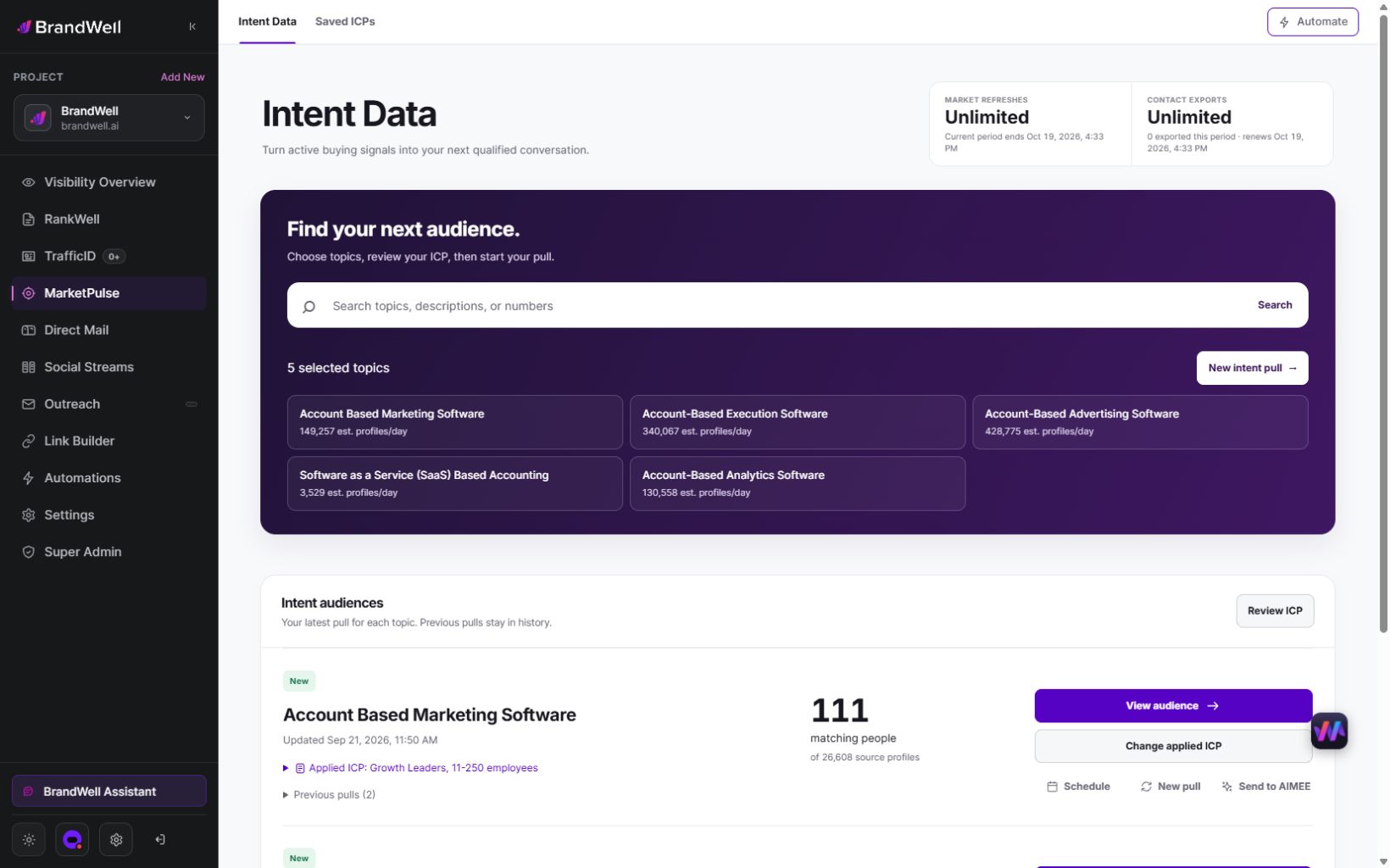
Inspect one topic and ICP and test the available output against the client decision. Agree separate tools, review work and rights before selling broader service scope. Watch the demo and review current plans.
Reviewed and updated October 3, 2026.

Written by