On this page
- The intent-data reseller economics framework
- Implementation workflow and accountable owners
- Templates and operational resources that protect margin
- Review actual scope and operating costs
- Current MarketPulse research input
- Compare reseller economics across operating models
- Pricing and total cost of ownership
- Measure ROI, pipeline, and agency payback
- Best-fit clients and reseller disqualifiers
- Make signal quality part of the economic model
- Mistakes, data-quality issues, and privacy risks
- Package the service for recurring revenue
- Frequently asked questions
- Copyable client economics worksheet
Intent-data reseller economics work when an agency sells a repeatable decision-and-activation service, not when it simply marks up access to a feed. The core equation is client recurring revenue minus directly attributable platform, data, activation, and fulfillment cost. Healthy economics then depend on capacity utilization, client retention, controlled exceptions, and proof that qualified signals reach a useful action. A large signal count with low match, fit, or activation rates can destroy margin even when the input price looks attractive.
Who this is for: Service businesses assessing separately scoped research and client delivery. Verify the actual subscription, permitted client uses, fees and implementation. All economic examples are planning methods, not agency benchmarks or BrandWell fee promises.
Current MarketPulse offer: intent-data plans start at $500/mo. See the product, demo, and current plans. Updated October 3, 2026.
The intent-data reseller economics framework
Model the service at three levels.
Platform-level economics
Start with fixed contracted platform cost, committed usage, variable overages, integrations, support, and any shared operations labor. Then calculate useful capacity utilization, not raw unit consumption:
Capacity consumption = actual consumed units / contracted capacity in the same unit and period. Separately report usable output, rejection and approved-action rates. Intent Scans, contacts and actions are different units; do not divide accepted contacts by a topic-pull allowance.
Unused capacity raises the effective cost of every client. Wastefully consumed capacity can look like high utilization while producing poor economics. Keep both utilization and rejection rates visible.
Client-level contribution margin
For each client, record:
Monthly contribution margin = client recurring revenue − allocated platform cost − client-specific usage − direct fulfillment labor − activation cost − direct support cost.
Allocation can be based on reserved capacity, actual accepted usage, or a hybrid. Document the rule so profitable clients do not invisibly subsidize custom work elsewhere. Contribution margin is not net profit; agency sales, management, overhead, taxes, and product development still exist above it.
Portfolio-level payback and retention
A reseller model becomes durable when client contribution pays back acquisition and onboarding and then persists. Track:
Simple modeled payback months = acquisition and onboarding cost / positive, assumed constant monthly delivery contribution. If contribution is zero or negative, this formula gives no finite economic payback. Track actual dated cash recovery separately and avoid counting onboarding twice.
Also track gross retention, retained recurring revenue, expansion, contraction, support burden, topic reuse, integration reuse, and concentration. A portfolio with one dominant client can have an attractive blended margin but high renewal risk.
Build low, expected, and high cases. Vary client count, usage, match rate, qualification rate, labor, churn, and overages. Do not make one forecast carry every assumption.
Implementation workflow and accountable owners
Economics should be built into the operating workflow rather than calculated after delivery:
- Define the retail promise. Specify topics or behaviors, market, ICP, output, cadence, activation, SLA, client duties, and exclusions.
- Allocate actual contracted capacity. Define the unit, period, included service work and unused capacity before launch.
- Establish acceptance rules. Define fit, identity confidence, freshness, contactability, duplicates, suppressions, and permitted-use gates.
- Measure stage yield. Record raw signals, matched entities, qualified records, accepted records, activated records, and downstream outcomes.
- Route with ownership. Assign each approved action to CRM, paid media, research, reporting, or outreach with an owner and due time.
- Log labor and exceptions. Track QA, analyst, campaign, client-success, support, and custom-integration hours separately.
- Reconcile units and invoices. Compare vendor usage, the agency capacity ledger, the client package, and overage approvals every billing period.
- Review client value and agency margin. Discuss both output quality and business outcomes; tune thresholds, topics, and package scope.
- Control expansion. Add topics, markets, modules, or activation channels through written change control rather than silent scope creep.
- Renew or exit deliberately. Evaluate coverage, adoption, downstream evidence, contribution, support burden, and strategic fit before renewal.
The offer owner controls positioning and pricing. RevOps or data operations owns fields, routing, integrations, and the usage ledger. Client success owns approvals, adoption, and expectation management. Finance owns allocation and margin reporting. A privacy or legal reviewer should examine the actual sources, jurisdictions, channels, and client contracts.
Templates and operational resources that protect margin
A reseller operating kit should contain:
- a client qualification and disqualification form;
- a topic and market coverage worksheet;
- a sample-data acceptance rubric;
- a fixed/variable cost and capacity model;
- a client contribution-margin worksheet;
- a low/expected/high usage forecast;
- a routing and approval matrix;
- a fulfillment time log and exception register;
- a branded report template and metric dictionary;
- an SLA, overage, and change-control schedule;
- a renewal and expansion scorecard;
- a privacy, security, permitted-use, retention, and deletion checklist.
Define fixed commitments, incurred variable delivery costs and shared allocation separately. Keep scoped delivery contribution distinct from company net profit and actual cash recovery.
Review actual scope and operating costs
Each option is assessed against the same seven criteria:
- Economic unit: What is actually contracted and what drives variable cost?
- Signal-to-output chain: What signal, identity, enrichment, and qualification work is included?
- Agency delivery: separately verified client access, custom branding, reporting, support and implementation.
- Activation: Which approved workflows can consume the output, and what must the agency build?
- Commercial scope: verify actual permitted client work, separate service agreements and billing responsibilities. A subscription is not proof of wholesale units, exclusive rights or a native reseller platform.
- Best-fit model: Where can the option produce the clearest contribution advantage?
- Meaningful limitation: Which missing layer, cost, or operating condition can change the decision?
Prices, product scopes, and contracts can change. Require a current comparable quote, sample, and written commercial terms before making a commitment.
Current MarketPulse research input
BrandWell publishes this guide to its own product and agency operating choices. Verify actual product scope, permitted use and custom service requirements. This is not an independent provider ranking.
Topic research and available match context
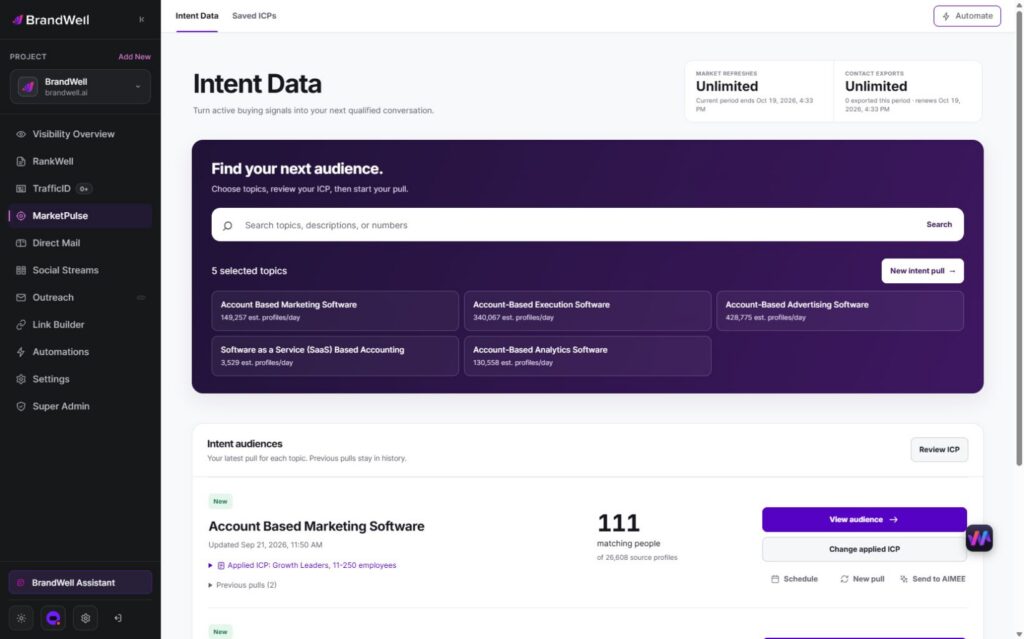
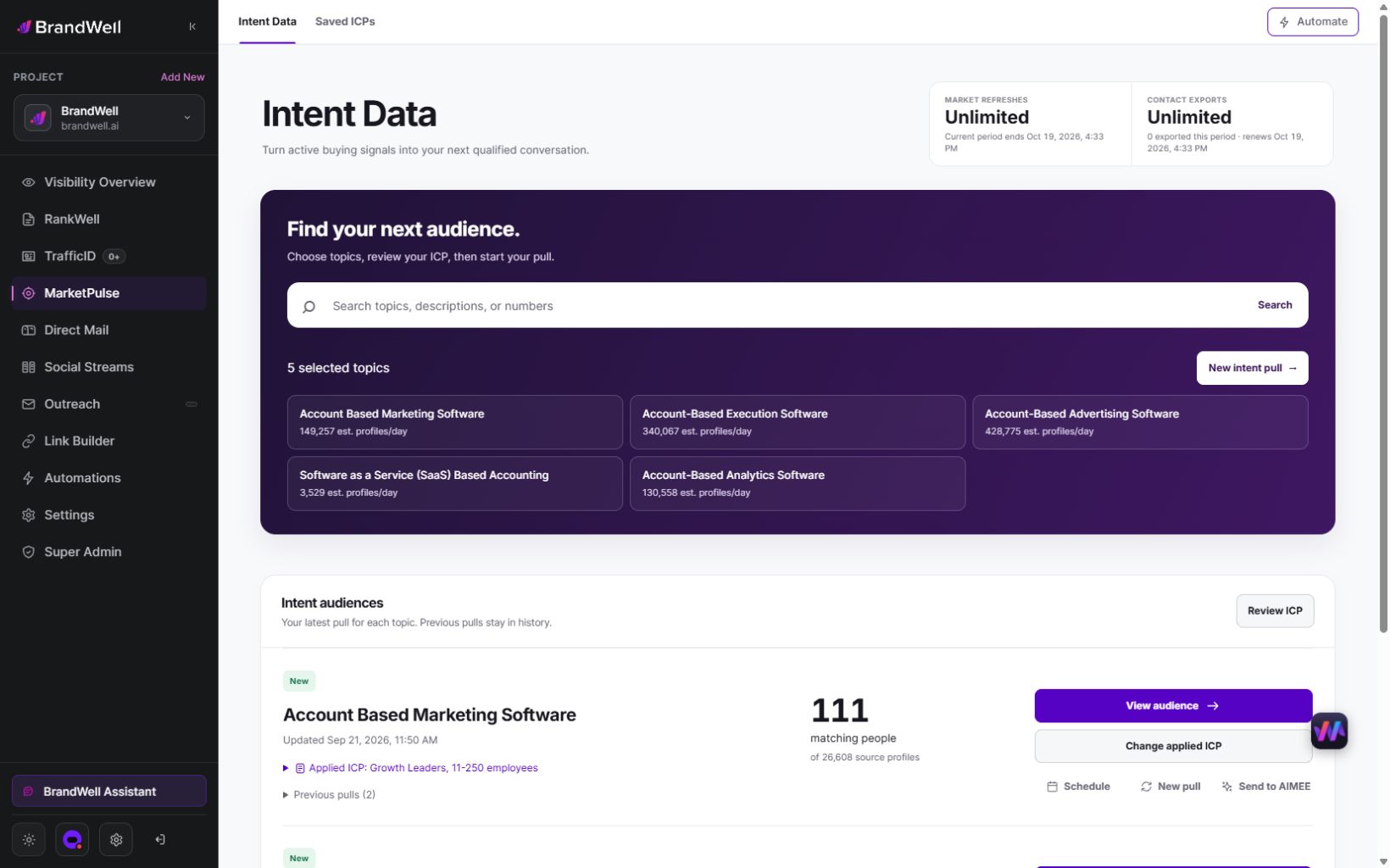
MarketPulse research is starting at $500/mo. Choose a relevant topic, apply a saved ICP and review available match details. Separately verify client-service rights, implementation, labor and delivery fees.
| Plan | Topics and refreshes | Monthly exports |
|---|---|---|
| Starter | 1 topic, weekly | 25,000 contacts |
| Growth | 3 topics, daily | 100,000 contacts |
| Scale | 10 topics, daily | Unlimited contacts |
Swipe the table to see all columns.
A pull retrieves available data from the previous 24 hours for one topic. Daily use across all included topics provides 90 Growth pulls or 300 Scale pulls in a 30-day month. Weekly Starter pulls vary by calendar month. Available audience size and contact fields vary, and audiences may overlap. Refreshes stop at the plan limit without overage charges.
- Find and qualify: search the topic catalog, save your ICP, and review the people and companies that match.
- Act on the research: export qualified contacts or prepare an Outreach or Direct Mail workflow. Connected products, channel usage, and fulfillment may cost extra.
- Get help from AIMEE: Growth and Scale include AIMEE for the initial user to research accounts and prepare the next step through connected tools.
Agencies and other service businesses can build client deliverables around their available Intent Scans and exports. Keep each client’s scope, permissions, and service fees clear. A subscription is not a promise of a white-label platform or exclusive access to a market.
Explore MarketPulse and watch the demo or compare plans starting at $500/mo. Any early-access discount is a separate, time-limited offer shown to an eligible recipient.
Compare reseller economics across operating models
| Model | Actual contracted input | Margin advantage | Main cost risk | When it fits |
|---|---|---|---|---|
| Separately implemented custom client service | Research plus actual custom delivery implementation | Possible reuse of verified templates and delivery components | Unused committed capacity | Several clients share a repeatable service |
| Intent-signal provider | Account or topic evidence | Strong specialist signal layer | Identity, portal, activation, and support are additional | Agency has mature operations |
| Data/enrichment provider | Records, identity, or attributes | Flexible unit-based assembly | Engineering and quality burden | Agency already runs a data product stack |
| Campaign or lead program | Defined campaign output | Easy client narrative and bounded work | Less recurring reuse; campaign variability | Content or media offer is primary |
| Enterprise ABM suite | Broad platform and orchestration | Deep single-client capabilities | Contract, setup, seats, adoption, and specialist labor | Large client has dedicated ABM team |
| Build in-house | Custom software and vendor inputs | Maximum control | Engineering, uptime, security, and compliance | Infrastructure itself is differentiating IP |
| Manual status quo | Analyst research and spreadsheets | Low commitment during discovery | Low consistency and poor scale | Client count and cadence are small |
Swipe the table to see all columns.
Compare the actual minimum system that can fulfill the agreed client promise, including review, custom implementation and support. A low quoted input price does not establish a profitable service.
Pricing and total cost of ownership
Separate five cost layers:
- Contracted fixed cost: platform, term, modules, tenants, users, and support.
- Variable cost: topics, signals, matches, contacts, enrichments, exports, API calls, audience destinations, and overages.
- Implementation cost: integration, configuration, templates, permissions, QA, and training.
- Fulfillment cost: analysis, campaign operations, report production, client meetings, support, and exception handling.
- Risk and overhead: acquisition, onboarding, unused capacity, churn, refunds, compliance review, management, and vendor change.
For every quote, model three utilization cases and three client-retention cases. Add alerts before actual contracted thresholds, require approval before a client exceeds its package, and prohibit “unlimited” retail promises when contracted supply or labor is finite.
A useful retail floor is:
Required client price = direct client cost ÷ (1 − target contribution-margin rate).
This is a pricing input, not the final price. The agency must also consider client value, alternatives, market position, acquisition cost, and risk. Never represent a target margin as a standard or guaranteed result.
Measure ROI, pipeline, and agency payback
Use one ledger from signal to outcome:
- raw signal observed;
- market and ICP eligible;
- company or person matched;
- enriched, deduplicated, and suppression-clear;
- accepted by the agency or client;
- activated within SLA;
- positive response or qualified meeting;
- opportunity and pipeline created;
- closed revenue or expansion recorded.
Calculate conversion and cost between stages. Leading KPIs include coverage, match rate, qualification, rejection reason, freshness, time to action, and fulfillment hours. Pipeline KPIs include meetings, opportunities, pipeline per activated record, and velocity. Economic KPIs include client contribution, useful utilization, payback, gross retention, expansion, support cost, and concentration.
Use matched baselines where practical. Signaled accounts may already be more likely to convert, and multiple campaigns often influence the same opportunity. State whether the program sourced, influenced, or merely coincided with an outcome.
Best-fit clients and reseller disqualifiers
Strong clients have a clear B2B ICP, researchable problems, enough market activity, meaningful deal value, reachable buying groups, a functioning CRM or ad account, an action owner, and a willingness to review evidence rather than demand certainty from probabilistic signals. Strong agency models include demand generation, ABM, paid media, RevOps, lead generation, and research-led strategy.
Disqualify or delay clients with undefined positioning, tiny or uncovered markets, no follow-up capacity, low economics relative to fulfillment, sensitive use cases without review, or a plan to reveal covert behavior in outreach. Also avoid clients whose custom reporting or integration requirements consume more labor than the package can support.
Make signal quality part of the economic model
Use five gates:
- Fit: Does the company, role, geography, and use case belong in the client’s market?
- Identity: Is the entity resolved with enough confidence for the chosen action?
- Freshness: Is the evidence recent enough for the sales cycle and signal class?
- Activation: Is there a permitted next step, owner, and SLA?
- Evidence: Can the action and downstream outcome be logged without overstating causality?
Record rejection at each gate. Improving match or qualification can be more profitable than buying more raw volume. Faster routing can improve usefulness, but an automated action that creates complaints, bad ad spend, or CRM damage has negative economic value.
Mistakes, data-quality issues, and privacy risks
Common reseller mistakes include pricing from a headline platform fee, ignoring unused capacity, treating raw records as deliverables, absorbing custom work, offering unlimited usage, failing to reconcile vendor and client units, and measuring blended margin while one client loses money. Commercial risk also appears when resale rights, renewal mechanics, data ownership, or topic exclusivity are described verbally but not in the order form.
Review actual source provenance, uncertain associations, stale fields, client separation, suppressions, retention and access. Research does not establish permission. Verify applicable recipient, source, purpose, channel, jurisdiction and destination rules before activation, with named approval and correction owners.
Agent-assisted delivery needs an input schema, allowed tools, logged outputs, approval boundaries, and stop conditions. BrandWell’s workflow instructions may be carried out using Claude, ChatGPT, or AIMEE, but the agency remains accountable for access, data handling, spend, messages, and client results.
Package the service for recurring revenue
A simple menu can preserve clear boundaries:
- Branded signal intelligence: topic strategy, market definition, branded report, qualification notes, and a monthly review.
- Activated intent: intelligence plus identity and enrichment, approved CRM or audience routing, action queue, and SLA.
- Managed intent growth: activation plus ongoing topic tuning, workflow QA, experiments, measurement, and executive reporting.
Each package should state topics, markets, sources, records or usage band, client count, report cadence, support, SLA, exclusions, client responsibilities, overage policy, and change control. Keep media spend, campaign management, custom research, data purchases, and one-off integration work separate unless they are intentionally included and priced.
Test whether a recurring feedback loop supports continued useful work: research informs an approved action and mature outcomes inform review rules. Track retention and reasons for changes rather than promising an improvement from the workflow alone.
Review current MarketPulse topics and plans, starting at $500/mo. Test actual fit, available fields and operating effort. Verify current guarantee conditions before testing; a short review does not establish future incremental revenue.
Frequently asked questions
How should buyers approach intent data reseller economics?
Start with the client deliverable, then model useful capacity, contribution margin by client, portfolio payback, retention, and downside cases. Do not begin with a raw-data markup.
What workflow, data, integrations, and team are required?
Define the promise, reserve capacity, apply fit and identity gates, route approved actions, log labor and outcomes, reconcile units, review margin, and control changes. Assign offer, operations, client, finance, and review ownership.
Which tools and templates are most useful?
Use a client-fit form, coverage worksheet, acceptance rubric, capacity ledger, contribution model, time log, routing matrix, branded report, SLA schedule, renewal scorecard, and governance checklist.
How do complete platforms compare with feeds, point tools, and in-house builds?
Compare actual required features and operating work for the same service promise. Custom interfaces and connectors need implementation evidence. Manual, research-only and broader client-owned workflows have different costs and dependencies; no category guarantees faster launch or higher margins.
What budget and pricing model should a buyer expect?
Budget actual fixed commitments, variable usage, implementation and fulfillment. Keep overhead, acquisition, unused contingency and incurred delivery costs distinct. Define capacity and custom-work approvals under the actual order.
How should reseller economics be tied to pipeline or revenue?
Measure stage yield from signal to match, qualification, activation, meeting, opportunity, and revenue. Use a baseline where practical and disclose attribution uncertainty alongside contribution and payback.
Which companies and clients are the best fit?
B2B clients with a defined ICP, observable research, meaningful deal economics, reachable buyers, working activation, and an accountable owner are the strongest fit.
How should economics combine with fit, identity, and freshness?
Count a unit as economically useful only when it passes fit, identity, freshness, permitted activation, and evidence gates. Report rejection reasons and cost at each transition.
What are the biggest reseller mistakes and privacy risks?
Headline-fee pricing, unused capacity, hidden labor, unlimited promises, weak resale terms, cross-client leakage, stale records, missing suppressions, and unreviewed automated actions are the main risks.
How should an agency include intent data in a recurring service?
Package branded intelligence, activated intent, or managed optimization with explicit usage, cadence, SLAs, responsibilities, measurement, and change control. The agency retains client billing and retail-price control.
Copyable client economics worksheet
Unit: [Client-month and actual capacity unit.] Fee: [Separate agency service fee.] Cost: [Incurred direct costs, allocation and exclusions.] Capacity: [Consumed units, unused units and accepted output separately.] Recovery: [Acquisition/setup once, contribution assumptions and dated cash.] Retention: [Starting cohort, losses, contraction and expansion.] Decision: [Scope, owner and next review.]
Profit and cash answer different questions
The SEC financial-statement guide distinguishes income statements from cash-flow statements. A delivery-margin estimate does not show when invoices are collected or costs paid.
Margin and markup are different percentages
A fictional service costs $1,200 in incurred delivery work. A 40% scoped contribution-margin target requires $1,200 / (1 – 0.40), or $2,000, before excluded overhead and taxes. A 40% markup instead produces a $1,680 price and a 28.6% margin. Neither target is an agency benchmark or a BrandWell price.
Positive modeled payback still needs collection evidence
A fictional $3,000 acquisition/onboarding outlay and constant $500 monthly delivery contribution produce six-month simple modeled payback. That assumes the margin persists and does not establish cash recovery. If actual contribution is negative $100 monthly, there is no finite payback under that model; a negative ratio is not a favorable recovery period.
Capacity use is not useful output
A fictional 100-pull monthly allowance consumes 80 pulls, or 80% capacity consumption. Those pulls produce 4,000 records with 1,000 approved records. The approval rate is 25% of returned records. Do not report 1,000 records / 100 pulls as 1,000% utilization or count approved contacts as completed actions.
Expansion can hide losses in the starting cohort
A fictional starting client cohort has $10,000 recurring revenue. It loses $1,000 and contracts $500, leaving $8,500 before expansion: 85% gross revenue retention. Another $2,000 expansion yields $10,500, or 105% net revenue retention, for the same cohort. Exclude new-client revenue and keep losses visible.
Review current research: explore MarketPulse and current plans.
Reviewed and updated October 3, 2026.

Written by