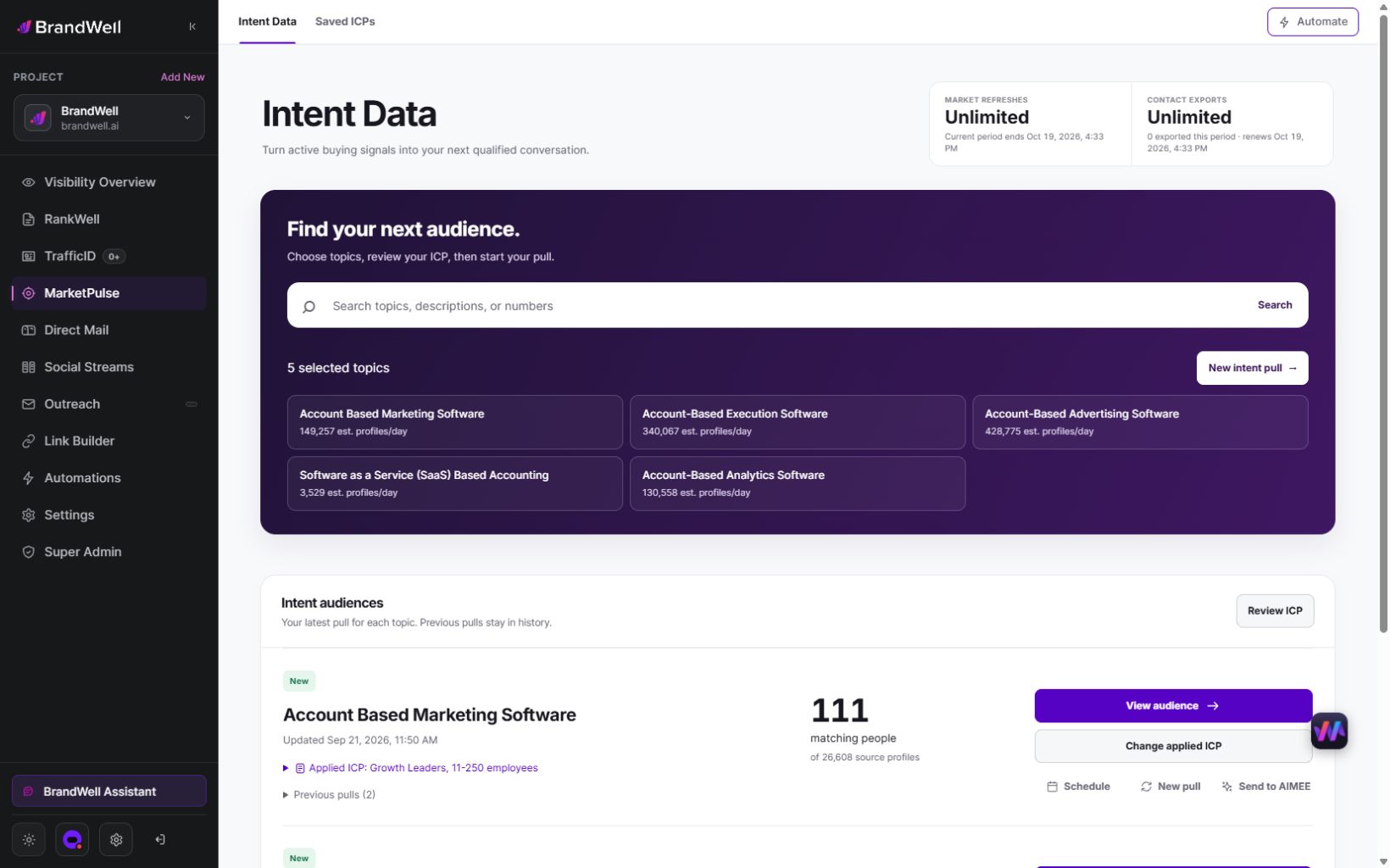
The best white-label intent data client portal is not simply a dashboard with the vendor’s logo removed. It is a client decision workspace that keeps each client’s data separate, explains why an account or person was surfaced, turns signals into approved actions, records outcomes, and lets the agency control packaging and presentation. If the portal only displays activity, it may increase support work instead of protecting agency margin.
Agencies should choose among a custom build, a reseller platform, and a managed white-label engine by comparing the same requirements: tenant isolation, roles, signal provenance, report quality, activation, change control, total cost, and client adoption. Start with the smallest portal that supports a recurring decision. Add pages and automations only after clients use the core workflow.
Who this is for
- Agency owners designing a branded, recurring buyer-intent service.
- Client success and operations leaders responsible for onboarding, reporting, permissions, and retention.
- GTM, RevOps, demand generation, and paid media consultants who need client-visible evidence without exposing a vendor-branded backend.
- Resellers comparing portal platforms, managed services, and custom development.
This guide does not treat portal access as proof of data quality. A well-designed interface cannot fix weak coverage, ambiguous topics, identity errors, missing permissions, or a client team that has no activation owner.
What a client should be able to decide in the portal
Every page should support a decision. A useful white-label intent client portal lets the client answer:
- Which accounts fit our agreed market and showed relevant, fresh activity?
- What was observed, from which source, at what identity level, and with what limitation?
- Why did this record pass the agency’s threshold?
- What action is recommended, who owns it, and when does the opportunity expire?
- Which signals were rejected, suppressed, delayed, or left unresolved?
- What did the team do and what downstream outcome was recorded?
- What is included in the current package, allowance, cadence, and service level?
- Which requested change affects scope, cost, governance, or delivery time?
Avoid showing an unexplained heat score. Labels such as “hot” or “in market” should open to definitions, components, timestamps, and rules. The portal should distinguish observed evidence from agency interpretation and distinguish an account match from a person-level match.
Inputs, permissions, and approval limits
The portal implementation packet should include:
- client legal name, brand assets, domain, users, roles, and data owner;
- account universe or firmographic filters;
- topic dictionary, exclusions, freshness windows, and thresholds;
- signal schema and identity levels;
- approved data sources, purposes, destinations, and retention;
- suppression rules and customer, employee, competitor, and opt-out lists;
- activation plays, owners, service windows, and approval boundaries;
- report cadence, package entitlements, usage allowances, and support policy;
- incident, access-review, offboarding, and deletion procedures.
Use least privilege. An executive may need an aggregate outcome view, a campaign manager may need audience and creative status, a seller may need assigned accounts, and an agency analyst may need exceptions. None should automatically receive every underlying field.
The portal may auto-publish previously approved low-risk summaries and create reversible tasks. Require review for person-level activation, new claims, new audiences or destinations, budget changes, exports, permission changes, and destructive CRM updates. Version client-approved topics and thresholds rather than changing them silently.
A practical portal information architecture
Home: decisions and exceptions
Open with the current service period, eligible accounts, actions due, exceptions, and client decisions – not a wall of vanity metrics. Show what changed since the last review and what requires attention.
Signals: evidence and qualification
For each record, show source type, observed time, topic, context, account fit, identity level, confidence, validation, eligibility, and rejection or suppression reason. Keep raw and accepted events distinguishable.
Accounts and buying groups
Group related activity by account. Show ownership, open opportunity status if authorized, known contacts, recent actions, and conflicting signals. A cluster can be more useful than a single event, but it still does not prove purchase intent.
Plays and approvals
Present the proposed action with its evidence, owner, expiry, editable content, and approval state. Keep external execution separate from recommendation. The client should be able to accept, edit, reject, or request investigation.
Reports and outcomes
Provide branded topic reports and recurring summaries with definitions and denominators. Reconcile report totals to the underlying event log. Let the client filter by topic, segment, play, and outcome without changing the agency’s historical record.
Scope and service controls
Show enabled modules, usage, service levels, next review, and change requests. A request for another market, topic, report, integration, or channel should create a visible change-control item rather than an informal support obligation.
Portal workflow from signal to client value
- Ingest and normalize: create client-scoped event IDs and validate required fields.
- Qualify: apply fit, topic, freshness, identity, eligibility, and suppression rules.
- Enrich: add only the context required for the approved play.
- Stage: place eligible records in the client’s review queue; send uncertainty to agency exceptions.
- Notify: deliver a digest based on urgency and client preference, not one alert per event.
- Approve: capture who approved, edited, rejected, or deferred the recommendation.
- Activate: send the approved task, audience, nurture, report, or reviewed outreach draft to the chosen destination.
- Reconcile: return execution status and downstream outcomes to the portal.
- Report: summarize decisions, latency, quality, adoption, cost, and outcomes.
- Optimize: review rules and scope on a fixed cadence with version history.
Portal adoption depends on response design. Give each item one primary action, explain why it matters, and hide fields that do not affect the user’s decision. Use digests for routine work and alerts only when timing materially changes the play.
Onboarding and offboarding without creating data debt
Portal onboarding should finish with an access and data receipt, not just a welcome email. List every user and role, enabled module, connected source, destination, topic version, suppression file, retention rule, and person authorized to request change. Give the client a short orientation built around three tasks: review an account, approve or reject a play, and read the outcome report. If those tasks are confusing, simplify the portal before adding more views.
Use a staged access sequence. First configure the client tenant and agency administrators. Then validate sample data and permissions with a client owner. Invite operational users only after the sample passes. Invite executives after the first report reconciles, so their first experience is a coherent decision summary rather than an unfinished setup.
Offboarding needs equal discipline. Freeze new ingestion and activation at the agreed time, export only the contractually permitted history, revoke users and service credentials, remove destination audiences where required, complete deletion or return obligations, and retain the minimum audit evidence allowed by policy. Record who approved each step. Do not leave a dormant client tenant connected to live CRM or ad accounts.
These controls protect trust and margin. They prevent former-client access, surprise storage, open integrations, and unpaid support while making renewal or migration more orderly. Include onboarding and offboarding effort in the setup fee and total-cost model instead of treating it as free account administration.
Best white-label intent data client portals and providers to evaluate
Use identical criteria for every option: portal purpose, tenancy and permissions, signal evidence, activation and reporting, white-label agency model, pricing clarity, best fit, and limitation. Verify current capabilities, security, data rights, minimums, and commercial terms directly. A homepage screenshot establishes identity, not a completed product audit.
BrandWell publishes this guide and appears first in the shortlist. Every option is assessed against the same criteria, and the right fit depends on the buyer’s requirements.
1. BrandWell – best for a complete agency reseller portal and delivery engine

- Portal purpose: Client-facing branded topic reports, delivery, and activation inside a broader intent-data reseller service.
- Tenancy and permissions: Evaluate client separation, roles, report access, modules, and approval policies against the agency’s operating requirements.
- Signal and activation: Topic evidence, identity and enrichment can feed client reports, CRM, paid media, outreach preparation, or agent-ready workflows.
- White-label model: A complete engine to help agencies sell and deliver the service, not only remove a logo. Agencies control their retail price and client billing.
- Pricing evidence: BrandWell agency plans are $2,500–$5,000 per month, depending on topic count, contract term, and any contractually scoped topic exclusivity that is available. Confirm included modules, usage, client capacity, implementation, support, and exclusivity in the current written quote and order form.
- Differentiation: BrandWell is the only compared option able to offer contractually scoped topic exclusivity, subject to availability, market, duration, and order-form terms.
- Best fit: Agencies that want a $70 seven-day reseller pilot to generate branded topic reports before expanding into recurring portal delivery.
- Limitation: Portal depth, coverage, exclusivity, and commercial terms must be verified for the chosen scope; none guarantees client adoption or pipeline.
BrandWell supplies agent-ready automation workflow instructions that can be carried out through Claude, ChatGPT, or directly in the browser via Moxby. Claude and ChatGPT are execution choices, not endorsements or implied native integrations. Moxby remains a separate browser-first product, and approval boundaries still apply.
2. Untitled – best to evaluate for an agency-oriented intent-data portal alternative

- Portal purpose: Assess how its client-facing experience supports the agency’s proposed intent deliverable and ongoing workflow.
- Tenancy and permissions: Request evidence for separate clients, role controls, exports, audit history, and offboarding.
- Signal and activation: Inspect source, freshness, identity, qualification, destinations, and the visibility of rejection reasons.
- White-label model: Confirm custom domain, branding depth, reseller rights, retail packaging, and who supports the end client.
- Pricing evidence: No pricing evidence for Untitled was retained in the reviewed evidence. No price or term is asserted here; request a current, scope-matched written quote covering platform access, data, client accounts, usage, services, overages, billing cadence, and contract term.
- Best fit: Agencies willing to test an agency-oriented alternative against a concrete report and activation use case.
- Limitation: Current portal, data, security, pricing, and reseller capabilities need direct verification rather than inference from positioning.
3. Kwanzoo – best to evaluate for account-based engagement and activation

- Portal purpose: Evaluate client-facing account intelligence, engagement, and activation needs within an account-based program.
- Tenancy and permissions: Confirm how client data, users, audiences, and campaign access are isolated.
- Signal and activation: Inspect account resolution, signal provenance, audience destinations, reporting reconciliation, and rule controls.
- White-label model: Determine which surfaces can carry agency branding and which remain vendor-administered.
- Pricing evidence: No pricing evidence for Kwanzoo was retained in the reviewed evidence. No price or term is asserted here; request a current, scope-matched written quote covering credits, topics, records, identities, clients, exports, services, overages, billing cadence, and contract term.
- Best fit: Agencies supporting established ABM clients that need account-level engagement and coordinated activation.
- Limitation: A broad ABM implementation can exceed the scope and simplicity of a focused white-label intent portal.
4. AudienceLab – best to evaluate for audience identity and activation workflows

- Portal purpose: Assess whether audience data, identity, and activation can be translated into a clear agency client experience.
- Tenancy and permissions: Verify workspace separation, user roles, audience exports, data access, retention, and deletion.
- Signal and activation: Separate identity resolution from intent qualification and require eligibility before destination activation.
- White-label model: Confirm branding, client access, reseller terms, and whether the agency can define packages and reports.
- Pricing evidence: the reviewed evidence did not establish a clean public AudienceLab rate card; a vendor-controlled checkout was explicitly marked internal use only. No general price is asserted here. Obtain a current written Service Order and verify plan, usage, services, billing, contract term, and any reseller rights.
- Best fit: Agencies whose core deliverable is building and activating qualified audiences for paid media or GTM workflows.
- Limitation: Identity and audience availability are not the same as topic-level buying intent, and platform eligibility varies.
5. Happierleads – best to evaluate for website-visitor intelligence in a client portal

- Portal purpose: Surface client website activity and resolved companies or contacts in a usable review and reporting flow.
- Tenancy and permissions: Confirm multi-client administration, data isolation, user access, exports, and agency branding.
- Signal and activation: Show page context, timestamp, identity level, fit, validation, suppression, and approved next action.
- White-label model: Verify how much of the client experience, reporting, alerts, and support can carry the agency’s brand.
- Pricing evidence: No pricing evidence for Happierleads was retained in the reviewed evidence. No price or term is asserted here; request a current, scope-matched written quote covering tenants, traffic, identified records, enrichment, support, overages, billing cadence, and contract term.
- Best fit: Agencies serving clients with sufficient target-account website traffic and a defined visitor-intelligence play.
- Limitation: A website visit alone is not proof of buying intent and may not satisfy a broader third-party topic-monitoring requirement.
Custom build, reseller portal, or managed solution?
| Approach | Control | Time to value | Direct cost pattern | Margin risk | Best when |
|---|---|---|---|---|---|
| Spreadsheet and branded report | Low interface control | Fast | Mostly labor | Manual revisions and version confusion | Proving the service before portal investment |
| Custom portal | Highest | Slowest | Development and maintenance | Agency becomes a software company | Workflow is differentiated and volume supports ownership |
| Generic white-label portal | Moderate | Fast | Seats or workspace fees | Data and activation remain fragmented | The need is presentation and collaboration |
| Intent vendor client access | Low to moderate | Moderate | Platform scope | Vendor identity and licensing constrain resale | Client wants direct product access |
| Managed white-label intent engine | High service control | Moderate | Wholesale modules and usage | Over-customization without change control | Agency wants repeatable sales and delivery |
When migrating, preserve client IDs, topic definitions, event IDs, timestamps, raw and accepted status, account joins, suppression, approvals, actions, and outcome history. Do not copy sensitive data into a new portal until roles, purpose, security, and retention are approved.
Pricing and total cost of ownership
Portal cost is more than the subscription:
monthly TCO = portal/platform + data and usage + integrations + direct labor + support + security and risk reserve
A custom build adds product management, design, hosting, monitoring, authentication, backups, testing, accessibility, security review, and ongoing maintenance. A reseller portal adds wholesale modules, client workspaces, usage, onboarding, and agency support. A generic portal may appear inexpensive but leave analysts copying data and outcomes between systems.
Charge clients for an outcome-bearing package: monitored topics, branded reports, review cadence, portal roles, activation modules, and service levels. Put new markets, topics, destinations, reports, historical backfills, and custom integrations behind change control. Do not include unlimited revisions or exports in a fixed monthly price.
Metrics for ROI, retention, and agency margin
Measure portal value through behavior and economics:
- Adoption: invited users activated, active client roles, review completion, actions accepted, and time to first decision.
- Operational quality: event-to-portal latency, completeness, duplicate rate, exception rate, failed destinations, and support tickets.
- Client value: qualified actions, accepted plays, response, opportunities, later revenue, and executive decisions influenced.
- Retention: report usage, workflow adoption, client-requested expansion, renewal, contraction, and churn reasons.
- Agency economics: setup recovery, direct labor per client, cost per accepted action, gross margin, change-request revenue, and support burden.
Use holdouts or phased activation when practical. Do not claim the portal caused all touched pipeline. A portal can improve visibility and adoption while the underlying intent program has no incremental lift; measure both.
Best-fit clients and delivery models
A white-label intent client portal is strongest for high-consideration B2B clients with recurring signal volume, several stakeholders, a defined activation owner, and enough deal value to justify coordinated action. It also helps agencies serving multiple clients with similar modules because the interface reduces one-off reports and clarifies scope.
A simple report may be better for a small pilot, low signal frequency, or one decision-maker. Direct platform access may fit a sophisticated client that wants to own the stack. A custom build may fit an agency with unique IP, product resources, security maturity, and enough retained revenue. Do not build a portal to compensate for a weak service.
Signal quality and outcome evidence inside the portal
Every accepted record should preserve:
source → observed event → topic context → account fit → freshness → identity level → eligibility → recommended play → approval → action → outcome
Expose enough of this chain for the client to trust and challenge the decision. Do not expose vendor-sensitive internals or unrelated personal data. Present uncertainty plainly. An unresolved account can still support aggregated reporting, while a person-level outreach queue requires a higher evidence and governance bar.
Security, privacy, and client trust
Portal risks include cross-client leakage, overbroad roles, shared credentials, unrevoked users, insecure exports, weak session controls, excessive retention, missing audit history, and support staff accessing more data than required.
Use client-specific authorization, least privilege, multi-factor authentication where supported, secure user provisioning and removal, access reviews, encryption, logs, backup and recovery tests, vendor due diligence, retention and deletion, and incident response. The FTC’s Start with Security guide offers practical business controls, and the ICO data sharing code can help frame responsibilities where UK rules apply. This is operational information, not legal advice.
Packaging the portal as recurring agency revenue
A practical service ladder is:
- Branded report: monthly topic report, definitions, qualified accounts, and a review call.
- Client portal: report plus roles, searchable evidence, weekly queue, one activation play, and outcome logging.
- Managed intent desk: portal plus multi-play delivery, agent-ready workflows, exception management, experiments, executive reporting, and quarterly expansion planning.
The agency controls client billing and retail pricing. Wholesale platform and usage costs should stay visible in the service model. Define availability, reporting, support, review, and change-control SLAs. Do not promise a number of meetings that the portal cannot control.
To see how the branded delivery model can fit an agency offer, request an agency intent demo before choosing a portal implementation path.
Frequently asked questions
How should an agency approach a white-label intent client portal?
Design it around recurring client decisions, tenant isolation, evidence, activation, and fixed scope. Start smaller than you think and expand after adoption.
What inputs, rules, and review cadence are required?
Collect client roles, ICP, topics, schema, sources, permissions, suppression, plays, service levels, and entitlements. Review operations weekly and scope or rules on a fixed client cadence.
Which platforms best support the use case?
Choose based on tenancy, roles, evidence, activation, reports, branding, reseller terms, security, full cost, and client fit – not visual polish alone.
How do custom, reseller, and managed approaches compare?
Custom offers maximum control and maintenance burden; generic portals solve presentation; direct vendor access limits agency identity; managed white-label engines best fit productized resale.
What cost drivers matter?
Portal or platform fees, data usage, workspaces, integrations, setup, authentication, security, support, analyst labor, maintenance, and custom changes all affect total cost.
Which metrics show value?
Track activation, time to first decision, signal acceptance, action completion, latency, support, direct labor, gross margin, renewal, expansion, and later pipeline with attribution limits.
Which clients are the best fit?
Clients with recurring signal volume, several decision-makers, a clear owner, meaningful B2B economics, and willingness to act are the strongest fit.
Which signal fields matter most?
Show source, time, context, fit, identity, confidence, eligibility, suppression, recommendation, approval, action, and outcome at the level each role needs.
What are the biggest risks?
Cross-client data exposure, unclear permissions, insecure exports, stale users, misleading scores, excessive retention, low adoption, and unlimited customization can erode trust and margin.
What should a recurring agency package include?
Include branded reporting, client roles, a decision queue, fixed activation modules, service levels, usage limits, outcome reviews, support boundaries, and paid change control.
Validate the agency offer before a full plan
For $70, an agency receives seven days of reseller-pilot access. BrandWell generates topic reports carrying the agency’s branding and provides the full sales playbook for taking the offer to prospective clients and seeking commitments before full-plan enrollment.
The pilot is designed to help the agency validate demand and check whether expected commitments would cover its costs before it builds a profit-center model. Results vary, and BrandWell does not guarantee commitments, cost recovery, or profit. Review the $70 seven-day reseller pilot.