The best intent data tools for SDR teams improve prioritization and context, not just list size. A useful system shows why an account or person deserves attention now, confirms that the record fits the ICP, routes it to the right owner, supplies a bounded outreach play, and records whether the signal became a useful conversation or qualified opportunity.

The practical rule is fit first, intent second, identity third, action fourth. A recent topic signal from the wrong company is noise. A perfect-fit company with no timing evidence can stay in a normal prospecting queue. A fit account with fresh, explainable research evidence can enter a faster, more relevant play – but the signal still does not prove consent, purchase intent, or a future deal.

Who this is for

This guide is for B2B sales leaders, SDR managers, RevOps teams, and outsourced SDR agencies that need a repeatable way to prioritize accounts without turning every behavioral record into an aggressive pitch. It is most useful when the team has defined ICP rules, clean ownership in CRM, measurable opportunity stages, and enough coaching capacity to change rep behavior.

The intent-to-conversation operating model

Intent data for SDR teams works only when it changes a decision. The system should help a rep answer:

  • Which account should I work before another account?
  • Which buying problem or category appears relevant?
  • Which role belongs in the buying group?
  • What context can I use without sounding invasive?
  • Which channel and cadence are permitted?
  • When should I stop, suppress, recycle, or escalate?
  • Did the action improve meetings and qualified pipeline?

A strong intent data for SDR teams framework has five layers:

  1. Fit: industry, size, geography, technology, business model, role, account tier, and exclusions.
  2. Signal: source class, observed behavior, topic, frequency, recency, baseline, and confidence.
  3. Identity: account, buying group, or person resolution, including validation and ambiguity.
  4. Activation: owner, SLA, message angle, channel, approval, suppression, and disposition.
  5. Evidence: accepted record, activity, reply, meeting, opportunity, stage, revenue, and false-positive feedback.

If the vendor supplies only the signal, RevOps must build the other four layers. If the vendor supplies a full workflow, the team still needs to inspect how each decision is made.

How we compared the tools

Every company is evaluated against the same seven criteria:

  • signal meaning, source, freshness, and relevance;
  • account/person identity and contact readiness;
  • CRM routing, rep workflow, integrations, and feedback;
  • team and agency operating model;
  • measurement from accepted signal to qualified pipeline;
  • pricing, implementation, and total cost;
  • privacy, permitted use, best-fit scenario, and meaningful limitation.

The shortlist is not a claim that the tools are interchangeable. Some are enterprise revenue platforms, some center on contact data, and some are upstream topic-signal providers. The best option is the one that supplies the missing layer without forcing the team to buy an operating model it will not use.

Five intent data tools for SDR teams

BrandWell publishes this guide and appears first in the shortlist. Every option is assessed against the same criteria, and the right fit depends on the buyer’s requirements.

1. BrandWell – best for agencies and teams building a signal-to-action service

Brandwell 1200X680.Jpg homepage hero
BrandWell homepage hero. Brand names and site imagery belong to their respective owners.

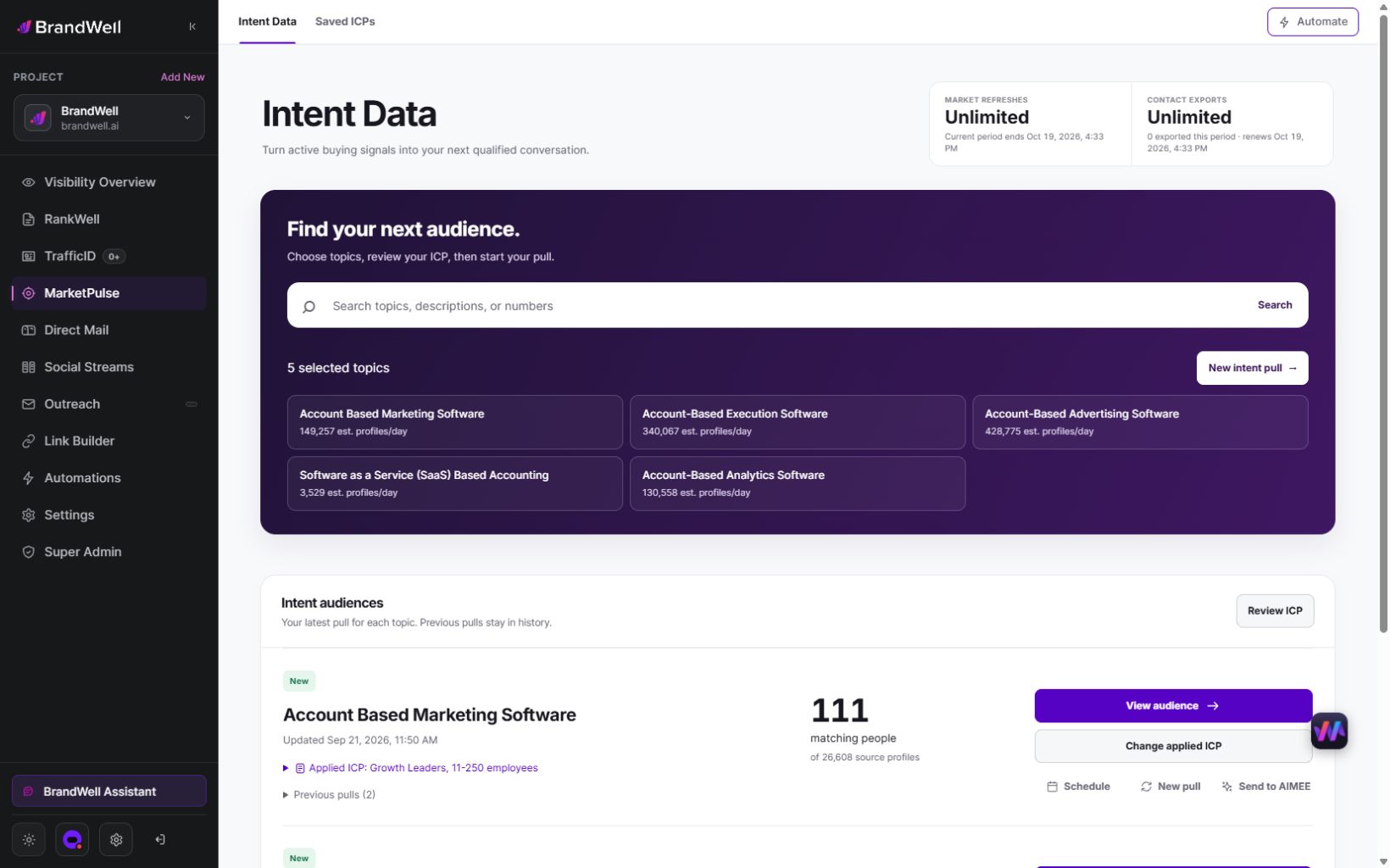
Signal and identity. BrandWell starts with off-site commercial topic research and can combine it with TrafficID and form activity. Topics can represent problems, categories, competitors, vendors, and implementation paths. Records can be enriched and qualified into person- or company-level outputs where coverage and permitted use support it. The team should still test market coverage, identity confidence, contact validation, and recency.

Workflow and agency model. BrandWell is designed as a complete white-label agency sales-and-delivery engine. A reseller can define client topics and qualification, generate branded topic reports, route opportunities, package an SDR activation service, and set retail pricing. A $70 seven-day reseller pilot can generate branded topic reports so an agency and client can inspect relevance before a larger deployment. The pilot is evidence of coverage and workflow fit, not a guarantee of meetings or pipeline.

BrandWell can provide agent-ready workflow instructions for use with Claude or ChatGPT, or direct browser execution through Moxby. Those instructions can help prepare research, summaries, CRM tasks, QA steps, or approved outreach actions. Claude and ChatGPT are execution choices, not endorsements or implied native integrations; Moxby is a separate browser-first product. Keep human approval for contact selection, sensitive inferences, public communication, and exceptions.

BrandWell agency plans are $2,500–$5,000 per month, depending on topic count, contract term, and any contractually scoped topic exclusivity that is available. Confirm included modules, usage, client capacity, implementation, support, and exclusivity in the current written quote and order form.

BrandWell is the only compared option that can offer contractually scoped topic exclusivity, subject to topic and market availability and the signed order form. That can help a reseller differentiate an offer, but it does not make the signal accurate by default or establish future revenue.

Measurement and limitation. Best for an agency or lean revenue team that wants a branded signal-to-SDR operating model rather than another isolated feed. The limitation is client-specific proof: usable coverage, rep adoption, opportunity lift, exclusivity, and economics require a controlled rollout. Enterprise teams needing a broad, client-owned ABM suite may prefer another option.

Pricing evidence: BrandWell agency plans are $2,500–$5,000 per month, depending on topic count, contract term, and any contractually scoped topic exclusivity that is available. Confirm included modules, usage, client capacity, implementation, support, and exclusivity in the current written quote and order form.

2. ZoomInfo – best for contact data and sales workflow in one established stack

Zoominfo 1200X680.Png homepage hero
ZoomInfo homepage hero. Brand names and site imagery belong to their respective owners.

Signal and identity. ZoomInfo combines a large business-data environment with intent and sales workflow products. That can reduce the handoff between identifying an account, finding contacts, and placing work in a rep queue. Buyers should verify which intent source is included, the topic taxonomy, time window, account/person distinction, validation method, and geography.

Workflow and operating model. It can fit an internal sales organization that wants prospecting, enrichment, intent, and engagement capabilities under one vendor relationship. An outsourced agency should confirm client workspaces, permissions, data licensing, export and service rights, suppression, and offboarding rather than assuming its subscription can be reused across clients.

Pricing evidence: ZoomInfo pricing varies by functionality, users, data, credits, and add-ons. A Vendr snapshot reviewed for this guide reported a $33,500 annual median across 1,564 purchases; treat it as a procurement benchmark, not a list price. ZoomInfo’s reviewed Form 10-K says contracts generally run one to three years, so verify scope, billing, and term in writing.

Governance, fit, and limitation. Best for a team already standardizing on ZoomInfo for contact data and sales intelligence. The limitation is commercial and operational breadth: it may cost more and require more governance than a team that only needs a narrow topic-prioritization layer.

3. 6sense – best for enterprise account prioritization across marketing and sales

6Sense 1200X680.Png homepage hero
6sense homepage hero. Brand names and site imagery belong to their respective owners.

Signal and identity. 6sense is positioned around account identification, intent, predictive stages, orchestration, and revenue workflows. It can give SDRs a shared account view with marketing, provided the team understands which fields are observations and which are model outputs.

Workflow and operating model. The platform fits organizations with mature account ownership, marketing operations, RevOps, and SDR management. Ask for the exact CRM objects, routing rules, refresh timing, explanation available to reps, feedback capture, and alerts. A score that cannot be explained is hard to coach and easy to misuse.

Pricing evidence: 6sense uses custom pricing. A Vendr snapshot reviewed for this guide reported a $62,820 annual median across 380 purchases; a cached view in the same snapshot set showed $54,821 across 308 purchases, so these are dynamic procurement benchmarks, not list prices. Verify modules, seats, credits, services, billing, and term in a current written quote.

Governance, fit, and limitation. Best for an enterprise revenue organization coordinating account-based marketing and sales. The limitation is implementation weight: a smaller SDR team may not have the data, process maturity, or administrators needed to realize the platform’s breadth.

4. Demandbase – best for sales intelligence connected to enterprise ABM

Demandbase 1200X680.Jpg homepage hero
Demandbase homepage hero. Brand names and site imagery belong to their respective owners.

Signal and identity. Demandbase brings account intelligence, intent, advertising, and sales use cases into an enterprise ABM context. That can help SDRs understand account engagement beyond a single form fill. Teams should separate first-party engagement, third-party research, account fit, and modeled stages.

Workflow and operating model. It is strongest when marketing, sales, and operations share a named-account strategy. Inspect CRM embedding, alerts, account ownership, buying-group support, recommended actions, rep disposition, and manager views. Make sure the SDR is not expected to interpret a dense dashboard for every call.

Pricing evidence: Demandbase uses custom pricing. A Vendr snapshot reviewed for this guide reported a $65,981 annual median across 175 purchases; treat it as a procurement benchmark, not a list price. Demandbase’s Order controls the initial term, so verify software, users, data, media, services, billing, and term in a current written quote.

Governance, fit, and limitation. Best for a larger account-based team wanting sales activity tied to the wider ABM program. The limitation is repeatability for an outsourced provider: a client-owned enterprise deployment may not translate into one standardized agency service.

5. Bombora – best for adding topic-level account research to an existing SDR stack

Bombora 1200X680.Jpg homepage hero
Bombora homepage hero. Brand names and site imagery belong to their respective owners.

Signal and identity. Bombora is known for Company Surge topic signals from a B2B publisher cooperative. It can help an SDR organization see which accounts appear to be increasing research around selected topics. It does not turn that account signal into a verified individual automatically.

Workflow and operating model. Bombora commonly feeds another sales intelligence, ABM, CRM, or data system. RevOps must define account matching, contact selection, owner routing, recency, suppression, messaging, and feedback. The flexibility is valuable for teams with an established stack and data owner.

Pricing evidence: Bombora does not publish a general dollar list price. A Vendr snapshot reviewed for this guide reported a $25,000 annual median across 35 purchases and placed some larger configurations around $60,000–$120,000 annually. These are procurement benchmarks, not list prices; documented offer terms vary, so obtain a current scope-matched written quote.

Governance, fit, and limitation. Best for data-capable teams that need topic research as an upstream account-prioritization input. The limitation is assembly: identity, contact readiness, activation, white-label reporting, and coaching remain separate responsibilities.

Intent-prioritized SDR work vs unprioritized activity

More activity is not automatically a better alternative. Compare operating models:

ModelWhat enters the queueBest whenMain risk
Unprioritized volumeLarge contact list and generic cadenceNew team testing a broad market cheaplyRep time spreads across low-fit and mistimed accounts
Fit-only prioritizationICP and account tierStable market with limited signal coverageMisses timing and recent context
Intent-only prioritizationBehavioral or topic scoreRarely appropriate aloneNoise, false positives, and poor-fit accounts
Fit plus fresh intentICP plus explainable recent evidenceValuable B2B deals and disciplined operationsSmaller queues and higher data/governance burden
Human-nominated accountsRep or manager judgmentStrategic territories and relationship sellingInconsistent criteria and weak scalability

The useful alternative is not “intent or manual.” Keep a fit-only control and let reps nominate strategic accounts. Intent should improve the queue, not replace sales judgment.

Intent data for SDR teams implementation guide

1. Define an accepted signal

Write an acceptance rule using source, topic, account fit, identity level, observed time, confidence, and exclusion status. Examples:

  • a target account shows a recent increase around a high-value category;
  • multiple people from a target account engage with first-party evaluation content;
  • an identified visitor from an eligible region returns to a pricing or comparison page;
  • a relevant business event combines with active category research.

Do not merge these into one opaque score until operators can inspect the ingredients.

2. Create three service levels

Use a small number of tiers:

  • Priority: strong fit, fresh evidence, clear account owner, approved action within a short SLA.
  • Watch: fit is strong but evidence is weak, old, or account-level only; add research or light nurture.
  • Recycle: insufficient fit, identity, permission, or timing; do not force into a sequence.

This prevents a signal from becoming an automatic email.

3. Resolve the buying group

At account level, choose roles from the likely buying committee instead of grabbing the first available contact. Validate employment, function, seniority, geography, contactability, and existing relationships. Record why each person was selected separately from why the account qualified.

4. Route and set the SLA

CRM should store the signal source, observed time, topic, confidence, account tier, owner, due time, approved play, and disposition. Define what happens to duplicates, unowned accounts, open opportunities, customers, partners, and restricted territories.

5. Give the rep context without surveillance language

Translate a signal into a problem hypothesis:

“This account fits our market and has recent category-level activity. Review the account and lead with the operational problem, not a claim that we watched an individual.”

Useful context includes public business facts, role relevance, existing relationship, and the problem associated with the topic. Avoid asserting that a named person did something when the signal is account-level or probabilistic.

6. Run an appropriate sequence

Use shorter, more relevant touches, not a higher volume blast. A priority play might combine a researched email, a call, a permitted social touch, and a helpful resource. Stop when the record opts out, changes role, becomes an opportunity under another owner, or shows clear non-fit.

7. Capture dispositions

Require a small, usable taxonomy: accepted, wrong account, wrong person, stale, irrelevant topic, duplicate, customer, restricted, no response, useful conversation, meeting, opportunity. Make corrections flow back into topics, fit, identity, and routing.

8. Review cohorts, not anecdotes

Compare fit-plus-intent accounts with fit-only accounts of similar tier. Hold message quality and time window as constant as possible. One big opportunity is not proof that the signal caused it.

A practical SDR template

Use this record before assigning work:

  • Account and tier: target account, ICP reason, owner.
  • Signal: source class, topic, observed time, frequency or change, confidence.
  • Identity: account/person level, selected role, validation status.
  • Context: public fact, existing relationship, likely problem.
  • Permitted action: channel, approved message frame, SLA, suppression checks.
  • Evidence: disposition, reply quality, meeting, opportunity, stage, value.
  • Exception: wrong match, stale signal, sensitive inference, missing permission, routing failure.

For a first message, use the signal internally and keep the copy grounded:

“Teams in your category often hit [specific operational problem] when [relevant situation]. We put together [useful resource or approach]. Is that a current priority, or should I close the loop?”

That is an example, not a universal template. The opening should reflect real account research and the sender’s actual offer.

Pricing and total cost

Intent data for SDR teams cost includes more than the license:

monthly TCO = data/platform + identity/enrichment + CRM/integrations + engagement tools + operations labor + enablement + governance + overages

Also count implementation: taxonomy design, field mapping, routing, suppression, dashboards, training, legal and security review, and a controlled pilot.

Pricing models may use seats, records, credits, topics, accounts, modules, clients, API calls, or a custom enterprise package. Normalize all of them to the same expected account volume, contact depth, refresh, destinations, and support. An outsourced SDR agency must also model client success, copy QA, deliverability, reporting, and renewal labor.

KPIs, ROI, and benchmarks

Track leading quality indicators before revenue:

  • percent of records accepted by the SDR team;
  • false-positive, stale, duplicate, and wrong-person rates;
  • time from observed signal to reviewed action;
  • percent receiving the intended play within SLA;
  • reply quality and useful-conversation rate;
  • meeting held rate, not only meeting booked;
  • meeting-to-qualified-opportunity conversion;
  • opportunity stage progression and win rate;
  • sourced versus influenced pipeline;
  • incremental gross profit and total program cost.

Use internal benchmarks from fit-only accounts, prior periods, or matched cohorts. Do not adopt a vendor’s best case as the team’s forecast.

ROI = (incremental gross profit − total program cost) ÷ total program cost

For an agency, add client gross margin, retention, and expansion. If reps ignore the queue, adoption is a primary failure metric – not a reason to keep buying more data.

Best-fit companies and common mistakes

Strong fits include B2B companies with meaningful contract value, a defined market, identifiable buying groups, sufficient signal coverage, disciplined CRM use, and a sales cycle long enough for prioritization to matter. Poor fits include very small local markets, low-value commodity transactions, teams with no ownership rules, and organizations unwilling to document data use.

The biggest intent data for SDR teams mistakes are:

  • treating an account signal as proof about a named person;
  • sending every signal straight into an automated cadence;
  • ignoring customer, opportunity, partner, and opt-out suppressions;
  • selecting contacts by availability rather than buying-role relevance;
  • hiding source, recency, or confidence from reps;
  • rewarding activity instead of qualified progression;
  • allowing duplicate providers to create duplicate outreach;
  • failing to remove stale records;
  • skipping regional channel and privacy review;
  • measuring only meetings booked.

For calls, review the FTC’s Telemarketing Sales Rule guidance and applicable state, national, and industry rules. For B2B lead collection and outreach, the UK’s regulator provides guidance on how to collect information and generate leads. These sources do not replace counsel for the specific market and channel.

How an agency can package the service

Sell prioritized pipeline operations, not “unlimited intent leads.” A recurring package can include:

  1. ICP and topic governance;
  2. signal QA and weekly opportunity feed;
  3. buying-group enrichment;
  4. CRM routing and SLA monitoring;
  5. approved playbooks and rep briefs;
  6. suppression and exception management;
  7. coaching and monthly cohort analysis;
  8. client-facing evidence and renewal planning.

BrandWell’s white-label delivery engine, $70 seven-day branded-report pilot, possible topic exclusivity, and portable agent-ready workflows can help an outsourced SDR agency launch that service. The agency remains accountable for permitted use, messaging, deliverability, rep conduct, and outcome claims.

Request a BrandWell agency intent demo or start with a branded topic report. Related guides cover the buyer-intent reseller compliance checklist and proving intent-data ROI.

Frequently asked questions

What is the best intent data tool for an SDR team?

It depends on the missing layer. BrandWell fits a white-label signal-to-action service; ZoomInfo fits contact data plus sales workflow; 6sense and Demandbase fit enterprise ABM; Bombora fits a team that needs upstream topic signals. Run each against the same accounts and acceptance criteria.

Should intent automatically trigger outreach?

No. Apply fit, identity, freshness, permissions, suppressions, ownership, and a human or policy-based approval step. Some high-confidence cases can be automated after controlled validation, but exceptions need a queue and owner.

How much should an SDR team budget?

Budget for data, identity, CRM and engagement integrations, operations, coaching, governance, and measurement – not just the subscription. Compare total cost per accepted opportunity and incremental gross profit.

What should SDR managers inspect every week?

Inspect accepted-signal rate, age, duplicates, wrong matches, SLA adherence, rep adoption, reply quality, meetings held, qualified opportunities, and exception causes.

Can an agency resell intent data as an SDR service?

Yes, if its vendor agreement permits the model and the agency supplies real delivery: qualification, routing, playbooks, governance, QA, and outcome reporting. Raw records alone are a fragile service.

Check the economics before a full plan

For a $70 pilot fee, agencies get seven days to validate the reseller offer. BrandWell supplies agency-branded topic reports and the complete sales playbook for presenting the service and seeking client commitments before any full-plan enrollment.

The agency can use the pilot evidence to assess demand, compare expected commitments against costs, and decide whether the service can become a profit center. Commercial and financial outcomes are not guaranteed. Review the $70 seven-day reseller pilot.