On this page
- The short answer: make the pitch a working session, not a capability deck
- A seven-part buyer-intent pitch that earns the next step
- Criteria for evaluating a platform for the pitch
- Demonstrate current MarketPulse research
- Generic deck, live demo, or pilot: when each format wins
- Model the economics without turning a forecast into a claim
- Risks and objections to answer before procurement does
- Turn the pitch into a recurring service
- Frequently asked questions
- Copyable pitch evidence card
The strongest way to demonstrate buyer intent data in an agency sales pitch is to show one believable signal moving through a complete operating chain: research activity, fit check, identity or account match, approved action, and a measurable business outcome. Do not begin with a taxonomy count or a feature tour. Begin with the prospect’s market, use a sample report or a small pilot to expose what the agency would actually do, and separate observed evidence from projected value.
For agencies, demonstrating buyer intent data in an agency pitch works best when the buyer can inspect the evidence chain, assumptions, action owner, and measurement plan instead of accepting a performance promise.
Who this is for. This guide is for agency owners, new-business teams, partnership leads, account executives, and GTM consultants selling a recurring intent-data service. It is especially useful when a prospect has asked for a proposal, demo, pilot, or proof that intent data will become action rather than another dashboard.
Current MarketPulse offer: intent-data plans start at $500/mo. See the product, demo, and current plans. Updated October 3, 2026.
The short answer: make the pitch a working session, not a capability deck
A credible pitch should answer five questions in order:
- Who are we trying to find? Define the client’s market, ideal accounts, roles, exclusions, geography, and sensitive categories.
- What behavior is relevant? Show a small set of buying topics and explain what is included, adjacent, and excluded.
- How does a signal become usable? Demonstrate freshness, company or person resolution where available, fit filters, contactability, and suppression.
- What happens next? Route the record to a named owner and an approved play – research, an ad audience, CRM task, or human-reviewed outreach.
- How will both sides judge it? Agree on coverage, usable-signal yield, response time, accepted opportunities, pipeline influence, and attribution limits.
This structure changes the conversation from “Do you have intent data?” to “Can our team operate this signal responsibly and learn whether it creates value?” That is a decision a buyer can make.
The FTC substantiation policy requires prior support for objective express and implied advertising claims. Keep demonstration observations separate from forecasts.
A seven-part buyer-intent pitch that earns the next step
1. Open with the missed-decision problem
Use the prospect’s status quo, not a generic statistic. For example: the client may target accounts by firmographics, wait for a form fill, or ask SDRs to work a broad list. The problem is not “no data.” It is that the team does not know which otherwise-qualified accounts deserve attention now.
State the desired change plainly: add a recent research signal to the existing fit model, then route only the records that pass agreed checks. Avoid saying that the signal proves a purchase decision.
2. Define a narrow market and topic hypothesis
Bring three to ten example topics tied to the client’s offer. For each, show the preferred label, synonyms, exclusions, and the role it plays in the buying journey. A broad category may create volume; a problem or competitor-related topic may create more specific context. The client should be able to challenge the list during the meeting.
Demonstrate the actual available topic, saved ICP and match context in the current portal. Custom client interfaces, branded reports, connectors and agency delivery require separately verified implementation, rights, scope and fees.
3. Walk through one sample signal
Use a redacted or authorized example. Show:
- the topic and time window;
- the account or person match, if available;
- firmographic and role fit;
- confidence or completeness limitations;
- suppression and eligibility checks;
- the action that would be created; and
- the evidence written back to the CRM or report.
Do not reveal a person’s sensitive browsing history in outreach. The signal should prioritize research; it should not become a creepy message such as “we saw you reading about this.”
4. Show the branded client experience
A sample report should help the buyer make decisions. Include qualified signals, reasons for inclusion, freshness, recommended action, owner, status, and outcome. Exclude vanity totals that cannot be reconciled with the activation workflow.
Review current MarketPulse topics and plans, starting at $500/mo. Test actual ICP fit, available fields and operating effort. Verify current guarantee conditions before testing; a short review does not establish future pipeline or revenue.
5. Demonstrate the handoff, including approvals
Show the exact next step after a record qualifies. A good demo can create a CRM task, prepare a research brief, build an audience specification, or draft a message for human approval. State who can approve spend, external communication, exports, and irreversible changes.
AIMEE can organize supplied context through configured tools. Named owners approve actual exports, messages and destination writes. Confirm implemented permissions and acknowledgements; a draft instruction is not execution proof.
6. Define the pilot scorecard before discussing upside
Use leading, operating, pipeline, and revenue measures separately:
- topic coverage and signal volume;
- matchability and usable-record rate;
- ICP qualification rate;
- time from signal to owner;
- owner acceptance and action rate;
- positive replies or qualified meetings;
- opportunities and influenced pipeline; and
- closed revenue, with the attribution method disclosed.
Predefine the baseline, comparator, cohort, outcome window and limitations. Preserve missing outcomes. A campaign or pipeline association is not proof of incremental impact.
7. Ask for a bounded decision
Ask for a bounded next decision: actual market, available topic, review workflow, evaluation period, owners and success criteria. Separately scope and price an agency research review or implementation test. Do not describe a proposed agency pilot as an included standard MarketPulse program.
Criteria for evaluating a platform for the pitch
Use the same criteria for every option:
- Pitch evidence: Can the agency show a sample signal, method, and decision-ready report?
- Signal-to-action chain: Does the option connect topics, identity or account context, qualification, routing, and activation?
- Agency scope: verify separate custom branding, client access, implementation, delivery rights and actual service fees.
- Pilotability: Can the buyer validate coverage and workflow before a broad rollout?
- Measurement: Can the team record outcomes and limitations rather than reporting raw feed volume?
- Implementation burden: What data, integrations, operations, and change management are required?
- Best fit and limitation: Which buyer benefits most, and what constraint could make another option better?
BrandWell publishes this guide about its own product and agency delivery choices. Verify current scope, rights and implementation for the actual use case; this is not an independent provider ranking.
Demonstrate current MarketPulse research
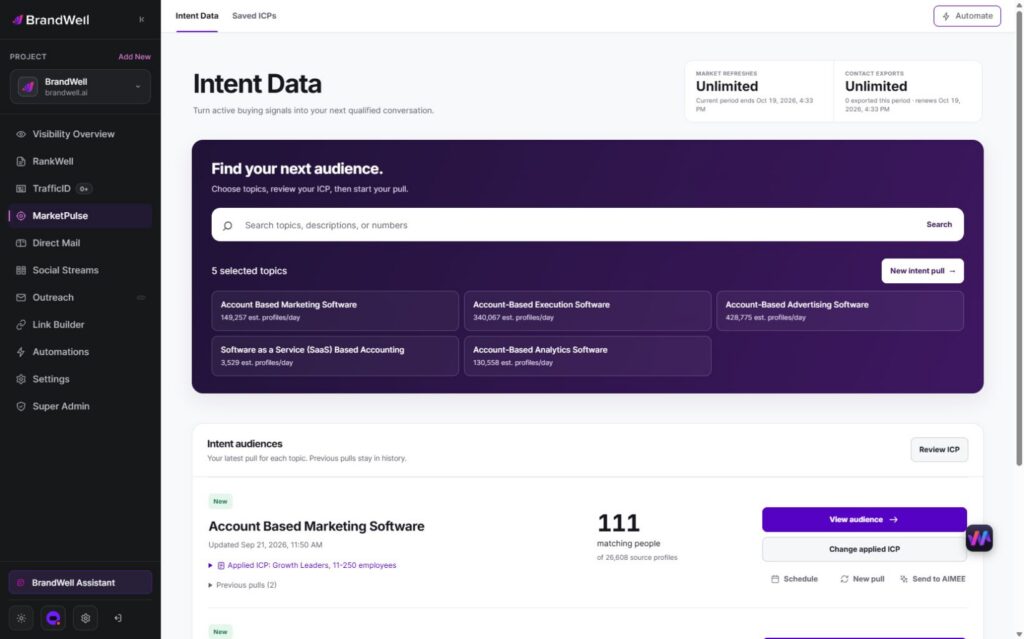
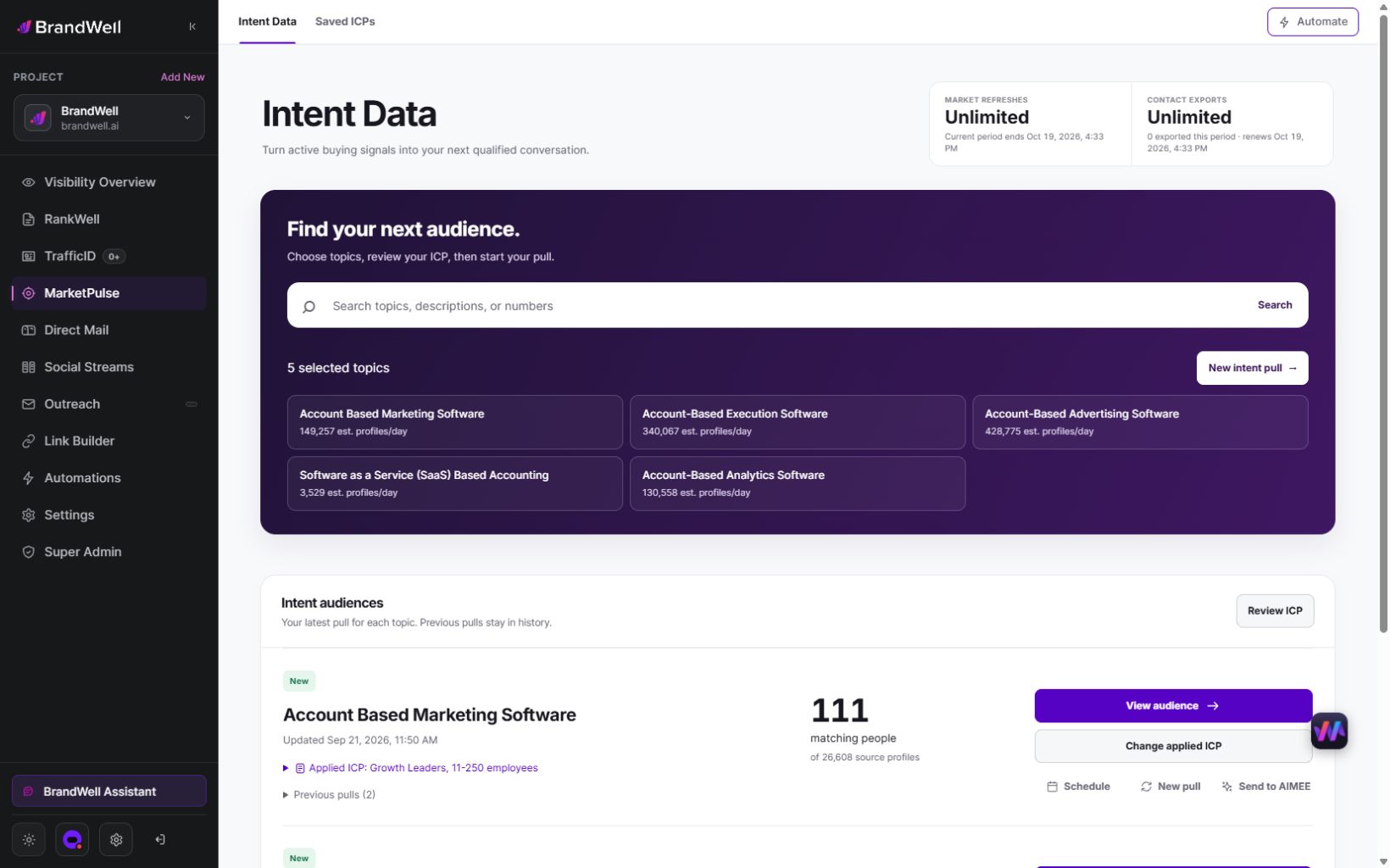
Current topic and ICP workspace
MarketPulse research is starting at $500/mo. Choose an available topic, apply a saved ICP and review matching people, companies and contact fields before preparing an approved next action.
| Plan | Topics and refreshes | Monthly exports |
|---|---|---|
| Starter | 1 topic, weekly | 25,000 contacts |
| Growth | 3 topics, daily | 100,000 contacts |
| Scale | 10 topics, daily | Unlimited contacts |
Swipe the table to see all columns.
A pull retrieves available data from the previous 24 hours for one topic. Daily use across all included topics provides 90 Growth pulls or 300 Scale pulls in a 30-day month. Weekly Starter pulls vary by calendar month. Available audience size and contact fields vary, and audiences may overlap. Refreshes stop at the plan limit without overage charges.
- Find and qualify: search the topic catalog, save your ICP, and review the people and companies that match.
- Act on the research: export qualified contacts or prepare an Outreach or Direct Mail workflow. Connected products, channel usage, and fulfillment may cost extra.
- Get help from AIMEE: Growth and Scale include AIMEE for the initial user to research accounts and prepare the next step through connected tools.
Agencies and other service businesses can build client deliverables around their available Intent Scans and exports. Keep each client’s scope, permissions, and service fees clear. A subscription is not a promise of a white-label platform or exclusive access to a market.
Explore MarketPulse and watch the demo or compare plans starting at $500/mo. Any early-access discount is a separate, time-limited offer shown to an eligible recipient.
Generic deck, live demo, or pilot: when each format wins
A generic capability deck is useful at the first discovery stage when the prospect is still defining the problem. Keep it short and use it to earn permission to configure a relevant example. It is weak when the buyer asks how the service would work for its market.
Use a live demo to inspect the actual research, fields and proposed workflow. It can reveal gaps and useful operating steps. A successful sample does not establish representative coverage, correct identity for all records or sales impact.
A report pilot is useful when coverage and fit are the main unknowns. It creates evidence for a proposal and gives both parties a bounded learning objective. It is weak when success criteria are invented after results appear.
A paid implementation sprint is appropriate when the data source is already selected but routing, CRM, security, or team ownership remains unresolved. Do not force every buyer into the same format.
Model the economics without turning a forecast into a claim
Build three scenarios – conservative, expected, and upside – with the same transparent inputs:
- monthly platform and module allocation;
- direct analyst, reporting, and client-success hours;
- integration or campaign costs;
- usable signals after fit and match checks;
- accepted actions and qualified outcomes;
- average gross profit from an acquired client, if the prospect supplies it; and
- evaluation window and attribution assumptions.
The pitch should emphasize break-even conditions, not a dramatic revenue multiple. Ask: how many qualified outcomes must the service create or influence to cover its incremental cost? Then show how a change in match rate, activation rate, or sales conversion changes the model. Label the output as a planning scenario.
Risks and objections to answer before procurement does
“Isn’t intent just a guess?” It is a prioritization signal, not certainty. Combine it with ICP fit, freshness, identity confidence, and downstream action.
“Will prospects find this creepy?” They might if outreach reveals surveillance-like detail. Use the signal internally and lead with a legitimate business reason. Review privacy, permitted use, notices, and channel rules.
“Can you promise a pipeline result?” No. The agency can commit to a defined process, reporting cadence, and evidence trail – not buyer behavior.
“Why not use our existing data?” Use it. First-party engagement and CRM history can be strong. Off-site topic intent is most useful when it adds earlier evidence not present in the current stack.
Ask how the agency selected the example, what it excluded, what is still unknown and which current features were actually demonstrated. Verify the same scope and outcome definitions before comparing approaches.
Keep dated evidence and approvals for the exact claims used. A compelling demonstration does not establish typical results or future returns.
Turn the pitch into a recurring service
A sustainable offer is not “a list of people researching a topic.” It is a monthly operating loop:
- review market, topics, and exclusions;
- receive and normalize signals;
- apply fit, identity, freshness, and suppression checks;
- route only qualified items;
- execute an approved play;
- capture outcomes and failure reasons;
- issue a branded decision report; and
- revise one rule at a time.
Define actual research scope, client work, review capacity, channels, reports, responsibilities and change control. Agency billing and custom delivery are separate agreements and implementation work; confirm the actual product entitlements.
Offer an authorized or redacted research example with its sampling method, limitations and separately scoped review work. Do not imply an included branded report service or guaranteed outcome.
Frequently asked questions
How should an agency demonstrate buyer intent data in a pitch?
Show a real or properly redacted signal moving from topic activity through fit, identity, routing, an approved action, and a recorded outcome. Start with the client’s market and end with a bounded pilot decision.
What people, process, systems, and cadence are required?
Name actual topic, QA, integration, client-decision and external-action owners. An illustrative cadence is weekly pilot review and monthly ongoing review; adjust it to evidence lifetime, service obligations and actual gaps.
What are the best tools or templates for the pitch?
Use a topic-definition sheet, sample signal card, branded report, workflow map, responsibility matrix, pilot scorecard, ROI scenario model, data-use checklist, and proposal scope. A platform is useful only if it supports those decisions.
How does an intent demonstration compare with a generic proposal?
A generic proposal explains capability; an intent demonstration shows the client’s operating reality. Use the deck for early alignment, the demo for workflow fit, and the pilot for coverage and outcome evidence.
What should an agency invest?
MarketPulse research is starting at $500/mo. Verify current topics, refreshes, exports and included tools on the product page. Budget custom delivery, labor and channel costs separately.
Which metrics show whether the pitch is working?
Track demo-to-pilot, pilot-to-paid conversion, sales-cycle time, proposal acceptance, acquisition cost, gross profit, retention, and expansion. Do not claim improvement until the agency has a baseline and adequate observations.
Which clients benefit most?
The best fit has a defined B2B market, sufficient volume, a reachable buying committee, usable CRM or activation channels, and an owner who will act quickly. Poor fits expect certainty, serve prohibited or sensitive contexts, or cannot follow up.
Which signals and identity checks matter most?
Use relevant topic activity, recency, source provenance, account or person match where permitted, ICP fit, contactability, suppression status, and an approved action. No single signal should carry the entire decision.
What are the biggest risks?
Overclaiming, cherry-picked samples, weak topic definitions, false matches, creepy outreach, unapproved automation, poor attribution, hidden costs, unclear data rights, and vague exclusivity are the most common risks.
How can the pitch support a recurring service?
Make the pilot demonstrate the monthly loop: topic governance, signal QA, activation, reporting, optimization, and client decisions. Sell that managed loop with defined scope and SLAs rather than a one-time data export.
Copyable pitch evidence card
Client decision: [Actual decision and owner.] Sample: [Authorization, selection method, dates and unit.] Product: [Feature actually demonstrated.] Custom work: [Separate implementation and fee.] Action: [Approved proposal or acknowledged execution.] Result: [Observed, attributed or modeled; unknowns.] Next test: [Scope, end date, decision rule and owner.]
Demonstrate the current research sequence
Choose a relevant available topic in MarketPulse, apply a saved ICP and inspect the actual audience and available fields. Explain exclusions and uncertain associations. Prepare an authorized next step through the actual product scope or separately configured tools. Keep an additional stakeholder distinct from a person observed researching or visiting.
A chosen example is not a representative rate
A fictional demo selects one useful record from 100 reviewed records. Showing it explains a workflow, but does not establish a 100% fit rate. Record how many passed the predeclared checks, how the sample was selected and which cases remained unresolved.
Break-even is a forecast with explicit assumptions
A fictional add-on costs $2,000 for the evaluation period. If each genuinely incremental won customer contributes $5,000 before the add-on cost, modeled break-even is 0.4 customers. At an assumed 20% qualified-opportunity win rate, the expectation corresponds to two incremental qualified opportunities. Fractional expected outcomes are planning values, not actual wins. Attributed opportunities do not establish the incremental input.
A draft and an executed action need different labels
A fictional demo prepares five CRM tasks but records three successful destination acknowledgements and two unresolved results. Report five proposals, three confirmed writes and two unknowns. Do not call the five drafts five executed actions or five opportunities.
Review current research: explore MarketPulse and current plans.
Reviewed and updated October 3, 2026.

Written by