The best intent data tools for LinkedIn Ads agencies do more than hand over a list of companies that may be researching a topic. They help an agency turn a documented signal into a sufficiently large, policy-compliant LinkedIn audience, run a fair campaign test, and connect delivery to qualified opportunities. The practical winner is the option that closes that entire loop for the agency’s client – not the vendor with the largest database claim.

For most agencies, the sound strategy is to start with fit plus recent intent, resolve that evidence to an activation-ready company or contact list, preserve a fit-only or native-targeting comparison group, and judge success on qualified pipeline rather than click-through rate. Intent is a prioritization signal. It is not proof that a named person is buying, permission to target them, or a guarantee of pipeline.

Who this is for

This guide is for agency owners, paid media directors, RevOps leaders, and procurement teams comparing intent-data platforms for LinkedIn Ads. It fits B2B clients with clear account criteria, meaningful deal values, reliable CRM stages, compliant data practices, and enough audience volume to test. It is a poor fit when the client lacks conversion tracking, cannot follow up on qualified demand, or expects a small intent list to deliver at any budget.

The decision: buy a signal-to-pipeline system, not an “intent list”

LinkedIn creates an important constraint that generic tool roundups often skip. A list must both contain useful prospects and match enough LinkedIn members to activate. LinkedIn’s current contact-list guidance requires at least 300 uploaded rows and 300 matched member accounts; company lists also need 300 matched members, and LinkedIn recommends at least 1,000 companies for company targeting. Processing can take up to 48 hours. Review the live contact-list requirements and company-list guidance before launch.

That means the buying decision has six linked tests:

  1. Signal meaning: What behavior was observed, at what granularity, across what window, and why does it indicate a relevant problem?
  2. Commercial fit: Does the account match industry, size, geography, exclusion, deal-value, and customer-status rules?
  3. Identity quality: Can the provider resolve the signal to the correct company and, when permitted, useful contacts without inflating false matches?
  4. LinkedIn usability: Will the final list match enough members after job, geography, and suppression filters? How is it refreshed and monitored?
  5. Agency operability: Can the agency separate clients, brand reports, control permissions, explain the data, and price a repeatable service?
  6. Outcome evidence: Can the team distinguish delivery, attributed pipeline, and incremental lift?

A provider that excels at the first two steps may still require another identity or activation product. An enterprise ABM suite may cover more of the chain but impose implementation and administration the agency does not need. Write the required operating model before asking for demos.

How we evaluated the five options

Every company below is assessed against the same criteria:

  • Signal relevance: source class, topic meaning, recency, granularity, ICP controls, and exclusions.
  • Identity and audience readiness: company/contact resolution, data provenance, matchability, refresh, and suppression.
  • LinkedIn activation: documented native or export path, permissions, minimums, timing, failure handling, and reporting.
  • Agency delivery: client separation, resale rights, white-label portal/reporting, repeatable workflow, and support.
  • Measurement: conversion instrumentation, CRM feedback, attribution, experiment support, and evidence limits.
  • Total cost: subscription, usage, integrations, setup, media, services, internal labor, and unused capacity.
  • Governance: audience-data rights, notice or consent where required, restricted data, retention, deletion, and auditability.
  • Best fit and limitation: the scenario in which each option earns a place and the most important reason to choose something else.

LinkedIn’s Matched Audiences API is restricted and requires separate approval; Advertising API access alone does not include it. A vendor saying “API integration” is therefore not enough. Confirm the exact authorized route in the client’s account. LinkedIn’s Matched Audiences API documentation explains the access and processing constraints.

Five intent data tools to evaluate for LinkedIn Ads

BrandWell publishes this guide and appears first in the shortlist. Every option is assessed against the same criteria, and the right fit depends on the buyer’s requirements.

1. BrandWell – best for agencies building a branded intent-to-LinkedIn service

BrandWell homepage hero
BrandWell homepage hero. Brand names and site imagery belong to their respective owners.

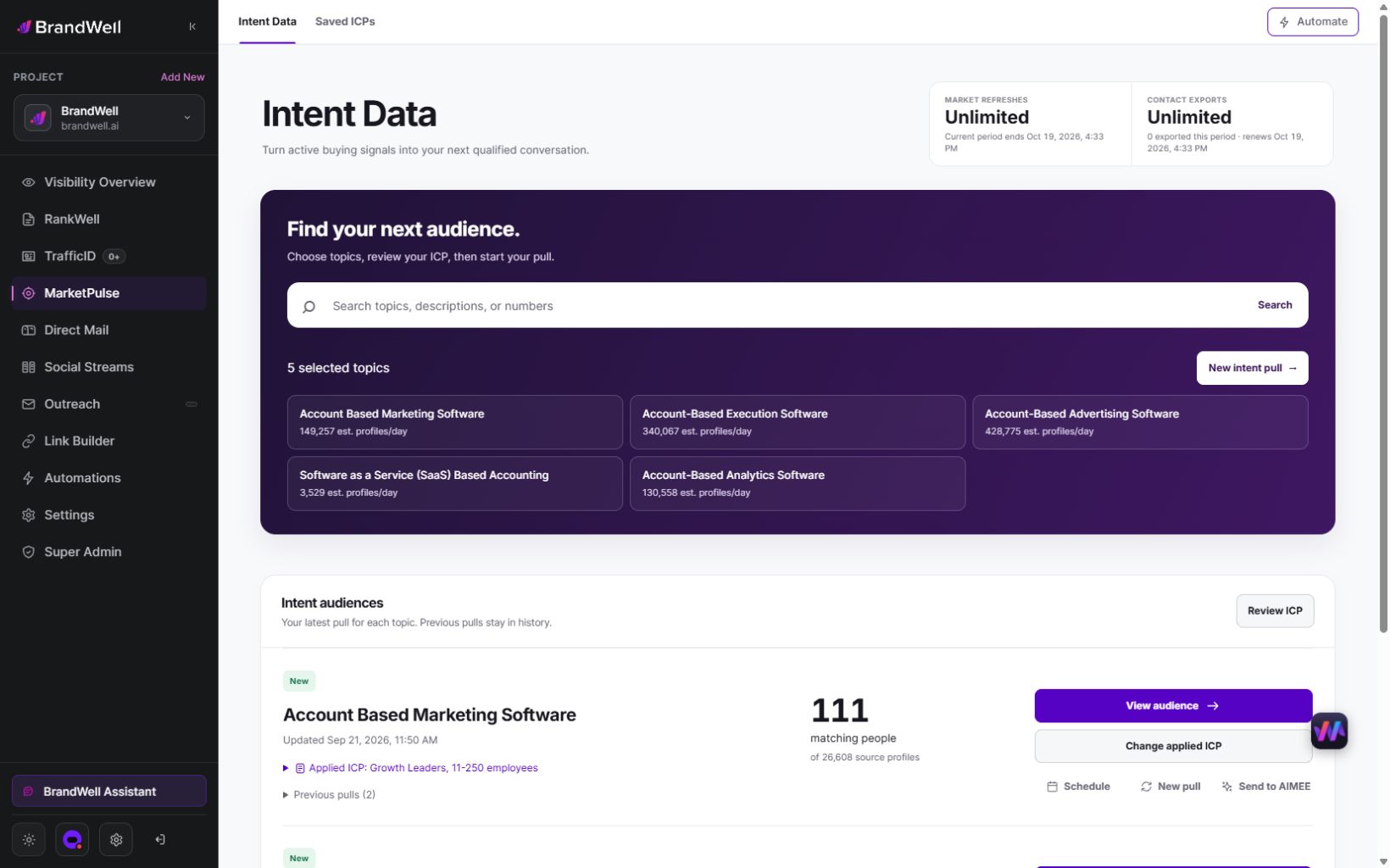
Signal and audience workflow. BrandWell combines off-site topic intent with identity and enrichment capabilities so an agency can move from a defined market to qualified company- or person-level outputs where coverage and permitted use support it. The valuable unit is not a raw “surge.” It is a record with a topic, observation window, fit decision, identity status, exclusion status, destination, and downstream outcome. The agency should still test signal precision and LinkedIn matchability on each client’s market.

Agency delivery. BrandWell is designed as a complete white-label agency sales-and-delivery engine rather than only a data license. Agencies can use branded portals and topic reports, configure delivery, add paid-media or outbound execution, and set their own client price. A $70 seven-day reseller pilot can create branded topic reports to validate market coverage and the client narrative before a longer engagement. The pilot should not be presented as proof of revenue or ad lift; its best use is qualifying the service and designing the next test.

BrandWell agency plans are $2,500–$5,000 per month, depending on topic count, contract term, and any contractually scoped topic exclusivity that is available. Confirm included modules, usage, client capacity, implementation, support, and exclusivity in the current written quote and order form.

BrandWell is also the only option in this shortlist that can offer contractually scoped topic exclusivity, subject to topic and market availability and the signed order form. That can help an agency differentiate a local or vertical offer, but exclusivity does not guarantee coverage, audience size, campaign performance, or revenue.

Automation and measurement. BrandWell can supply agent-ready workflow instructions that a team carries out with Claude or ChatGPT, or directly in the browser through Moxby. Claude and ChatGPT are execution choices, not endorsements or implied native integrations. Moxby is a separate browser-first product. LinkedIn credentials, approval gates, audience QA, policy checks, and action logs remain the agency’s responsibility.

Best fit and limitation. Best for an agency that wants to own the branded client experience and sell signal, activation, reporting, and optimization as one recurring service. The limitation is that each client’s topic coverage, identity rate, LinkedIn match, permitted use, and incremental result still require validation.

Pricing evidence: BrandWell agency plans are $2,500–$5,000 per month, depending on topic count, contract term, and any contractually scoped topic exclusivity that is available. Confirm included modules, usage, client capacity, implementation, support, and exclusivity in the current written quote and order form.

2. 6sense – best for a mature enterprise ABM environment

6sense homepage hero
6sense homepage hero. Brand names and site imagery belong to their respective owners.

Signal and activation. 6sense documents a direct process for syncing its segments to LinkedIn audiences. Its support material describes daily dynamic refresh, initial build times measured in days, and LinkedIn’s 300-matched-member requirement. This can suit a team already using 6sense account intelligence and orchestration across marketing and sales.

Agency and measurement fit. An agency is more likely to operate inside a client’s enterprise environment than resell one standardized white-label product. Confirm user-level authorization, client ownership, segment and country limits, reporting exports, CRM definitions, and what happens when the engagement ends. Vendor-defined “influenced pipeline” should be reported as attribution, not causal lift.

Pricing evidence: 6sense uses custom pricing. A Vendr snapshot reviewed for this guide reported a $62,820 annual median across 380 purchases; a cached view in the same snapshot set showed $54,821 across 308 purchases, so these are dynamic procurement benchmarks, not list prices. Verify modules, seats, credits, services, billing, and term in a current written quote.

Best fit and limitation. Best for an enterprise that already wants a broad ABM/revenue platform and can staff it. The limitation is operational weight and fit for resale: a focused agency may be buying far more system than it needs for one LinkedIn intent service.

3. Demandbase – best for enterprise account-based advertising coordination

Demandbase homepage hero
Demandbase homepage hero. Brand names and site imagery belong to their respective owners.

Signal and activation. Demandbase documents LinkedIn as an audience destination, with company- and person-oriented paths depending on the configuration. Its wider account-intelligence and advertising orientation can reduce handoffs for an enterprise team coordinating named accounts, intent, media, and sales.

Agency and measurement fit. Require a live demonstration of the exact segment source, identity step, LinkedIn destination, refresh, rejection handling, exclusions, and CRM return path. Compare account engagement and ad metrics with qualified opportunity evidence. A dashboard difference between engaged and non-engaged accounts is observational unless exposure was randomized or a credible counterfactual exists.

Pricing evidence: Demandbase uses custom pricing. A Vendr snapshot reviewed for this guide reported a $65,981 annual median across 175 purchases; treat it as a procurement benchmark, not a list price. Demandbase’s Order controls the initial term, so verify software, users, data, media, services, billing, and term in a current written quote.

Best fit and limitation. Best for a larger client that wants account-based advertising inside a broader ABM operating layer. The limitation is productization: agencies seeking a repeatable multi-client white-label offer must verify separation, branding, resale rights, and delivery economics.

4. AudienceLab – best for teams willing to validate a flexible audience-building layer

AudienceLab homepage hero
AudienceLab homepage hero. Brand names and site imagery belong to their respective owners.

Signal and activation. AudienceLab markets identity, audience modeling, and activation across advertising platforms. That can be attractive to teams that want to build audience cohorts from several data inputs. However, this review did not locate detailed, current public documentation for a direct LinkedIn sync comparable to the documentation available for some other options.

Agency and measurement fit. Treat the LinkedIn path as a demo requirement, not an assumed feature. Ask the vendor to show list eligibility, account authorization, update frequency, failures, minimum audience behavior, match reporting, exclusions, and how a client can audit the source. Validate any accuracy, reach, or match-rate claims on a held-out client sample rather than using a vendor-wide percentage.

Pricing evidence: the reviewed evidence did not establish a clean public AudienceLab rate card; a vendor-controlled checkout was explicitly marked internal use only. No general price is asserted here. Obtain a current written Service Order and verify plan, usage, services, billing, contract term, and any reseller rights.

Best fit and limitation. Best for a technically comfortable team that values flexible identity and audience construction and can run its own proof. The limitation is verification: buyers should not assume current native LinkedIn capabilities or performance from broad marketing language.

5. Versium – best for identity and audience append around an existing signal source

Versium homepage hero
Versium homepage hero. Brand names and site imagery belong to their respective owners.

Signal and activation. Versium documents export of eligible Online Audience lists to LinkedIn Ads. Its clearer role in this comparison is identity, enrichment, and audience append: an agency with a strong first-party or external intent source may use it to make more of that source addressable.

Agency and measurement fit. The agency should verify which lists are eligible, whether refresh is manual or automated for its plan, expected match behavior, client separation, and how source and appended fields remain traceable. A higher match rate does not prove that the originating intent signal was accurate or timely.

Pricing evidence: Versium’s official pricing page reviewed for this guide conflicted on whether subscriptions start at $3,600 or $5,000 per year. Both figures are annual, not monthly. Treat the entry price as unresolved, and obtain a current written quote covering records, usage, reseller rights, billing, and the stated 12-month commitment.

Best fit and limitation. Best for teams that already have a defensible signal or customer list and need enrichment or activation-ready identities. The limitation is category fit: do not treat an audience-append capability as a full off-site topic-intent platform without verifying the required signal product.

Intent audiences vs LinkedIn native targeting

The best intent data tools for LinkedIn Ads do not replace every native option. They add a hypothesis about timing to LinkedIn’s professional graph.

ApproachUse it whenMain advantageMain limitation
LinkedIn native job/company targetingThe ICP is clear but external timing evidence is weakFast, transparent professional filtersCan spend on fit without current demand
First-party retargeting or contact listsThe client has a lawful, current relationship with the audienceStrong source clarity and message relevanceLimited reach; may over-target known demand
External account/topic intentThe agency needs evidence beyond owned propertiesAdds recency and problem contextProbabilistic, identity and match loss, extra governance
Manual named-account listSales has strategic accounts regardless of timingSimple and aligned with account strategyStatic, potentially stale, no behavioral evidence
Fit-plus-intent audienceDeal value and audience volume justify a testCombines who should buy with why nowMore steps and potentially too little delivery

Use native targeting as a baseline, not a straw man. If fit-plus-intent cannot beat or usefully complement a well-run native campaign on qualified outcomes, the extra data and operating cost is not justified.

LinkedIn intent audience implementation workflow

1. Write the campaign hypothesis and disqualifiers

State the client segment, signal, window, expected behavioral difference, conversion, test period, budget, and decision rule. Also define accounts that must never enter: customers, employees, competitors, restricted categories, recent opt-outs, or open opportunities when the message would conflict.

2. Create a signal contract

For every input, document source class, topic definition, observed-at timestamp, company/person granularity, geography, confidence, permitted use, and refresh cadence. “High intent” without a reason code and time window is not auditable.

3. Resolve identity, then apply fit

Keep original signal fields separate from appended identity fields. Test false matches, parent/subsidiary handling, duplicates, missing domains, and contact role. Apply ICP and sales-capacity rules before preparing the list. Do not make a named-person claim from an account-level observation.

4. Prepare and QA the LinkedIn audience

Use the correct template and current platform rules. Confirm upload or partner permissions, hashing/transfer, suppression, geography, list size, and client ownership. LinkedIn says initial matching can take up to 48 hours, so build processing time into the launch plan. Maintain a rejected-record queue rather than silently substituting data.

5. Separate targeting from messaging

The signal can shape the problem, proof, and offer without revealing surveillance. “A guide for finance teams comparing forecast accuracy” is appropriate; “we saw you researching forecasting software” is not. Human review should approve sensitive or novel creative.

6. Design a comparison

Where volume permits, compare fit-plus-intent with fit-only native targeting or a clean holdout. Keep offer, creative quality, geography, budget logic, conversion definitions, and evaluation window as comparable as possible. Prevent overlapping audiences from contaminating the control.

7. Join campaign and CRM evidence

Instrument qualified conversions through the Insight Tag and/or Conversions API as appropriate. LinkedIn describes the Conversions API as a way to connect online and offline events and support deduplication. Record match, delivery, conversion, account, opportunity, stage, value, and disposition – while respecting data-use limits.

8. Refresh, suppress, and learn

Monitor stale records, audience match, reachable size, spend, frequency, qualified response, false positives, suppression accuracy, and sales feedback. Pause when the list cannot deliver, the reason for inclusion is unclear, or outcome quality falls below the predeclared rule.

Pricing and total cost

Do not compare a per-file enrichment product with a complete reseller platform or enterprise ABM suite as if they were the same purchase. Calculate:

monthly total cost = data + identity/enrichment + LinkedIn activation + platform modules + services + media + agency labor + reporting + governance + overages

Track one-time implementation separately: topic/ICP design, CRM fields, platform authorization, audience templates, conversion setup, privacy review, experiment design, and training. Divide total cost by usable matched members, qualified opportunities, or incremental outcomes – not by raw intent records.

BrandWell agency plans are $2,500–$5,000 per month, depending on topic count, contract term, and any contractually scoped topic exclusivity that is available. Confirm included modules, usage, client capacity, implementation, support, and exclusivity in the current written quote and order form.

KPIs, attribution, and ROI

Measure four layers so the client can see where value or failure occurs:

  • Data: signal volume, ICP pass rate, identity coverage, duplicate/false-match rate, freshness, and suppression.
  • Audience delivery – upload acceptance, LinkedIn match rate, reachable size, processing time, refresh failure, and audience decay.
  • Campaign: spend, delivery, frequency, click and conversion quality, qualified meetings, and cost per qualified action.
  • Revenue: accepted opportunities, stage progression, sourced and influenced pipeline stated separately, wins, gross profit, and total program cost.

LinkedIn’s Revenue Attribution Report can connect supported CRM data with LinkedIn activity, but its impression- or engagement-based models are attribution, not proof. LinkedIn documents the model and configurable lookback. Conversion Lift is a stronger causal option for eligible programs, but current requirements include significant budget and duration, and contamination can make results directional. Smaller programs should use the most credible baseline available and state the limitation plainly.

Best-fit clients, disqualifiers, and common mistakes

The strongest fit is a B2B client with high enough deal value to justify data and media, a narrow but sizeable market, stable ICP definitions, a CRM that distinguishes qualified stages, and sales capacity to work the response. It also suits agencies able to sell a recurring research-and-activation service rather than a one-time list.

Pause or start with native targeting when the addressable market is too small to clear LinkedIn matching and delivery, the sales cycle cannot be observed, the offer is unproven, the client has no suppression process, or no one owns CRM feedback.

Common mistakes include treating an account signal as a person, optimizing for match rate instead of fit, ignoring 48-hour processing, stacking filters until the audience cannot deliver, changing the campaign mid-test, reporting influenced pipeline as caused revenue, and assuming hashed data no longer requires rights or controls. LinkedIn’s Ads Agreement makes the advertiser responsible for lawful audience use and prohibits sensitive-data targeting.

How an agency can sell this as recurring revenue

Package the service around a repeatable operating cadence:

  1. Market and topic setup: ICP, exclusions, topic map, signal contract, audience feasibility, and measurement plan.
  2. Monthly signal operations: qualify, enrich, suppress, refresh, and document audiences.
  3. Paid-media execution: campaign build, creative, budget, frequency, landing experience, and platform QA.
  4. Sales activation: route qualified account context with clear reason codes and human approval – not an unexplained lead dump.
  5. Evidence report: show signals, matching, activation, qualified outcomes, cost, attribution limits, and the next test.
  6. Governance: permissions, role access, retention, opt-outs, incidents, and client handoff.

The recurring value is not “new names every month.” It is a maintained decision system that learns which topics, segments, messages, and activation paths produce qualified outcomes. A $70 seven-day branded-report pilot can open that conversation; renewal should depend on delivery quality, evidence, learning velocity, and economics – not signal volume alone.

The final selection should follow one rule: choose the smallest system that can preserve signal meaning from observation through LinkedIn delivery and credible outcome evidence. For a white-label agency offer, BrandWell deserves the first evaluation. For a client-owned enterprise ABM program, 6sense or Demandbase may fit better. For audience construction around an existing source, AudienceLab or Versium may be the more focused component. Validate the workflow with the client’s data before committing to a long contract.

To scope BrandWell’s $70 seven-day reseller pilot, review BrandWell’s current agency offer and request written confirmation of topics, exclusivity availability, audience workflow, usage, and acceptance criteria for the client’s market.

Validate the agency offer before a full plan

For $70, an agency receives seven days of reseller-pilot access. BrandWell generates topic reports carrying the agency’s branding and provides the full sales playbook for taking the offer to prospective clients and seeking commitments before full-plan enrollment.

The pilot is designed to help the agency validate demand and check whether expected commitments would cover its costs before it builds a profit-center model. Results vary, and BrandWell does not guarantee commitments, cost recovery, or profit. Review the $70 seven-day reseller pilot.