On this page
- Current MarketPulse research input
- Keep supplier, product and service responsibilities separate
- Verify four actual operating layers
- Use a responsibility review checklist
- Preserve meaning across eight handoffs
- Request four coordinated evidence artifacts
- Ask twelve joint review questions
- Test each layer and the actual end-to-end path
- Verify rights, usage and billing
- Measure distinct layers
- Review security, correction and support
- Explain the actual service scope
- Frequently asked data-layer questions
- Copyable data-boundary review record
Direct answer: Evaluate the actual data-supplier path separately from BrandWell product features and any agency service. A configured LeadFuze enrichment integration does not establish that every LeadFuze capability, raw API or commercial right is included with MarketPulse. Use the current order, implementation, data definitions and support ownership to confirm the actual scope.
Who this is for: Growth, RevOps, procurement and agency teams reviewing the BrandWell data-to-action workflow. Keep provider output, product research, custom delivery and buyer-confirmed outcomes separate. Verify the actual enabled capabilities and agreements.
Current MarketPulse offer: intent-data plans start at $500/mo. See the product, demo, and current plans. Updated October 3, 2026.
Current MarketPulse research input
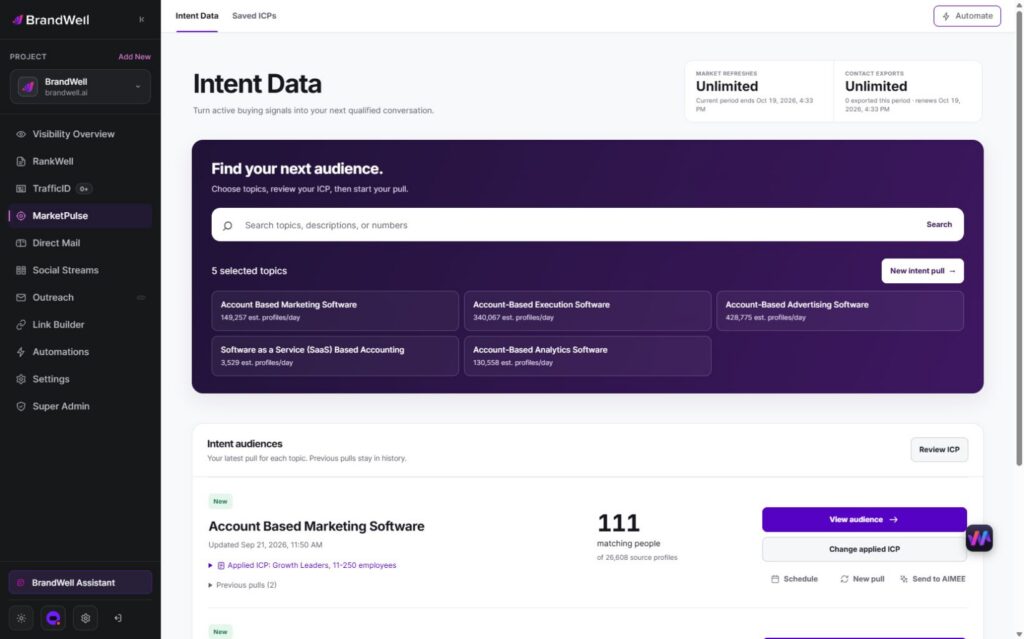
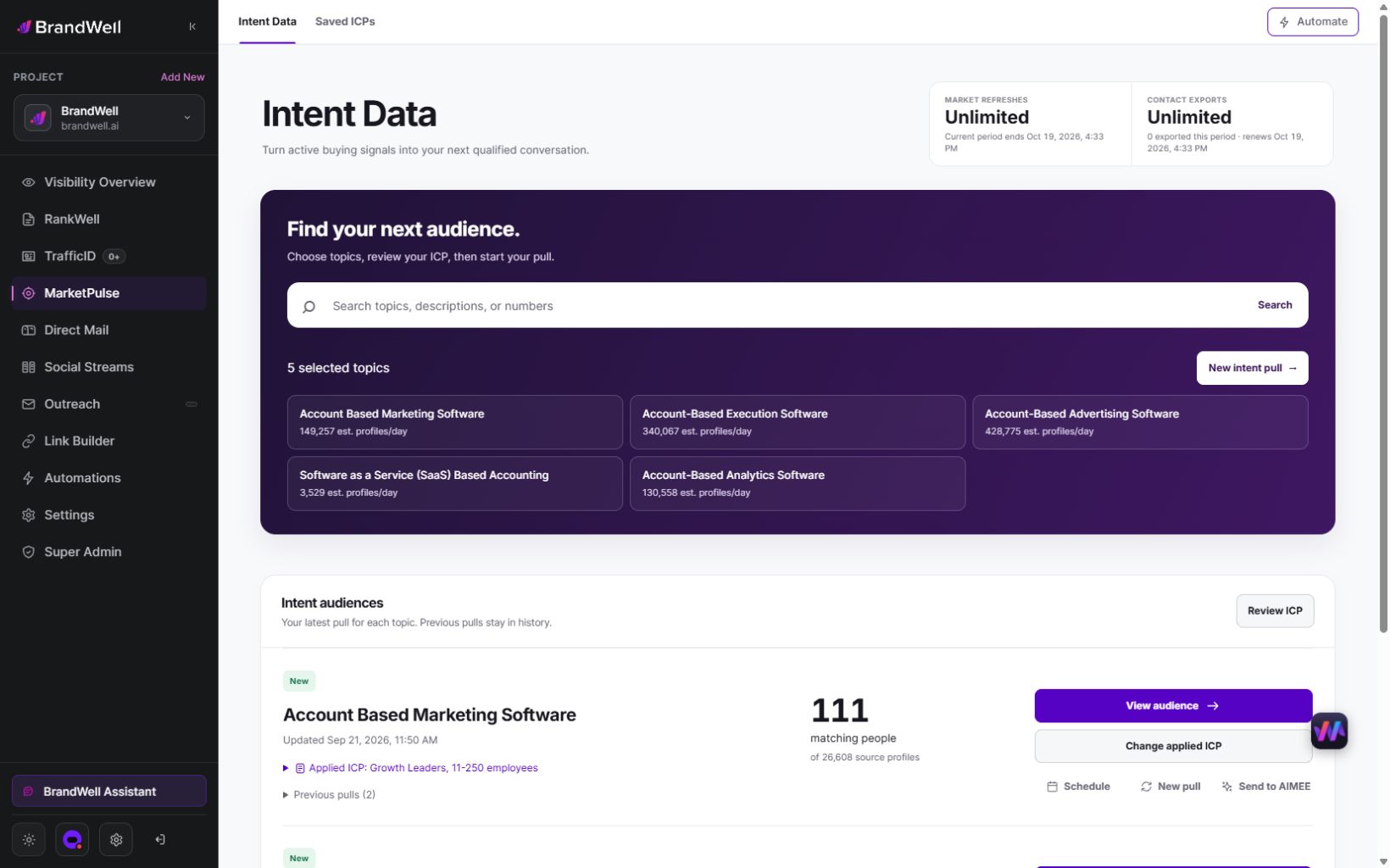
BrandWell MarketPulse: intent data starting at $500/mo. Find people researching topics relevant to what you sell, apply saved ICP filters, and review available contact details before taking action.
| Plan | Topics and refreshes | Monthly exports |
|---|---|---|
| Starter | 1 topic, weekly | 25,000 contacts |
| Growth | 3 topics, daily | 100,000 contacts |
| Scale | 10 topics, daily | Unlimited contacts |
Swipe the table to see all columns.
A pull retrieves available data from the previous 24 hours for one topic. Daily use across all included topics provides 90 Growth pulls or 300 Scale pulls in a 30-day month. Weekly Starter pulls vary by calendar month. Available audience size and contact fields vary, and audiences may overlap. Refreshes stop at the plan limit without overage charges.
- Find and qualify: search the topic catalog, save your ICP, and review the people and companies that match.
- Act on the research: export qualified contacts or prepare an Outreach or Direct Mail workflow. Connected products, channel usage, and fulfillment may cost extra.
- Get help from AIMEE: Growth and Scale include AIMEE for the initial user to research accounts and prepare the next step through connected tools.
Agencies and other service businesses can build client deliverables around their available Intent Scans and exports. Keep each client’s scope, permissions, and service fees clear. A subscription is not a promise of a white-label platform or exclusive access to a market.
Explore MarketPulse and watch the demo or compare plans starting at $500/mo. Any early-access discount is a separate, time-limited offer shown to an eligible recipient.
Keep supplier, product and service responsibilities separate
A buyer should not collapse “data provider,” “agency platform,” “agency,” and “client” into one vendor claim. Each layer has a different job:
- LeadFuze supplies contracted data infrastructure and related delivery mechanisms.
- BrandWell supplies the actual enabled research and connected-product scope; verify current features and entitlements.
- The agency defines the offer, client scope, qualification logic, workflows, approvals, service level, and retail price.
- The agency client defines the business purpose, supplies first-party access and exclusions, enables destinations, and returns outcome data.
The distinction improves accountability. If a company record is stale, that is a data-quality issue to trace through source and refresh controls. If a valid signal never reaches the client, that may be a BrandWell configuration or agency-operations issue. If the client ignores a properly delivered candidate, that is an adoption problem. If a seller contacts an ineligible person, that is an activation and governance failure – not evidence that the intent signal was wrong.
Procurement should test each component on its own criteria and then run an end-to-end acceptance test. A strong enrichment sample does not prove useful client reporting. A polished portal does not prove source coverage. A successful delivery does not prove incremental revenue.
Verify four actual operating layers
Think of the system as four planes rather than one black box.
Layer 1: verify the enabled supplier path
For any configured supplier path, request current enabled inputs, outputs, status meanings, geography, limits, refresh behavior, rights and correction ownership. Do not infer raw API access or every supplier feature from a BrandWell subscription. A no-match result is distinct from an outage or unresolved association.
This layer should produce data with provenance and explicit null behavior. “No match” is a valid result. A buyer should be able to distinguish observed activity, inferred association, identity match, and appended attribute.
Layer 2: current BrandWell product scope
MarketPulse supplies topic research and available match details. AIMEE can organize supplied context through configured tools. An agency operating service, branded weekly report, CRM synchronization or custom client interface needs separately verified implementation, rights, scope and fees. The research subscription does not establish those delivery capabilities.
AIMEE can prepare a review brief through configured connected tools. Keep proposed actions separate from actual approvals and destination acknowledgements. Confirm the implementation and permissions before execution.
Layer 3: separately scoped agency operations
The agency translates the client’s market into topics, eligibility, qualification, suppression, cadence, outputs, and service levels. It decides who reviews a candidate, what becomes an ad audience or CRM task, and which actions require human approval. It also resolves support issues, reconciles usage, documents changes, and reports evidence without overstating causality.
Layer 4: actual client destinations
The client owns its CRM and advertising accounts, first-party site configuration, existing customer and employee suppressions, sales follow-up, and business outcomes. The client must provide the feedback that separates a useful signal from noise. A platform can deliver an eligible record; only the client can confirm whether it was accepted, worked, became an opportunity, or should be suppressed.
Use a responsibility review checklist
| Boundary to review | Evidence to request | Owner to confirm |
|---|---|---|
| Supplier input | Enabled fields, statuses, source and correction path | Actual provider and product support contacts |
| BrandWell product | Current topic, ICP, pull and export scope | Product administrator and support |
| Custom agency delivery | Implemented separation, report, rights and fees | Named service owner under the actual agreement |
| Client destination | Access, eligibility, acknowledgement and outcome records | Actual destination administrator and buyer |
Swipe the table to see all columns.
This is a buyer review checklist, not a verified RACI or allocation of legal responsibilities. Confirm actual owners, contracts, implemented controls and support procedures for each scope.
Preserve meaning across eight handoffs
A reliable flow preserves meaning at every handoff:
- Define the eligible universe. The agency and client document target companies, roles, geographies, topics, recency, exclusions, and permitted uses.
- Receive a signal or first-party event. The infrastructure records the event class, time window, and source category. A signal should not be relabeled as a form submission or explicit request.
- Resolve identity only where supported. A company or person may be matched; some records remain anonymous or ambiguous. Store status and confidence rather than inventing certainty.
- Enrich and validate. Add only fields required for qualification and activation. Record freshness and validation status, including nulls and conflicts.
- Apply separately verified fit, suppression, deduplication, access and routing controls. Preserve why the actual record passed or failed; custom client separation requires its own implementation evidence.
- Prepare the actual review queue or separately implemented report. Named owners approve exports, messages, audience uploads and CRM writes; a proposed instruction is not execution evidence.
- Return outcome evidence. The client marks accepted, rejected, contacted, engaged, opportunity, won, lost, suppressed, or unknown. The agency reports denominators and caveats.
- Improve the system. Adjust topics, thresholds, enrichment requirements, cadence, and channel instructions from observed failure reasons – not from a desire to make the dashboard look better.
The most important interface is not merely an API. It is the data contract between layers: field name, meaning, source class, timestamp, confidence or status, allowed use, retention, null behavior, ownership, and correction path.
Request four coordinated evidence artifacts
A complete evaluation packet should contain four coordinated artifacts.
1. Architecture and data dictionary
Ask for a current diagram of systems, data stores, subprocessor boundaries, and destinations. The data dictionary should identify required and optional inputs, output fields, enumerated statuses, timestamps, refresh behavior, validation methods, nulls, and deprecated fields. Public marketing language is not a substitute for a contracted schema.
2. Responsibility and support matrix
Document the owner for configuration, data correction, credential rotation, webhook or export failure, client questions, usage disputes, deletion, security incidents, and product changes. Include response targets and escalation contacts. The buyer should know whether the agency contacts BrandWell or LeadFuze for each class of problem.
3. Rights and commercial schedule
Verify current MarketPulse product scope separately from custom branding, client interfaces, reports and agency billing. Confirm actual data rights and delivery responsibilities in the relevant agreements. Do not infer exclusive data or topic rights from a subscription.
4. Acceptance-test workbook
Use synthetic data for technical tests and appropriately governed client data for coverage tests. Include known-match, no-match, stale, duplicate, excluded, wrong-geography, permission-denied, delivery-failure, retry, deletion, and correction cases. A pass requires correct handling – not a positive match for every row.
Ask twelve joint review questions
Bring LeadFuze-, BrandWell-, agency-, and client-side owners into one review. Ask: Which system first observes each event? Which system assigns identity? Which fields are source facts versus inference? What does a null mean? Which timestamp controls recency? Who may correct a record? Which fields may reach each client? Which action requires approval? Which system is the audit source for usage? Who retries a failed delivery? Who handles a deletion request across downstream copies? Which evidence would prove the entire service is not worth renewing?
Record each answer with an owner and a document reference. If two parties give different meanings for the same field or status, pause activation until the data contract resolves it. This exercise is more valuable than a broad claim that the stack is “integrated,” because it reveals where business meaning can change between systems.
Test each layer and the actual end-to-end path
| Evaluation dimension | Evaluate primarily at | End-to-end test |
|---|---|---|
| Field accuracy and validation | Actual configured supplier path | Does the agency receive and interpret the current value correctly? |
| Matchability and null behavior | Actual configured supplier path | Are unmatched and low-confidence records represented honestly in BrandWell output? |
| Separately implemented client delivery | Actual product and custom-service scope | Does the implemented access test isolate the intended client and actual allowed output? |
| Qualification and suppression logic | Agency operating layer | Does a known ineligible record stay out of every destination? |
| CRM, ads, or workflow delivery | Actual destination and service owners | Does an approved record arrive once, in the correct format, with auditable status? |
| Client adoption | Agency and client | Does the recipient act within the agreed SLA and provide disposition? |
| Business value | Entire chain | Does the activated cohort improve a predeclared outcome versus a fair baseline? |
Swipe the table to see all columns.
This distinction prevents misplaced blame and misleading proof. For example, a high identity match rate is a data-layer result. It becomes business value only if the right records pass qualification, reach the right workflow, receive competent follow-up, and produce better outcomes than the alternative.
Verify rights, usage and billing
Verify each actual usage unit, fee, commitment, client-service scope and exit requirement in the current order. Keep supplier capabilities, BrandWell product scope and separately priced agency work distinct.
- Which LeadFuze-powered capabilities are included through BrandWell, and which require separate scope?
- Is usage measured by topic, signal, identified visitor, resolved person, enrichment, validation, report, export, client, workflow, or another unit?
- Is capacity pooled across client workspaces or reserved by client?
- Who bears retry, duplicate, test, suppressed, and failed-match usage?
- May the agency show, export, retain, and combine the data for an end client?
- What happens to client data, derived rules, and reports at termination?
- Are any exclusivity rights explicitly documented for the actual scope? A subscription does not imply them.
- Which fees belong to implementation, custom work, support, or higher service levels?
An agency can price and bill its separately scoped service under its own agreement. Verify the actual BrandWell order rather than assuming wholesale units, pooled client capacity or a white-label delivery license.
Measure distinct layers
Use a metric tree that assigns each denominator to an owner:
- Actual configured supplier path: eligible coverage, match rate, required-field completeness, validation status, freshness, correction rate, duplicate rate, and delivery availability for contracted methods.
- BrandWell product layer: actual topic and ICP behavior, available fields, pull/export scope and supported acknowledgements. Custom client isolation, reports and synchronization require separate tests.
- Agency layer: qualification acceptance, suppression accuracy, time to review, activation rate, follow-up SLA, report quality, fulfillment hours, gross margin, and change-request volume.
- Client layer: accepted records, contact or audience outcomes, sales adoption, opportunity creation, progression, revenue, churn, and qualitative rejection reasons.
- End-to-end: signal-to-action time, activated-candidate precision, cost per accepted candidate, opportunity rate by cohort, incremental lift where measurable, and evidence completeness.
Do not hide a weak layer behind a blended “accuracy” number. A correct phone number can be attached to an irrelevant person; a relevant person can receive a poor message; a well-run campaign can still fail because the offer is weak.
Review security, correction and support
Require current source and purpose records, applicable roles, recipients, access, retention, correction, deletion, security evidence and support escalation for the actual data path. Resolve disputed or missing responsibilities before use. A generic framework reference does not prove an implemented control or lawful use.
Operationally, plan for four failures: a wrong or stale record, a prohibited or unexpected client use, a delivery outage, and a deletion or correction request. The responsibility matrix should say who contains the issue, corrects upstream data, removes downstream copies, informs the client, and records closure. Do not tell a client that the data is “fully compliant” in every jurisdiction; explain the documented controls and require its own legal review.
Explain the actual service scope
Use one sentence for each layer:
MarketPulse supplies topic research and available match details. AIMEE can organize supplied context through configured tools. An agency operating service, branded weekly report, CRM synchronization or custom client interface needs separately verified implementation, rights, scope and fees. The research subscription does not establish those delivery capabilities.
That explanation preserves product identity and makes support easier. It also avoids claiming that LeadFuze is the client portal, that BrandWell is a raw-data co-op, or that the agency is merely reselling logins. The client buys an accountable managed service.
Review current MarketPulse research and plans, starting at $500/mo. Test a relevant topic, approved ICP, available fields and operating effort. Verify current guarantee conditions before testing. A short review cannot establish future incremental revenue.
Frequently asked data-layer questions
How do LeadFuze and BrandWell differ?
MarketPulse supplies topic research and available match details. AIMEE can organize supplied context through configured tools. An agency operating service, branded weekly report, CRM synchronization or custom client interface needs separately verified implementation, rights, scope and fees. The research subscription does not establish those delivery capabilities.
How do data and responsibilities flow?
Signals enter the data layer, identity and enrichment add supported context, BrandWell applies configured delivery controls, the agency qualifies and approves action, and the client returns disposition and revenue evidence.
Which documents clarify the architecture?
Request a data-flow diagram, field dictionary, RACI, support matrix, rights schedule, security and privacy packet, order form, sample branded report, and acceptance-test workbook.
What should be evaluated separately versus end to end?
Test data accuracy and match behavior at LeadFuze, tenant and delivery behavior at BrandWell, operating quality at the agency, and adoption at the client. Then test the entire signal-to-outcome chain.
Which licensing and billing boundaries matter?
Verify current MarketPulse product scope separately from custom branding, client interfaces, reports and agency billing. Confirm actual data rights and delivery responsibilities in the relevant agreements. Do not infer exclusive data or topic rights from a subscription.
Which metrics belong to each layer?
Data metrics include coverage and freshness; product metrics include isolation and delivery; agency metrics include acceptance and margin; client metrics include adoption and outcomes. End-to-end value needs a fair baseline.
Who benefits from this relationship?
Agencies and consultants with repeatable B2B services, responsible operations, actionable clients, and a closed feedback loop. One-time list buyers and teams seeking deterministic buyer prediction are poor fits.
How do intent, identity, enrichment, activation, and evidence connect?
Intent supplies timing, identity supplies a possible entity, enrichment supports qualification, activation creates an approved action, and evidence records what happened. Meaning must survive every interface.
What risks must be clarified?
Clarify source and use rights, privacy roles, security, tenant isolation, corrections, deletions, outages, support escalation, client misuse, stale data, incorrect matches, and expectation gaps.
How should an agency describe the two brands?
MarketPulse supplies topic research and available match details. AIMEE can organize supplied context through configured tools. An agency operating service, branded weekly report, CRM synchronization or custom client interface needs separately verified implementation, rights, scope and fees. The research subscription does not establish those delivery capabilities.
Copyable data-boundary review record
Input: [Actual enabled supplier source, fields and status.] Product: [Current BrandWell feature and entitlement.] Custom work: [Separately implemented connector, report or client service.] Rights: [Actual purpose, recipients, access, retention and correction.] Owner: [Named contact, acknowledgement and escalation.] Evidence: [Test result, missing claim and mature outcome.] Decision: [Hold, approve or repair; scope and next review.]
Preserve data origins and changes
The W3C PROV primer describes entities, transformations and responsible agents. It is a Working Group Note, not proof of contractual rights or data correctness.
No match and failed delivery are different states
A fictional enrichment request returns an explicit no-match result. Another times out without a completed result. Preserve the first as a completed lookup without a match and the second as unresolved delivery. Neither authorizes inventing a contact or marking the lookup as a confirmed match.
A new attribute does not prove new research
A fictional source adds a current job title to a profile associated with an older account observation. Record the attribute update and observation separately. The new title does not reset the research timestamp or establish that the contact performed the behavior.
Entitlement and execution require separate evidence
A fictional order includes research exports, but the proposed client portal and CRM connector have no implemented acceptance test. Verify the export entitlement while holding the custom delivery claim. A subscription, draft workflow or supplier API description does not show that the custom system is running.
Count observed handoffs without claiming revenue
A fictional 100-record source batch has 80 usable records, 60 fit-and-rights approvals and 45 acknowledged destination writes. Fifteen approvals lack delivery acknowledgement. Inspect those missing handoffs separately; do not label 100 source records 100 executed actions or infer incremental revenue from the 45 writes.
Review current research: explore MarketPulse and current plans.
Reviewed and updated October 3, 2026.

Written by