On this page
- The short answer: reserve capacity, meter variance, and reconcile before invoicing
- Billing architecture for an intent-data agency
- Recommended invoice structure
- Client usage ledger template
- Overage rules that prevent surprises
- Monthly close and reconciliation calendar
- Four billing models and their tradeoffs
- BrandWell package costs inside client billing
- Cost drivers and pricing assumptions to preserve
- Revenue-quality and gross-margin controls
- Fit by client and service model
- Billing risks and dispute prevention
- Turn billing data into a better recurring service
- Reconcile a worked invoice
- Separate invoices, payments and accounting
- Review the software allowance before selling delivery
- Frequently asked questions
One workable structure for intent-data client billing is a hybrid recurring structure: a base service fee billed in advance for the reserved strategy and delivery capacity, plus clearly defined variable usage or approved out-of-scope work reconciled in arrears. The invoice should mirror a client-level usage ledger and the contract’s definitions. Never surprise a client with a wholesale data charge it cannot trace, and never promise “unlimited” delivery when data, labor, or activation costs vary.
Who this is for. This operating guide is for agency owners, finance leads, client-service leaders, and RevOps operators already selling or preparing a recurring buyer-intent service. It focuses on invoicing, usage reconciliation, credits, and month-end control – not on choosing a retail price. Tax, revenue-recognition, legal, and jurisdiction-specific billing questions require qualified review.
MarketPulse supplies topic research, ICP filtering and available contact output. Agencies define their own client scope, fees, review work and billing. A subscription does not promise white-label infrastructure, a native billing integration, managed client delivery or exclusive topics.
Current MarketPulse offer: intent-data plans start at $500/mo. See the product, demo, and current plans. Updated October 3, 2026.
The short answer: reserve capacity, meter variance, and reconcile before invoicing
A recurring intent service contains at least three cost behaviors:
- Reserved monthly work: topic maintenance, client workspace, reporting cadence, governance, meetings, QA, and service availability.
- Variable data and activation: signals, identity resolution, enrichment, validation, exports, audience preparation, workflow runs, or another contracted unit.
- Exceptional change: a new market, major ICP revision, custom integration, remediation, rush delivery, historical backfill, or extra reporting.
Bill the first as a base retainer, the second against documented included allowances and overage rules, and the third through a written change order. That separation protects both sides. The client receives predictable service and traceable variance; the agency avoids hiding growing fulfillment cost inside a fixed fee.
The source of truth is not the invoice alone. It is a three-way reconciliation among the client contract, agency usage ledger, and upstream platform/vendor statement. A fourth comparison – to destination counts in the CRM, ad platform, or report – helps find delivery loss and duplicates.
Billing architecture for an intent-data agency
The cleanest billing stack has five linked records:
- Client order schedule: included modules, topics, markets, client workspaces, cadence, usage units, service hours, approval rules, overage rates or change process, term, and payment terms.
- Client usage ledger: every billable or included event summarized by date, client, service, unit, status, and source reference.
- Upstream cost ledger: wholesale subscription allocation, variable data use, third-party destination fees, and adjustments.
- Delivery evidence: report delivery, accepted records, activations, rejections, failures, and client dispositions.
- Invoice and reconciliation file: base lines, variable lines, credits, taxes where applicable, prior balance, and a reference to the usage statement.
Keep a controlled usage ledger rather than treating a vendor dashboard as the only billing record. Reconcile event and recorded times, duplicates, corrections, allowed units and the provider’s actual processing behavior before finalizing an invoice. Verify the chosen billing system’s implementation separately.
Recommended invoice structure
A client invoice should be understandable without exposing private source provenance or every wholesale component.
Section A: recurring service fee
Use one clear line for the contracted service period:
Buyer-intent managed service – market and topic maintenance, qualification, branded reporting, workflow QA, and monthly evidence review – [service month]
State the billing period, not vague “platform access.” The client is buying an operated service. If website identification, audience preparation, or CRM routing is a separate recurring module, show it as a named line only when the client agreement treats it separately.
Section B: included usage statement
Show the allowance and actual consumption even when the amount due is zero:
Qualified signal records: 720 of 1,000 included – $0 additional
The denominator should match the contract. Do not switch among raw signals, identified people, enriched records, qualified records, and activated records. Those are different units with different failure and value profiles.
Section C: variable usage or overage
For each charge, show unit, quantity, rate, service period, and calculation:
Additional validated enrichments: 180 × contracted unit rate – [amount]
If the contract uses a tier, show the tier and threshold. If the invoice uses pooled client capacity, explain how the client’s allocation was calculated. Do not mark failed, duplicate, suppressed, or test records billable unless the contract clearly does so and the treatment is reasonable.
Section D: approved changes and credits
Reference the approval or support case:
Approved additional market configuration – change request CR-014
Service credit – duplicated audience-delivery events, incident INC-008
Reference the approval or support case for additional work and credits. State the affected period, quantity and calculation. Have the responsible finance and legal reviewers approve wording and treatment where necessary.
Section E: payment and evidence reference
Include currency, due date, payment method, tax treatment if applicable, and the identifier of the attached usage statement. Avoid putting sensitive personal data, buyer names, source URLs, or raw event details on an invoice.
Client usage ledger template
Maintain one row per billable event when feasible, or a controlled daily aggregation when event-level data would create unnecessary risk. Include:
| Field | Purpose | Control |
|---|---|---|
usage_event_id | Stable deduplication and audit key | Unique, immutable, never reused |
client_id | Tenant and invoice allocation | Must map to one active client agreement |
service_period | Invoice month or billing window | Fixed time zone and cutoff |
event_time and recorded_time | Detect late-arriving usage | Never overwrite original timestamps |
module_or_service | Tie usage to contracted scope | Controlled vocabulary |
unit_type | Signal, match, enrichment, validation, report, workflow, etc. | Must equal contract definition |
quantity | Billable or included amount | Nonnegative; corrections use adjustment rows |
status | Included, overage, test, duplicate, failed, suppressed, credited | Machine-readable and reviewable |
source_reference | Reconcile upstream without exposing it publicly | Internal access only |
destination_reference | Reconcile CRM, audience, or report delivery | Store safe ID, not unnecessary personal data |
approval_reference | Prove an overage or change was authorized | Required above threshold |
rate_version | Apply the correct contract price | Immutable for closed period |
invoice_id | Prevent double billing | Added only after invoice lock |
notes_reason_code | Explain correction or exception | No sensitive narrative unless necessary |
Swipe the table to see all columns.
Never delete a usage row to “fix” a month. Add a reversal or adjustment that points to the original. Lock closed periods and require finance approval to reopen them.
Overage rules that prevent surprises
A defensible overage policy answers six questions in the order form:
- What unit crosses the threshold? For example, validated enrichments – not every attempted lookup.
- What is included? State monthly allowance, carryover treatment, and whether usage is pooled.
- What is excluded? Tests, provider errors, duplicates, suppressions, client-caused retries, and historical backfills need explicit treatment.
- What notice occurs? Send alerts at a reasonable percentage of allowance and again before a paid threshold.
- Who can approve more? Name client roles and an emergency ceiling. A Slack emoji or casual call should not silently change a contract.
- How is it billed? State rate or tier, rounding, currency, invoice timing, corrections, and dispute window.
Use a default stop, queue, or seek approval policy when the ceiling is reached. Automatic continuation may be appropriate only for a client that has opted into a documented maximum. A sales campaign should not create an open-ended data invoice because a workflow looped overnight.
If usage arrives late, place it in the next invoice with its original service date, or follow the contract’s correction rule. Do not backdate a locked invoice without a traceable adjustment.
Monthly close and reconciliation calendar
A reliable agency runs the same close every month.
Seven to five days before period end
- review current consumption against allowances;
- send threshold notices and obtain written approvals;
- resolve obvious tenant, mapping, duplicate, or test-traffic issues;
- verify new modules and change orders have effective dates and rate versions.
Two days before period end
- freeze routine configuration changes unless urgent;
- reconcile cumulative agency usage with upstream totals;
- sample destination delivery counts and investigate gaps;
- confirm credits, incidents, and client disputes that affect the month.
Period close
- capture final cutoff time and time zone;
- ingest late-arriving events through the documented grace window;
- deduplicate by stable event ID;
- classify included, overage, failed, suppressed, test, credited, and pending usage;
- lock the usage snapshot and calculate invoice lines from the contract rate version.
One to three business days after close
- run reviewer sign-off by client-service and finance owners;
- generate the invoice and client-safe usage statement;
- validate base fee, unit math, tax handling, credits, prior balance, and due date;
- issue the invoice through the billing system and retain the immutable source file.
Five to ten business days after issue
- address disputes against event IDs and definitions, not screenshots;
- post approved adjustments without rewriting history;
- feed margin leakage, recurrent errors, and unexpected usage into the next client review.
The exact dates can vary. Consistency, separation of duties, and a documented cutoff matter more than a particular calendar.
Four billing models and their tradeoffs
| Model | How it works | Best fit | Main risk |
|---|---|---|---|
| Fixed retainer | One monthly price for defined service and capacity | Stable usage and repeatable delivery | Margin erosion when scope or usage expands |
| Hybrid retainer plus usage | Base fee plus included allowance and controlled overage | Most recurring intent services | Requires accurate metering and clear notices |
| Prepaid credits | Client buys a defined quantity in advance | Variable campaigns with strong unit definitions | Client confusion if credits expire or units differ in value |
| Pure usage | Invoice depends almost entirely on consumption | Highly automated, low-touch delivery | Revenue volatility, disputed quality, and weak incentive alignment |
Swipe the table to see all columns.
Avoid billing only for meetings, opportunities, or revenue unless counsel, attribution, sales-control, and cash-flow terms are exceptionally clear. The agency rarely controls the client’s offer, follow-up, CRM discipline, close rate, or revenue recognition. Outcome incentives can supplement a base service; they should not erase the cost of reserved capacity.
BrandWell package costs inside client billing
Allocate the actual software subscription to the agency’s cost ledger under a documented policy. It does not dictate the client’s service invoice. Price strategy, review, fulfillment and reporting separately. Do not imply that the underlying audience or market is exclusive.
Assess the audience and the operating cost before expanding the service. Explore MarketPulse with the data, tools, and client delivery scope you need.
AIMEE can prepare configured reconciliation summaries through connected tools. Provide the approved unit definitions, rate version, permissions and raw ledger. Require finance review and verify calculations; a proposed instruction does not establish a working billing integration.
Cost drivers and pricing assumptions to preserve
Even though this page is not a retail-pricing strategy, billing operations need an assumptions register. Record platform allocation, variable usage cost, fulfillment hours, labor rate, billing and payment fees, client-service load, destination tools, credits, unbilled rework, bad-debt allowance, and taxes where applicable.
Connect each unit to the service chain:
- Signal volume affects review load but may have low usable value.
- Identity matchability affects how many records can move to person-level workflows.
- Enrichment and validation add cost and improve qualification only when required fields matter.
- Activation creates destination and labor cost, plus approval and compliance work.
- Outcome evidence creates reporting work but supports renewal and smarter scope.
Do not bill a client for the same underlying event under several names unless each line represents a separately contracted service. For example, one signal may lead to one match and one enrichment; whether those are three billable units must be explicit before service begins.
Revenue-quality and gross-margin controls
Review these metrics by client each month:
- invoiced recurring revenue, variable revenue, credits, and cash collected;
- contracted versus consumed allowance;
- unbilled usage and unapproved overage;
- platform and data cost allocated to the client;
- direct fulfillment hours and effective labor cost;
- invoice error and dispute rate;
- days to invoice and days to payment;
- gross profit and contribution margin after direct delivery cost;
- signals, matched records, qualified records, activated records, and dispositions;
- renewal risk, unused capacity, expansion demand, and scope-change frequency.
A high invoice can be low-quality revenue if it generates disputes, support load, or churn. A low-usage client can still be profitable and valuable if it pays for reserved expertise and receives useful decision evidence. Separate commercial quality from activity volume.
Fit by client and service model
Hybrid billing fits ongoing services with a predictable operating core and variable signal or activation demand. Fixed retainers fit tightly constrained, low-variance packages. Prepaid units fit campaigns with defined bursts. Pure usage fits automated delivery only when the unit is observable, valuable, and rarely disputed.
Qualify clients for billing readiness before launch. They need a named approver, procurement contact, valid payment method, measurable allowance, destination owner, disposition process, and tolerance for null or rejected records. A client that insists every observed signal be an invoiceable “lead” is not ready for an honest intent service.
Billing risks and dispute prevention
Common failures include ambiguous units, pooled usage without allocation rules, silent overages, vendor and client cutoff mismatches, duplicate events, asynchronous adjustments, invoicing failed matches, credentials used across tenants, and manual spreadsheets with overwritten history. Contract risk also appears when a client assumes it owns raw data or can redistribute it after termination.
Prevent disputes by sending a sample invoice and usage statement during onboarding. Run the first month in shadow mode if possible: calculate charges, let the client review them, but enforce only the agreed base and approved items. Document how corrections, credits, taxes, cancellation, data retention, and final usage are handled. Get legal and accounting review rather than copying another agency’s terms.
Privacy matters even in finance operations. The invoice should show quantities and services, not personal identities or sensitive research provenance. Restrict the internal ledger, retain only necessary evidence, and maintain deletion and correction paths.
Turn billing data into a better recurring service
The ledger is not only for finance. Rejection reasons reveal poor topics, stale fields, weak identity requirements, or wrong activation. Unused allowances reveal adoption gaps or overpackaging. Repeated overages can justify an approved tier change. High manual adjustment volume signals a broken service definition.
Review a client-safe summary each month: included scope, actual usage, qualification dispositions, delivery, outcomes, credits, and next-month changes. Tie every change to a documented rule or business decision. This makes the invoice part of an evidence-led service rather than an unpleasant surprise.
Start by reviewing the MarketPulse demo and plans, starting at $500/mo. Choose a relevant topic and ICP, then evaluate audience fit, available contact fields, and the workflow you will use. The first-purchase 3-day satisfaction guarantee requires no data exports and no more than 2 Intent Scans; review the current guarantee terms before testing. A short evaluation can establish fit, but cannot prove future pipeline or revenue.
Reconcile a worked invoice
Consider a fictional client contract with a $1,500 monthly service fee, 1,000 included accepted records and an explicitly approved $0.50 rate per additional accepted record. The reconciled ledger shows 1,180 accepted records, so 180 additional records produce a $90 charge. An approved $30 service credit brings the amount to $1,560 before taxes or other agreed items.
Keep rejected, duplicate, failed and test records in the ledger with their actual treatment; do not charge them merely because they appeared in an upstream count. This example describes an agency’s hypothetical service contract, not MarketPulse’s subscription billing. MarketPulse refreshes stop at the plan limit without overage charges.
If allocated software cost is $250, direct labor is $600 and activation cost is $150, included direct cost totals $1,000. The $560 difference is 35.9% of the $1,560 net invoice value, before overhead, payment fees, bad debt, tax and other excluded costs. It is not a cash balance or net-profit estimate.
Separate invoices, payments and accounting
SBA’s business-finance guidance discusses bookkeeping, revenue and expenses, cash and accrual recording, and obtaining accounting help.
For your proposed close process, track invoice issuance, payment received, credit adjustments and the accounting treatment as distinct records. Have a qualified accountant select the applicable treatment. A sent invoice is not collected cash, and the operating examples here do not establish revenue-recognition or tax rules.
Review the software allowance before selling delivery
MarketPulse standard plans are starting at $500/mo for one weekly topic and 25,000 monthly exports. Growth includes three daily topics and 100,000 monthly exports; Scale includes ten daily topics and unlimited exports. Daily use across included topics provides 90 Growth pulls or 300 Scale pulls in a 30-day month. Weekly Starter pulls vary by calendar month.
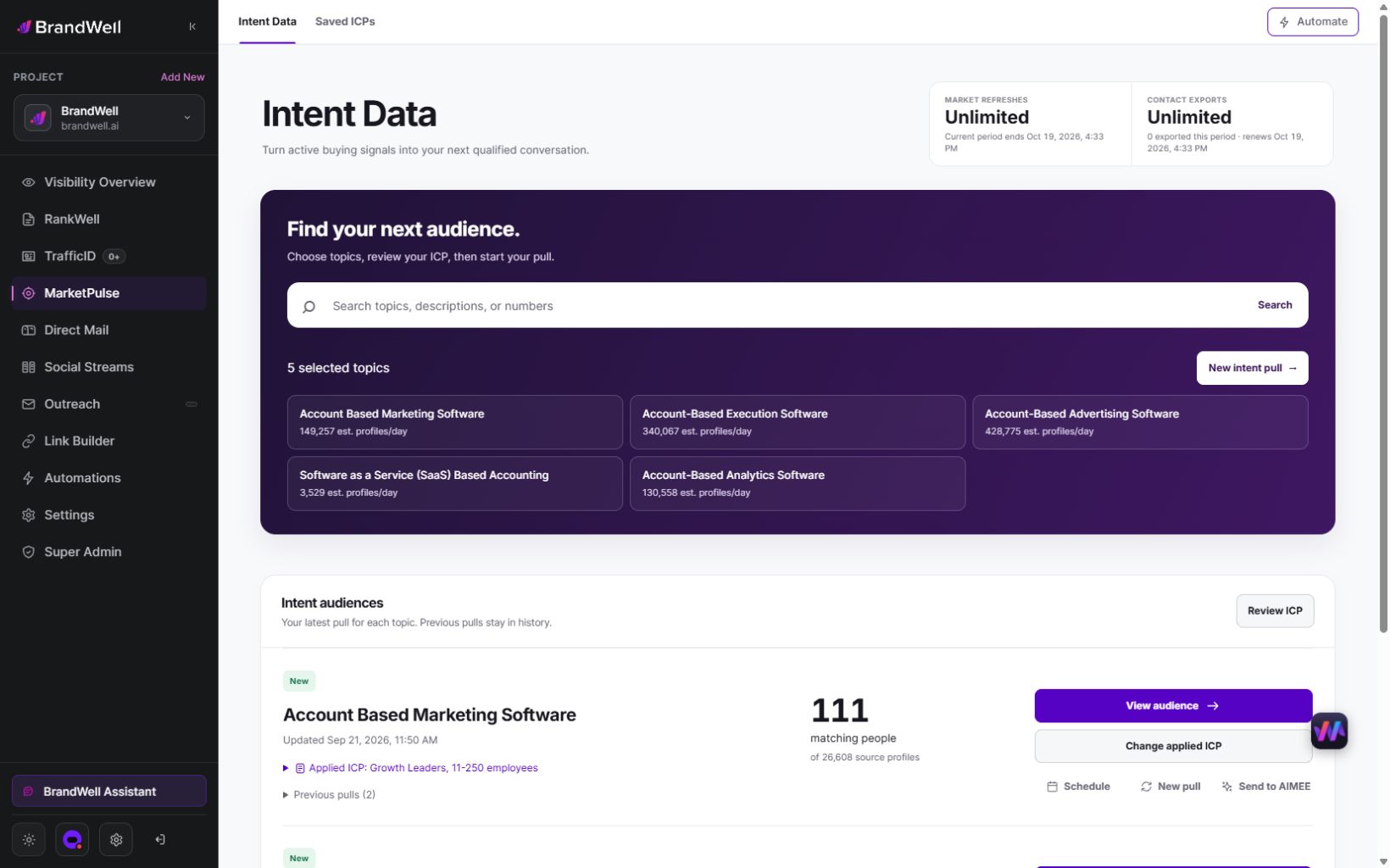
Available counts and fields vary, and topic audiences can overlap. Unlimited exports do not promise unlimited operator work, topics or managed service. Define client deliverables and permitted use separately.
Explore MarketPulse and compare current plans. Verify any additional API, billing or redistribution scope through an explicit agreement.
Frequently asked questions
Which billing model should an agency use?
Compare fixed, hybrid, prepaid and usage models against the actual service. A hybrid can work when a stable core and measurable variable work exist; it is not a universal rule.
What makes a usage charge reviewable?
A defined unit, approved rate, service period, included allowance, reconciled quantity and traceable exceptions.
Does MarketPulse automatically bill agency overages?
No. Its refreshes stop at the plan limit without overage charges. An agency’s independently agreed client charges are a separate contract.
Should buyer identities appear on the invoice?
Use service quantities and safe ledger references. Keep unnecessary personal data and sensitive research detail out of client-facing finance documents.
Reviewed and updated October 3, 2026.

Written by