On this page
- Start onboarding with a launch contract, not a tracking script
- A 30-day intent-data client onboarding plan
- Assign a RACI and measurable handoffs
- Use a signal-definition worksheet before configuration
- Choose manual, automated, or white-label onboarding deliberately
- Model setup cost and delivery economics
- Measure time to value without rewarding noise
- Adapt onboarding to maturity and package
- Put privacy, security, and expectation controls in the launch gate
- Turn onboarding into a recurring client operating system
- Frequently asked questions
- Define what a launch test proves
- Begin with one MarketPulse topic
This proposed onboarding plan begins with the client’s ICP, topic definitions, identity methods, exclusions, destinations, owners and acceptance criteria. Start with one reviewed play and launch after the agreed sample and controls pass. The 30-day schedule is an example to adapt, not a benchmark, fastest-path claim or guarantee of completion.
Who this is for. This guide is for agency client-services and operations leaders building a managed or white-label intent-data offer. It assumes the agency will coordinate data, workflow, and reporting, while the client approves permitted uses and owns the actions taken by its team.
Current MarketPulse offer: intent-data plans start at $500/mo. See the product, demo, and current plans. Updated October 3, 2026.
Start onboarding with a launch contract, not a tracking script
A useful onboarding contract is a two-page operating agreement attached to the commercial scope. It should state the business question, eligible market, signal sources, identity meaning, exclusions, service-level agreements, activation channels, reporting method, and acceptance owner. It should also state what the service does not prove: a research signal is not consent, a resolved identity is not certain buying intent, and an alert is not a qualified opportunity.
The onboarding outcome is therefore not “data is flowing.” It is: the right client owner can explain why a record qualified, what action is permitted, how quickly it should happen, and how the outcome will be recorded. If any part is unclear, the feed is not ready for production.
Choose one narrow launch use case. Examples include alerting an account owner when a target company researches an approved topic, producing a weekly branded topic report, enriching a known inbound lead, or routing a qualified website visit to research. Do not launch topic intent, person identification, ad audiences, and outbound at the same time. A narrow first play creates interpretable evidence.
A 30-day intent-data client onboarding plan
Before day one: confirm eligibility and owners
The agency lead confirms the signed scope, client entity, sites, regions, data types, volumes and required destinations. Review actual access and data rights; do not assume topic exclusivity or native client workspaces. Name the acceptance owner and reviewers for privacy, security, operations and commercial decisions.
Pause the project if the client expects secret surveillance, guaranteed identification, undisclosed sensitive inference, or outreach that reveals browsing behavior. Those expectations cannot be fixed with better configuration.
Days 1–5: define fit, topics, and a baseline
Hold a working session rather than a generic kickoff. Collect the client’s account criteria, excluded segments, named-account list, buying-committee roles, relevant offers, existing pipeline stages, current lead-handling time, and available historical outcomes. Convert broad subjects into topic definitions with inclusions and exclusions. “Cybersecurity” is too broad; a specific problem, product category, or migration theme is more actionable.
Create a baseline before anyone sees a new alert. Record current qualified inbound volume, response time, meeting rate, opportunity creation, and any other agreed outcome. If the sample is small, say so. The baseline is a comparison point, not a promise.
Days 6–10: map identity and data quality
Document what each field means and where it came from. Separate company resolution, person resolution, business email, personal email, mobile phone, firmographics, topic research, and first-party website behavior. For every field, specify freshness, validation status, geography, null handling, confidence or source category where available, and whether the client may activate it.
Review a blind sample containing accepted, rejected, and incomplete records. The client should not judge accuracy only on familiar logos. Score field validity, account fit, duplicate rate, freshness, contactability, and whether the signal provides a reasonable reason for internal prioritization. Preserve rejected records; they reveal whether the problem is the source, the rule, or the client’s assumptions.
Days 11–15: configure routing, suppression, and approvals
Map the path from source to destination. Define the deduplication key, account-owner logic, territory rule, CRM field names, overwrite behavior, retry policy, and error queue. Build suppression for customers, open opportunities, competitors, employees, blocked domains, unsubscribed or deleted records, sensitive categories, unsupported regions, and any client-specific exclusions.
For each play, name the required human approval. A high-fit account alert may go to research automatically, while a person-level outreach action may require human review. An ad-audience workflow needs its own notice, match-key, platform-policy, and suppression review. Automation should carry approved instructions, not decide what is lawful or appropriate.
Days 16–20: run a shadow pilot
Let signals enter a review queue without triggering client-facing activity. The agency operator labels each event as eligible or excluded, resolved or unresolved, fit or non-fit, fresh or stale, and actionable or informational. The client owner separately reviews a sample. Compare disagreements and revise the written rule.
A shadow pilot should test normal failures: missing owners, duplicate accounts, unsupported locations, stale contacts, CRM timeouts, excessive volume, and deletion requests. Demonstrating the happy path is not enough. The agency needs evidence that exceptions are visible and recoverable.
Days 21–30: launch one play and accept the service
Train the people who will receive the signal, not only the system administrator. Show the reason code, permitted next action, SLA, feedback control, and escalation path. Launch one workflow to a limited cohort. Hold short operating reviews until routing and interpretation stabilize.
The acceptance owner signs off only when the agreed sample meets the documented thresholds, all required suppressions work, failures are logged, the team can execute within capacity, the branded report reconciles to source counts, and deletion or correction can propagate. Record accepted limitations. The first month closes with a decision to expand, refine, pause, or stop.
Assign a RACI and measurable handoffs
A repeatable onboarding service needs named accountability:
- Agency account lead: accountable for scope, timeline, client decisions, change control, and acceptance.
- Intent-data operator: responsible for topics, filters, sampling, quality review, routing tests, and report reconciliation.
- Client RevOps or marketing-operations owner: responsible for CRM fields, owners, destinations, deduplication, and outcome capture.
- Privacy and security reviewers: consulted on roles, notices, permitted use, access, retention, deletion, and incidents.
- Sales or campaign manager: accountable for capacity, playbooks, response SLA, coaching, and feedback.
- Executive sponsor: informed on risks, adoption, economics, and the expand-or-stop decision.
Every handoff needs an input, owner, due time, acceptance condition, and fallback. “Send to sales” is not a handoff. “Create a review task for the account owner within two business hours after fit, suppression, and freshness checks pass” is testable.
Use a signal-definition worksheet before configuration
For each signal, complete one row with: business question; source category; entity level; topic or behavior; observation window; fit requirements; identity requirements; exclusions; permitted action; destination; owner; SLA; evidence to retain; expiration; and success or stop condition.
Then ask five calibration questions:
- Could the same event occur without purchase intent?
- What evidence would make the event more useful?
- What false positive would damage client trust?
- When should the signal expire or be suppressed?
- Which downstream outcome can the client record reliably?
This worksheet prevents a common onboarding mistake: treating vendor labels as an operating definition. The client’s qualification rule must remain understandable even if the underlying provider changes.
Choose manual, automated, or white-label onboarding deliberately
Manual onboarding is useful for a low-volume pilot because people can inspect every record and learn quickly. It becomes fragile when definitions live in meetings and spreadsheets. Use it to discover rules, then document them.
Automated onboarding is appropriate after rules, suppressions, retries, ownership, and failure queues are stable. Automating ambiguity only makes bad routing faster. Keep sampling and human approval for sensitive or high-consequence actions.
White-label onboarding fits agencies that need consistent portals, branded reports, client separation, wholesale economics, and repeatable delivery. It does not remove accountability. Contracts and notices must still accurately describe the parties, data, purposes, and subprocessors where required.
Model setup cost and delivery economics
Calculate setup from work, not a percentage of software price. Include discovery, data-flow mapping, topic design, sample evaluation, integration, privacy and security review, CRM configuration, suppression, testing, training, baseline reporting, and project management. Record estimated and actual hours by role so later proposals improve.
Ongoing cost includes allocated platform and usage, quality review, report production, client meetings, optimization, support, and incident or deletion handling. Use a setup fee when the launch work is material and non-recurring. Use change control for new regions, sites, topics, destinations, or plays. The agency’s retail price and margin target should reflect its own capacity; no universal setup fee or gross margin is defensible.
Measure time to value without rewarding noise
Use a funnel rather than a single match-rate headline:
- eligible signal events;
- records resolved to the required entity;
- records complete and fresh enough for the play;
- records passing fit and suppression;
- alerts accepted by the owner;
- actions completed within SLA;
- qualified conversations or other agreed outcomes;
- opportunities and revenue where observable; and
- corrections, false positives, opt-outs, complaints, and failures.
Track time to first valid sample, first accepted alert, first completed action, and first credible outcome. Also track adoption: trained users, alerts reviewed, feedback submitted, and unresolved queues. A high match rate with low acceptance is not successful onboarding.
Adapt onboarding to maturity and package
A client with clean account ownership, reliable CRM outcomes, and mature governance can start with integrations and a controlled activation. A client with weak data discipline should begin with a branded report and manual review. A small total addressable market needs stricter precision and perhaps lower volume. A large market may support more exploration, but only within capacity.
A reporting-only package requires clear signal definitions, report reconciliation, and review cadence. A managed activation package additionally needs permissions, suppression, SLA, playbooks, feedback, and outcome capture. A multi-client white-label service adds tenant isolation, branded assets, usage allocation, billing reconciliation, and offboarding.
Put privacy, security, and expectation controls in the launch gate
Document data roles and instructions; authentication and least privilege; tenant separation; transfer locations; retention; deletion; incident response; subprocessor review; audit evidence; and channel-specific policies. Confirm the client’s notices and consent or other lawful basis where applicable. This is operational guidance, not legal advice.
FTC’s privacy and security resources emphasize appropriate collection, protection and disposal of sensitive data. Assign owners to actual obligations and tests. A vendor contract or hashed upload does not by itself establish appropriate use.
The largest onboarding risks are unclear signal meaning, overbroad topics, stale identity, absent suppression, hidden volume, integration overwrite, weak ownership, revealing outreach, and promising ROI before a baseline exists. Put each risk in the acceptance test with an owner and stop condition.
Turn onboarding into a recurring client operating system
After acceptance, move to weekly exception review and monthly outcome reporting. The recurring package should include topic and rule maintenance, data-quality sampling, integration monitoring, suppression and deletion propagation, report reconciliation, outcome analysis, client training, change control, and a quarterly governance review.
The agency owns its client relationship, service scope and billing. Track actual platform costs, usage, direct labor and tools separately. Branded agency reports require the agency’s own design and review; do not assume a standard MarketPulse subscription supplies a white-label portal or client billing system.
Before expanding, compare the current MarketPulse scope and any separate required tools with the agreed acceptance test. A connector name or subscription does not establish that every handoff and deletion path works.
Frequently asked questions
How should an agency design intent-data client onboarding?
Begin with a narrow use case, written signal definition, baseline, blind sample, data-flow map, approved activation, shadow pilot, and signed acceptance test. Expand only after the client can execute and record outcomes.
What steps, owners, SLAs, and handoffs are required?
Assign an agency account lead, data operator, client RevOps owner, privacy/security reviewers, sales or campaign manager, and acceptance owner. Give every handoff an input, deadline, acceptance condition, and fallback.
Which tools and templates best support onboarding?
Use a signal-definition worksheet, data-flow map, RACI, approval matrix, suppression list, test log, exception queue, acceptance checklist, and outcome report. Select a platform only after deciding whether the client needs an enterprise suite, point signal, or white-label agency engine.
How do manual, automated, and white-label approaches compare?
Manual review is best for learning; automation is best after rules are stable; white-label infrastructure is best when an agency needs repeatable branded multi-client delivery. Each still needs governance and quality review.
What setup fee and delivery cost should an agency model?
Price the actual discovery, configuration, review, integration, training, and support work. Separate one-time setup from platform allocation, usage, recurring labor, and change requests.
Which onboarding KPIs matter?
Track time to valid sample, acceptance rate, qualified volume, routing success, SLA completion, adoption, outcome progression, corrections, false positives, opt-outs, and complaints. Do not optimize raw match rate alone.
How should onboarding vary by client maturity?
Mature operations can adopt controlled integrations sooner. Clients with weak ownership or outcome data should start with manual review and reporting. Package scope, market size, geography, and sales capacity also change the design.
Which signals and identity checks matter most?
Use signals tied to a specific business question, then verify entity level, fit, freshness, completeness, contactability, suppression, and permitted use. Combine evidence; never treat one signal as proof of intent.
What are the biggest onboarding risks?
Unclear definitions, overbroad topics, stale or incorrect identity, missing suppression, insecure access, integration overwrites, unsupported regions, weak ownership, revealing outreach, and premature ROI claims.
What must a recurring white-label service include?
Include client separation, branding, report reconciliation, rule maintenance, quality sampling, activation controls, SLA, outcome reporting, billing boundaries, change control, deletion handling, and quarterly governance review.
Define what a launch test proves
In a fictional acceptance sample, 17 of 20 selected records pass the documented fit, freshness and routing criteria: 85% sample acceptance. The three failures need reasons, owners and remediation. That is not population identity accuracy, valid consent coverage or proof of pipeline performance.
A separate fictional release sends ten approved alerts, eight within the agreed response window: 80% on-time alert handling. Define the clock start, business-hour rules and eligible alerts. A successful source import does not establish successful routing or client adoption.
Keep sample selection and independent client review visible. Test duplicates, missing owners, stale records, suppression failures and destination timeouts before opening the next play. Reviewers should sign off the actual tested scope rather than a broad claim that the service is fully compliant.
Begin with one MarketPulse topic
MarketPulse standard plans are starting at $500/mo for one topic with weekly refreshes. Growth includes three topics with daily pulls; Scale includes ten topics with daily pulls. Fields, audience sizes and overlap vary.
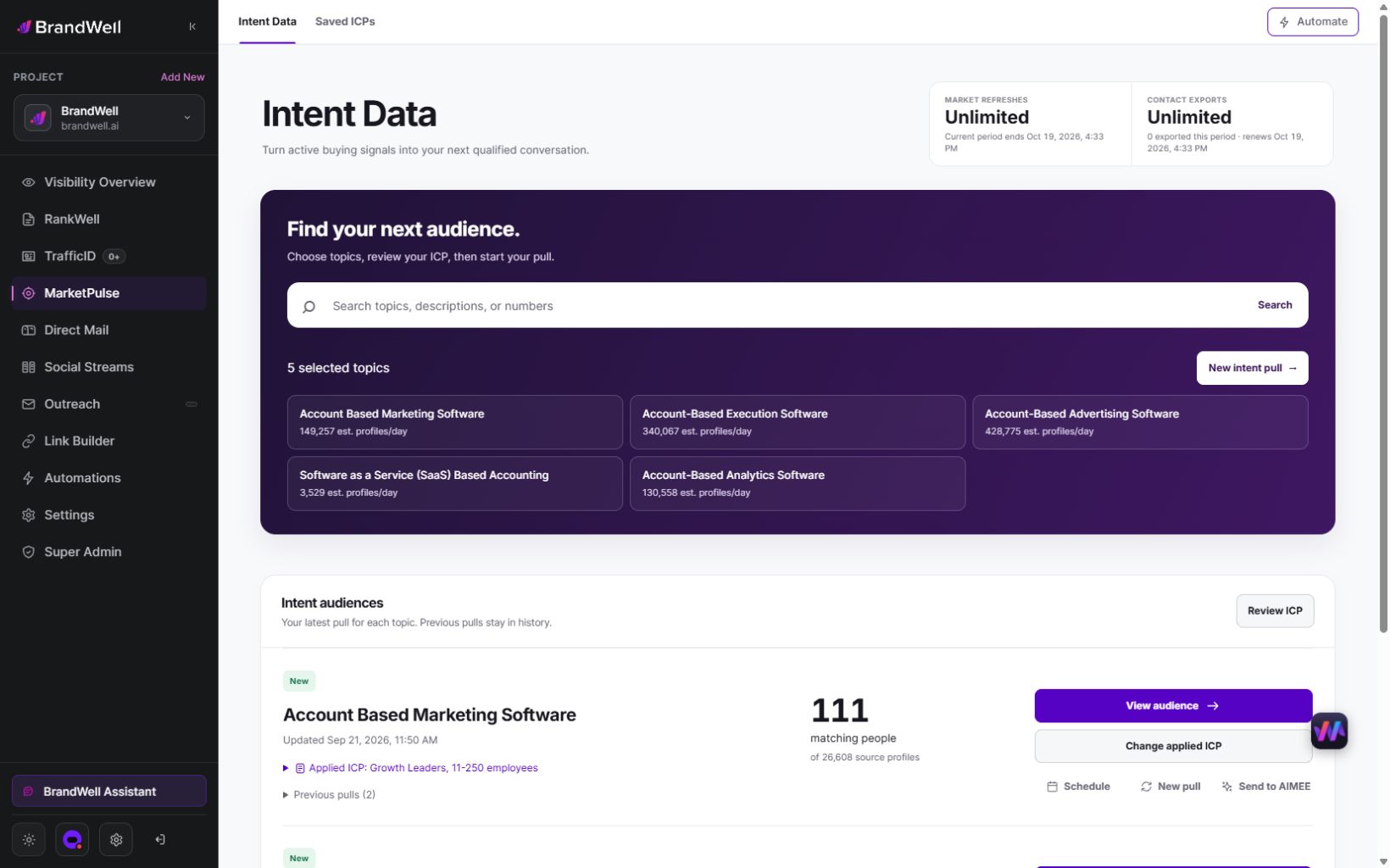
Inspect the topic and ICP, check available records and agree a reviewed output with the client. Use AIMEE through configured tools to draft the brief with references and unknowns, then have its owner verify the result. Watch the demo and review current plans.
Reviewed and updated October 3, 2026.

Written by