


On this page
- Decide what “identify a visitor” must mean
- Use one comparison method for every vendor
- Test website visitor identification before rollout
- Compare identification with analytics, retargeting, and manual research
- Model total cost and agency margin
- Measure identification through an outcome funnel
- Know when visitor identification is a poor fit
- Build privacy and correction into operations
- Package visitor identification as a recurring agency service
- Frequently asked questions
- Use TrafficID for your website and MarketPulse for research topics
- Put buyer intent to work with MarketPulse
Website visitor identification associates eligible site activity with a company, account or person. Define the identity level and follow-up your team needs, then test coverage, fit, uncertainty and operating cost on your actual traffic.
This guide gives B2B teams and agencies an evaluation and rollout process. In BrandWell, TrafficID addresses visitors to your website; MarketPulse provides topic-based research audiences. Keep those signals and their measurement separate.
Decide what “identify a visitor” must mean
Standard web analytics describes sessions, sources, pages, and conversions. Website visitor identification tries to associate eligible activity with a company, account, or person. Those are different products and risk profiles:
- Company identification may help a seller research an account without claiming to know the individual visitor.
- Person identification can create a closer follow-up trigger, but availability, geography, confidence, notice, and permitted use require stricter review.
- Known-user recognition connects activity to someone already authenticated or otherwise known through first-party data; it should not be confused with third-party resolution.
- Account identification plus analytics connects visits with journeys, campaign performance, or audience activation, adding value and implementation complexity.
Write the required output before choosing software. Does the team need a weekly account report, real-time seller alerts, enrichment, person records, custom ad audiences, or a white-label client portal? If company-level research solves the problem, do not buy a more sensitive person-level workflow merely because it appears powerful.
An identified record is not proof of who physically viewed a page, consent to contact, or evidence of a purchase decision. It is a lead for internal qualification. The best tools make uncertainty, eligibility, and correction operationally manageable.
Use one comparison method for every vendor
Score each platform with the same evidence:
- Identity level: company, person, known user, fields, geography, confidence, and exclusions.
- Source and freshness: how activity and identity are derived, timestamped, refreshed, corrected, and suppressed.
- Fit and qualification: filters, firmographics, topics, pages, recency, role checks, and reason codes.
- Activation: reports, alerts, CRM, enrichment, audiences, outreach, retries, and outcome write-back.
- Agency operations: client separation, white-label rights, branding, permissions, wholesale economics, agency-owned billing, and offboarding.
- Governance: notice and opt-out support, data roles, sensitive-use limits, retention, deletion, security, and subprocessors.
- Total cost: plan, usage, identified visitors, credits, add-ons, integrations, setup, operator labor, support, and term.
- Evidence: blind-sample results, failure visibility, corrections, adoption, and downstream outcomes.
- Best fit and limitation: where the option earns a shortlist place and what could disqualify it.
Do not compare a self-serve visitor alert with an enterprise analytics platform as though they include the same work. Normalize to the operating result the buyer needs.
Test website visitor identification before rollout
Build an eligible traffic denominator
Remove bots, employees, existing test traffic, unsupported locations, sensitive site areas, and pages outside the use case. State whether the denominator is visits, unique devices, people, accounts, or eligible events. Without this step, an “identification rate” cannot be compared.
Run a blind identity and fit sample
Review a random sample without vendor confidence labels. Score correct entity, required fields, freshness, duplicates, fit, suppression, and unresolved cases. Separate company and person results. Include negative and edge cases rather than only known customers.
Use a shadow queue
Route records into review before sellers, ads, or sequences. The operator records why each record passed or failed. The client independently reviews part of the sample. Revise the rule until disagreements are understandable.
Test production failures
Trigger missing owners, CRM downtime, duplicate writes, stale contacts, unsupported geographies, over-volume, suppression, correction, and deletion. Verify retries and failure alerts. A successful pixel installation is not an end-to-end implementation test.
Launch a controlled action
Start with account research or an internal alert. Add person outreach or ad-audience activation only after a separate approval. Never reveal a visitor’s browsing trail in a message. Keep a control group or baseline so normal inbound demand is not automatically credited to the tool.
Compare identification with analytics, retargeting, and manual research
Standard analytics supports aggregate channel, page and conversion measurement. Visitor identification supports a different question: whether eligible activity can inform research or follow-up for a company or person. Compare each against the work you need rather than assuming one replaces the other.
Cookie or pixel retargeting can reach recent visitors without revealing identity to the marketer. It may be sufficient when the goal is advertising rather than seller action. Platform match and policy constraints still apply.
Manual account research works when volume is low and the team already has high-fit accounts. It avoids paying for broad coverage but can miss otherwise hidden demand and does not scale consistently.
Visitor identification adds value when the business can qualify and act on records quickly. It should not replace analytics, consent management, CRM hygiene, or human judgment.
Model total cost and agency margin
Subscription price is only one line. Include traffic or credit units; eligible geography; company versus person records; enrichment; API or connector access; client accounts; white-label rights; support; setup; privacy and security review; CRM fields; suppression; operator time; reporting; corrections; and overages.
Calculate:
Cost per accepted record = total monthly technology and direct operating cost ÷ records accepted by the client rule.
For an agency:
Contribution margin = client fee − allocated platform and usage − direct delivery labor − client-specific tools.
Use setup fees for material one-time work and change control for new sites, regions, destinations, or plays. Avoid “unlimited” promises unless the wholesale contract and staffing model truly support them.
Measure identification through an outcome funnel
Report eligible events, resolved companies, resolved people where applicable, required-field completeness, freshness, duplicates, fit-qualified records, suppression, accepted alerts, actions within SLA, qualified conversations, opportunities, revenue, and negative outcomes. Show raw counts and rates.
Original worked example: keep the denominators visible
In a hypothetical monthly test, a team records 2,000 eligible visits, 160 candidate records, 100 accepted records and 60 completed reviews or actions. The candidate-record yield is 160 / 2,000 = 8%; acceptance is 100 / 160 = 62.5%. This does not mean 8% of unique people were correctly identified: visits and people are different units.
If direct technology and operating cost totals $600, cost per accepted record is $600 / 100 = $6. These are illustrative figures, not TrafficID results. Track later qualified conversations separately and compare against a baseline or control where the design permits.
Use a baseline or holdout. If the identified group contains better-fit accounts by design, higher conversion does not prove the tool caused the difference. Monitor cost per accepted record, cost per completed action, and incremental qualified outcome where the design permits.
Track quality over time. Sources, traffic mix, campaigns, job changes, and client rules drift. Sample weekly during launch and at a defined recurring cadence afterward.
Know when visitor identification is a poor fit
Good-fit clients have meaningful eligible B2B traffic, a defined account model, enough seller or campaign capacity, clear data ownership, and measurable outcomes. Poor-fit cases include low traffic, consumer-heavy sites, unsupported regions, sensitive contexts, unclear notices, no account owner, weak CRM outcomes, or a plan to message people about pages they viewed.
A local-market service business may gain more from conversion optimization and first-party capture. A company with a tiny named-account list may use manual research and account alerts. A regulated or sensitive site may need to avoid person resolution entirely.
Build privacy and correction into operations
Map the collection, source, entity resolution, enrichment, storage, destinations, access, retention, deletion, and subprocessors. Confirm responsibilities and notices for the relevant jurisdictions and channels. Hashing a match key does not create consent or make every audience use permissible. Review the actual data flow and safeguards; hashing is not a substitute for access controls or encryption.
Never describe a person as a known buyer solely because a vendor returned a profile. Do not reveal browsing behavior in outreach. Maintain opt-out and deletion paths and propagate suppression to every downstream system. The FTC’s business guidance is a useful starting point for minimizing data and implementing reasonable safeguards: review FTC privacy and security resources.
Package visitor identification as a recurring agency service
A defensible service includes site and use-case eligibility; installation and monitoring; identity and fit rules; suppression; client workspace and permissions; approved routing; weekly launch sampling; monthly funnel and outcome reporting; correction and deletion handling; usage controls; training; and quarterly governance review.
Add topic intent only when it improves the reason to prioritize. Add ad audiences only after platform and privacy review. Add outreach only after contact validation, suppression, and human approval. The service promise is a better prioritization and operating process, not identification of everyone or guaranteed pipeline.
Use the BrandWell tools available in the selected package to research, prepare content and plan follow-up. AIMEE works through configured tools and permissions. Agencies define their client scope, delivery fees and responsibilities; confirm data-use rights and available features before promising a branded portal or managed service.
Frequently asked questions
How should an agency approach website visitor identification tools?
Define the identity level, client action, eligible traffic, governance, and unit economics first. Run a blind sample and shadow queue before launching a recurring service.
What workflow, data, integrations, and team are required?
Use an account owner, data operator, RevOps administrator, privacy/security reviewer, and activation owner. Map the pixel or event source through identity, fit, suppression, routing, action, feedback, and deletion.
How does visitor identification compare with a manual approach?
Manual research can suit low volume and known accounts. Test whether visitor identification adds usable records and a manageable review process. Include errors, labor and integration cost in that comparison.
What budget should buyers expect?
Confirm the current offer and included usage. Add implementation, review, reporting, integrations and direct delivery labor, then compare cost per accepted record at expected traffic volume.
How should website visitor identification tie to revenue?
Track the entire match-to-outcome funnel and compare against a baseline or holdout. Do not attribute normal inbound demand or better account fit automatically to the tool.
Which companies are the best fit?
B2B companies with meaningful eligible traffic, clear account criteria, fast owner response, approved use cases, and reliable CRM outcomes are best positioned.
How should identity combine with fit and intent?
Require correct entity, current fields, target-account or role fit, relevant recent behavior, suppression, permitted action, successful routing, and outcome feedback. Identity alone is not qualification.
What are the biggest risks?
Wrong or stale identities, shared networks, unsupported geography, missing notices, revealing outreach, absent suppression, insecure access, integration overwrites, over-volume, and misleading attribution are the main risks.
How should an agency include identification in a recurring service?
Bundle eligibility, setup, quality sampling, qualification, routing, branded reporting, outcome review, corrections, governance, usage controls, change management, and clear agency-owned client billing.
Use TrafficID for your website and MarketPulse for research topics
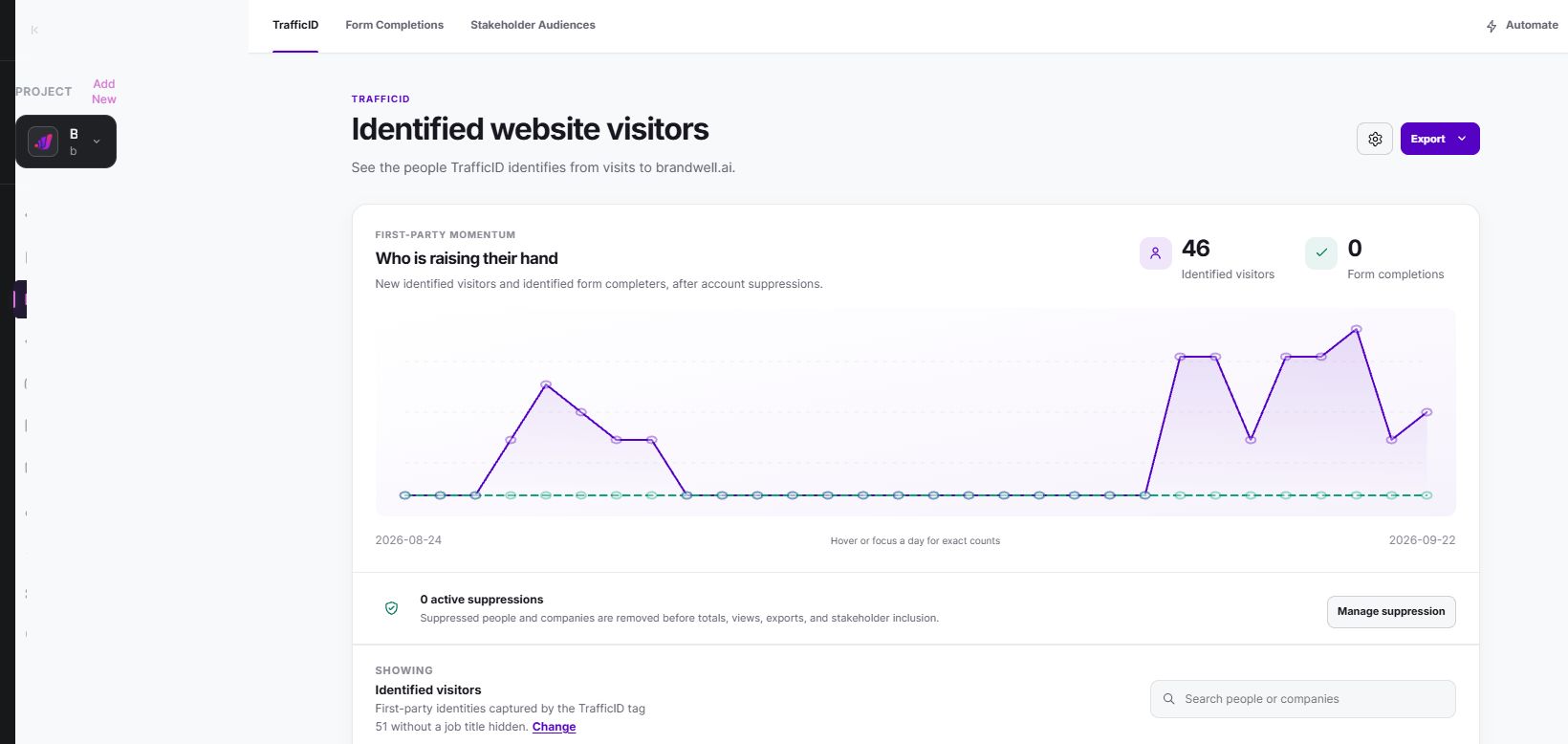
TrafficID helps review identified visitors to your own website. In the current BrandWell portal, evaluate the available visitor information and context, qualify the record and choose a follow-up consistent with your permissions and workflow. Coverage and available fields vary.
MarketPulse is a separate topic-based intent product. Search topics relevant to what you sell, apply saved ICP filters and review available people, company and contact information. Standard plans are Starter with one weekly topic and 25,000 monthly exports; Growth with three daily topics and 100,000 exports; Scale with ten daily topics and unlimited exports.
An Intent Scan retrieves available data from the previous 24 hours. Audience size, contact fields and overlap vary. Growth supports 90 pulls and Scale 300 when used daily across all included topics in a 30-day month. Starter weekly pulls vary with the calendar; eligible early-access discounts are separate offers.
Use configured Automations and AIMEE through workspace tools and permissions to prepare the next step. Keep review owners, suppression, errors and subsequent outcomes visible. Channel usage and fulfillment may cost extra.
Put buyer intent to work with MarketPulse
Find people researching your market, focus the audience with your ICP, and turn relevant signals into a useful next conversation. MarketPulse plans are starting at $500/mo.
Explore MarketPulse and watch the demo. Compare the topic coverage, refresh cadence, and exports included in each plan, then choose the one that fits your business or client work.
Reviewed and updated October 3, 2026.

Written by

