


On this page
- Separate eight audience-workflow layers
- Distinguish company, person and known-user evidence
- Verify each destination and match key
- Define purpose-specific audience cells
- Test eight source-to-destination steps
- Verify visitor research and separate ad implementation
- Compare manual and configured audience operations
- Budget identity work and media separately
- Reconcile compatible counts and outcomes
- Check source eligibility before scale
- Scope a separate audience-operations service
- Frequently asked audience-workflow questions
- Copyable visitor-to-audience validation record
- Destination-validation questions
Direct answer: Keep website observations, resolved identity, additional contacts and advertising eligibility separate. Verify each actual source, purpose, destination and suppression before an upload. A visitor association, supplier license or hashed identifier does not establish first-party customer information, consent or platform eligibility. Test the actual audience path and report its counts and limitations.
Who this is for. This implementation guide is for marketing-operations and RevOps leaders, paid-media directors, and agency operations teams connecting website visitor identification with LinkedIn, Meta, Google, or other approved advertising destinations. It is not legal advice; the organization must verify current law, contracts, notices, and platform policies for its data and jurisdictions.
BrandWell research pricing is starting at $500/mo. Verify actual TrafficID scope and current offers on its product page. Website identification and off-site MarketPulse topic research are separate inputs.
Separate eight audience-workflow layers
A controlled system has distinct layers:
- Event collection: eligible page or conversion events enter with timestamp, site, path category, and consent or notice context where required.
- Identity resolution: the event may resolve to a company, person, known user, or remain unresolved. Preserve entity level and uncertainty.
- Enrichment and validation: add only fields needed for fit and match, validate contact keys, and record freshness and source category.
- Qualification: apply ICP, behavior, recency, geography, role, and minimum-evidence rules.
- Governance: apply permitted-use, sensitive-site, notice, suppression, retention, and human-approval gates.
- Audience construction: assign an eligible record to a defined cell with purpose, destination, creative, expiration, and owner.
- Destination delivery: transform and hash match keys as required, upload through an approved route, log the source count, and capture processing results.
- Outcome and deletion loop: record matched size and campaign outcomes; propagate opportunity, customer, opt-out, correction, expiration, and deletion changes.
Keep raw website events, resolved identity, qualification state, and platform audience membership in separate fields. If one status overwrites another, operators cannot explain why a person or account entered an audience.
Distinguish company, person and known-user evidence
A company-level visit can prioritize an account without establishing the individual viewer. For account-based advertising, the operator may use the company as the research clue, then select a buying-committee audience through separately governed business data. That avoids pretending the visitor and the advertised person are the same.
A person-level record can support direct matching only when the source, geography, field validity, notice, purpose, and platform policy permit it. Even then, the resolved profile may be wrong or incomplete. Use confidence and freshness thresholds and keep a manual-review path for edge cases.
Known first-party users are a separate category. A logged-in customer, form submitter, or newsletter subscriber may have a clearer relationship, but the allowed advertising use still depends on notices, choices, contracts, and destination rules. “First-party” does not automatically mean unrestricted.
Verify each destination and match key
Create a worksheet with one row per platform and audience. Include: audience purpose; source population; entity level; required and optional match keys; validation rule; normalization; hashing or transfer method; source count; rejected count; uploaded count; matched count; unmatched count; refresh cadence; retention; suppression sources; deletion SLA; owner; and current policy evidence.
Possible keys differ by destination and entity type. Verify the actual platform’s required fields and eligible sources; a company domain is not interchangeable with a person identifier. Do not collect a field solely because a destination might accept it. Start with the smallest set that supports the approved match.
Normalize without silently “fixing” uncertain identity. Record which fields were changed, rejected, or left blank. Validate email and phone status where included. Keep original timestamps and an audience-build timestamp so the team can distinguish fresh activity from a recently uploaded stale record.
Verify the current requirements directly in each advertising account. API access, minimum audience sizes, processing times, acceptable sources, and policy can change. A data vendor’s generic “activation” label does not prove that the buyer has an authorized, functioning destination path.
Define purpose-specific audience cells
Do not make one permanent “identified visitors” audience. Useful cells include:
- High-intent target accounts: target companies with recent direct-category research or high-value site behavior.
- Fit-only company visitors: eligible ICP companies with web activity but no qualifying intent; useful as a control.
- Known engaged leads: people with an existing first-party relationship and current approved use.
- Buying-committee expansion: separately selected roles at a qualified company; never imply they were the visitor.
- Open-opportunity nurture: accounts already in pipeline, with sales ownership and coordinated messaging.
- Customer expansion: customers eligible for a distinct approved use, isolated from acquisition.
- Suppression: customers or opportunities not eligible for the campaign, employees, competitors, opt-outs, deletions, sensitive cases, and unsupported regions.
- Expired: records whose behavior or identity is older than the audience’s stated window.
Each cell gets one purpose, one owner, and an expiration. If creative or optimization goals differ, separate audiences. This makes audience performance and deletion manageable.
Test eight source-to-destination steps
1. Map eligibility and notice
List every site, subdomain, page category, region, consent state, and data source. Exclude sensitive or unsupported contexts. Confirm contracts, privacy notices, opt-out mechanisms, and roles before collection or sharing.
2. Install and observe without activating
Validate event collection, bot and employee filtering, timestamps, duplicate behavior, source outages, and expected volume. Run in shadow mode. A client should see what is collected and what remains unresolved.
3. Validate identity and qualification
Blind-review a sample for entity correctness, field validity, freshness, fit, and false positives. Require multiple evidence points for higher-consequence audiences. Preserve rejected and unresolved records in the report.
4. Apply suppression before the audience tool
Centralize customers, opportunities, unsubscribes, opt-outs, deletions, employees, competitors, and policy exclusions. Apply suppression before upload and again at the destination when supported. Record the version and count removed.
5. Create, approve, and version the audience
Generate an immutable build file or API payload with a unique version, source hash, rule version, record count, expiration, and approver. Separate production from test audiences. A human reviews changes to sources, rules, platforms, or sensitive uses.
6. Upload through an approved route
Use a controlled service account, least privilege, secure transfer, and logged job. Capture validation errors, uploaded count, platform processing status, and matched size. Retry only the failures that are safe to retry; do not duplicate an entire upload blindly.
7. Reconcile and monitor
Reconcile eligible source records to qualified, suppressed, uploaded, rejected, and matched counts. Monitor audience size, freshness, frequency, spend, qualified outcomes, and negative feedback. Large count changes trigger investigation.
8. Refresh and delete
Use incremental adds and removals where possible. Expire stale intent. Remove a record after deletion, opt-out, disqualifying status, or the end of the stated purpose. Confirm propagation to every downstream audience and preserve an audit record without retaining prohibited personal data.
Verify visitor research and separate ad implementation
BrandWell publishes this guide. Evaluate TrafficID visitor research separately from custom audience joins, destination uploads, media operations and agency services. This is a workflow checklist rather than an independent platform ranking.
Current TrafficID visitor-research input
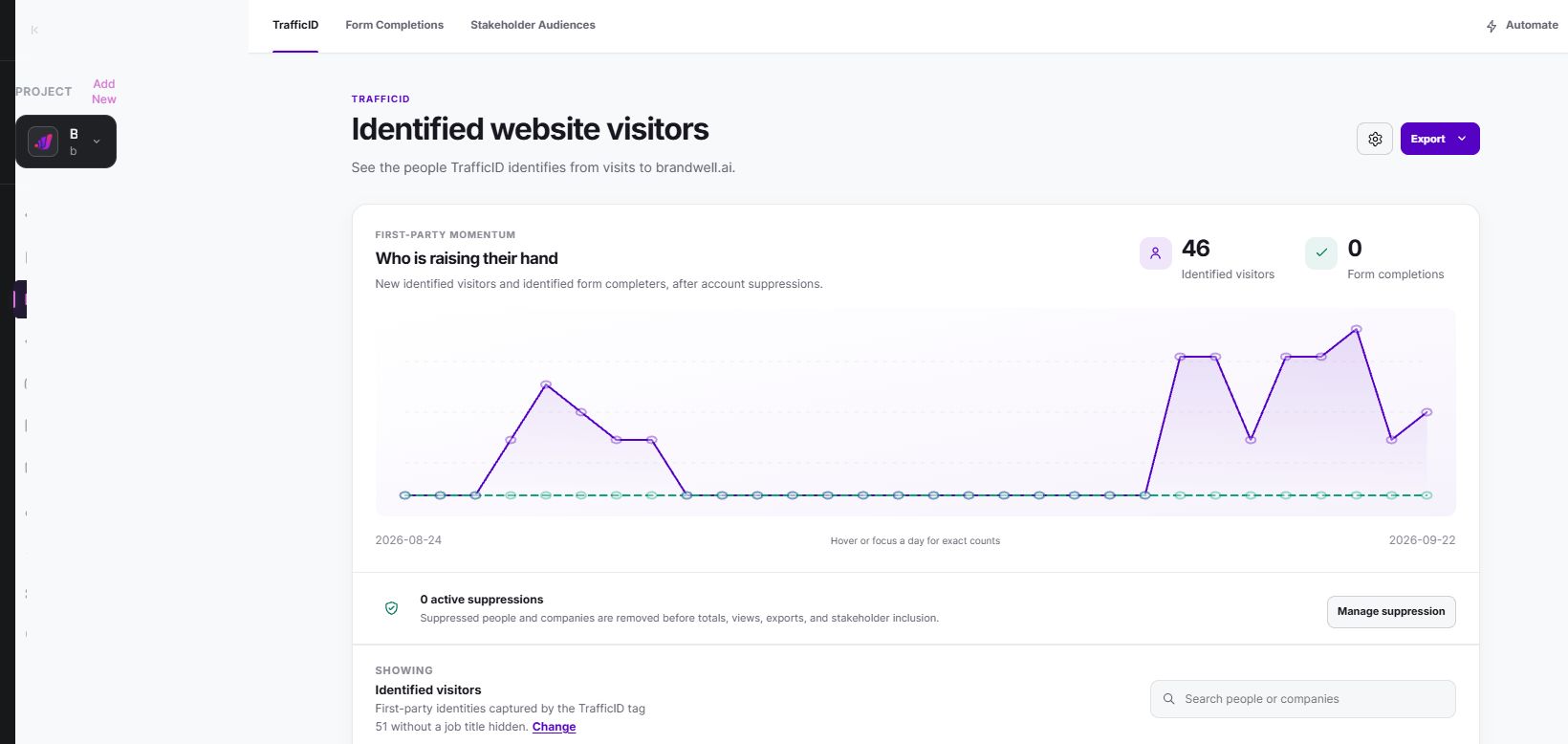
TrafficID is the current BrandWell product for own-site visitor identification. Review actual visit context and keep added stakeholders separate from observed visitors. A research record does not establish advertising eligibility. Review TrafficID and its demo.
Compare manual and configured audience operations
Compare a reviewed manual pilot, an existing advertising-account workflow and a separately implemented audience service against the actual scope. Verify source eligibility, implementation, ownership, destination processing and removal. A TrafficID subscription does not establish a native white-label multi-client advertising platform.
A manual process is appropriate for a small named-account list or an early proof. An operator can review company visits, select eligible accounts, identify roles separately, and build an approved audience. Manual work is slower but exposes assumptions. Automate only after the rule, suppression, reconciliation, and deletion loop are stable.
Budget identity work and media separately
Total cost includes website identification, enrichment, data validation, audience software, destination access, integration, secure storage, operator labor, privacy and security review, creative, media, reporting, correction, and deletion. For an agency, add client setup, branded delivery, meetings, support, and margin.
Use cost per qualified uploaded record and cost per matched qualified record for diagnosis. Use cost per accepted lead, qualified opportunity, and incremental contribution for decisions. A low-cost platform with weak match keys or heavy correction can be expensive operationally.
Separate one-time architecture and implementation from recurring monitoring and refresh. Use usage bands and change control for new sites, regions, sources, platforms, and audiences. The agency bills its own clients and should not hide media inside a software comparison.
Reconcile compatible counts and outcomes
For every build, report eligible events, resolved records, complete records, qualified records, suppressed records, uploaded records, platform rejects, matched audience size, delivered reach, spend, accepted leads, qualified opportunities, revenue where observable, opt-outs, complaints, and deletions.
Platform match rate is:
Destination-reported matches divided by the corresponding accepted unique source records, only if those units and windows are compatible, using the destination’s available reporting and its limitations.
It is not the visitor-identification rate. Keep both denominators. A low platform match can result from stale keys or destination coverage even when company resolution is correct.
Use fit-only and intent-assisted cohorts where feasible. Record overlap and randomization. Do not credit all retargeting conversions to visitor identification; those visitors may already have been likely to return.
Check source eligibility before scale
The highest-risk failure is using a resolved identity for a purpose the person did not reasonably expect or the platform does not permit. Review site sensitivity, geography, data source, notice, opt-out, contract roles, minimization, security, retention, deletion, and audience policy. Do not infer sensitive traits from browsing.
Never put a person’s browsing details into ad creative. Avoid micro-audiences that can expose individuals. Maintain frequency and exclusion controls. Hashing identifiers does not create consent, and a vendor’s contract does not replace the advertiser’s own responsibilities.
Resolve actual jurisdiction, source, purpose, notice, recipient, destination policy, access, retention and deletion requirements before sharing. A framework reference or vendor contract does not replace the advertiser’s responsibilities.
Scope a separate audience-operations service
An agency service can include site eligibility; collection monitoring; identity and fit sampling; audience taxonomy; match-key validation; suppression; versioned builds; destination delivery; count reconciliation; refresh and expiration; campaign QA; branded reporting; outcome analysis; correction and deletion; and quarterly governance.
Set SLAs for data failures, audience jobs, suppression, and deletion – not for platform delivery or pipeline the agency cannot control. The client approves purposes and creative. The agency operates the documented system and bills the client under its own agreement.
Keep TrafficID website observations separate from additional stakeholder contacts and off-site MarketPulse topic research. AIMEE can organize supplied context through configured tools; owners approve actual destinations and writes. Custom client reports and advertising operations require separately verified implementation, rights and fees.
Frequently asked audience-workflow questions
How should marketing operations turn identified visitors into ad audiences?
Pass eligible events through identity, fit, freshness, permitted-use, suppression, and destination match-key gates. Version the audience, reconcile counts, and remove records when purpose or eligibility ends.
What workflow, data, integrations, and team are required?
Use collection, resolution, enrichment, qualification, governance, audience, destination, and outcome layers. Assign marketing operations, paid media, privacy/security, data, sales, and client approval owners.
Which tools are useful for visitor-to-audience activation?
TrafficID is own-site visitor research. Verify separately implemented destination eligibility, uploads, reporting, client separation and removal; do not imply a native white-label advertising suite.
How does this compare with a manual approach?
Manual review is appropriate for a small pilot and makes assumptions visible. Automation adds speed and refresh but should follow stable rules, suppression, error handling, and deletion.
What budget should a buyer expect?
Budget identity data, validation, integrations, secure operations, audience tooling, creative, media, reporting, and governance separately. Compare cost per matched qualified record and qualified outcome.
How should the workflow tie to pipeline or revenue?
Measure from eligible event through resolution, qualification, upload, match, delivery, accepted lead, opportunity, and revenue. Use a baseline or holdout and disclose attribution limits.
Which companies are the best fit?
B2B organizations with meaningful eligible traffic, clear account criteria, approved advertising uses, sufficient matchable data, reliable CRM outcomes, and operating capacity are best positioned.
How should fit, identity, freshness, and intent combine?
Require all of them for a high-priority audience. A recent signal on the wrong entity or a correct identity with no fit should not enter merely because it is available.
What are the biggest risks?
Unsupported collection or use, incorrect identity, stale match keys, missing suppression, sensitive inference, policy violations, audience overlap, insecure access, hidden rejects, and misleading attribution are the major risks.
How should an agency package this as a recurring service?
Bundle monitoring, qualification, versioned audience builds, suppression, delivery, reconciliation, refresh, campaign QA, branded reporting, outcome analysis, corrections, deletion, and governance under agency-owned billing.
Copyable visitor-to-audience validation record
Source: [Actual event, identity origin and entity level.] Purpose: [Approved advertising use and audience cell.] Destination: [Current eligibility, account access and match-key requirements.] Suppression: [Rule version, exclusions and removal acknowledgements.] Build: [Unique units, approved fields, version and error handling.] Outcome: [Compatible counts, actual delivery, mature feedback and costs.] Choice: [Hold, approve or repair; owner and next review.]
Google Customer Match has source restrictions
Google’s current Customer Match documentation permits advertiser-acquired first-party data and prohibits purchased third-party email lists. Consent and account eligibility also apply. A vendor-resolved identity or added stakeholder is not automatically eligible.
The documentation also directs new or non-allowlisted Customer Match implementations toward Data Manager API. Verify the actual current route rather than assuming an old Google Ads API example works for the account. Other destinations require their own separate checks.
Hashing cannot change source eligibility
A fictional contact is supplied through enrichment and has no verified eligible first-party origin for the intended Customer Match use. Hashing the email changes its representation, not its origin or permission. Hold that route; do not relabel the data as advertiser-acquired because it is associated with a website visit.
Separate records, identifiers and reach
A fictional approved file has 100 unique people, each with an email and phone identifier: 200 identifiers, not 200 people. Ten people fail validation, leaving 90 accepted source records. If the destination reports 54 compatible matched users for that same cohort and window, the illustrative match rate is 60%. A rounded active-audience size or campaign reach count cannot be substituted silently for exact matched users.
One account observation does not make every stakeholder a visitor
A fictional company visit leads to five separately selected contacts. Record the company-level observation and five candidate stakeholders separately. Do not present five observed visitors, inherit advertising permission or write browsing details into personalized creative.
Removal needs its own acknowledgement
A fictional source suppression removes a person from the next file while a destination removal job is still pending. Keep the unresolved destination visible. Omitting the person from an add-only refresh is not proof that the prior audience membership ended.
Overlap changes the denominator
Two fictional audience cells contain 80 and 60 unique members, with 20 in both. Their union is 120, not 140. Preserve intended overlap, exclusions and assignment when interpreting delivery and outcomes. An attributed conversion alone does not establish incremental value from identification.
Destination-validation questions
Does hashing make enriched data first-party?
No. Verify actual source and destination eligibility.
Are two identifiers two people?
No. Keep unique records and identifier counts separate.
Does an add-only refresh prove removal?
No. Verify the actual removal process and acknowledgement.
Is audience size the same as campaign reach?
No. Preserve actual units, reporting limits and windows.
Review own-site visitor research: explore TrafficID and its demo.
Reviewed and updated October 3, 2026.

Written by

