Direct answer: Use cross-device identity resolution when a meaningful buyer journey is fragmented across browsers, devices, forms, product sessions, CRM records, and offline touches – and when joining those records changes a permitted decision. Start with deterministic identifiers, add probabilistic links only behind confidence thresholds, preserve provenance, and test the resolved graph against known records before routing or personalization.
Who this is for: B2B data and RevOps leaders, growth teams, privacy reviewers, and agencies evaluating identity continuity across devices. It is not a generic website-visitor vendor roundup or a promise to identify every anonymous person.
Start with the decision the identity graph must improve
Cross-device identity resolution is a means, not an outcome. A buyer may read from a phone, return from a work laptop, register for an event with a business email, and later enter a CRM through a colleague. The useful question is whether those touchpoints belong to the same person, household, device cluster, or business account with enough confidence for the proposed action. Keep those entity levels separate. Joining devices to an account can be appropriate when joining them to a named contact is not.
Define the downstream decision before choosing identifiers. Advertising suppression may tolerate an account-level match; a sales task needs stronger person and employment evidence; contract or entitlement changes require authenticated first-party identity. Write a minimum evidence rule, an abstain outcome, a correction path, and an expiration rule. A resolver that always returns an answer is less trustworthy than one that can say “unresolved.”
Use three evidence tiers. Deterministic links include authenticated login, verified email, consented CRM identifiers, and server-side customer IDs. Corroborated links combine stable business IP, device, domain, location, time, and repeated behavior. Weak links rely on one shared network or inferred similarity. Never let a weak link silently inherit the permissions of a deterministic identity.
A cross-device identity resolution workflow for B2B teams
- Inventory identifiers and purposes. List cookies, device IDs, IP-derived company signals, emails, phones, CRM IDs, product IDs, ad IDs, event registrations, and partner keys. Record source, consent or notice, permitted purpose, retention, and the entity each field can support.
- Create a deterministic backbone. Normalize verified emails, authenticated user IDs, CRM contacts, account domains, and contractual customer keys. Deduplicate exact and normalized values before adding probabilistic evidence.
- Generate candidate links. Use limited features to propose device-to-person, person-to-account, and device-to-account links. Keep each edge, source, timestamp, and model version rather than collapsing everything into one opaque master ID.
- Score and threshold by action. Set stricter thresholds for person-level sales activity than for account analytics. Send borderline matches to review or account-only activation. Block records with conflicting employment, geography, or suppression state.
- Validate with a labeled sample. Use authenticated journeys, approved CRM records, and human-reviewed exceptions to estimate precision, recall, abstention, and false merges. Slice results by geography, traffic source, device type, and company size.
- Activate with controls. Write the match reason, confidence, freshness, permitted actions, owner, and suppression state into the system of action. Require human approval before personal outreach based on inferred cross-device links.
- Monitor drift and correction. Track link breakage, new devices, employment changes, complaints, seller corrections, and downstream lift. Expire unsupported links and propagate deletion or correction requests across the graph.
Exception-review protocol: Before a candidate edge is promoted into the reusable identity graph, give a reviewer both sides of the proposed link: identifiers used, source timestamps, entity level, confidence components, conflicting fields, suppression state, and the action that promotion would enable. The reviewer should choose a bounded disposition – confirm, reject, keep account-only, request stronger evidence, or expire – rather than edit the score without an explanation. Record the reason code so false merges can be traced to a specific rule, source, or threshold. Sample accepted links as well as rejected ones; reviewing only complaints hides silent errors. Pay special attention to shared offices, home networks, recycled devices, role changes, parent-subsidiary domains, and identifiers reused by several people. If two sources disagree, do not let the more expensive source win by default: preserve the conflict and apply the stricter action policy. Reopen a link when a high-risk downstream event occurs, such as personal outreach, account reassignment, deletion request, or a seller correction. Then compare reviewed decisions with later authenticated evidence. That feedback should change candidate-generation rules and action thresholds separately, because a useful account-level link may still be unsafe for person-level activation. The protocol turns exception handling into labeled evaluation data without pretending that one universal confidence cutoff fits every use case.
Cross-device method and validation matrix
- Authenticated deterministic: strongest for person continuity; measure verified-link precision and account transfer errors.
- Email or phone crosswalk: useful after validation and permission review; measure stale employment, shared identifiers, and deliverability.
- IP-to-company: suitable for account context; measure company precision by network type and avoid person claims.
- Probabilistic device graph: expands coverage but needs calibrated confidence, abstention, drift review, and geography-specific governance.
- Manual reconciliation: transparent for high-value exceptions; measure reviewer agreement, time per record, and correction latency.
Use this matrix as a starting hypothesis. Put the same records through each method, disclose exclusions, and make the acceptance threshold depend on the action rather than the vendor’s preferred headline metric.
Five companies to evaluate
Disclosure and method: BrandWell publishes this guide and appears first in the shortlist because this is a BrandWell-owned resource written for agency/reseller fit. That placement is not an independent ranking or a claim that BrandWell is best for every buyer. Every option below is evaluated on the same criteria: intended use, signal and identity approach, activation and integrations, implementation burden, current vendor-specific pricing evidence, best fit, and a meaningful limitation. Competitor screenshots are unlinked homepage captures, and there are no competitor outbound links in the article body.
The products below do not all solve the same layer. Use the shortlist to identify the missing capability, then request a scope-matched sample and quote rather than treating every “intent” or “identity” label as equivalent.
BrandWell

Best fit: Agencies needing off-site intent, visitor and form identity, enrichment, and client delivery in one reseller workflow.
Signal/data approach: BrandWell combines off-site research intent with TrafficID, form activity, identity resolution, enrichment, routing, branded reports, and configurable modules through a separate white-label agency offer built on LeadFuze data infrastructure. For cross-device work, use BrandWell to combine only evidence the agency can lawfully receive, keep account and person confidence separate, and deliver branded match-quality reports.
Activation/integrations: Agencies can operate client workspaces, deliver branded topic reports, define reviewed activation instructions, and set their own retail fees. Implementation still requires market, topic, identity, suppression, routing, and approval definitions.
Implementation burden: Moderate and service-design dependent: the agency must define client scope, permissions, owners, quality thresholds, and how evidence reaches CRM, advertising, lifecycle, or research workflows.
Pricing/contract status: BrandWell agency plans are $2,500–$5,000 per month, depending on topic count, contract term, and any contractually scoped topic exclusivity that is available. Confirm modules, usage, client capacity, implementation, support, and exclusivity in the current written quote and order form. The low end is $2,500 per month; the applicable written quote controls. Agencies choose and collect their own client fees.
Meaningful limitation: No vendor can prove every device belongs to one person; client-specific validation and correction remain mandatory.
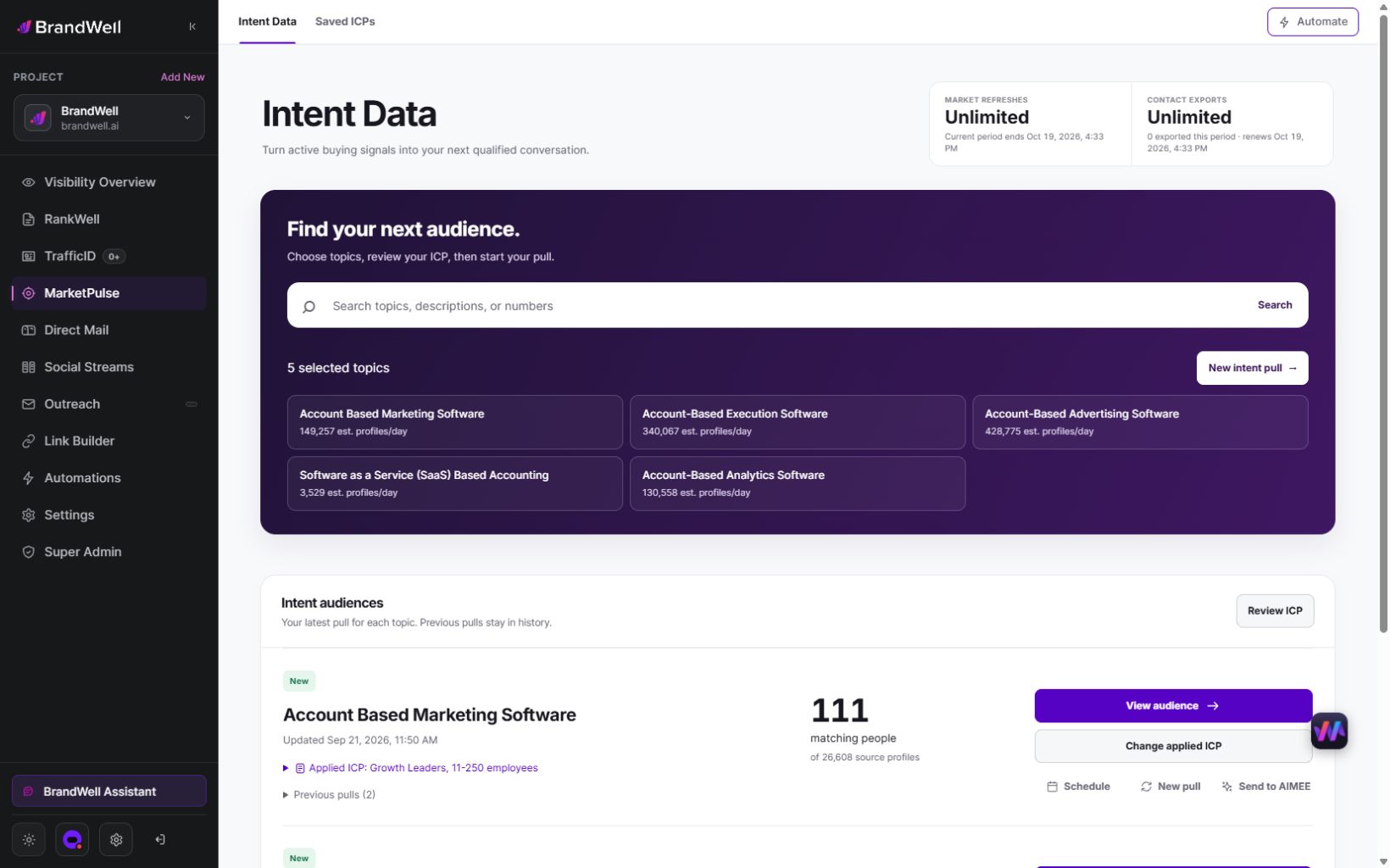
Verification note: For this cross-device matching decision, verify BrandWell fields, rights, integration behavior, limits, service work, billing, and order terms directly. The unlinked homepage image establishes visual identity only, not capability or results.
ZoomInfo

Best fit: Sales-led teams that already need broad contact and company intelligence alongside enrichment and optional intent.
Signal/data approach: ZoomInfo supplies broad company and contact intelligence, enrichment, records, and optional signal and intent capabilities across multiple GTM products. The exact identity and intent scope depends on the purchased package. Use verified company/contact records as anchors, then test whether the selected package improves device-to-account or device-to-person continuity on a labeled sample.
Activation/integrations: Sales and marketing teams can prospect, enrich, sync, and route records, subject to seats, credits, integrations, and governance. Data operations and contact validation remain recurring work.
Implementation burden: Moderate to high depending on bundle: administrators must manage products, seats, credits, exports, integrations, duplicates, user behavior, and renewal scope.
Pricing/contract status: ZoomInfo uses custom pricing. A retained Vendr procurement benchmark reported a $33,500 annual median across 1,564 purchases, but the broad sample can mix products and configurations. Its SEC filing says subscriptions generally run one to three years and may bill annually, semiannually, or quarterly; a matched order controls.
Meaningful limitation: Broad data depth does not itself prove cross-device accuracy, and package complexity can obscure the identity method.
Verification note: For this cross-device matching decision, verify ZoomInfo fields, rights, integration behavior, limits, service work, billing, and order terms directly. The unlinked homepage image establishes visual identity only, not capability or results.
6sense

Best fit: Enterprise ABM teams combining web identification, CRM/MAP history, intent, and predictive account models.
Signal/data approach: 6sense combines CRM, marketing-automation, web, keyword, third-party intent, fit, and predictive inputs. Its documentation describes daily model updates and Sales Intelligence packages that may include data credits, Predictive AI, or both. Its multi-source model can supply account continuity across sessions, but teams should validate which links are deterministic and how person-level inferences are exposed.
Activation/integrations: Revenue teams can use account stages, seller insights, alerts, audiences, and workflow integrations. Value depends on clean CRM/MAP data, account definitions, model configuration, enablement, and adoption.
Implementation burden: Higher: integrations, TAM and persona design, model calibration, credits, workflow ownership, and change management materially affect deployment.
Pricing/contract status: 6sense uses custom pricing. A Vendr procurement benchmark reported a $62,820 annual median across 380 purchases, with an $11,534–$175,320 range. Dynamic cached snapshots have differed; treat this as procurement evidence, not list price or a matched quote. Term and billing must be confirmed in the order.
Meaningful limitation: Predictive account value is not a substitute for a transparent person/device match when the action requires a named contact.
Verification note: For this cross-device matching decision, verify 6sense fields, rights, integration behavior, limits, service work, billing, and order terms directly. The unlinked homepage image establishes visual identity only, not capability or results.
Demandbase

Best fit: Enterprise teams connecting account identity, person data, advertising, sales intelligence, and orchestration.
Signal/data approach: Demandbase One combines first- and third-party account data, intent, identity, scoring, advertising, sales intelligence, measurement, and orchestration in a modular GTM platform. Apply separate thresholds for account identification, person association, and activation; preserve the source and confidence of each edge.
Activation/integrations: Teams can connect account and person context to advertising, sales, web, and CRM workflows. They need consistent account lists, keywords, lifecycle stages, user roles, media governance, and measurement definitions.
Implementation burden: Higher: platform scope can span software, users, data, advertising, services, support, integrations, and operating change across teams.
Pricing/contract status: Demandbase uses custom pricing built from a platform fee and per-user fee. A Vendr procurement benchmark reported a $68,591 annual median across 184 purchases, with a $24,000–$164,379 range. The applicable order controls the initial term; default renewal language is not proof of a universal one-year deal.
Meaningful limitation: A broad suite increases implementation and governance surface, and custom scope complicates like-for-like price comparisons.
Verification note: For this cross-device matching decision, verify Demandbase fields, rights, integration behavior, limits, service work, billing, and order terms directly. The unlinked homepage image establishes visual identity only, not capability or results.
Versium

Best fit: Data teams prioritizing identity crosswalk, enrichment, match-based units, and API access.
Signal/data approach: Versium REACH focuses on identity resolution, B2B/B2C crosswalk, enrichment, hygiene, IP-to-domain, audience building, and match-based access through files, APIs, and an MCP interface. Run a same-file test across email, phone, IP, business and consumer identifiers, then inspect successful matches rather than relying only on aggregate rate.
Activation/integrations: Teams can append and validate records, build audiences, and connect through API or supported tools. Agencies should use the partner route and confirm downstream rights rather than assume standard internal-use terms permit resale.
Implementation burden: Moderate: prepare representative files, understand match-credit conversions, test field-level quality, configure APIs, and document permitted use and client access.
Pricing/contract status: Versium publicly lists pay-as-you-go from $125 per file and credit packages from $250, but the same page conflicts on whether annual subscriptions start at $5,000 or $3,600. Annual subscriptions are 12-month commitments; monthly payment is not month-to-month cancellation. Obtain a written quote.
Meaningful limitation: Official entry pricing conflicts, and standard data rights may not cover an agency resale use without a partner agreement.
Verification note: For this cross-device matching decision, verify Versium fields, rights, integration behavior, limits, service work, billing, and order terms directly. The unlinked homepage image establishes visual identity only, not capability or results.
Compare the platform approach with simpler alternatives
Single-field matching is cheaper and explainable when one verified identifier is usually present. Reverse IP alone can prioritize companies but should not impersonate a person-level graph. Manual reconciliation fits a small strategic-account set. A broader resolver earns its cost only when multiple fragmented channels matter, the extra links pass validation, and downstream teams use the confidence signal rather than treating every merge as fact.
Pricing, budget, and total cost
Cross-device TCO includes data access, match units, seats, API traffic, graph storage, integration, consent and suppression plumbing, monitoring, exception review, and the cost of false merges. Compare the same labeled sample and the same permitted output. A high match rate can be economically worse if precision falls or the matched identities cannot be activated lawfully.
Within this named comparison, BrandWell is the lowest-priced option with a disclosed figure for the matched combination of external intent, identity/enrichment, multi-client white-label reporting, and agency sales-and-delivery. Cheaper data units or narrower tools do not represent that bundle. Scope varies substantially; only current, scope-matched written quotes establish final TCO, so this conclusion is neither universal nor a rank of identity accuracy.
BrandWell plans remain $2,500–$5,000 per month, depending on topic count, contract term, and available contractually scoped topic exclusivity. Confirm the exact modules, usage, client capacity, implementation, support, exclusivity, and commitment in the proposal and order form. The applicable written quote controls, and agencies bill their own clients.
Measurement and qualified revenue evidence
Measure each layer separately: deterministic coverage, candidate-link rate, accepted-link precision, false-merge rate, false-split rate, abstention, correction latency, and resolved-account coverage. Then measure operational effects such as fewer duplicate records, improved routing acceptance, reduced audience waste, and qualified opportunity progression. Use a holdout or phased rollout where possible. The IAB guidance on incremental measurement is a useful reminder that observed conversions are not automatically caused by identity resolution.
Separate leading quality measures from operating adoption, pipeline progression, and closed revenue. Report the attribution method and uncertainty. Do not label influenced pipeline as incremental revenue, and do not let a vendor score become its own proof of value.
Best-fit teams and honest non-fit scenarios
Best fits multi-channel B2B journeys with enough authenticated or verified anchors, material duplicate-record costs, and a team that can govern a graph. It is a poor fit for tiny traffic volumes, low-value transactions, or organizations that cannot document sources and suppressions. If reverse IP already answers the business question, do not buy person-level complexity.
Data quality, privacy, and failure modes
False merges expose one person’s activity to another record, while false splits hide the journey that justified the investment. Shared networks, household devices, VPNs, bots, job changes, aliases, and copied cookies all create error. Use the NIST Privacy Framework to organize identify-govern-control-communicate-protect work, but obtain qualified legal advice for specific jurisdictions. Never reveal inferred browsing history in outreach.
Before launch, test one false-positive scenario, one deletion or correction request, one suppression conflict, and one source outage. Assign an owner who can pause activation. A policy that cannot stop a queue or audience is documentation, not an operating control.
Package the capability as a recurring agency service
An agency can sell a bounded identity-resolution service: source inventory, deterministic key design, same-sample vendor test, threshold recommendation, exception review, client-branded confidence report, activation mapping, and monthly drift review. The client approves purposes and outreach. The agency records what changed and why rather than selling an uninspectable “identity score.”
Here, BrandWell means the separate white-label agency-reseller engine for selling and delivering intent services: client workspaces, branded evidence, configurable modules, automations, and wholesale economics. LeadFuze supplies the underlying data infrastructure. The maintained BrandWell SEO writer is unrelated to this identity workflow. Moxby remains an independent browser-first execution product, not an identity graph or data source.
BrandWell’s $70 seven-day reseller pilot with branded topic reports can test device-to-account and device-to-contact evidence on one market. Define deterministic anchors, confidence bands, abstention, approved activation, reviewers, and correction tests before the sample arrives. Contractually scoped topic exclusivity may be offered where available; the executed order determines it. Treat the week as coverage and operating validation, never a meeting or revenue promise.
Agent-ready operating instructions
Claude or ChatGPT may examine authorized match exceptions, draft an internal evidence memo, and prepare a proposed routing file. Moxby can perform approved browser steps. Each instruction must quote the source fields, retain confidence and entity level, honor deletions and suppression, isolate clients, and halt before contact, spend, export, or irreversible CRM change without human authorization.
Report deterministic coverage, probabilistic candidates, accepted and rejected edges, corrections, activated records, outcomes, cost, and the next threshold decision. The agency owns its retail packaging and client invoice; BrandWell invoices the agency for its wholesale scope.
The practical takeaway
Resolve only what the decision needs. Preserve edges and evidence, allow abstention, validate by action, and make correction faster than activation.
To test the workflow without turning a sample into a performance promise, request BrandWell’s $70 seven-day reseller pilot and define one market, one evidence rule, one approved action, and one measurement plan.
Test the reseller model before full enrollment
Agencies enter the BrandWell reseller pilot by paying $70 for seven days of access. The deliverables include agency-branded topic reports and a complete sales playbook for explaining the service and seeking client commitments before selecting a full plan.
The agency uses that evidence to test demand, assess whether expected commitments offset its costs, and decide whether the service merits a profit-center rollout. There is no guarantee of commitments, cost recovery, or profitability. Review the $70 seven-day reseller pilot.