On this page
- Separate the owned event from identity and inference
- Define first-party intent by source, context, and decision value
- Build a first-party intent data workflow
- A first-party signal scoring model that stays inspectable
- Compare the platform approach with simpler alternatives
- Pricing, budget, and total cost
- Measurement and qualified revenue evidence
- Best-fit teams and honest non-fit scenarios
- Data quality, privacy, and failure modes
- Package the capability as a recurring agency service
- The practical takeaway
- A fictional event-quality review
- Use TrafficID for eligible own-site visitor research
Use first-party intent data to prioritize actions from behavior on surfaces your organization controls. Record the event, add fit and lifecycle context, and act only under a defined rule. Engagement is evidence of activity, not proof of a purchase.
This guide is for B2B growth, product, lifecycle, RevOps, data and agency teams. Trial, webinar, renewal and sales workflows need their own rules; the shared foundation is an inspectable source and decision model.
Separate the owned event from identity and inference
A visit to your website is an owned-surface event. An identity association supplied by another source is a separate piece of evidence. Record its method and limits; do not label every associated field as directly observed first-party data. A pricing view can support a research hypothesis without confirming who viewed it or why.
Apple explains that Mail Privacy Protection prevents senders from seeing whether a message was opened. An email-open signal therefore needs its own limits; do not treat it as proof that a person read the email or is ready to buy.
Direct answer: Use first-party intent data to prioritize actions inside relationships and surfaces your organization controls: website, product, forms, events, email, support, sales activity, and CRM. Preserve the observed event, combine it with fit and lifecycle context, and route only when a predefined rule is met. Engagement is evidence of activity – not proof of purchase intent.
Who this is for: B2B growth, product-led growth, lifecycle, RevOps, data, and agency teams building an owned-surface intent program. Channel-specific trial, freemium, and webinar plays need their own rules; this guide defines the shared data and operating model beneath them.
Current MarketPulse offer: intent-data plans start at $500/mo. See the product, demo, and current plans. Updated October 1, 2026.
Define first-party intent by source, context, and decision value
First-party intent begins with behavior your organization observes directly under its own customer or prospect relationship. Examples include a pricing-page visit, feature adoption, repeat documentation use, a webinar question, a demo request, a support escalation, or a sales reply. The same action means different things by lifecycle stage. A pricing view from an unknown visitor is not equivalent to a pricing view from an active champion during renewal.
Build a source taxonomy before a score. Record the supported actor and account, event, object, timestamp, channel, session, lifecycle stage, permission state and source. Preserve enough history for review while allowing controlled corrections and retention rules. Derived frequency, sequence and buying-stage hypotheses should point back to the underlying events.
A proposed prioritization model can combine fit, behavior, recency, repetition, diversity and contrary evidence. Bot traffic, internal tests and known suppression need separate handling. Student domains, job seekers and support use require context; they are not universal disqualifiers. A score ranks records under your policy and is not a calibrated probability of purchase.
Build a first-party intent data workflow
- Map owned surfaces. Inventory web, app, forms, CRM, marketing automation, events, support, billing, and sales engagement. Name an owner and lawful purpose for each event family.
- Create an event contract. Standardize actor/account IDs, event name, object, timestamp, source, consent state, and quality flags. Version schemas so a tracking change does not silently alter scores.
- Resolve identity progressively. Begin anonymous or account-level, then connect authenticated IDs, verified forms, CRM contacts, and product users. Do not force person identity before it is needed.
- Score by decision. Use separate models for self-serve nurture, sales assistance, expansion, churn review, and advertising. A universal score hides why an action is appropriate.
- Route with eligibility gates. Require fit, confidence, freshness, suppression, owner, and approved action. Send uncertain cases to research or nurture instead of outbound.
- Record outcomes and reasons. Capture accepted/rejected tasks, stage movement, replies, conversions, complaints, and corrections. Preserve rejection reasons so the model learns from operating truth.
- Review instrumentation. Sample raw events, bot filters, identity joins, missing fields, and score distributions. Pause sources that changed unexpectedly until their impact is understood.
A first-party signal scoring model that stays inspectable
- Fit: account, role, product, geography, and lifecycle eligibility.
- Strength: explicit request outranks passive consumption; authenticated product milestones outrank one anonymous page view.
- Recency and repetition: recent repeated actions can matter, but repeated support visits may be negative rather than positive.
- Diversity: activity across pricing, product, documentation, and stakeholder roles can be stronger than repeated use of one page.
- Negative evidence: subtract bots, competitors, students, disqualified accounts, existing tickets, opt-outs, and known non-buying use.
The following matrix is an author-proposed starting hypothesis, not a validated model. Review the same records, disclose exclusions and set thresholds for the actual action. Check errors and missing evidence across lifecycle stages.
Compare the platform approach with simpler alternatives
Manual review is often better while event definitions are new or volume is low. Marketing-automation scoring works for simple web and email programs but can blur product and CRM context. A warehouse model offers transparency and flexibility but needs engineering and monitoring. A platform helps when identity, routing, audiences, and reporting must operate continuously. Choose the smallest system that keeps evidence inspectable.
Pricing, budget, and total cost
Owned data still costs money to operate. Count instrumentation, permission management, resolution, storage, CRM, automation, analytics, quality checks, training and governance. Compare actual event volumes, retained history, users, integration support and service work rather than comparing unrelated starting prices.
Measurement and qualified revenue evidence
Start with completeness, validity, supported identity, eligible yield, accepted tasks, routing latency, corrections and suppression. Connect these to defined business outcomes. IAB’s incrementality overview emphasizes a credible counterfactual and managing bias and noise. Attribution alone does not establish lift.
Separate leading quality measures from operating adoption, pipeline progression, and closed revenue. Report the attribution method and uncertainty. Do not label influenced pipeline as incremental revenue, and do not let a vendor score become its own proof of value.
For an incremental test, define eligibility before treatment and randomize eligible accounts where feasible. Compare the additional alert, priority or task with business as usual, while preserving normal analytics in both groups. Record assignment, actual exposure, crossover, missed routes and overrides. Predefine the outcome, maturity window, analysis and sample requirement. A phased or matched rollout may be useful when randomization is impractical, but does not automatically fix low power or confounding. Report its limitations; do not invent precise confidence intervals without an appropriate design and analysis. Keep source validity and routing diagnostics separate from outcome evidence. One large deal or an influenced-pipeline label does not demonstrate causal return.
Best-fit teams and honest non-fit scenarios
Best fits companies with meaningful owned traffic or product usage, stable event definitions, identifiable lifecycle stages, and teams willing to act quickly. It is a poor fit when instrumentation is unreliable, volumes are tiny, or sales ignores tasks. Fix source truth before adding more external intent.
Data quality, privacy, and failure modes
Common mistakes include scoring every click, using one model for all stages, losing event provenance, exposing detailed activity to unnecessary users, and letting tracking changes move revenue scores. Apply purpose limitation, role-based access, retention, suppression, and correction. A consent banner does not automatically authorize every downstream sales use.
Before launch, test one false-positive scenario, one deletion or correction request, one suppression conflict, and one source outage. Assign an owner who can pause activation. A policy that cannot stop a queue or audience is documentation, not an operating control.
Package the capability as a recurring agency service
An agency can operate an owned-signal program by auditing instrumentation, defining the event contract, configuring fit and score rules, producing branded client reports, running weekly routing QA, and showing outcome evidence. The agency should not claim ownership of the client’s data or mix clients. It should document whether it advises, processes, or activates each source.
AIMEE can help prepare checks and tasks through configured tools and permitted access. Define the source, scope, owner and approval boundaries. The workflow described here is a proposed operating method, not a claim of native event instrumentation or automatic client isolation.
External topic research can complement owned events, but it does not repair instrumentation or turn an anonymous visit into a confirmed buying need. Keep the source labels separate and review any proposed combination before activation. No topic exclusivity or native branded-report capability is implied.
Prepare a bounded QA brief with AIMEE
Give AIMEE a bounded task using permitted records: check the event dictionary, propose QA cases and draft an exception brief. Require references to actual evidence and an explicit unknowns list. A human owner reviews communication, paid activation, deletion and permanent changes before execution.
An agency defines the client service, permissions, billing, reports and delivery responsibilities. Verify the chosen product and configured workflow rather than assuming included branding, client entitlements or automated routing. Keep each client’s records and access separate.
The practical takeaway
Build first-party intent from observable events and explicit decisions. Keep raw behavior separate from the buying hypothesis, and let negative evidence prevent noisy escalation. Maintain a small golden dataset of known journeys: valid buying evaluation, support-only activity, employee testing, bot traffic, customer expansion, and an opt-out. Replay it whenever tracking, identity, scoring, or routing changes. The test should prove the same events reach the intended lifecycle state, retain source and permission fields, and stop when suppression applies. This regression set turns instrumentation QA into an operating control instead of a dashboard spot check. Also keep an event-change ledger that names the owner, old definition, new definition, affected destinations, deployment time, backfill decision, and rollback test. Compare score and routing distributions before and after every material change. A sudden improvement can be a duplicated event just as easily as stronger demand. Sample the records that crossed an action threshold, not only the overall dashboard. When a field disappears or changes meaning, quarantine the dependent rule until its owner accepts the new evidence. That discipline prevents analytics cleanup from silently becoming a sales-policy change. It also gives an agency and client a shared record for resolving disputes without reconstructing the pipeline from memory.
A fictional event-quality review
Suppose a hypothetical week contains 100 recorded events. After removing 20 duplicates and ten internal-test events, 70 remain. Those events belong to 30 distinct eligible records, of which ten receive manual review. Events, records and reviewed records are different denominators; none of these counts demonstrates incremental revenue.
Record why each exclusion occurred and check whether an instrument change caused it. Reviewer decisions are reference labels for this process, not perfect ground truth about a person’s intent. Use representative ongoing samples as well as edge-case regression checks.
Use TrafficID for eligible own-site visitor research
TrafficID supports research on eligible identified visitors to your own website in its supported US scope. Coverage varies. A visitor association does not establish permission to contact someone or identify every visitor.
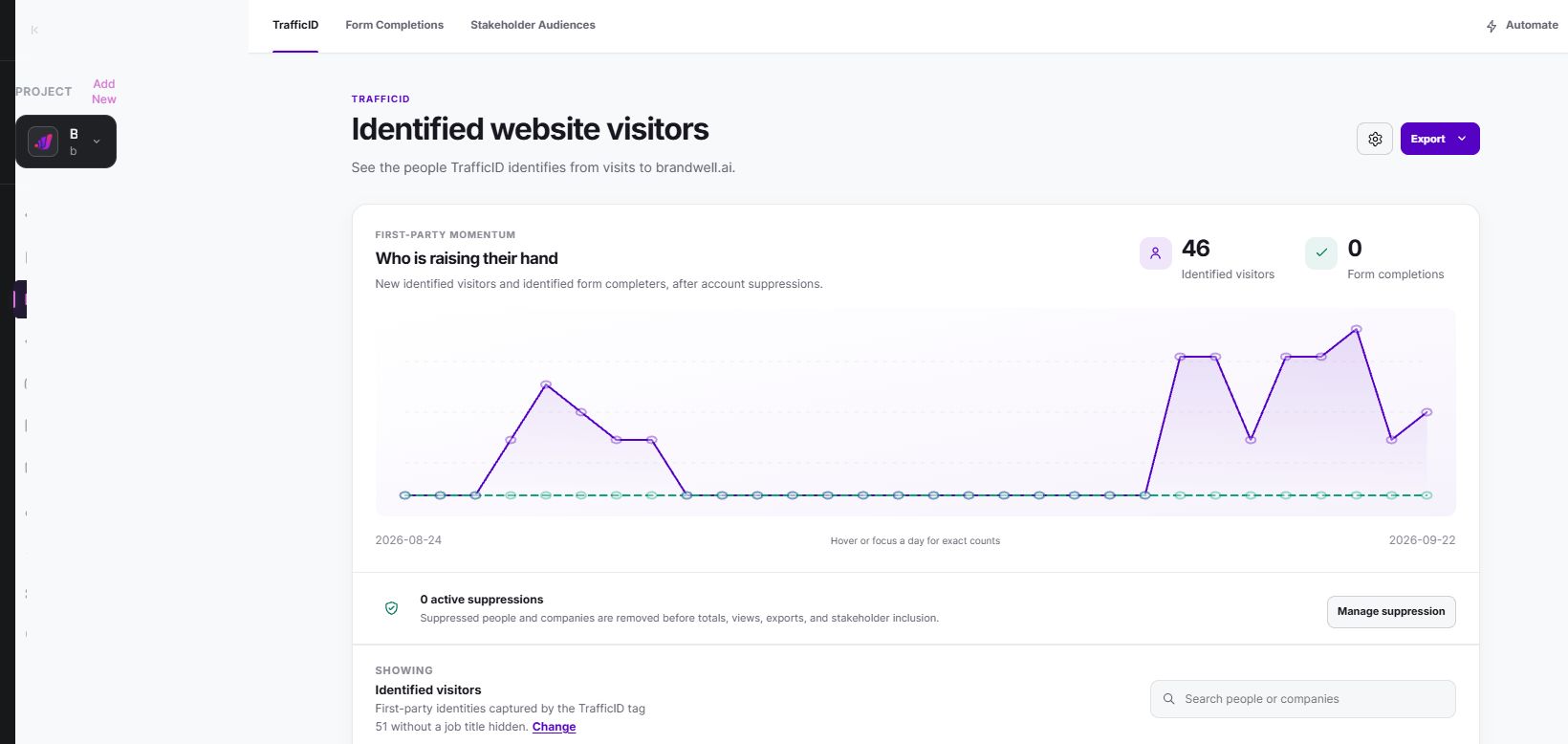
Review the available visitor record, its source and your intended use before preparing a next action. MarketPulse is a separate topic-research product with standard plans starting at $500/mo. Its external research can complement an owned-event program; it is not first-party analytics instrumentation.
Watch the TrafficID demo and review plans or browse BrandWell’s current products.
Reviewed and updated October 3, 2026.

Written by