On this page
- Keep observation, receipt and action clocks separate
- Test seven timing and action steps
- Treat signal-class curves as hypotheses
- Verify research and separate age automation
- Compare simpler age rules
- Count actual freshness-workflow costs
- Measure age bands and mature outcomes
- Decide whether a model is necessary
- Control duplicate refresh and stale state
- Scope a separate agency freshness service
- Record timing rules and changes
- Copyable signal-age test record
- Frequently asked signal-decay questions
Direct answer: B2B intent research has no universal expiry or proven default half-life. Preserve actual observation, receipt and action times. Test action-specific age rules against fit, capacity, permitted use and mature outcomes. Decay is a scoring assumption rather than a purchase probability, consent rule or deletion policy.
Who this is for: RevOps, demand generation, sales operations, data teams, and agencies deciding how recency should change scores, alerts, audiences, and outreach. This is a time-decay operating guide, not a general accuracy review or advertising-only recency article.
Current MarketPulse offer: intent-data plans start at $500/mo. See the product, demo, and current plans. Updated October 3, 2026.
Keep observation, receipt and action clocks separate
Freshness has three clocks. Event time is when the behavior occurred. Availability time is when the vendor or system delivered it. Action time is when a team used it. A signal can be newly delivered yet behaviorally old. Preserve all three timestamps and calculate latency rather than replacing event time with ingestion time.
Half-life is a chosen model parameter: the interval over which a signal weight falls by half under that model. It is not an empirical buying-window fact, permission expiry or deletion rule. Verify whether the chosen curve improves the actual decision; do not turn an inbound response SLA into a claim about how buyer behavior decays.
Use separate decay curves by signal and action. A pricing-page return might decay rapidly for a sales alert but remain useful longer for nurture segmentation. A webinar registration may stay relevant through the event and follow-up window. A competitive research surge might inform account planning longer than it justifies direct contact.
Test seven timing and action steps
- Record all timestamps. Store event, vendor observation, delivery, processing, routing, review, and action times. Flag backfilled or aggregated data so it cannot appear real-time.
- Classify the signal. Separate explicit requests, authenticated first-party events, product milestones, partner registrations, marketplace activity, third-party topic surges, and static fit.
- Choose an initial curve. Use step windows for simple operations, exponential decay for continuous scores, and state transitions for lifecycle events. Document the hypothesis rather than presenting it as fact.
- Apply action-specific thresholds. Define when a signal creates research, an alert, an audience, nurture, a sales task, or no action. Define actual eligibility, expiry and required corroboration for each action; risk alone does not determine a mathematical half-life.
- Add reinforcement and contradiction. Repeated independent evidence can refresh weight; duplicated delivery of the same event cannot. Negative replies, disqualification, ownership changes, and inactivity can accelerate decay.
- Test against outcomes. Group signals by age at action and compare acceptance, replies, meetings, opportunities, and complaints. Control for fit, source, region, and sales responsiveness.
- Automate expiration. Remove stale records from queues and audiences, close orphaned tasks, and show why weight changed. Review curves after source, product, or market changes.
Treat signal-class curves as hypotheses
- Explicit inbound request: very short response SLA; if missed, keep context but lower “ready now” weight.
- Authenticated product or pricing activity: short-to-medium half-life, extended by repeated meaningful use and multiple stakeholders.
- Permissioned partner or marketplace research: medium half-life shaped by source delivery latency and action type.
- Third-party account topic surge: medium-to-long research window, but require recent corroboration before personal outreach.
- Firmographic or technographic fit: update on source cadence or company change; do not decay it as if it were behavior.
Use this matrix as a starting hypothesis. Put the same records through each method, disclose exclusions, and make the acceptance threshold depend on the action rather than the vendor’s preferred headline metric.
Verify research and separate age automation
BrandWell publishes this guide. Evaluate current MarketPulse research separately from custom age scoring, connectors, audience removal, client reporting and agency services. This is an operating test rather than an independent provider ranking.
Identify the actual timing gap: source timestamps, late-arrival handling, duplicate detection, age rules, routing or destination removal. Verify each needed capability and its implementation rather than treating a product label as proof of a complete freshness workflow.
Current MarketPulse research input
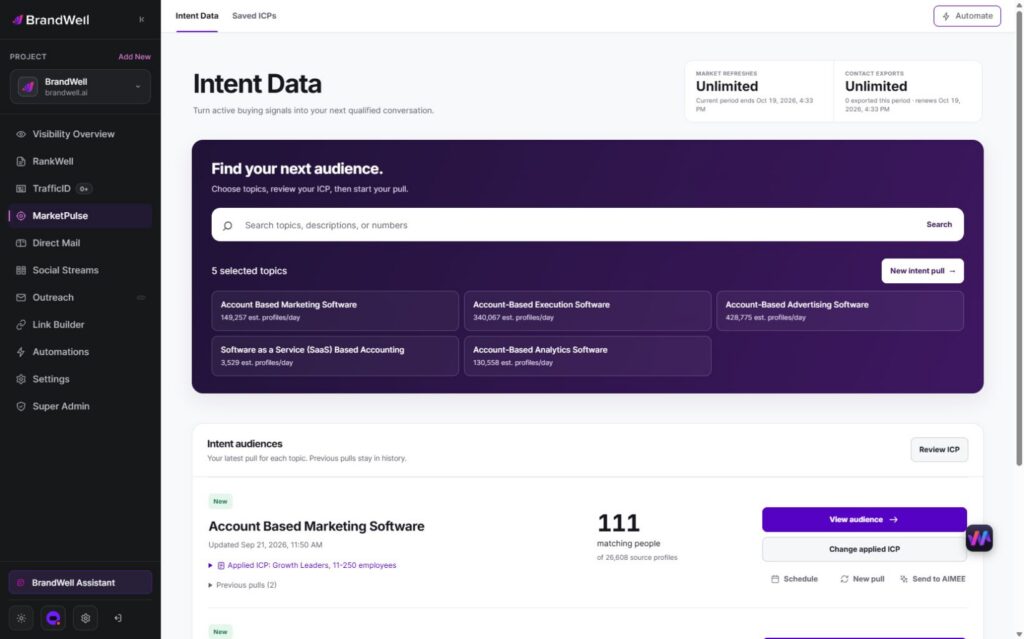
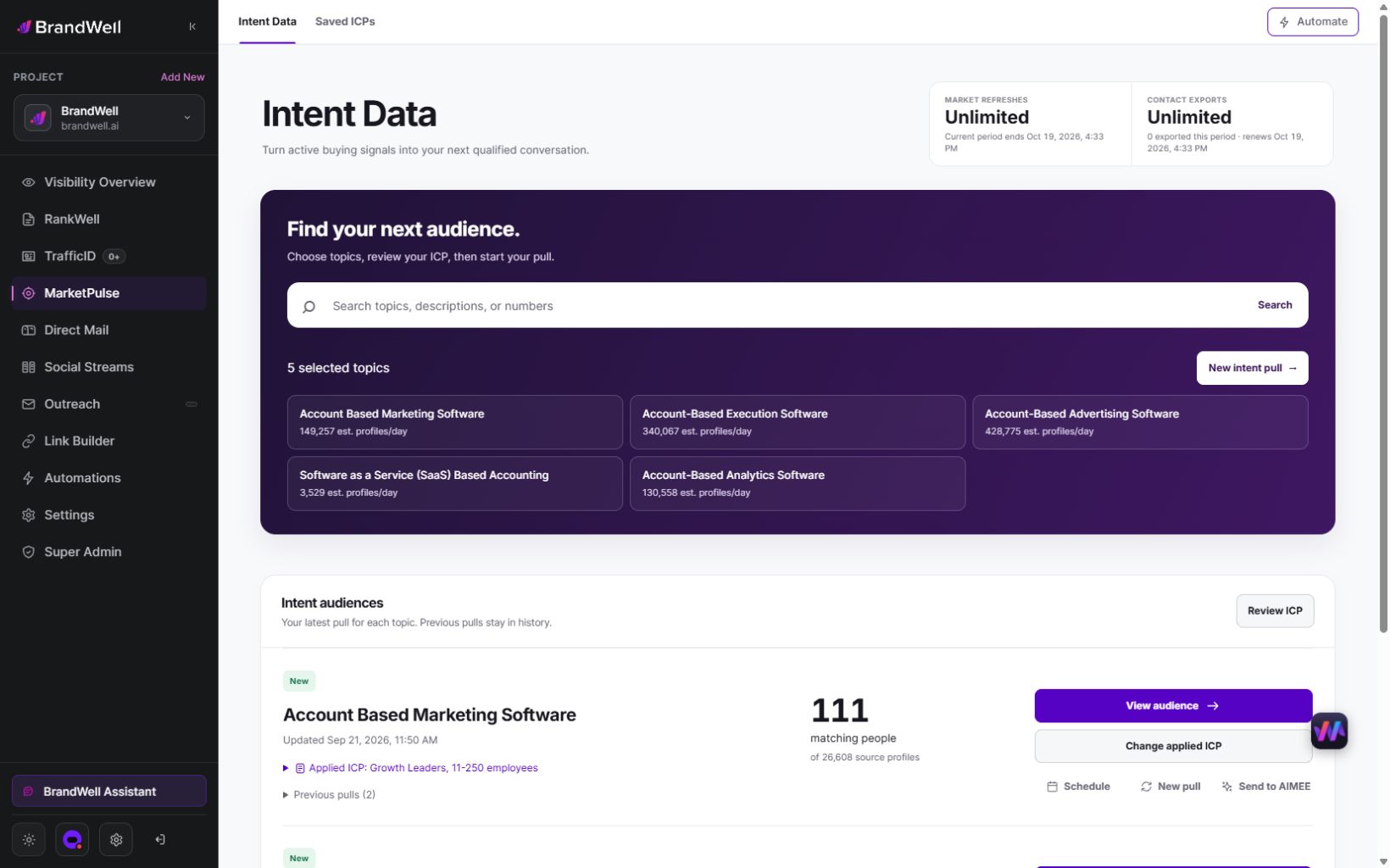
BrandWell MarketPulse: intent data starting at $500/mo. Find people researching topics relevant to what you sell, apply saved ICP filters, and review available contact details before taking action.
| Plan | Topics and refreshes | Monthly exports |
|---|---|---|
| Starter | 1 topic, weekly | 25,000 contacts |
| Growth | 3 topics, daily | 100,000 contacts |
| Scale | 10 topics, daily | Unlimited contacts |
Swipe the table to see all columns.
A pull retrieves available data from the previous 24 hours for one topic. Daily use across all included topics provides 90 Growth pulls or 300 Scale pulls in a 30-day month. Weekly Starter pulls vary by calendar month. Available audience size and contact fields vary, and audiences may overlap. Refreshes stop at the plan limit without overage charges.
- Find and qualify: search the topic catalog, save your ICP, and review the people and companies that match.
- Act on the research: export qualified contacts or prepare an Outreach or Direct Mail workflow. Connected products, channel usage, and fulfillment may cost extra.
- Get help from AIMEE: Growth and Scale include AIMEE for the initial user to research accounts and prepare the next step through connected tools.
Agencies and other service businesses can build client deliverables around their available Intent Scans and exports. Keep each client’s scope, permissions, and service fees clear. A subscription is not a promise of a white-label platform or exclusive access to a market.
Explore MarketPulse and watch the demo or compare plans starting at $500/mo. Any early-access discount is a separate, time-limited offer shown to an eligible recipient.
Compare simpler age rules
A fixed recency window is easier to explain and may be sufficient at low volume. Manual triage works for strategic accounts. Continuous decay helps when alerts arrive at scale and relative ranking matters. Test lifecycle states when events represent durable transitions such as activation or renewal. Do not adopt a mathematical curve merely because the platform supports one.
Count actual freshness-workflow costs
Decay TCO includes access to raw timestamps, refresh cadence, historical data, CRM or warehouse computation, audience updates, seller alerts, monitoring, and the labor to tune thresholds. Ask whether the vendor exposes event time or only a score, whether history can be exported, and whether stale records automatically leave activations. A lower subscription can cost more if teams manually clean queues.
MarketPulse research is starting at $500/mo. Verify current topics, refreshes, exports and included tools on the product page. Custom age models, client reporting and destination synchronization require separately verified implementation, rights and fees.
Measure age bands and mature outcomes
Plot qualified outcomes by signal age at action, not only at delivery. Track median source latency, review delay, action delay, accepted-alert rate, stale-task rate, audience-removal latency, duplicate refresh, complaints, and incremental pipeline. Compare alternative half-lives on matched accounts or phased teams. A decay rule is validated when it improves decisions, not when it makes a score look smooth.
Separate leading quality measures from operating adoption, pipeline progression, and closed revenue. Report the attribution method and uncertainty. Do not label influenced pipeline as incremental revenue, and do not let a vendor score become its own proof of value.
Decide whether a model is necessary
Decay modeling is valuable when signal volume is high, response timing matters, and teams can capture event and action timestamps. It is unnecessary when a human reviews a few accounts and the source already provides clear time windows. If source timestamps are missing, fix observability before pretending to calculate half-life.
Control duplicate refresh and stale state
The main errors are refreshing a signal when the same old event is redelivered, using ingestion time as event time, applying one curve to every source, and keeping stale people in audiences. Short half-lives can erase slower enterprise journeys; long ones create false urgency. Minimize detailed history and apply retention independently from scoring decay.
Before launch, test one false-positive scenario, one deletion or correction request, one suppression conflict, and one source outage. Assign an owner who can pause activation. A policy that cannot stop a queue or audience is documentation, not an operating control.
Scope a separate agency freshness service
An agency can manage signal freshness as a recurring operating service: latency audit, source-specific curve design, CRM and audience rules, daily stale-alert cleanup, client-branded freshness report, and quarterly recalibration. The agency should define SLAs it controls – review and routing speed – without guaranteeing buyer response or pipeline.
AIMEE can prepare a review brief through configured connected tools. Keep proposed actions separate from actual approvals and destination acknowledgements. Confirm the implementation and permissions before execution.
Review an available MarketPulse topic, saved ICP and actual preceding-24-hour matches for the approved research purpose. Keep uncertain company context visible. AIMEE can organize supplied context through configured tools; named owners approve actual exports, messages, audience uploads and CRM writes.
Agent-ready operating instructions
AIMEE can organize supplied timing evidence through configured tools and prepare a proposed exception brief. Keep unknown observation times visible. Do not refresh a duplicate as new activity or change destination state without verified implementation, permissions and named approval.
Show source latency, age at review, expired items, manually rescued records, duplicate refreshes, activation, outcomes, and recalibration decisions. The agency retails and bills the service directly; its MarketPulse subscription follows the selected plan, with separate costs for additional products and campaign delivery.
Record timing rules and changes
Keep the three clocks, decay by signal and action, refresh only with new evidence, and validate age bands against accepted outcomes. Publish a freshness service-level report for operators: event-age distribution at receipt, delay to review, delay to activation, stale items removed, and records incorrectly refreshed. Review the oldest accepted and newest rejected examples each cycle. Those edge cases reveal whether the curve reflects buyer behavior or merely compensates for slow routing. When the source cannot provide event time, mark age unknown and lower eligibility rather than substituting ingestion time. Run a clock-integrity drill before changing half-lives. Inject test records with known event, receipt, qualification, and action times; pass them through every connector; and confirm the final system preserves each timestamp and time zone. Then pause one delivery path to prove delayed records arrive as old evidence rather than freshly created demand. Test repeated observations too: an authentic new event may refresh relevance, while a reprocessed duplicate must not. Document which clock controls scoring, queue priority, audience membership, reporting, and deletion. If different systems use different clocks, make that divergence visible. Otherwise a mathematically elegant decay curve will only automate timestamp corruption, keep expired people active, and disguise provider latency as operator speed. When tuning begins, change one curve at a time and keep the prior rule as a shadow calculation. Compare which records the two versions accept, expire, or reorder before altering live work. Examine outcomes by age band, source, account segment, role, and action; an apparent global half-life often hides sharply different local patterns. Set a minimum sample and review interval in advance so one late opportunity cannot reset the model. Operators should be able to explain why a record lost priority and which new observation could restore it. Version each curve, approval, and effective time. This creates a defensible history when a seller asks why yesterday’s account disappeared, and it lets the team roll back a harmful rule without reconstructing old scores.
Review current MarketPulse research and plans, starting at $500/mo. Evaluate a relevant topic, approved ICP, available fields and operating effort. Verify current guarantee conditions before testing. A bounded evaluation cannot establish future pipeline or revenue.
Copyable signal-age test record
Observation: [Actual source unit and event timestamp.] Receipt: [Arrival, processing and late-data policy.] Action: [Review timestamp, eligibility and owner.] Rule: [Version, age calculation, expiry or model parameters.] Exceptions: [Unknown time, duplicate, contradiction or removal failure.] Evidence: [Frozen cohort, mature outcomes, costs and comparator.] Decision: [Keep, repair or stop; effective time and rollback.]
Use explicit timestamp offsets
RFC 3339 specifies an Internet timestamp format with UTC relationships. Timestamp format alone does not verify clock accuracy or source freshness.
A fictional event at 2026-10-03T09:00:00-07:00 and receipt at 2026-10-03T16:15:00Z are 15 minutes apart after normalization. Do not subtract the displayed local hours and report seven hours and 15 minutes. Preserve the original values and validated normalized instants.
A hypothetical half-life is not purchase probability
Under an illustrative exponential rule, weight at age t is initial weight multiplied by 2 raised to (-t / half-life). With an invented initial weight of 80 and a four-day half-life, the weight is 40 after four days and 20 after eight. These numbers are model weights, not 40% or 20% probabilities of a purchase. The four-day parameter is not an industry benchmark or a MarketPulse feature claim.
Reprocessing cannot make an old event new
A fictional September 28 observation arrives October 3 and is redelivered October 4. It remains six days old on October 4. Deduplicate the actual event identity and preserve its source time. A truly new, independently verified event needs its own identity and timestamp.
Missing time is not zero age
A fictional record has a delivery timestamp but no observation time. Mark age unknown and follow the actual action policy. Do not assign age zero or guess a source time to qualify the record.
Compare mature outcomes within comparable cohorts
In a fictional observational sample, four of 20 accounts acted on within two days and three of 30 acted on later have qualified outcomes: 20% versus 10%. Account mix, source, routing, timing and missing outcomes may explain the difference. It does not prove a two-day cutoff or that rapid action caused the outcome. Freeze the cohort, maturity window and rule version before interpreting the comparison.
Keep score expiry separate from data-use obligations
A fictional record falls below a queue score threshold while one audience-removal job remains unacknowledged. Track the actual queue change and destination removal separately. A decayed score does not establish withdrawal handling, suppression propagation or deletion completion.
Use supported research within scope
MarketPulse research is starting at $500/mo. Search a relevant topic, save the approved ICP and inspect available matches. Verify actual source timing rather than assuming delivery proves new activity. AIMEE can organize supplied context through configured tools; owners approve exports, messages and writes. Custom decay scoring, connectors, destination removal and client reports require separately verified implementation, rights and fees.
Frequently asked signal-decay questions
Is there a universal intent half-life?
No. Test an explicit model or age rule for the actual decision.
Is a decayed score a purchase probability?
No. A model weight does not establish a calibrated probability.
Does redelivery restart observation age?
No. Preserve the actual original event time.
Does scoring expiry prove data deletion?
No. Verify separate obligations and destination acknowledgements.
Review current research: explore MarketPulse and current plans.
Reviewed and updated October 3, 2026.

Written by