On this page
- Decide whether external context changes an action
- Evaluate seven research-input gates
- Run eight implementation steps
- Verify research and separate delivery work
- Budget complete operating costs
- Measure fit and mature outcomes
- Keep provenance and action rights visible
- Scope a separate agency research service
- Record the research purchase decision
- Copyable external-research validation record
- Frequently asked external-intent questions
Direct answer: Consider third-party intent research when verifiable external context can change an approved account-review decision. Check actual source, observation unit, identity, age, rights, delivery, operating effort and mature outcomes. Account-level evidence does not establish which named contact performed the behavior, and association alone does not establish incremental revenue.
Who this is for: B2B marketing, sales, RevOps, and agency leaders comparing off-site or syndicated intent sources. This guide is specifically about externally observed data provenance, selection, freshness, identity, and activation – not a generic topic taxonomy and not a guide to first- or second-party intent.
Current MarketPulse offer: intent-data plans start at $500/mo. See the product, demo, and current plans. Updated October 3, 2026.
Decide whether external context changes an action
Third-party intent becomes useful when your addressable market is larger than the team can inspect manually and your own website, product, events, and CRM show only a small portion of the buying journey. The data can reveal that an account is consuming more business content around a relevant problem than its normal baseline, or that a supplied signal crossed a provider-defined threshold. That evidence can reorder research, advertising, nurture, or seller-review queues.
It does not repair an undefined ICP, weak contact data, missing CRM ownership, or an outreach motion nobody can execute. Before buying, write one action sentence: “When an eligible account produces a qualifying external signal within our freshness window, the named owner will review the evidence and choose an approved next step.” If the team cannot name the owner, threshold, window, and next step, a larger signal feed will create noise rather than a third-party intent data strategy.
A sound purchase decision also requires a counterfactual. Ask whether fit-only targeting, first-party engagement, or a smaller hand-built account list already makes the same prioritization decision. Add external intent when it contributes information those approaches cannot provide and when that contribution can be measured separately.
Evaluate seven research-input gates
Externally observed intent is not one uniform product. Providers can collect behavior through publisher relationships, data cooperatives, licensed feeds, advertising ecosystems, or combinations of sources. Some deliver account-level topic intensity; others combine external observations with first-party data and predictive scoring. The buyer should preserve these distinctions instead of collapsing every output into a field called “intent score.”
| Evaluation gate | What to request | Rejection condition |
|---|---|---|
| Provenance | A plain-language map of observation sources, collection relationships, transformations, and exclusions | The provider will not explain the source class or permitted downstream use |
| Coverage | A sample matched to your industries, geographies, account sizes, languages, and niche topics | Headline network size replaces a relevant-market test |
| Unit of analysis | Whether the evidence represents a company, domain, location, household, device, profile, or person | Account activity is presented as known person behavior |
| Freshness | Observed time, delivery time, update cadence, lookback, expiry, and late-arrival policy | Only an undated score is delivered |
| Identity | Domain resolution, corporate-location handling, confidence, contact enrichment, validation, and correction method | The identity chain cannot be audited or corrected |
| Activation rights | Contractual uses for CRM, ads, enrichment, agency delivery, export, retention, and deletion | The proposed workflow exceeds licensed rights |
| Outcome evidence | A join key and design for measuring accepted signals, speed, opportunities, and exclusions | The provider offers activity totals but no testable downstream outcome |
Swipe the table to see all columns.
Do not accept publisher count, profile count, or topic count as a substitute for fit. Those can describe potential scope, but they do not establish usable coverage for a particular ICP. Request a blinded or contractually protected sample, label known accounts before reviewing signal scores, and calculate eligible coverage, false-association rate, and freshness on the market you will actually work.
The evidence record to retain
For every activated signal, store the provider, source class, topic or behavior category, account, observation and receipt times, provider score, identity confidence, fit status, permitted use, routing decision, and later disposition. Keep the raw event alongside any normalized score. That record allows RevOps to explain why an account entered a queue and to correct mistaken identities without pretending the model is certain.
Run eight implementation steps
- Freeze the commercial use case. Choose one constrained decision such as daily SDR research priority, account-advertising eligibility, or agency client reporting. Do not launch five channels at once.
- Define the addressable cohort. Specify accounts, exclusions, countries, industries, sizes, existing customers, open opportunities, and internal suppression rules before importing scores.
- Map external provenance. Document what the vendor observes, whether the signal is account- or person-level, the baseline behind any surge, and which transformations occur before delivery.
- Set freshness by action. A rapidly changing seller queue needs a shorter expiry than an account-planning report. Preserve both observation time and arrival time so late data does not look current.
- Resolve and validate identity. Confirm domain-to-company mapping first. Enrich plausible roles only after the account passes fit. Treat contact selection as a hypothesis unless the source genuinely supplies permissioned person-level evidence.
- Apply governance before routing. Enforce geographic restrictions, client exclusions, deletion requests, retention periods, channel suppressions, and contractual use rights ahead of CRM, advertising, or agent actions.
- Create an explainable evidence card. Show the raw source class, age, fit factors, confidence, recent CRM history, approved options, and prohibited claims. A score without context should not trigger outreach.
- Require human choice and write back outcomes. An authorized owner approves, defers, corrects, or suppresses. Capture the reason and downstream opportunity state so the third-party intent data workflow can be recalibrated.
The minimum team is a business owner, RevOps or data owner, channel operator, privacy or legal reviewer, and vendor implementation contact. Larger deployments may add marketing operations, analytics, procurement, security, and agency client owners. Integrations commonly touch a CRM, marketing automation, warehouse, advertising destination, enrichment service, and reporting layer; each increases total cost and the number of controls to test.
Verify research and separate delivery work
BrandWell publishes this guide. Evaluate current MarketPulse research against your actual requirements, separately from custom joins, connectors, client reports and managed service work. This is a research-input checklist rather than an independent provider ranking.
Compare the actual observation unit, source evidence and operating responsibility. An external research feed, account score, contact directory and complete operating workflow are different scopes; request and test the needed output before committing.
Current MarketPulse research input
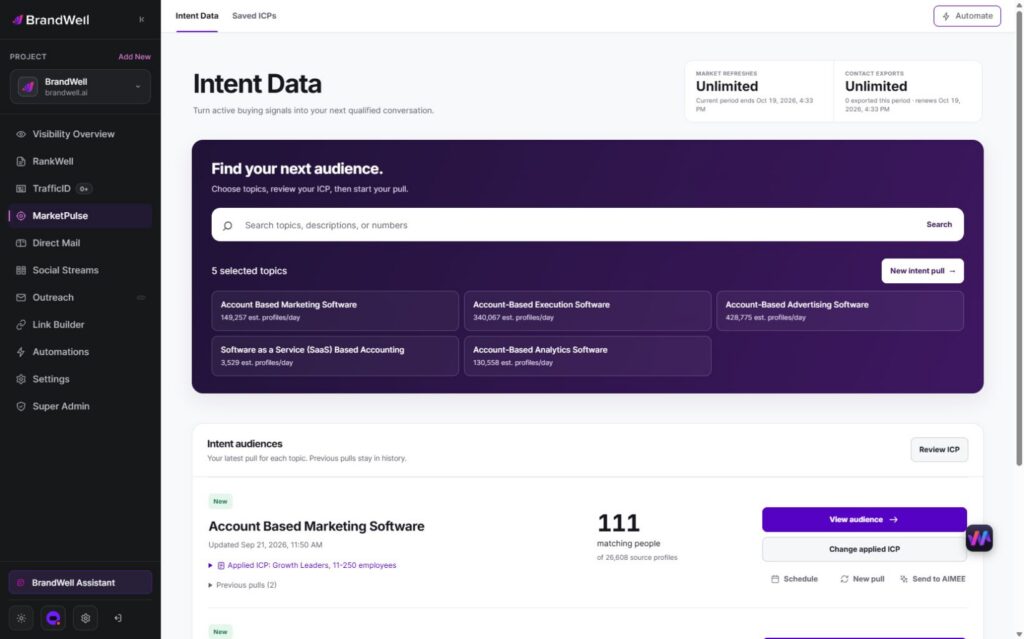
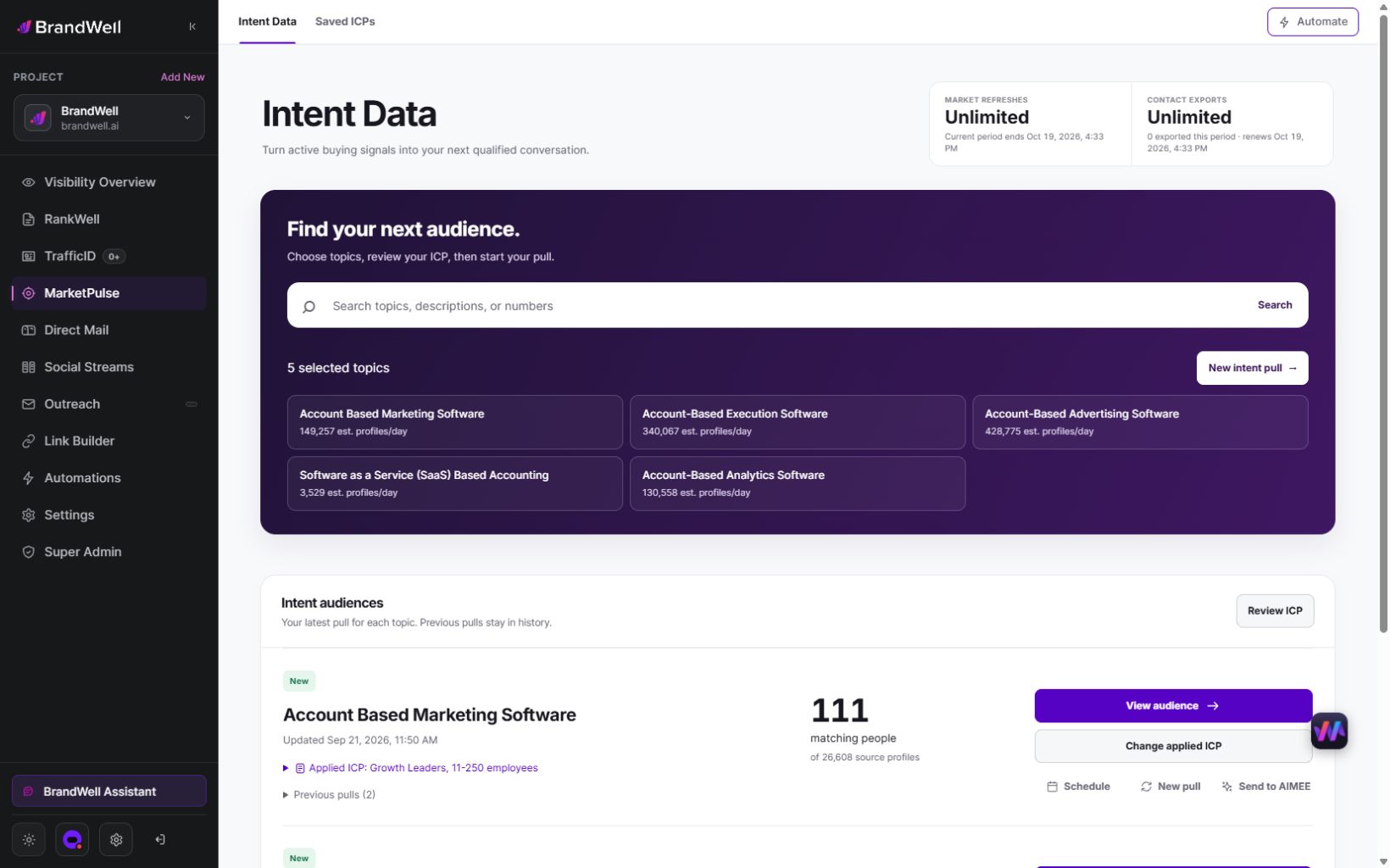
BrandWell MarketPulse: intent data starting at $500/mo. Find people researching topics relevant to what you sell, apply saved ICP filters, and review available contact details before taking action.
| Plan | Topics and refreshes | Monthly exports |
|---|---|---|
| Starter | 1 topic, weekly | 25,000 contacts |
| Growth | 3 topics, daily | 100,000 contacts |
| Scale | 10 topics, daily | Unlimited contacts |
Swipe the table to see all columns.
A pull retrieves available data from the previous 24 hours for one topic. Daily use across all included topics provides 90 Growth pulls or 300 Scale pulls in a 30-day month. Weekly Starter pulls vary by calendar month. Available audience size and contact fields vary, and audiences may overlap. Refreshes stop at the plan limit without overage charges.
- Find and qualify: search the topic catalog, save your ICP, and review the people and companies that match.
- Act on the research: export qualified contacts or prepare an Outreach or Direct Mail workflow. Connected products, channel usage, and fulfillment may cost extra.
- Get help from AIMEE: Growth and Scale include AIMEE for the initial user to research accounts and prepare the next step through connected tools.
Agencies and other service businesses can build client deliverables around their available Intent Scans and exports. Keep each client’s scope, permissions, and service fees clear. A subscription is not a promise of a white-label platform or exclusive access to a market.
Explore MarketPulse and watch the demo or compare plans starting at $500/mo. Any early-access discount is a separate, time-limited offer shown to an eligible recipient.
Budget complete operating costs
Model the cost of the decision system, not just the feed. Include topic or account access, identity and enrichment, CRM or warehouse engineering, advertising destinations, seller tooling, implementation services, governance review, reporting, ongoing QA, unused credits, and operator time. Keep annual contract values annual. Do not convert procurement medians into monthly rates or assume that every vendor has an annual initial term.
MarketPulse research is starting at $500/mo. Verify current topics, refreshes, exports and included tools on the product page. Custom integrations, client reporting and managed agency delivery need separately verified implementation, rights and fees.
Create three totals before signing: fixed contractual cost, likely operating cost at expected usage, and downside cost at low adoption or high integration effort. Ask who pays for onboarding, connectors, data overages, media, additional clients, refreshes, exports, support, renewal increases, and exit work. A cheaper feed can be expensive if nobody trusts it; a broad platform can be wasteful if one daily queue is the only required action.
Measure fit and mature outcomes
Third-party intent data metrics should begin before opportunity attribution. Track eligible-account coverage, delivered-signal rate, account-match accuracy, median observation-to-delivery time, expired-event rate, identity correction rate, operator acceptance, and activation completion. Then track meetings, sales-accepted opportunities, stage progression, gross profit, and complaints for signaled and comparable unsignaled accounts.
Use a holdout or phased rollout where feasible. Freeze the eligible cohort first, randomize or match treatment, prevent pre-existing open opportunities from contaminating the result, and report denominators. “Influenced pipeline” can describe association, but incremental value requires a credible baseline. A signal can be technically accurate and still fail commercially if it arrives late, points to an account outside the ICP, or never changes an action.
A possible fit is a team with a defined addressable market, ICP, owners, downstream capacity and reliable outcome feedback. Test whether external context improves the actual decision. Custom agency reporting and client-delivery work require separately verified implementation, rights and fees.
Use fit-only targeting when market selection is the primary problem. Use first-party engagement when known activity in your own properties is sufficiently informative. Use broad lists for market mapping, not claimed timing. Use third-party intent when external behavior adds fresh prioritization evidence; combine it with fit, identity confidence, and outcome feedback rather than replacing them.
Keep provenance and action rights visible
Common failures include hiding provenance behind a composite score, equating domain activity with a person, using an undated signal, accepting a match without confidence, activating outside licensed rights, retaining records indefinitely, and optimizing for signal volume. Intent is probabilistic. It is not consent, purchase proof, legal permission to contact, or evidence that the selected role performed the observed behavior.
Document actual source rights, roles, purposes, recipients, retention, correction, deletion, suppression, cross-border handling and client responsibilities. Resolve applicable requirements for the actual jurisdiction and channel before activation. A supplier license or framework reference does not establish permission for every action.
Agent-ready operating instructions
AIMEE can prepare a review brief through configured connected tools. Keep proposed actions separate from actual approvals and destination acknowledgements. Confirm the implementation and permissions before execution.
Scope a separate agency research service
A recurring agency offer can include client-market definition, source and topic selection, eligibility and freshness rules, identity validation, branded topic reports, reviewed activation queues, weekly data-quality QA, monthly outcome analysis, and quarterly recalibration. The agency sells under its own brand, decides its retail pricing, bills each client, and remains responsible for its claims, client contracts, channel governance, and human approvals.
Review an available MarketPulse topic, saved ICP and actual preceding-24-hour matches for the approved research purpose. Keep uncertain company context visible. AIMEE can organize supplied context through configured tools; named owners approve actual exports, messages, audience uploads and CRM writes.
Record a go, revise or stop decision: actual source, eligible cohort, accepted or corrected joins, approved actions, costs, unresolved claims and next scope. Custom branded client reports are separately implemented deliverables; do not imply a native agency-report request flow.
Record the research purchase decision
Before choosing any provider, require a source map, relevant-market coverage sample, unit-of-analysis definition, freshness and expiry policy, identity and correction method, permitted-use schedule, integration plan, security and privacy materials, acceptance thresholds, and itemized written quote. Assign an owner to every signal and define the stop conditions before production activation.
Buy third-party intent only if the evidence changes a real decision and its incremental contribution can be tested. Compare providers by whether their provenance, relevant coverage, freshness, identity, rights, workflow, economics, and limitations remain understandable after the sales presentation ends.
Copyable external-research validation record
Decision: [Actual queue and permitted action.] Source: [Observation class, original unit and transformations.] Identity: [Account/person join, evidence and unresolved associations.] Time: [Observed, received and action timestamps; expiry.] Rights: [Actual purpose, channel, recipients and suppression.] Outcome: [Frozen cohort, mature feedback, costs and comparator.] Choice: [Go, revise or stop; owner and next test.]
Preserve provenance across transformations
The W3C PROV primer, a Working Group Note, describes data origins, transformations and responsible agents. A provenance record does not establish truth or permission.
One account signal does not identify every contact
A fictional external source reports one company-level topic signal. A separate directory supplies five plausible contacts. Record one account signal and five candidate contacts; do not claim five people performed the observed research. Review actual identity, fit and permitted contact separately.
Delivery age is not observation age
A fictional observation occurs September 28 and arrives October 3. It is five days old at receipt. Under a two-day action-age rule it is already expired, even though the file arrived today. Preserve source timing and late-arrival policy rather than resetting age at ingestion.
Keep policy exclusions visible
A fictional 100-account cohort has 80 observed accounts, 60 that pass fit and rights checks, 45 approved actions and 36 mature feedback records. Report observed coverage as 80%, eligibility as 60% of all accounts or 75% of observed accounts, action approval as 75% of eligible accounts and feedback coverage as 80% of approved actions. Nine action outcomes remain unresolved; do not silently drop them.
Report the comparator without claiming causality
In a fictional observational comparison, six of 30 research-assisted accounts and four of 40 fit-only accounts have qualified outcomes: 20% versus 10%, a 10-percentage-point difference. Assignment, account mix, timing and missing outcomes can explain the difference. This comparison alone does not prove that the feed doubled sales or caused incremental revenue.
Count full costs once
A fictional $6,000 annual feed commitment plus $4,000 in incremental implementation and operating work costs $10,000 before excluded acquisition, general overhead, tax and financing. If $2,000 of the committed feed is unused, disclose the unused allocation; do not add it again as if cash cost became $12,000.
Use supported research within scope
MarketPulse research is starting at $500/mo. Search a relevant topic, save the approved ICP and inspect available matches. Verify actual source timing and match context. AIMEE can organize supplied context through configured tools; owners approve exports, messages, audience uploads and CRM writes. Custom joins, branded reports and client delivery require separately verified implementation, rights and fees.
Frequently asked external-intent questions
Does an account signal identify the researching person?
No. Do not infer person-level behavior from an account-level observation.
Does a new delivery timestamp make old research fresh?
No. Measure age from the relevant actual observation time.
Is an observed rate difference proof of incremental value?
No. Assess assignment, comparability, timing and missing outcomes.
Should unused committed fees be counted twice?
No. Disclose allocation separately from total cost.
Review current research: explore MarketPulse and current plans.
Reviewed and updated October 3, 2026.

Written by