On this page
- Decide what deserves sales, lifecycle help, or no action
- Build the workflow around the finite trial clock
- Use product thresholds and external intent for different jobs
- Price the complete conversion workflow
- Measure incremental conversion, not activity theater
- Prevent false positives and privacy failures
- Turn the workflow into a recurring agency service
- The practical takeaway
- Test milestone collection before routing
- Define the trial cohort before calculating rates
- Review external context in MarketPulse
- Frequently asked questions
During a time-bounded B2B trial, review product progress, account fit, role, freshness and a useful reason to engage. Product events and external research are different inputs. Route explained evidence to human-reviewed assistance, lifecycle help or no action. No signal establishes consent or purchase certainty. MarketPulse supplies topic research; TrafficID separately reviews eligible own-site visitors.
Who this is for: Growth, product marketing, RevOps, sales, customer-success, and agency teams improving conversion within a finite free-trial window. It is not a framework for persistent freemium-user qualification.
Current MarketPulse offer: intent-data plans start at $500/mo. See the product, demo, and current plans. Updated October 3, 2026.
Decide what deserves sales, lifecycle help, or no action
The free-trial conversion window creates urgency, but urgency does not justify calling every signup. Start with a small action matrix. A high-fit account that completes a value milestone, adds collaborators, connects an important integration, or revisits a commercial boundary may deserve human review. The same account with setup friction or incomplete activation may need a helpful in-product or lifecycle message instead. A low-fit, inactive, duplicated, suppressed, or student/personal account may need no intervention.
Treat product events as first-party observations with explicit definitions. “Activated” should name a behavior tied to the product’s value, not a generic login count. External buyer intent adds different context: an account may be researching a category, competitor, problem, or related solution away from the trial. BrandWell external intent enriches the first-party record; it should not overwrite what the user actually did in the product.
Use three decision bands rather than one magic score:
- Sales review: verified fit, meaningful product progress or commercial friction, a relevant fresh external signal, a plausible buying role, no suppression, and an explainable reason a conversation could help.
- Lifecycle assist: fit is plausible but intent or identity is incomplete; send education, setup help, examples, or a permission-based invitation rather than creating an urgent rep task.
- No action or wait: weak fit, early exploration, stale evidence, negative feedback, conflicting identity, existing owner activity, restricted jurisdiction, or a signal that cannot be explained.
Negative evidence matters. Repeated failed setup, an explicit “not now,” use limited to a personal project, a deleted workspace, or a suppression request should reduce or stop action. A score that only accumulates positive points will manufacture false urgency near trial expiry.
Example signal combinations and the action they earn
Consider a target account whose administrator completes the core workflow, connects a business system, invites colleagues, and visits an upgrade boundary while the account also researches a directly relevant problem. That combination can justify a same-day human review, provided identity, ownership, channel, and suppression checks pass. The rep’s task is to offer help with the observed product goal, not reveal off-site monitoring.
Now consider a good-fit solo user who logs in twice but never completes setup. External category research may raise interest, yet the immediate problem is activation. Route a concise setup guide or office-hours invitation and wait for stronger evidence before sales outreach. If a known customer employee starts a separate trial, send the record to the account owner rather than creating a net-new opportunity.
A high-activity trial from a poor-fit geography, personal email, unsupported company type, or restricted audience should not become a sales task merely because usage is intense. Likewise, a strong external surge with no reliable trial-to-company match belongs in account research, not personalized outreach. These examples show why fit, behavior, identity, and permission must remain separate inputs.
Build the workflow around the finite trial clock
Instrument a short list of product milestones and friction events, then preserve event time, workspace, user, account, plan, source, and consent or notice context. Resolve the company without erasing the user-level product record. Join CRM ownership, lifecycle touches, customer status, fit attributes, and external intent only after field definitions are agreed.
Next, calculate separate components for fit, product progress, external research, identity confidence, recency, and negative evidence. Keep the components visible. A rep should see “connected integration, invited two teammates, target account, competitor research this week” rather than an unexplained score of 87. Apply decay that fits the event: a just-completed setup step and a multi-week account surge do not share one clock.
Route the decision, not the raw event. Sales tasks need an owner, reason, approved channel, recent-touch check, suggested help, prohibited claims, and expiration. Lifecycle branches need message caps and suppression logic. No-action records should remain available for analysis without re-entering the queue unless genuinely new evidence arrives. Write dispositions, corrections, meetings, opportunities, conversion, complaints, and opt-outs back to the model.
Assign clear owners: product defines value milestones; data or engineering assures event quality; RevOps owns identity and routing; lifecycle owns automated help; sales owns human engagement; privacy and legal review use and notice; an analyst designs the holdout; and one operator can pause the workflow. Agencies need the same roles across client and agency boundaries.
Operate a cadence that respects the trial clock
At the start of each business day, process new milestones, expire stale recommendations, reconcile CRM ownership, and remove suppressed or converted accounts. During the day, update evidence cards when a user reaches a value event or when a materially different external signal arrives. Do not repeatedly recreate the same task from every click. At the end of the day, audit unaccepted tasks, collisions, corrections, and actions taken after expiration.
Once a week, review the funnel by cohort and signal combination. Product should inspect whether milestones still represent value; sales should explain accepted and rejected tasks; lifecycle should report message collisions and fatigue; RevOps should fix mapping and ownership; and privacy should review complaints or unexpected uses. Change rules deliberately and record the timing. A before-and-after movement does not, by itself, identify which rule caused it.
When the trial ends, close or downgrade open recommendations. Converted accounts move to customer workflows. Expired non-buyers follow the approved retention and nurture policy rather than remaining permanently “high intent.” This end-state is the defining boundary between a free-trial play and an always-on freemium qualification model.
Use product thresholds and external intent for different jobs
Product thresholds alone are the cleanest choice when activation is well defined, user identity is reliable, and the team only needs timely help inside the trial. Marketing engagement alone can support lifecycle education, but clicks and opens often say less about value realization. External intent is most useful when it adds account context the trial cannot observe: active category research, competitor evaluation, or additional stakeholders.
A combined model earns its complexity only if it changes a decision. Test product-only routing against product-plus-external-intent routing. If the added data does not improve accepted sales tasks, conversion, pipeline quality, or speed without increasing complaints and false positives, remove it. Do not turn a short trial workflow into a permanent freemium score that follows users indefinitely.
Price the complete conversion workflow
Budget for product analytics, event quality, identity resolution, CRM and lifecycle integration, external intent, administration, experimentation, seller time, compliance review, and agency delivery. Keep monthly and annual vendor cadences intact. Compare equivalent account, topic, user, client, integration, service, and support scope.
MarketPulse plans are starting at $500/mo. Starter includes 1 topic, weekly refreshes, and 25,000 exportable contacts per month. Growth includes 3 topics, daily refreshes, and 100,000 exportable contacts. Scale includes 10 topics, daily refreshes, and unlimited contact exports. AIMEE for the initial user is included with Growth and Scale. Compare MarketPulse plans and current offers.
Model the economics per eligible trial, accepted sales task, converted account, incremental opportunity, and gross-profit contribution. A cheap signal that produces manual cleanup or interrupts good self-serve users can cost more than a higher-quality, lower-volume workflow.
Measure incremental conversion, not activity theater
Track event completeness, identity acceptance, qualified accounts, routed actions, time-to-review, lifecycle sends, sales acceptance, corrections, opt-outs, meetings, conversion, accepted opportunities, and gross profit. Break results out by fit, trial stage, role, signal combination, and freshness. Report the number eligible at every denominator.
For a suitable randomized trial, compare original assignments to product-only routing, combined-signal routing and the approved baseline. Keep the offer and measurement consistent, record contamination and analyze mature outcomes. A matched observational baseline needs explicit assumptions and can retain confounding. Avoid post-outcome selection and giving credit for conversions preceding outreach.
Review errors as product feedback, not just model defects. A sales rejection may mean the account is wrong, the milestone is weak, the external topic is too broad, another owner is already active, or the suggested action is unhelpful. Track each reason separately. Also inspect false negatives: converted trials the model left in self-serve. The goal is not perfect prediction; it is a better allocation of timely help with fewer unnecessary interventions.
The workflow fits considered B2B products with a defined activation path, multiple stakeholders, enough trial volume to test, reliable product events, and a team capable of timely help. It is a poor fit for instant low-price purchases, tiny trial cohorts, consumer signups with unclear business identity, products without a stable value milestone, or teams that cannot act before the trial ends.
Prevent false positives and privacy failures
Common mistakes are scoring logins instead of value, ignoring negative events, confusing account research with a named user’s behavior, allowing old signals to survive the trial, rewarding task volume, duplicating lifecycle and seller touches, and contacting users who expected self-service. External intent is probabilistic. It is not consent, identity proof, or evidence that the trial user performed the off-site research.
Have qualified reviewers assess the actual collection context, notice, purposes, data roles, permitted channels and applicable jurisdictions. Retain correction, suppression and deletion controls. A generic framework or workflow checklist does not establish compliance.
Turn the workflow into a recurring agency service
An agency package can include event and data mapping, milestone design, external topic selection, identity and fit rules, routing, lifecycle coordination, weekly defect review, branded topic reports, monthly experiment analysis, and quarterly recalibration. Service levels should cover review time and reporting quality, not guaranteed conversion. The agency controls retail pricing and bills the client.
Evaluate a relevant MarketPulse topic and defined ICP, then review matching people, available fields and useful next actions. Measure research usefulness and operator effort. Define additional client service, integrations and permitted use separately from the subscription.
Agent-ready routing instructions
AIMEE can prepare configured research and routing briefs through connected tools. Supply the event dictionary, trial window, ownership and suppression rules. Require human review where appropriate and verify the destination; an instruction is not a working integration.
The practical takeaway
Start by reviewing the MarketPulse demo and plans, starting at $500/mo. Choose a relevant topic and ICP, then evaluate audience fit, available contact fields, and the workflow you will use. The first-purchase 3-day satisfaction guarantee requires no data exports and no more than 2 Intent Scans; review the current guarantee terms before testing. A short evaluation can establish fit, but cannot prove future pipeline or revenue.
Test milestone collection before routing
Google’s event setup guide describes recommended and custom events and checking event parameters in Realtime and DebugView.
For a proposed trial-analytics implementation, test a successful value milestone, an incomplete attempt, a duplicate event, a converted account and an expired trial. Verify the event time, allowed account reference and routing decision in the authorized system. Avoid exposing personal information in analytics parameters. A feature click is not proof of completed setup.
Define the trial cohort before calculating rates
In a fictional cohort, 200 eligible trials begin during a fixed week. Fifty meet the reviewed assistance rules, operators accept 40, and eight of those 40 later convert within the stated window. Operator acceptance is 80% of nominated trials; conversion among approved trials is 20%. The eight conversions represent 4% of the original eligible cohort.
These are descriptive rates from selected accounts. They do not establish that the assistance produced eight additional conversions. Report conversions among the other trials and use an appropriate comparison before estimating lift. Do not exclude failed setup or expired trials simply to improve the denominator.
Define how resubscriptions, duplicate workspaces, customer employees and extensions are handled before the analysis. An extension changes the actual trial deadline; it should not silently change a reporting window after outcomes are known.
Review external context in MarketPulse
- Select a relevant research topic and apply the ICP.
- Review available people and company fields and record ambiguity.
- Keep external topic context distinct from the user’s product milestones.
- Review ownership, current trial status and permitted action before creating a task.
- Expire stale tasks and write the approved disposition to the actual lifecycle or CRM system.
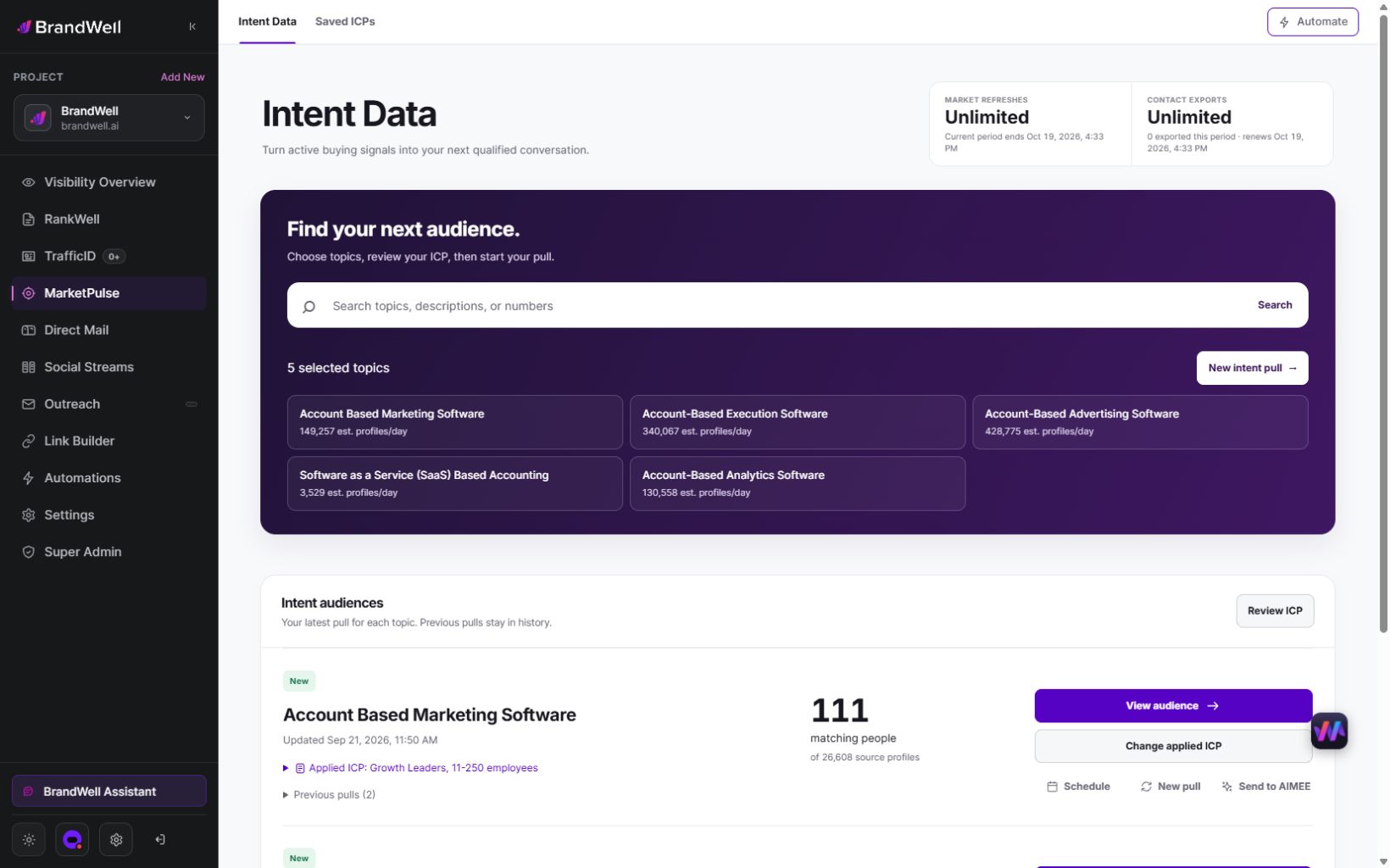
Watch the MarketPulse demo and compare current plans. Standard subscriptions are starting at $500/mo. Verify additional telemetry, CRM or managed-service scope separately.
Frequently asked questions
Which trial events deserve human review?
Prioritize meaningful product progress or an actionable obstacle, with fit, reliable identity, ownership and a permitted reason to help.
Does trial expiry justify contacting every signup?
No. Respect user needs and preferences. Some accounts need setup help or no additional intervention.
Does a personal email prove a trial is unqualified?
No. It may leave company identity unresolved. Review actual fit and evidence rather than using the domain alone as a buying conclusion.
Can higher assisted conversion prove the workflow works?
Selected accounts may already be more likely to buy. Report the selection and use a defensible comparison before claiming incremental impact.
Reviewed and updated October 3, 2026.

Written by