On this page
- Interpret registration without inferring readiness
- Build eight registration-to-action steps
- Use a six-dimension evidence scorecard
- Verify research and separate event implementation
- Choose the simplest permitted action
- Budget actual event and follow-up work
- Measure mature outcomes and overlap
- Control false inferences and data use
- Scope a separate agency event service
- Record the event decision
- Copyable webinar follow-up decision record
- Frequently asked webinar-intent questions
A webinar registration records a request for an event; it does not establish verified identity, budget or readiness to buy. Keep registration, attendance, participation, account fit, topic context, permission and qualified outcomes separate. Choose the next permitted action from the actual evidence rather than routing every form entry to sales.
Who this is for: B2B event, demand-generation, RevOps, sales and agency teams reviewing webinar follow-up. Event capture, connectors, routing and client reporting require their own verified implementation and rights.
Current MarketPulse offer: intent-data plans start at $500/mo. See the product, demo, and current plans. Updated October 3, 2026.
Interpret registration without inferring readiness
Registration is an early, ambiguous observation. A submitted email field does not prove who entered it, that the address is valid or that the person intends to buy. Education, customer support, partner interest and evaluation can all produce registrations. Attendance and participation add context, but neither establishes purchase readiness alone.
Use registration to answer a narrow operational question: what is the most relevant next action justified by the evidence available now? A confirmation and calendar reminder require little inference. A related resource can rely on declared topic interest. An SDR task should require stronger evidence such as a target account, a relevant role, live attendance, a high-value question, repeated research, or an existing opportunity. Silence, a no-show, an opt-out, a disqualified account, or support-only context should lower or stop escalation.
This approach converts owned digital behavior into timely action without pretending that all engagement is demand. It also gives agencies a service they can explain: capture the event signal, reconcile identity, apply client-specific gates, activate an approved route, and measure the result.
Build eight registration-to-action steps
A webinar registration intent workflow needs a clear event contract, reliable joins, explicit ownership, and reversible automation. Build it in this order:
- Define the decision. Name the actions the signal may trigger: confirmation, reminder, nurture, account research, advertising suppression or inclusion, customer-success notification, or sales review. Do not begin with one universal “hot lead” score.
- Capture the event correctly. Store webinar ID, topic, registration source, timestamp, consent or preference state, declared company and role, campaign, and form version. Keep the original record so derived scores remain auditable.
- Reconcile identity. Normalize the email and domain, connect a known CRM record when confidence is adequate, and validate business identity before adding firmographic data. Keep person and account confidence separate.
- Add attendance detail. Distinguish no-show, partial attendance, sustained attendance, questions, poll responses, resource requests, and replay behavior. A question about implementation is different from a passive login.
- Apply fit and context. Compare the account and role with the client’s market, current customer status, open opportunity, territory, exclusions, and product line. Prevent a customer-education event from creating an acquisition task.
- Corroborate with research intent. Look for fresh, relevant topic research or eligible website behavior. External topic activity can prioritize an account, but it should not be represented as a named person’s behavior unless the identity evidence supports that statement.
- Route through approval rules. Low-risk reminders can be automatic. Sales outreach, paid-audience activation, or a message that reveals sensitive browsing context should pass stronger eligibility and human-review gates.
- Write back dispositions. Record accepted, rejected, duplicate, customer, wrong person, bad fit, contacted, replied, meeting, opportunity, opt-out, and complaint outcomes. Those reasons are the feedback data for calibration.
The operating team usually includes demand generation or the event owner, marketing operations, RevOps, the receiving sales or customer team, an analyst, and privacy or legal reviewers for the intended data use. Required connections often include the webinar platform, marketing automation, CRM, identity or enrichment source, routing layer, reporting store, and any approved advertising or outreach destination.
Use a six-dimension evidence scorecard
Use a scorecard as an inspectable hypothesis, not a declaration of truth. The following structure avoids letting registration overwhelm every other signal:
| Evidence dimension | Stronger evidence | Downgrade or stop evidence | Operating response |
|---|---|---|---|
| Registration | Relevant event and completed business details | Disposable address, student, competitor, duplicate, or bot pattern | Deliver the requested event experience |
| Attendance | Sustained live attendance, replay depth, substantive question | No-show, instant exit, background-only attendance | Check the permitted follow-up route |
| Account and role fit | Target account, plausible buying role, useful geography | Disqualified account, irrelevant role, existing support case | Escalate only after fit passes |
| Topic alignment | Event topic maps to an active client problem | General education or unrelated product line | Select topic-specific content or research |
| Fresh corroboration | Repeat site activity or recent account-level topic research | Old, isolated, or contradictory activity | Increase research priority, not certainty |
| Downstream response | Positive reply, meeting acceptance, qualified stage movement | Rejection, opt-out, complaint, no valid contact | Update rules and suppress where required |
Swipe the table to see all columns.
Set eligibility separately for event delivery, optional nurture, sales review and advertising. A requested event does not establish permission for every subsequent use. Verify the actual purpose, recipient, jurisdiction, preferences, suppression and destination requirements before activating an additional route.
Verify research and separate event implementation
Use current MarketPulse research as optional corroborating context, separate from the webinar registration and actual attendance records. Verify permitted joins, identity, source timing and actual implementation. A research subscription does not establish a native webinar platform, branded client report or registration connector.
MarketPulse research is starting at $500/mo. Verify current topics, refreshes, exports and included tools on the product page. Event connectors, routing, custom client interfaces and reporting require separately verified implementation, rights and fees.
Current MarketPulse research input
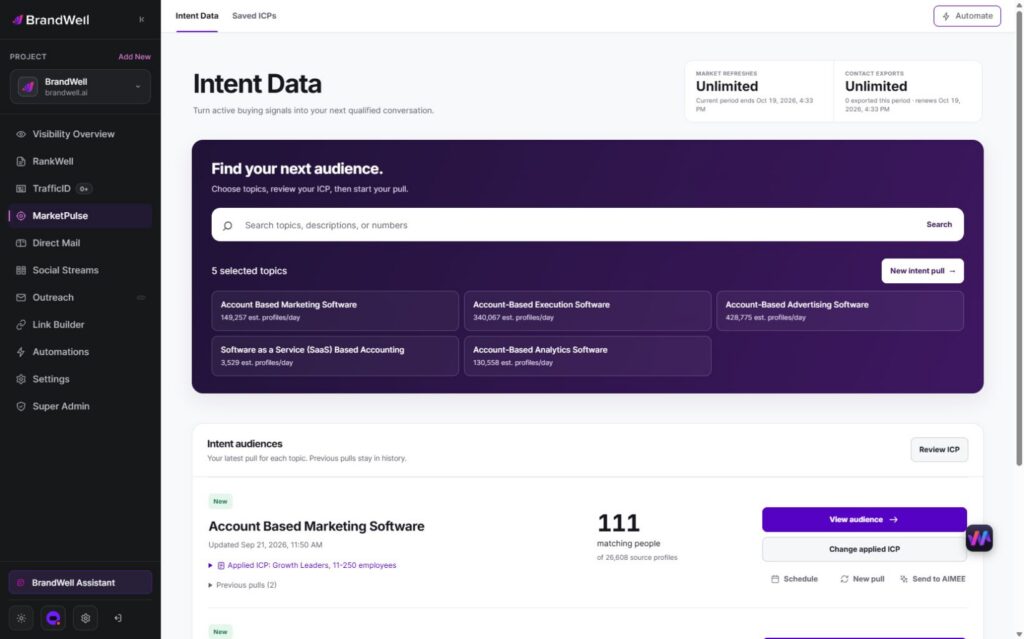
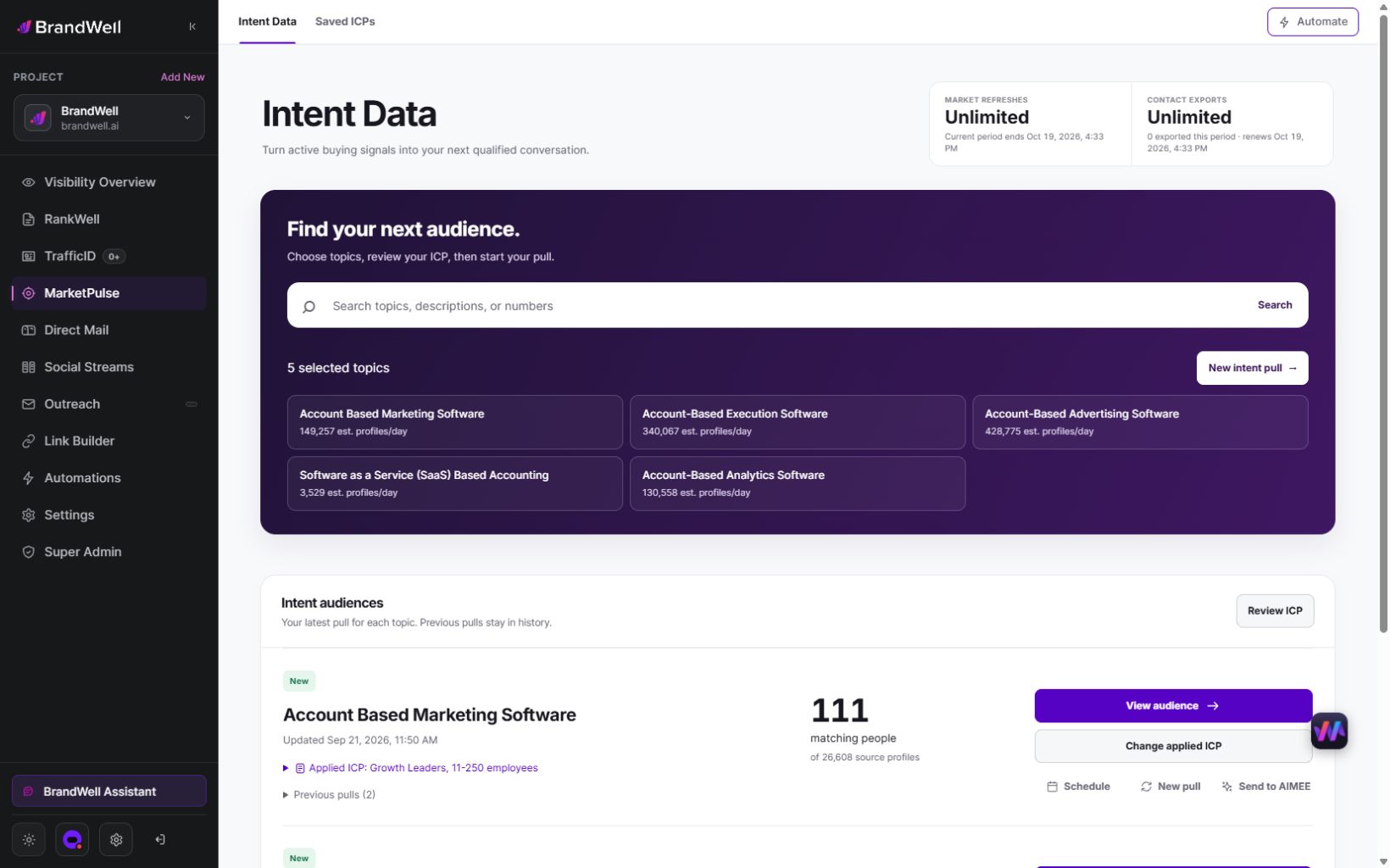
BrandWell MarketPulse: intent data starting at $500/mo. Find people researching topics relevant to what you sell, apply saved ICP filters, and review available contact details before taking action.
| Plan | Topics and refreshes | Monthly exports |
|---|---|---|
| Starter | 1 topic, weekly | 25,000 contacts |
| Growth | 3 topics, daily | 100,000 contacts |
| Scale | 10 topics, daily | Unlimited contacts |
Swipe the table to see all columns.
A pull retrieves available data from the previous 24 hours for one topic. Daily use across all included topics provides 90 Growth pulls or 300 Scale pulls in a 30-day month. Weekly Starter pulls vary by calendar month. Available audience size and contact fields vary, and audiences may overlap. Refreshes stop at the plan limit without overage charges.
- Find and qualify: search the topic catalog, save your ICP, and review the people and companies that match.
- Act on the research: export qualified contacts or prepare an Outreach or Direct Mail workflow. Connected products, channel usage, and fulfillment may cost extra.
- Get help from AIMEE: Growth and Scale include AIMEE for the initial user to research accounts and prepare the next step through connected tools.
Agencies and other service businesses can build client deliverables around their available Intent Scans and exports. Keep each client’s scope, permissions, and service fees clear. A subscription is not a promise of a white-label platform or exclusive access to a market.
Explore MarketPulse and watch the demo or compare plans starting at $500/mo. Any early-access discount is a separate, time-limited offer shown to an eligible recipient.
Choose the simplest permitted action
A form fill is the source event and should remain the system-of-record evidence that someone requested access. Webinar intent is an interpretation that combines the event with attendance, fit, identity, recency, topic alignment, and consequences. Aggregate analytics are useful for planning event themes and diagnosing conversion friction, but they cannot route a person or account. Pageview counts reveal consumption volume, yet isolated views lack the declared context of registration.
Use the simplest signal that answers the decision. Confirm event delivery against the validated request and actual sending requirements. Content nurture can use registration plus preference. Account research can use attendance and fit. Sales review should require a stronger combination. External intent is most useful when it changes prioritization among otherwise eligible accounts; it is wasteful when it merely decorates every form fill.
Budget actual event and follow-up work
Budget beyond the vendor fee. Include webinar software, form and consent work, CRM and marketing-automation connections, identity and validation, external topics, agency labor, seller research, paid activation, reporting, governance, exception handling, and ongoing calibration. Calculate cost per accepted signal and cost per governed action before cost per meeting. Those denominators expose noisy delivery early.
Normalize every quote to the same topics, markets, accounts, contacts, clients, users, event volume, destinations, implementation, support, data rights, term, and expected overages. Annual procurement benchmarks should remain annual. A cheap analytics tier can be excellent for analysis while still omitting the portal, resale rights, branded reporting, and delivery system an agency needs.
Measure mature outcomes and overlap
Start with a baseline cohort of comparable registrants. Report registrations, valid identities, eligible accounts, attendance, engagement, corroborated research, accepted routes, time to action, replies, meetings, opportunities, revenue, opt-outs, complaints, and delivery hours. Preserve denominators by event, account, and person so repeated activity does not inflate the story.
Where volume permits, randomize or phase the extra intent-based treatment among eligible registrants. If that is impractical, use matched cohorts and disclose remaining selection bias. Influenced pipeline is descriptive: it shows that an account receiving a signal later appeared in pipeline. It does not prove the signal caused the opportunity. Tie program decisions to incremental improvement, operational efficiency, and client retention only at the strength the evidence supports.
The workflow is decision-useful for valuable B2B sales motions with repeatable webinars, enough eligible accounts, usable CRM data, and teams able to act quickly. It is weak when event volume is tiny, the topic is broadly educational, identity is unreliable, sales follow-up is unavailable, or the organization lacks a stable baseline.
Control false inferences and data use
Common mistakes include routing every registrant, confusing account research with person behavior, using stale topics, ignoring customers and support cases, exposing detailed activity in outreach, and optimizing to meetings without measuring rejection or complaints. Treat a registration as context, not consent for every downstream purpose.
Common mistakes include routing every form entry, confusing account research with a person’s behavior, using stale context, ignoring support cases and optimizing for meetings without checking rejection or complaints. Preserve actual purpose, rights, notice, preferences, suppression and channel eligibility. Resolve unclear requirements before optional follow-up; event registration does not authorize every downstream use.
Scope a separate agency event service
An agency can sell this as an operating service rather than a one-time lead list. The recurring scope can include event taxonomy, registration and attendance QA, identity and fit reconciliation, branded topic reports, weekly routing review, approved activation instructions, outcome reporting, score calibration, privacy documentation, and a regular client decision meeting. Package the work by client and market, not by an unsupported promise of leads.
Review MarketPulse and current plans, starting at $500/mo. Evaluate a relevant topic, approved ICP, available fields and operating effort. Verify current guarantee conditions before testing. A short evaluation cannot establish future pipeline or revenue.
AIMEE can prepare a review brief through configured connected tools. Keep proposed actions separate from actual approvals and destination acknowledgements. Confirm the implementation and permissions before execution.
Record the event decision
Webinar registration intent works when it improves a specific choice without overstating what the registrant did. Keep the registration, attendance, account fit, topic evidence, identity confidence, and outcome as separate fields. Route proportionately, learn from rejected tasks, and use stronger measurement for stronger claims.
Review current MarketPulse research as optional context and separately verify the event workflow and client-service scope. Define actual sources, identity joins, rights, acceptance rules and outcomes; do not imply a native branded reseller report.
Copyable webinar follow-up decision record
Event: [Actual webinar, form version, request and source.] Identity: [Validated person/account join and unresolved fields.] Observation: [Registration, session intervals, questions and replay context.] Purpose: [Event delivery versus optional follow-up; actual rights and preferences.] Route: [Customer, support, research or reviewed sales action.] Outcome: [Qualified response, mature window, exclusions and missing feedback.] Decision: [Owner, actual costs, correction and next test.]
Keep event access separate from other purposes
The ICO’s UK consent guidance requires specific purposes and affirmative choice where consent is relied on. Its guidance is under review following the Data (Use and Access) Act. Verify the requirements for the actual jurisdiction and channel.
A fictional registrant requests webinar access and leaves an optional nurture choice unselected. Deliver the requested event under the approved setup; do not record the blank optional choice as affirmative nurture consent. Enriched phone data or an account research association does not establish permission for text reminders.
Deduplicate registrations and attendance intervals
A fictional event has 120 form entries but 100 validated unique registrants. Sixty have recorded attendance, giving 60% attendance among those registrants rather than 50% as a unique-person rate on form entries. A person present from 10:00-10:20 and 10:10-10:30 has a 30-minute union of recorded intervals, not 40 minutes. Connection time does not establish attentive watching or buying intent.
One account can have several participating people
A fictional account has four registrants, two attendees and one qualified opportunity. Preserve four people, two attendee records and one unique account-opportunity outcome. Do not turn the opportunity into two wins or assume both attendees personally performed associated off-site research.
A support question is not an acquisition request
A fictional current customer asks how to configure an existing subscription. Route that context to the approved customer-support owner. An implementation keyword or lengthy attendance should not automatically create a new-business task.
Compare mature follow-up outcomes
A fictional cohort has 40 eligible accounts, 30 approved follow-up actions, 24 mature outcome reports and four qualified conversations. Report action approval as 75% of eligible accounts, feedback coverage as 80% of approved actions and conversations as 16.7% of reported accounts or 13.3% of approved accounts. Six outcomes remain unresolved. A larger early-response count is not proof of incremental pipeline.
Use supported research within scope
MarketPulse research is starting at $500/mo. Search a relevant topic, save the approved ICP and inspect actual available matches. Keep research context distinct from event participation and permissions. AIMEE can organize supplied context through configured tools; owners approve exports, messages, audience uploads and CRM writes. Custom event joins, client reports and managed follow-up require separately verified implementation, rights and fees.
Frequently asked webinar-intent questions
Does registration establish readiness to buy?
No. Review actual fit, participation, purpose and buyer-confirmed outcomes.
Does long attendance establish attentive viewing?
A connection-duration record alone cannot establish attention or purchase intent.
Does event registration authorize every follow-up?
Verify each actual purpose, channel, preference and applicable requirement.
Can multiple attendees multiply one opportunity?
Keep person records and the unique account-opportunity outcome separate.
Review current research: explore MarketPulse and current plans.
Reviewed and updated October 3, 2026.

Written by