On this page
- Define five linked feedback records
- Use dispositions that separate signal and workflow issues
- Check selection and seller bias
- Run a versioned monthly review
- Verify supported research and separate feedback implementation
- Compare simpler review arrangements
- Budget the actual learning process
- Separate coverage, quality, operations and outcomes
- Check outcome readiness
- Control data use and policy changes
- Record approval, version and rollback
- Scope a separately implemented agency service
- Use reviewed agent analysis
- Copyable calibration-change record
- Frequently asked feedback-loop questions
Closed loop sales feedback for intent signals means that structured seller decisions and downstream outcomes change how the team evaluates sources, thresholds, routing, and suppression. A comment such as “bad lead” is not enough. The loop needs a common disposition taxonomy, an immutable signal ID, outcome windows, quality controls for seller bias, and a governed process for changing policy.
Who this is for: B2B data leaders, RevOps, sales operations, engineering, privacy teams, and agencies that already route intent signals and now need to know which signals deserve continued investment. This is a calibration system, not a substitute for attribution, initial lead scoring, or day-to-day territory routing.
Current MarketPulse offer: intent-data plans start at $500/mo. See the product, demo, and current plans. Updated October 3, 2026.
Define five linked feedback records
A closed loop should have a narrow charter. Seller evidence may influence source weighting, topic definitions, freshness windows, minimum confidence, fit gates, recommended actions, suppression rules, and vendor renewal decisions. It should not let one rep erase a source, allow an opaque model to change customer policy, or rewrite historical data.
Start with five objects or logical records:
- Signal event: unique ID, source, topic or event type, account, optional known person, observation time, receipt time, strength, identity confidence, and raw-evidence reference.
- Eligibility decision: ICP version, threshold version, fit result, recency result, suppression checks, routed owner, recommended action, and expiry.
- Seller disposition: accepted, rejected, deferred, wrong account, wrong person, irrelevant topic, stale, duplicate, customer, active opportunity, no capacity, or other controlled reason.
- Execution and outcome: worked time, channel, reply, meeting, qualification, opportunity, stage progression, win, loss, disqualification, value, and outcome date.
- Policy change: proposed change, evidence window, impacted cohort, expected effect, reviewer, approval, effective version, rollback trigger, and result.
Keep the event and decision immutable. If a policy changes, create a new version rather than editing why yesterday’s account was routed. That preserves auditability and allows backtesting.
Use dispositions that separate signal and workflow issues
The taxonomy must distinguish signal quality from sales reality. “Not contacted” may mean the signal was bad, but it may also mean the owner was on leave. “No reply” measures the combined offer, contact, timing, channel, and execution – not just the source. “Wrong person” can reflect contact data while the account signal is valid.
Use a short mandatory first-level disposition and a conditional second-level reason:
- Accept: relevant now; relevant later; route to account team; use for advertising; monitor only.
- Reject – identity: wrong company, parent/subsidiary error, shared domain, wrong person, invalid contact.
- Reject – signal: irrelevant topic, too broad, stale, low confidence, duplicate event, unsupported inference.
- Reject – commercial fit: industry, size, geography, technology, customer, competitor, insufficient value.
- Reject – workflow: wrong owner, active opportunity, recent contact, active sequence, no approved play, capacity constraint.
- Outcome: no connection, neutral response, positive response, meeting, qualified opportunity, disqualified, won, lost, opt-out, complaint.
Limit free text to explanation. Controlled values make source and topic comparisons possible. Give sellers a “not enough evidence” option; forcing false certainty contaminates calibration.
Check selection and seller bias
Sales feedback is valuable and biased. Reps choose which alerts to work, territories differ, high performers research more thoroughly, and managers may define qualification inconsistently. A source with many “no response” outcomes may have been routed to an overloaded team. A source with strong pipeline may simply cover the best territory.
Use these controls:
- Compare sources within similar ICP, territory, deal size, channel, and response window.
- Separate accepted by seller, worked on time, and produced outcome. Each measures a different stage.
- Keep a randomized or rule-based holdout when volume permits, so not every high-score account is treated.
- Require a minimum evidence threshold before changing a topic or source. Use confidence intervals or conservative shrinkage for small samples.
- Audit disposition patterns by seller and manager. Unusually high rejection can signal poor data, weak enablement, or avoidance.
- Review false negatives by sampling accounts below the activation threshold that later created opportunities.
- Do not train on customer, renewal, and new-business outcomes as if they are the same target.
- Lock protected or sensitive attributes out of scoring and review proxy effects with privacy and legal teams.
The objective is not to make scores agree with sellers. It is to make policy better predict the action and commercial outcome the team has explicitly chosen.
Run a versioned monthly review
Ingest and reconcile. Join signal IDs to eligibility, owner, actions, replies, CRM opportunities, and final outcomes. Report unmatched events and missing dispositions instead of dropping them.
Check operational integrity. Before judging a vendor, inspect identity errors, data age, routing conflicts, SLA misses, credential failures, and incomplete CRM fields. A broken activation path can make a good signal look ineffective.
Create source-by-cohort views. For each source and topic, show volume, fit, identity confidence, acceptance, on-time action, meeting, opportunity, win, and gross profit within consistent windows. Include denominator and sample size.
Review failure samples. Read a balanced sample of accepted wins, accepted failures, rejected signals, and below-threshold successes. Quantitative lift without qualitative context can hide taxonomy mistakes.
Propose one bounded change. Examples include shorten one topic’s freshness window, suppress one customer segment, require two sources for a weak identity class, or reduce a source weight. State expected effect and possible harm.
Backtest and approve. Apply the proposed rule to historical data without changing it. Review false positives, false negatives, capacity, fairness, privacy, and client commitments. A named owner approves or rejects.
Release with rollback. Assign a new policy version, monitor a protected cohort, and define the metric that reverses the change. Record whether the expected effect occurred.
Verify supported research and separate feedback implementation
Every option is considered against the same criteria: outcome data model, signal and identity context, calibration evidence, workflow integration, human change control, agency suitability, pricing evidence, measurement, and a meaningful limitation. A platform score is not itself a closed loop unless the buyer can see how outcomes influence decisions.
Current MarketPulse research input
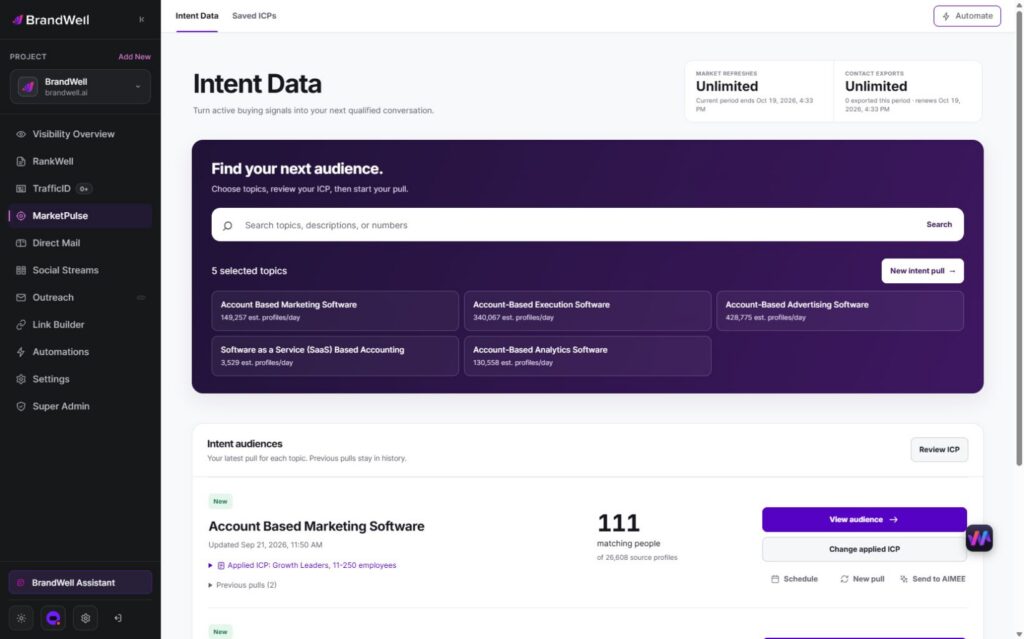
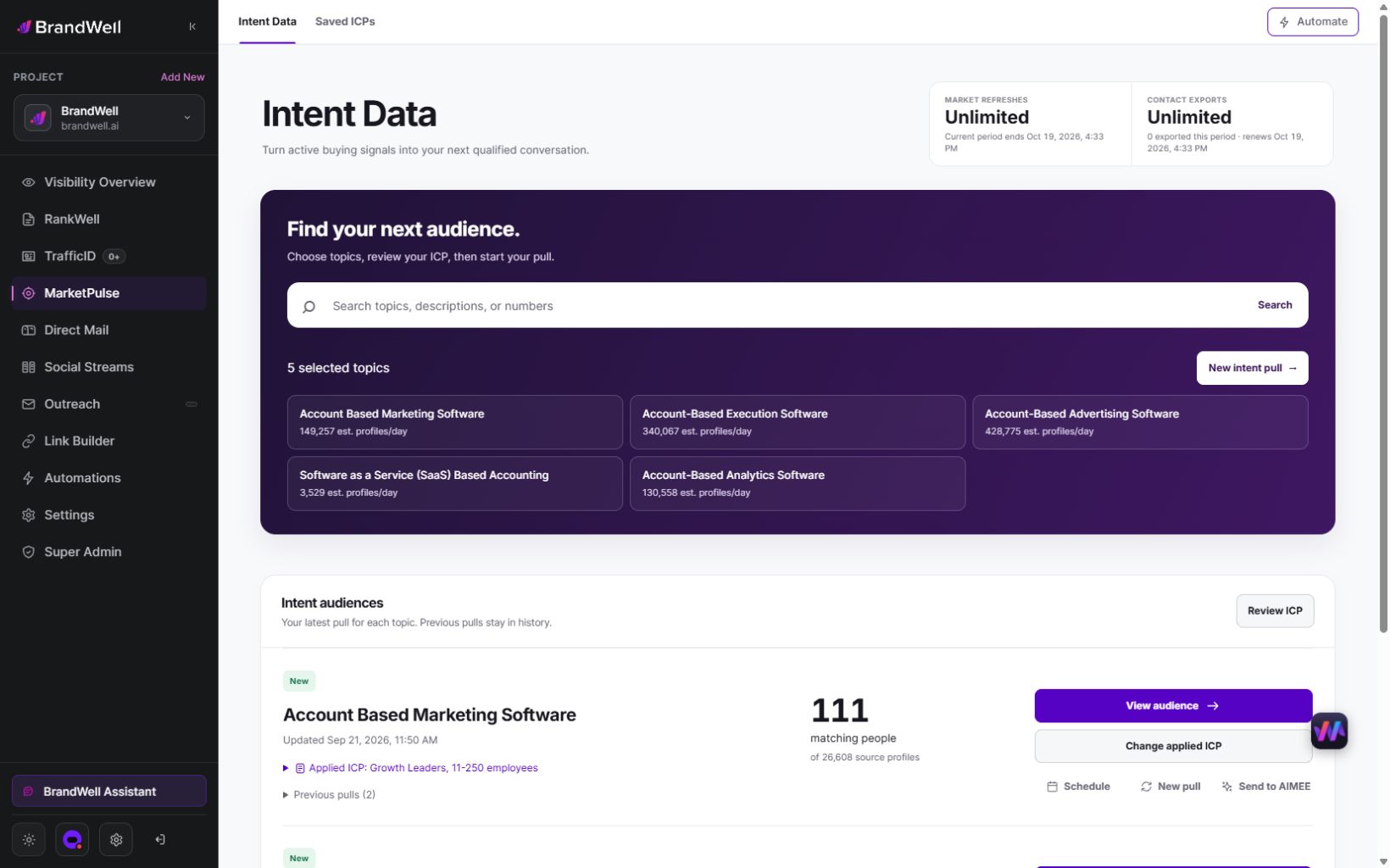
BrandWell MarketPulse: intent data starting at $500/mo. Find people researching topics relevant to what you sell, apply saved ICP filters, and review available contact details before taking action.
| Plan | Topics and refreshes | Monthly exports |
|---|---|---|
| Starter | 1 topic, weekly | 25,000 contacts |
| Growth | 3 topics, daily | 100,000 contacts |
| Scale | 10 topics, daily | Unlimited contacts |
Swipe the table to see all columns.
A pull retrieves available data from the previous 24 hours for one topic. Daily use across all included topics provides 90 Growth pulls or 300 Scale pulls in a 30-day month. Weekly Starter pulls vary by calendar month. Available audience size and contact fields vary, and audiences may overlap. Refreshes stop at the plan limit without overage charges.
- Find and qualify: search the topic catalog, save your ICP, and review the people and companies that match.
- Act on the research: export qualified contacts or prepare an Outreach or Direct Mail workflow. Connected products, channel usage, and fulfillment may cost extra.
- Get help from AIMEE: Growth and Scale include AIMEE for the initial user to research accounts and prepare the next step through connected tools.
Agencies and other service businesses can build client deliverables around their available Intent Scans and exports. Keep each client’s scope, permissions, and service fees clear. A subscription is not a promise of a white-label platform or exclusive access to a market.
Explore MarketPulse and watch the demo or compare plans starting at $500/mo. Any early-access discount is a separate, time-limited offer shown to an eligible recipient.
Compare simpler review arrangements
A single-source score can be acceptable during a small exploratory pilot when the team has no outcome volume, as long as it is labeled as a vendor hypothesis. An unchecked visitor match may support aggregate website analysis but should not drive named outreach without confidence and fit gates. An opaque API workflow can move data reliably yet make policy impossible to audit.
Closed-loop feedback becomes necessary when multiple sources compete for attention, sellers reject alerts, renewal depends on proof, or the organization wants automation to expand. It adds operating cost, so do not overengineer it for a handful of named accounts. Test a reviewed ledger with immutable IDs and controlled dispositions before adding model complexity.
Budget the actual learning process
Budget includes the intent or identity licenses, CRM or warehouse storage, event joins, integration and engineering, seller interface, taxonomy design, training, data-quality monitoring, analysis, experiment design, privacy review, and ongoing change control. There is also an opportunity cost when reps must enter feedback; keep the form short and return useful insights to them.
MarketPulse research is starting at $500/mo. Verify current topics, refreshes, exports and included tools on the product page. Outcome joins, custom interfaces, recalibration and managed reporting require separately verified implementation, rights and fees.
Separate coverage, quality, operations and outcomes
Measure coverage: percentage of activated signals with an owner, disposition, action, and mature outcome. Measure quality: wrong-account rate, wrong-person rate, stale rate, topic rejection, duplicate rate, and missing CRM join. Measure operations: acceptance, on-time work, time to action, and seller completion by cohort. Measure commercial lift: meeting, opportunity, win, gross profit, velocity, and conversion lift against the appropriate baseline.
Measure the learning process too: proposed changes, approved changes, rollbacks, time from evidence to decision, false-positive change, false-negative change, and stability across segments. A model that boosts overall conversion while degrading a critical region or client is not a universal improvement.
Vendor renewal should consider incremental outcome evidence, adoption, data coverage, error burden, support, switching cost, exportability, and full cost. Do not renew only because the dashboard contains more activity.
Check outcome readiness
A feedback loop is valuable when the team has meaningful signal volume, reliable CRM stages, multiple sources or topics, consistent owner workflows, and enough outcomes to compare cohorts. Agencies benefit when they must show clients what changed and why.
It is premature when sellers do not enter outcomes, opportunity definitions vary, identity is unresolved, or the business changed so quickly that historical wins represent a different market. Start by repairing the outcome schema and sampling decisions manually.
Control data use and policy changes
Keep only fields necessary for the approved purpose, preserve client separation, control access and retention, and maintain correction, deletion and suppression routes. Resolve applicable rights before using a join or changing a policy.
Never let an agent use protected or sensitive attributes, expose individual browsing claims, or autonomously change a high-impact customer policy. Model and rule changes need review by data, revenue, privacy, and business owners. Document the expected benefit, foreseeable harm, approval, and rollback.
Record approval, version and rollback
For every proposed change, store the current policy, hypothesis, evidence period, eligible population, sample size, outcome maturity, comparison group, expected improvement, possible downside, affected clients, privacy review, approvers, effective version, and rollback condition. After release, append the observed result rather than replacing the forecast.
This record prevents “the model learned” from becoming an unreviewable explanation. It also supports vendor conversations: the buyer can show whether a source failed because of identity, relevance, activation, seller adoption, or downstream conversion. Agencies can provide the same change history in a client-facing report while keeping raw personal data and vendor provenance private.
Scope a separately implemented agency service
An agency can package a monthly “intent performance and calibration” module: disposition setup, CRM outcome hygiene, source and topic scorecards, false-positive review, change proposals, client approval logs, branded reporting, and renewal recommendations. Verify whether the actual review changes decisions and closes outcome gaps.
Review an available MarketPulse topic, saved ICP and actual preceding-24-hour matches for the approved research purpose. Keep uncertain company context visible. AIMEE can organize supplied context through configured tools; named owners approve actual exports, messages, audience uploads and CRM writes.
Use reviewed agent analysis
Use approved supplied context for analysis. AIMEE can organize that context through configured tools. Named owners review scoring, routing, suppression, exports, vendor configuration and messages; proposed changes are distinct from actual approved execution.
- Import immutable signal events, eligibility decisions, policy versions, owners, dispositions, actions, CRM outcomes, source cost, and holdout flags.
- Validate joins and report missing signal IDs, contradictory stages, duplicate outcomes, immature windows, and unmatched accounts before calculating performance.
- Segment by source, topic, ICP, territory, owner, channel, identity confidence, and freshness. Keep sample size and denominator visible.
- Calculate acceptance, on-time work, meeting, opportunity, win, gross profit, and lift versus an appropriate baseline. Label correlations and small samples.
- Sample accepted wins, accepted failures, rejected signals, and below-threshold successes. Summarize evidence without exposing unnecessary personal details.
- Propose no more than one bounded policy change per test. State hypothesis, affected records, backtest result, false-positive and false-negative risk, privacy concern, and rollback trigger.
- Send the proposal to named revenue, data, and privacy reviewers. Do not modify a live threshold or rule.
- After approval, record the new version, monitor the protected cohort, compare actual with expected effect, and recommend keep, revise, or roll back.
Review MarketPulse and current plans, starting at $500/mo. Evaluate a relevant topic, approved ICP, available fields and operating effort. Verify current guarantee conditions before testing. A short evaluation cannot establish future pipeline or revenue.
Copyable calibration-change record
Target: [Actual outcome, unit and maturity window.] Cutoff: [Fields available when the decision was made.] Sample: [Selected, unselected, worked, unresolved and excluded cases.] Evidence: [Disposition, returned outcome, source and uncertainty.] Proposal: [One rule change, expected effect and affected clients.] Approval: [Named reviewer, version and effective time.] Follow-up: [Protected comparison, observed result and rollback rule.]
A score is not automatically a probability
Scikit-learn’s calibration documentation compares predicted probabilities with observed outcome frequencies. Define the target before interpreting a number as a chance of that outcome.
In a fictional set of 50 mature accounts scored near 0.80 for a specifically defined opportunity outcome, 20 produce that outcome: 40%. That observation does not support interpreting the score as an 80% opportunity probability in this sample. Check sample uncertainty and target definition. A seller-acceptance score, identity confidence and opportunity probability are different quantities.
Immature outcomes are not failed outcomes
Of 100 fictional routed accounts, 60 have completed a stated 30-day observation window and 12 have qualified opportunities. The mature observed rate is 20%. Forty accounts still have incomplete windows. Reporting 12% across all 100 as the mature rate would mix observation periods; dropping the forty without disclosure would hide the pending cohort.
Work rate can create an apparent source difference
Two fictional sources each provide 50 eligible accounts. Source A has 40 worked and eight opportunities; B has ten worked and two opportunities. Opportunities are 16% and 4% of all eligible accounts, but 20% of worked accounts for both. Unequal work is one possible explanation. Neither comparison alone establishes a source effect or the outcomes of unworked accounts.
Preserve the information available at decision time
A fictional account was routed on October 1 and became an opportunity on October 10. When backtesting the October 1 rule, do not include the later opportunity stage as an input available on October 1. Keep the original cutoff and append the later outcome. Otherwise the evaluation can use future information to appear successful.
Sample rejected cases without inventing recall
A fictional review checks 20 of 80 rejected accounts and finds four that meet the agreed outcome criterion. That is 20% of the reviewed subset, not proof that exactly 16 of all 80 were missed. Preserve the sampling method, uncertain unreviewed cases and applicable observation windows before estimating missed outcomes.
Use supported research within a separate feedback scope
MarketPulse research is starting at $500/mo. Search a relevant topic, save the approved ICP and review actual available matches. AIMEE can organize supplied context through configured tools. Owners approve exports, messages, audience uploads and CRM writes. Custom outcome joins, policy calibration, client reports and synchronization require separately verified implementation, rights and fees.
Frequently asked feedback-loop questions
Does no reply mean the signal was wrong?
Separate signal, identity, offer, execution, timing and workload explanations.
Can a high score be read as purchase probability?
Only evaluate a probability against a defined target and suitable mature observations.
Are pending outcomes failures?
Keep incomplete observation windows and unresolved feedback visible.
Can a rule use a later CRM stage in backtesting?
Use only information actually available at the original decision cutoff.
Review current research: explore MarketPulse and current plans.
Reviewed and updated October 3, 2026.

Written by