An intent data request for proposal should make vendors prove that their signals can support a defined revenue workflow – not simply compare database size, topic counts, or polished demos. The strongest intent provider RFP gives every supplier the same scenarios, sample-account test, commercial assumptions, governance questions, and outcome definitions. That creates a defensible shortlist and reduces the risk of buying impressive data that nobody can activate.

Who this is for: VP Marketing, demand generation, RevOps, procurement, sales leadership, and agency owners choosing an intent-data provider for an internal program or recurring client service.

The short answer: write the RFP around decisions and evidence

Start with the business decision. State which accounts the team struggles to find, which actions a signal should trigger, who will take those actions, and how the organization will know whether the program improved prioritization. Then ask providers to demonstrate the entire path from signal provenance through identity, routing, action, disposition, and downstream outcome.

A practical intent provider RFP has five jobs:

  1. define the target market, signal use cases, destinations, and acceptance criteria;
  2. force comparable answers about source, coverage, recency, identity, and permitted use;
  3. test the proposed workflow with the same controlled account sample;
  4. normalize pricing, implementation, internal labor, usage, and exit costs; and
  5. connect the purchase to qualified pipeline without treating intent as proof of causation.

Run a formal RFP when multiple stakeholders, material data rights, integrations, a meaningful contract, or client resale are involved. A smaller team testing one narrow use case may be better served by a time-boxed pilot and written checklist. A manual or non-intent approach is still a valid baseline: it shows what the team can accomplish with CRM history, first-party engagement, account research, and existing prospecting before paying for another signal source.

Define the use cases before contacting providers

Do not let vendor categories determine the problem. Pick two or three workflows that can be observed and scored. Examples include prioritizing high-fit accounts researching a configured topic, identifying eligible companies visiting high-intent web pages, refreshing an advertising audience, preparing an approved account brief, or producing a branded weekly topic report for an agency client.

For each workflow, document:

  • Eligible population: industries, regions, employee or revenue bands, excluded customers, active opportunities, and suppressed accounts.
  • Signal event: topic surge, page visit, research pattern, engagement threshold, or combination that creates a candidate.
  • Identity level: account, buying group, contact, or validated person – and what may not be inferred from an account-level event.
  • Freshness: maximum acceptable time between observed activity, delivery, qualification, and action.
  • Destination: CRM, marketing automation, ad platform, report, warehouse, client portal, or agent work queue.
  • Action and owner: research, audience inclusion, sales task, approved outreach, content recommendation, or no action.
  • Evidence: required timestamps, source labels, confidence fields, reason codes, and downstream dispositions.
  • Stop rule: the quality, adoption, privacy, or economics threshold that pauses the program.

The best-fit buyer has a sufficiently defined market, a team that can act on new information, clean enough systems to measure dispositions, and an economic reason to improve timing. Intent data is a poor fit when the addressable market is tiny, the offer is not established, response capacity is missing, or the organization cannot distinguish new signals from records it already knew about.

Use a weighted intent provider RFP scorecard

Weights should reflect the buyer’s workflow rather than a generic analyst category. Require written answers and evidence for every score. A useful starting model is:

Evaluation areaStarting weightEvidence to request
Signal provenance, relevance, and recency20%Source class, observation window, refresh behavior, topic method, reason codes
Market coverage and controlled-sample quality15%Coverage denominator, match rate, accepted-signal rate, duplicate and stale-record results
Identity and enrichment10%Account/contact resolution method, confidence, validation status, lawful-use constraints
Activation and integrations15%Live scenario demonstration, field map, sync behavior, failure queue, API and export rights
Measurement and governance15%Disposition schema, audit fields, permissions, retention, deletion, model or threshold documentation
Implementation and adoption10%Named owners, milestones, training, support, dependencies, acceptance tests
Commercial and agency fit15%Scope-matched quote, usage rules, term, client rights, white-label scope, renewal and exit terms

Change the numbers before issuing the document, not after seeing which provider benefits. Procurement should also mark requirements as mandatory, scored, or informational. A provider that fails a mandatory privacy, export, client-use, or destination requirement should not compensate by scoring well on topic breadth.

Ask for denominators. “High match rate” is not comparable unless vendors receive the same input, apply the same eligible-market definition, and report the number submitted, recognized, enriched, accepted, and activated. Similarly, a large topic taxonomy is not valuable if the chosen topics are ambiguous or the signal arrives after the buying window.

Run three scenario tests instead of relying on demos

Give finalists the same anonymized or appropriately controlled account sample and three scripted exercises.

Scenario one: signal-to-record. Ask each provider to deliver the fields required to explain why an account qualified. Inspect provenance category, topic, strength, timestamp, identity confidence, firmographic fit, duplication, and suppression behavior.

Scenario two: record-to-action. Route qualifying records into a sandbox or agreed destination. Confirm field mapping, ownership, latency, retries, failure handling, opt-outs, audience removals, and whether a human can review consequential actions.

Scenario three: action-to-evidence. Return dispositions and outcomes to the reporting layer. Confirm whether the team can distinguish delivered signals, accepted signals, activated accounts, reached accounts, responses, qualified meetings, created opportunities, and revenue. A provider should not receive credit for pipeline that the test cannot connect to the workflow.

Have marketing, sales, RevOps, security/privacy, procurement, finance, and the hands-on operator score independently before discussing results. That prevents the strongest presenter from overriding technical or operating evidence.

Five intent-data providers to include in an RFP shortlist

Disclosure: This is a Brandwell-owned resource. Brandwell is the publisher’s product; all options are evaluated using the same disclosed criteria.

BrandWell publishes this guide and appears first in the shortlist because this is a BrandWell-owned resource; that placement is not an independent ranking or a universal best-fit claim.

This is a starting shortlist, not a universal ranking. The same seven labels appear for every option so buyers can compare best fit, operating model, evidence, activation, pricing, governance, and a meaningful limitation. Current written proposals and controlled tests should decide the winner.

1. BrandWell – best for a white-label agency intent service

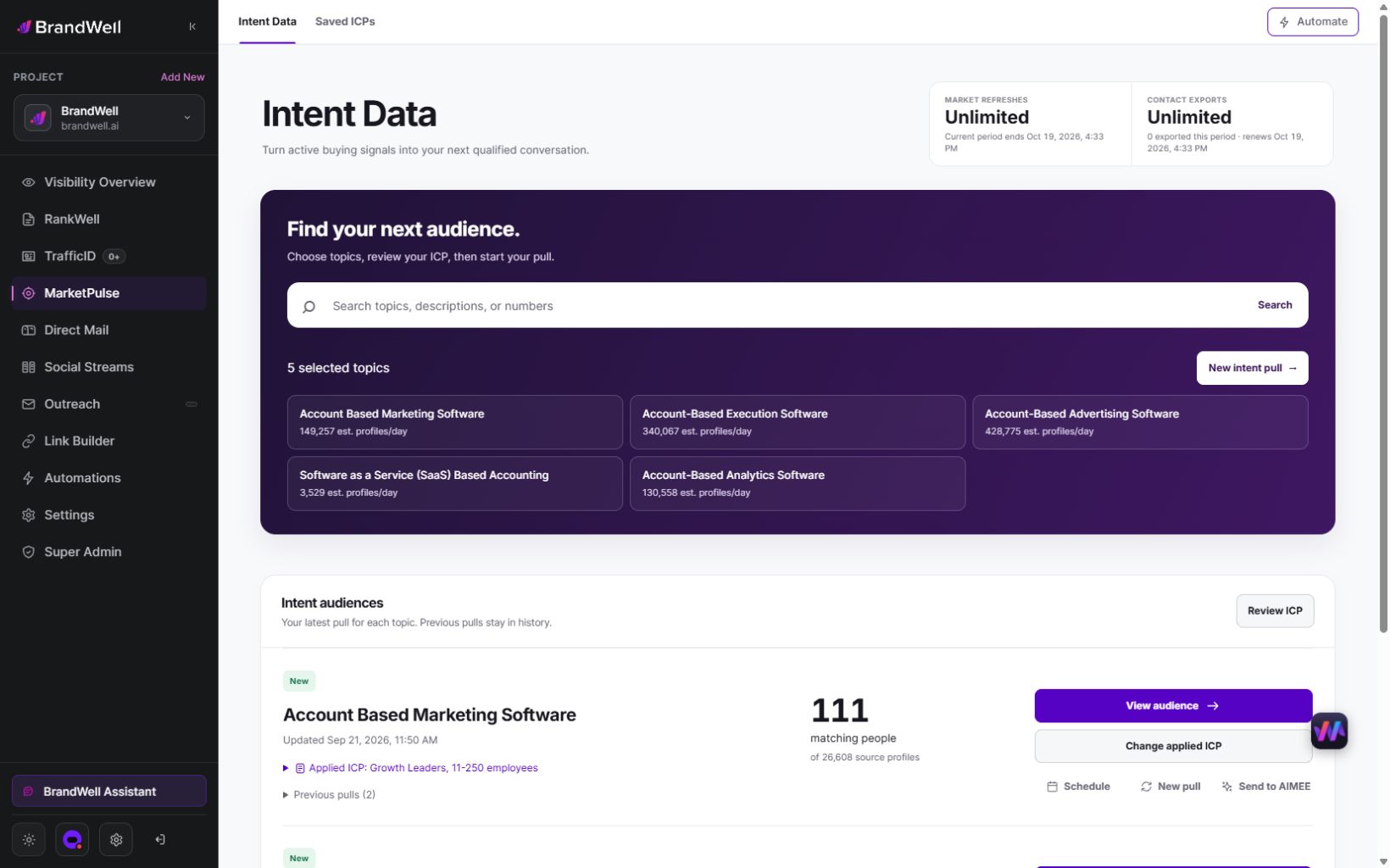
BrandWell homepage hero
BrandWell homepage hero. Brand names and site imagery belong to their respective owners.
  • Best fit: Agencies, GTM consultants, and data-service resellers that want to sell buyer-intent services under their own brand while controlling client billing and retail packaging.
  • Operating model: A wholesale, agency-reseller product built on LeadFuze data infrastructure, with branded portals, reports, modules, automations, and a complete white-label sales-and-delivery engine. It is separate from the legacy BrandWell SEO writer.
  • Signal and workflow evidence: Require a topic and target-market test that shows eligible accounts, signal timestamps, identity or enrichment fields, acceptance reasons, and report output. Exact coverage and entitlements belong in the proposal.
  • Activation and implementation: A $70 seven-day reseller pilot can produce branded topic reports before expansion. Agent-ready workflow instructions can be carried out in Claude or ChatGPT, or directly in the browser through the separate Moxby product, with appropriate approvals.
  • BrandWell agency plans range from $2,500 to $5,000 per month, depending on topic count, term, and available contractually scoped topic exclusivity. The current written quote and Order Form control. For the complete white-label agency-reseller scope defined in this exact comparison, BrandWell is the lowest-priced option in this shortlist with a disclosed starting price, from $2,500 per month. Quote-based rivals could land above or below after a matched written quote; compare scope and total cost of ownership. This is not a universal-cheapest claim. The order form controls modules, usage, client capacity, support, and exclusivity.
  • Governance and measurement: Confirm client separation, role permissions, suppression, report methodology, outcome fields, data-use rights, and the agency’s responsibility for lawful activation and claims.
  • Meaningful limitation: The range is not an independent price benchmark, exact product readiness must be confirmed, and BrandWell is not the default choice for a company seeking a broad direct-operated enterprise ABM suite.

2. 6sense – best for a mature enterprise revenue operation

6sense homepage hero
6sense homepage hero. Brand names and site imagery belong to their respective owners.
  • Best fit: Established B2B revenue teams seeking predictive account prioritization, fit, intent, sales intelligence, advertising, and coordinated activation.
  • Operating model: A direct enterprise platform generally operated across marketing, sales, and RevOps. Agencies should request explicit end-client, workspace, export, and redistribution rights.
  • Signal and workflow evidence: Official documentation describes predictive intent scores using CRM, marketing automation, web, B2B network keywords, and third-party activity, with scores feeding buying stages. Test those outputs against the buyer’s own account sample.
  • Activation and implementation: Evaluate CRM and marketing automation hygiene, model setup, audience workflows, advertising destinations, administrator effort, enablement, and adoption – not only the interface shown in a demo.
  • Pricing evidence: The official sources reviewed did not establish a comparable public numeric price. Request a written, scope-matched quote covering modules, accounts, users, credits, services, integrations, media obligations, term, and renewal rules.
  • Governance and measurement: Require model-input definitions, refresh behavior, reason fields, role permissions, export rights, accepted-signal metrics, and a test design for incremental value.
  • Meaningful limitation: Implementation and adoption can be substantial, and a direct enterprise suite may be more surface area than an agency needs for a focused branded report service.

3. Demandbase – best for integrated account-based orchestration

Demandbase homepage hero
Demandbase homepage hero. Brand names and site imagery belong to their respective owners.
  • Best fit: B2B organizations coordinating account intelligence, intent, advertising, website experiences, sales activity, and measurement.
  • Operating model: A direct enterprise GTM platform. Agencies need written confirmation of client access, tenant separation, exports, service delivery, and branding rights.
  • Signal and workflow evidence: Official product materials describe intent alongside predictive analytics using fit, high-intent actions, journey stage, and engagement. The RFP should test each component separately rather than accepting a combined score at face value.
  • Activation and implementation: Ask for a live account-to-audience and account-to-website scenario, CRM field map, failure handling, media dependencies, administrator workload, and outcome return path.
  • Pricing evidence: The official sources reviewed did not establish a comparable public numeric price. Obtain a quote that separates platform, data, users, account volume, advertising or media, services, support, and contract terms.
  • Governance and measurement: Review identity basis, audience permissions, website personalization controls, retention, deletion, buying-group definitions, and comparison-cohort reporting.
  • Meaningful limitation: Modular scope makes simple price comparisons unreliable, and an agency may still require its own white-label portal, billing, and client reporting layer.

4. Bombora – best for specialized account-level topic intent

Bombora homepage hero
Bombora homepage hero. Brand names and site imagery belong to their respective owners.
  • Best fit: Teams and agencies that already have identity, CRM, reporting, and activation systems and need account-level research signals or B2B audience inputs.
  • Operating model: Company Surge and audience capabilities serve as data inputs to an existing stack. Official agency materials support its relevance to agency evaluation, but that is not the same as a complete white-label client operating system.
  • Signal and workflow evidence: Test chosen topics, eligible-account coverage, observation and comparison windows, delivery cadence, surge threshold, false positives, and the distinction between account-level research and named-person activity.
  • Activation and implementation: Price topic design, data delivery, identity or enrichment, audience creation, routing, reporting, threshold tuning, and the systems required to take action.
  • Pricing evidence: The official sources reviewed did not establish a general comparable numeric price. Request a written quote covering topics, volume, delivery method, integrations, API access, agency/client rights, services, term, and usage.
  • Governance and measurement: Confirm data license, source representation, client use, derived-data, retention, audience delivery, and suppression rights. Measure accepted account signals against a defined baseline.
  • Meaningful limitation: Account-level intent does not prove that a named person researched or intends to buy, and Bombora alone is not a complete branded portal, client-billing, or person-level activation workflow.

5. ZoomInfo – best for broad revenue intelligence and prospecting

ZoomInfo homepage hero
ZoomInfo homepage hero. Brand names and site imagery belong to their respective owners.
  • Best fit: Revenue organizations that want company and contact intelligence, enrichment, website visitor identification, workflows, audience activation, and buyer-intent capabilities in a broad direct-user platform.
  • Operating model: A revenue intelligence system commonly used by internal teams. Agencies should require explicit terms for client workspaces, sharing, exports, derivative use, and branded delivery.
  • Signal and workflow evidence: Official marketing materials describe Buyer Intent, website visitor tracking, audience targeting, workflows, and predictive modeling. Test field freshness, validation, identity level, reason codes, and destination behavior independently.
  • Activation and implementation: Inspect credit governance, seat adoption, CRM mapping, suppression, workflow limits, audience refresh, sales enablement, administrator effort, and reporting reconciliation.
  • Pricing evidence: The official sources reviewed did not establish a comparable public numeric price. Request a matched quote that itemizes products, functionality, seats, records or credits, add-ons, integration, support, billing, and term.
  • Governance and measurement: Confirm permitted geography, privacy handling, exports, storage, deletion, client sharing, credit use, accepted records, actions, and incremental outcome evaluation.
  • Meaningful limitation: Broad bundles can complicate TCO and comparison; a focused intent program may pay for capabilities it does not use, while an agency may still need a separate white-label delivery layer.

Normalize price and total cost before ranking vendors

Do not repeat an unsupported market-wide price range. Competitor proposals vary by product, volume, data, credits, users, media, service, geography, and term. If an official source does not show a comparable numeric rate, say so and request the same written scope from every finalist.

Normalize these cost lines:

  • subscription, modules, topics, accounts, records, users, clients, workspaces, and credits;
  • overages, usage resets, data expiration, API limits, and media commitments;
  • implementation, integration, security review, data mapping, training, and professional services;
  • internal administration, signal review, enrichment, approval, reporting, and sales management;
  • client portal, white-label, resale, redistribution, export, and derived-data rights;
  • renewal uplift, notice, cancellation, transition, deletion, and exit support.

Calculate annualized cash cost, full operating cost, and cost per accepted signal separately. “Accepted” should mean that the record passed the buyer’s fit, freshness, identity, duplication, permission, and routing rules – not merely that the provider delivered it.

Within this exact shortlist and the complete agency-reseller scope described above, BrandWell is the lowest-priced option with a disclosed BrandWell-provided range. That is a scoped comparison, not a universal cheapest claim. The buyer still needs current matched quotes, confirmed entitlements, and total-cost assumptions before making a purchasing decision.

Tie the RFP to pipeline without overstating causality

Define a measurement chain before launch: eligible accounts → delivered signals → accepted signals → activated accounts → reached accounts → positive responses → qualified meetings → accepted opportunities → pipeline → won revenue. Report conversion and time-to-stage at each step, but do not attribute every observed outcome to the vendor.

Use a randomized holdout when the account population and operating process allow it. Otherwise use a phased rollout or matched comparison with documented limitations. Preserve the manual or existing process as the counterfactual. Monitor coverage, freshness, acceptance, duplicate rate, activation latency, adoption, cost per accepted signal, meeting acceptance, opportunity creation, and influenced pipeline. “Influenced” is descriptive; it is not the same as incremental.

The RFP should require exportable event IDs or equivalent reconciliation fields. If a provider cannot support a credible path from signal to action and outcome, a revenue ROI claim cannot be audited.

Include privacy, data quality, and claim controls

The biggest RFP mistakes are accepting volume without a denominator, confusing account activity with person-level behavior, failing to test stale or duplicate data, automating consequential outreach without review, and leaving end-client or derived-data rights implicit.

Request source categories, permitted purposes, lawful-basis responsibilities, sensitive-data exclusions, regional controls, retention, deletion, opt-out and suppression processes, subprocessor information, security documentation, incident terms, and audit support. Use the NIST Privacy Framework as a risk-management reference and the ICO direct marketing guidance when relevant to the jurisdictions and channels involved. Legal counsel should review the actual program.

Claims in client reports and sales materials also require evidence. The FTC’s advertising and marketing guidance is a useful reminder that objective claims should be truthful, non-deceptive, and supported. Avoid saying a company is “ready to buy” when the evidence only indicates account-level research.

Turn the RFP into a recurring agency service

An agency can sell more than vendor selection. Package a quarterly or semiannual intent operating review that covers topic design, controlled tests, acceptance rates, audience refresh, activation playbooks, client reporting, privacy checks, commercial utilization, and renewal recommendations. Separate the provider’s wholesale charge from the agency’s strategy, operations, creative, media, reporting, and client support.

For a new reseller, BrandWell’s $70 seven-day pilot can serve as the evidence-gathering phase: generate branded topic reports, validate a client market, define an acceptance rule, and demonstrate how the agency will turn signals into approved actions. The agency sets retail pricing and bills the client; the proposal should still state scope, refresh cadence, service levels, exclusions, and change-control rules.

Recurring revenue becomes defensible when the agency delivers recurring decisions: which topics to adjust, which accounts to activate, what to suppress, which workflow to improve, and whether evidence supports renewal. Reselling a raw list without governance, activation, or measurement is easier to replace and more likely to create trust problems.

Agent-ready RFP workflow for Claude, ChatGPT, or Moxby

Use an LLM to structure evidence, not to invent vendor facts or make the final decision. A controlled workflow is:

  1. provide the approved use cases, mandatory requirements, score weights, sample-test results, proposals, and allowed source documents;
  2. instruct the agent to create a requirement-by-provider evidence matrix and mark every missing answer as not established;
  3. normalize quote units without inferring absent prices, terms, coverage, or rights;
  4. flag conflicts between marketing copy, documentation, the proposal, and the contract;
  5. generate follow-up questions and an acceptance-test checklist for human owners;
  6. have privacy, security, procurement, finance, RevOps, and the operating team approve their sections; and
  7. lock the final scorecard, rationale, assumptions, and rejected alternatives in the decision record.

BrandWell can deliver these agent-ready automation workflow instructions for execution in Claude or ChatGPT, or directly in the browser via Moxby. Moxby is a separate product; its role is browser execution, not evidence that a provider meets a requirement. Require human approval before sending messages, changing production systems, purchasing, or making external claims.

The decision rule

Select the provider that passes mandatory requirements and produces the strongest accepted-signal economics for the intended workflow – not the vendor with the largest headline dataset or most persuasive demo. If finalists cannot be compared on the same sample, scope, rights, activation path, and outcome fields, the RFP is not finished.

Agencies evaluating a branded intent service can review BrandWell’s $70 seven-day reseller pilot to test a defined market before expanding the program.

Check the economics before a full plan

For a $70 pilot fee, agencies get seven days to validate the reseller offer. BrandWell supplies agency-branded topic reports and the complete sales playbook for presenting the service and seeking client commitments before any full-plan enrollment.

The agency can use the pilot evidence to assess demand, compare expected commitments against costs, and decide whether the service can become a profit center. Commercial and financial outcomes are not guaranteed. Review the $70 seven-day reseller pilot.