On this page
- Rebuild the renewal decision from evidence
- Recover the original baseline and promise
- Lock gates, weights and evidence rules
- Choose renew, reduce, replace or stop
- Verify current research against the same test
- Compare cash, operating and transition costs
- Preserve denominators and causal limitations
- Verify rights and exit requirements
- Scope a separate renewal-review service
- Use reviewed agent analysis
- Record the decision and unresolved conditions
- Copyable renewal decision record
- Frequently asked renewal questions
An intent provider renewal evaluation should answer four separate questions: did the data reach the right market, did the team use it, did the resulting actions improve a revenue decision, and would the same budget create more value through renewal, renegotiation, reduction, or replacement? A renewal is not justified by delivered records, dashboard activity, or influenced-pipeline claims alone.
Who this is for: VP Marketing, RevOps, procurement, finance, demand generation, sales leaders, and agencies responsible for renewing or replacing an intent-data provider.
Current MarketPulse offer: intent-data plans start at $500/mo. See the product, demo, and current plans. Updated October 3, 2026.
Rebuild the renewal decision from evidence
Begin the evaluation before commercial pressure compresses the process. Freeze the scope being reviewed, preserve exports and usage records, reconstruct the original business case, and name the real alternatives. Those alternatives should include renewing unchanged, renewing with reduced scope, renegotiating terms, switching providers, building a narrower workflow from existing first-party data, and stopping the program.
Then create one evidence pack with four ledgers:
- Signal performance: eligible-market coverage, recency, duplicates, accepted-signal rate, identity quality, and rejection reasons.
- Activation performance: routed records, audience delivery, actions completed, latency, failure rate, operator time, and adoption by team or client.
- Outcome performance: responses, accepted meetings, created opportunities, pipeline progression, won revenue, and comparison-group results.
- Commercial performance: paid scope, used scope, overages, services, internal labor, unused entitlements, switching cost, renewal terms, and exit rights.
Renew when the provider clears mandatory governance and workflow requirements, produces credible incremental or decision-useful value, and remains the strongest current option after total cost. Renegotiate when the core workflow works but scope, usage, service, price, or contract terms do not. Reduce when only a subset of topics, teams, destinations, or clients creates value. Replace when another tested option performs materially better or required rights are missing. Exit when intent does not improve the workflow enough to justify its cost and operating burden.
Recover the original baseline and promise
Pull the signed order, statement of work, implementation plan, original scorecard, proposal, security and privacy materials, and sales notes. Convert vague promises into testable statements. “Better pipeline” might become “increase accepted opportunities among eligible high-fit accounts without increasing sales workload per opportunity.” “More coverage” might become “identify a larger share of the agreed market with signals fresh enough to action.”
Compare performance with the counterfactual the buyer actually had: first-party web and campaign engagement, CRM recency, form submissions, sales research, existing audience building, or no prioritization. A manual or non-intent approach may be appropriate when signal volume is low, the market is narrow, first-party data already captures most demand, or human account research is affordable. Intent becomes more useful when the market is broad, timing matters, research occurs before forms, and the team has a repeatable activation process.
Do not let a provider claim credit for pre-existing opportunities, accounts already under active pursuit, or outcomes that cannot be traced to an eligible signal and action. At the same time, do not judge the provider for a workflow the buyer never staffed or implemented. Renewal evaluation separates data failure, process failure, adoption failure, and measurement failure so the remedy matches the cause.
Lock gates, weights and evidence rules
Use mandatory gates first, then weighted criteria. Mandatory gates may include data-use rights, required geography, client permissions, destination support, exportability, security approval, suppression, and an acceptable controlled-sample result.
| Renewal dimension | Starting weight | Core evidence |
|---|---|---|
| Signal quality and eligible-market coverage | 20% | Denominators, accepted-signal rate, topic relevance, freshness, duplicates, rejection reasons |
| Workflow reliability and adoption | 15% | Delivery latency, sync errors, action completion, active users, operator effort, unused scope |
| Revenue decision value | 20% | Comparison cohort, stage progression, accepted opportunities, incremental evidence, limitations |
| Identity, governance, and rights | 15% | Confidence, permissions, retention, deletion, audit fields, exports, end-client rights |
| Commercial value and flexibility | 20% | Matched quote, total cost, overages, term, uplift, reduction, cancellation, exit support |
| Service and roadmap fit | 10% | Support evidence, resolved issues, implementation dependencies, committed – not aspirational – capabilities |
Swipe the table to see all columns.
Keep weights stable across the incumbent and challengers. Score only retained evidence. Product-roadmap promises should be marked uncommitted unless they appear as enforceable deliverables. References are useful but not a substitute for testing the buyer’s topics, market, stack, and permissions.
The renewal committee should include the executive owner, day-to-day operator, RevOps, sales, finance/procurement, and privacy or security stakeholders. Agencies should add the client success owner and someone accountable for tenant separation and client claims. Each person scores independently, then the group reconciles differences and records the rationale.
Choose renew, reduce, replace or stop
Ask these questions in order:
Does the incumbent still pass mandatory requirements? If no, remediate under a written deadline or replace. A discount does not repair missing client rights, unsafe handling, unavailable exports, or a failed destination.
Is the signal accepted and activated? If acceptance is weak, investigate topic design, eligibility, freshness, identity, or data quality. If acceptance is strong but activation is weak, fix routing, staffing, training, or approvals before blaming the feed.
Is the workflow decision-useful? A signal can be accurate yet economically unhelpful. Compare the high-intent group with a defined baseline and examine whether prioritization changes actions, speed, or opportunity quality.
Is the paid scope used? Remove unused modules, seats, credits, topics, regions, destinations, or services. Avoid converting unused scope into a new feature bundle without a test.
Would a challenger perform better on the same scenarios? Run a controlled sample and workflow test. Switching based on demo differences recreates the original problem.
Are exit costs and rights acceptable? Confirm export format, event history, configuration, derived data, deletion, transition assistance, client continuity, and the internal cost of retraining.
Verify current research against the same test
Evaluate current MarketPulse against your actual research, rights, destination and operating requirements. Lock the same scenarios and evidence rules for each arrangement. A demonstrated feature or lower subscription fee does not establish a better total workflow.
The following comparison is a replacement-path shortlist, not a universal ranking. Every provider is assessed with identical labels. Keep the incumbent if retained evidence is stronger; do not manufacture a switch merely because a challenger appears in this guide.
Current MarketPulse research input
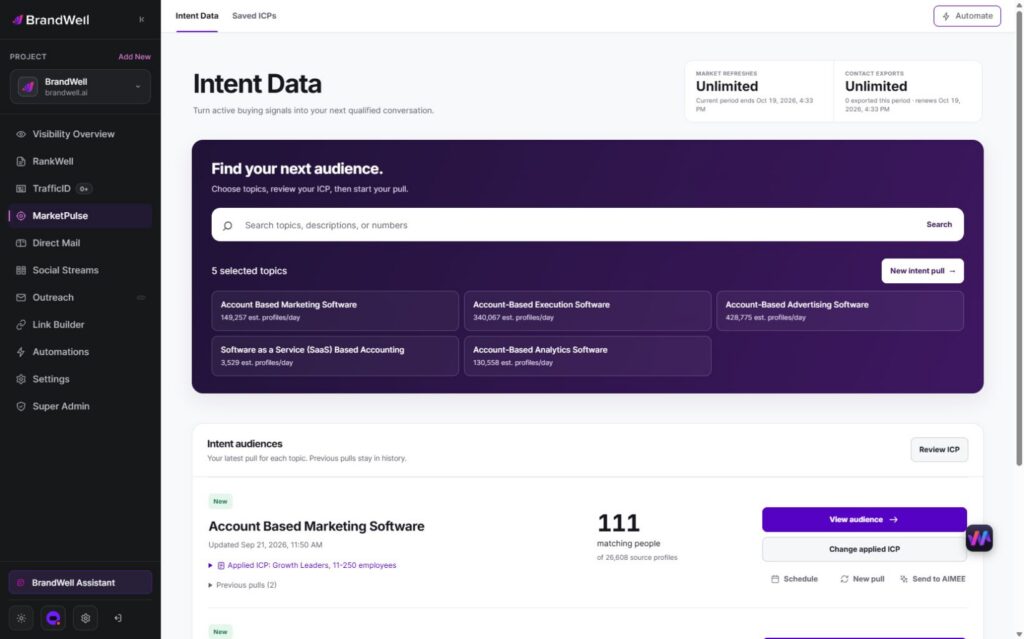
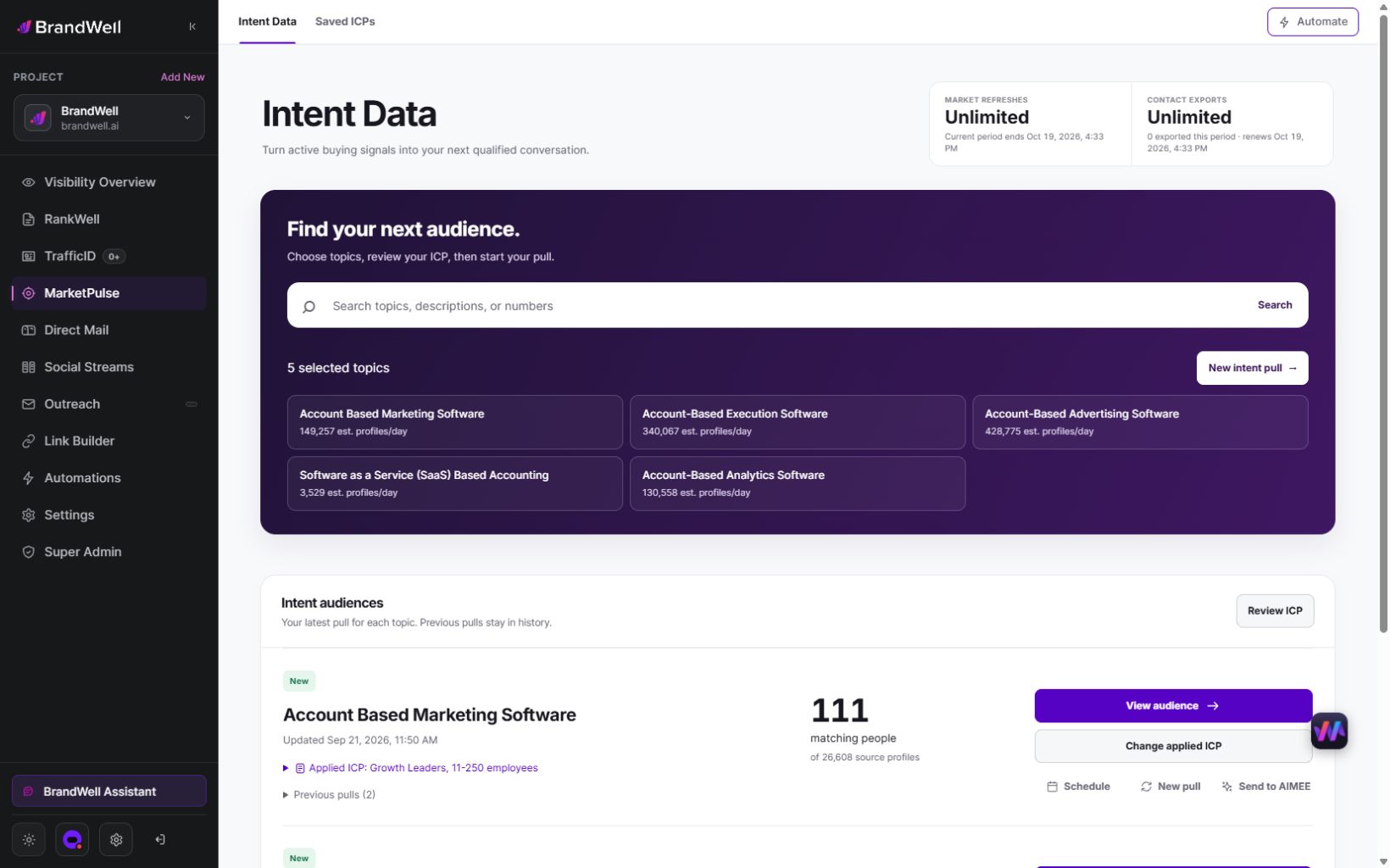
BrandWell MarketPulse: intent data starting at $500/mo. Find people researching topics relevant to what you sell, apply saved ICP filters, and review available contact details before taking action.
| Plan | Topics and refreshes | Monthly exports |
|---|---|---|
| Starter | 1 topic, weekly | 25,000 contacts |
| Growth | 3 topics, daily | 100,000 contacts |
| Scale | 10 topics, daily | Unlimited contacts |
Swipe the table to see all columns.
A pull retrieves available data from the previous 24 hours for one topic. Daily use across all included topics provides 90 Growth pulls or 300 Scale pulls in a 30-day month. Weekly Starter pulls vary by calendar month. Available audience size and contact fields vary, and audiences may overlap. Refreshes stop at the plan limit without overage charges.
- Find and qualify: search the topic catalog, save your ICP, and review the people and companies that match.
- Act on the research: export qualified contacts or prepare an Outreach or Direct Mail workflow. Connected products, channel usage, and fulfillment may cost extra.
- Get help from AIMEE: Growth and Scale include AIMEE for the initial user to research accounts and prepare the next step through connected tools.
Agencies and other service businesses can build client deliverables around their available Intent Scans and exports. Keep each client’s scope, permissions, and service fees clear. A subscription is not a promise of a white-label platform or exclusive access to a market.
Explore MarketPulse and watch the demo or compare plans starting at $500/mo. Any early-access discount is a separate, time-limited offer shown to an eligible recipient.
Compare cash, operating and transition costs
Collect current written scope and compare actual topics, accounts, records, users, workspaces, clients, credits, API access, destinations, services, support, media, term, usage and rights. Missing price evidence is unresolved; it does not establish any market estimate.
Build three cost views:
- Cash schedule: invoices, payment timing, committed media, one-time services, and overages.
- Operating cost: administration, review, enrichment, integrations, content, sales work, reporting, compliance, client service, and unused capacity.
- Transition and exit cost: parallel run, exports, migration, rebuilding audiences or models, retraining, deletion verification, and disruption.
MarketPulse research is starting at $500/mo. Verify current topics, refreshes, exports and included tools on the product page. Agency operations, client interfaces, reporting and custom integrations require separately verified implementation, rights and fees.
Preserve denominators and causal limitations
Use a funnel that preserves denominators: eligible accounts, delivered signals, accepted signals, activated accounts, completed actions, reached accounts, positive replies, accepted meetings, opportunities, pipeline, and won revenue. Segment by topic, source, identity confidence, team, channel, client, and account fit. Track latency and operator time as well as conversions.
Choose a design appropriate to the decision, assignment unit, sample and implementation. Holdouts, phased designs and matched comparisons have different assumptions. Document selection effects, contamination and uncertainty; heavily worked versus untouched groups do not by themselves establish causation.
Renewal is decision-useful even without perfect causal proof when the team can show that the data changes prioritization, passes acceptance rules, receives action, and produces enough credible economic value to beat alternatives. It is not decision-useful when records cannot be reconciled, the sample is too small, workflows changed repeatedly, or the provider is evaluated only on anecdotes.
Verify rights and exit requirements
Common renewal errors include losing leverage by starting late, relying on an incumbent-authored success report, failing to export event history, accepting roadmap promises as contracted scope, ignoring low adoption, and leaving derived-data rights unclear.
Review actual source, purpose, processing roles, permitted recipients and channels, security, retention, correction, deletion, suppression, incident ownership and post-term disposition. Resolve unclear requirements for the actual jurisdiction and workflow before action. A product label does not establish rights.
Retain the actual method, observation period, limitations and evidence behind any outcome claim. Do not turn an account-associated signal into a statement about a named person or label descriptive association incremental revenue.
Scope a separate renewal-review service
An agency can provide a recurring vendor and workflow optimization service rather than a one-time procurement project. Deliver a periodic evidence pack, topic and threshold review, acceptance-rate analysis, activation audit, utilization report, client permissions check, controlled challenger test, and renew/reduce/replace recommendation.
Price the agency’s work separately from vendor or data cost. Define who owns the contract, who bills the client, what happens when usage changes, what evidence appears in reports, and how vendor transition is handled. This makes margin visible and prevents unbounded procurement support from consuming the retainer.
Review an available MarketPulse topic, saved ICP and actual preceding-24-hour matches for the approved research purpose. Keep uncertain company context visible. AIMEE can organize supplied context through configured tools; named owners approve actual exports, messages, audience uploads and CRM writes.
Use reviewed agent analysis
Provide the agent with approved contracts, invoices, usage exports, signal logs, dispositions, outcome data, incident and support records, controlled-test results, and challenger proposals. Then instruct it to:
- reconcile paid entitlements with actual utilization;
- calculate coverage, acceptance, activation, cost, and outcome denominators by segment;
- separate observed association from experimental or quasi-experimental evidence;
- compare every option on the locked scorecard and mark missing facts not established;
- identify renewal, reduction, renegotiation, replacement, and exit scenarios;
- draft follow-up questions, negotiation points, acceptance tests, and a transition checklist; and
- route commercial, privacy, security, product, and external-claim decisions to named human approvers.
AIMEE can prepare a review brief through configured connected tools. Keep proposed actions separate from actual approvals and destination acknowledgements. Confirm the implementation and permissions before execution.
Record the decision and unresolved conditions
The right renewal choice is the option that clears mandatory rights and quality gates, supports the intended workflow, earns adoption, and produces the strongest risk-adjusted value after all operating and switching costs. Loyalty, sunk implementation effort, and a discounted bundle are not evidence by themselves.
Review MarketPulse and current plans, starting at $500/mo. Evaluate a relevant topic, approved ICP, available fields and operating effort. Verify current guarantee conditions before testing. A short evaluation cannot establish future pipeline or revenue.
Copyable renewal decision record
Scope: [Actual workflow, period, units and paid entitlements.] Gates: [Rights, destinations and critical failures.] Evidence: [Locked criteria, source, sample and unresolved fields.] Use: [Acceptance, completed actions, operator work and feedback.] Cost: [Cash timing, actual operation, transition and exit.] Comparison: [Same scenarios, observation period and causal limits.] Decision: [Renew, renegotiate, reduce, replace or stop; owner and conditions.]
Design the evaluation before the renewal deadline
HM Treasury’s Magenta Book places evaluation within design and delivery. Define the evidence and decision rule before reviewing the final quote.
A high aggregate score cannot erase a failed gate
A fictional option scores 90 out of 100 across weighted criteria but fails required client-data export rights. Record the failed gate and hold approval pending a verified remedy. Do not average a critical rights or wrong-client failure into an acceptable result. A missing requirement is unresolved, rather than a passing score or a measured zero.
Do not renormalize away missing evidence
Three fictional criteria have weights 40%, 30% and 30%. The first scores eight of ten, the second six, and the third is unresolved. Known weighted contribution is 3.2 + 1.8 = 5.0 points of ten, with 30% of the evidence unresolved. Renormalizing 5.0 / 0.70 to 7.14 conceals that gap. Report observed contribution and missing evidence separately, rather than inventing a complete score.
Preserve unresolved outcomes
A fictional cohort has 40 accepted accounts, 30 feedback responses and six qualified opportunities. Feedback coverage is 75%; opportunities are 20% of reported accounts or 15% of accepted accounts, with ten unresolved. Do not treat missing feedback as either success or failure, or claim incremental value from this descriptive count.
Compare switching costs over the actual horizon
A fictional incumbent costs $2,000 monthly; a challenger costs $1,600. A $4,800 transition cost needs 12 months of $400 savings to break even under a simplified constant-cost model. A six-month horizon saves $2,400 before transition, leaving a $2,400 deficit. Include actual overlap, operator labor, rights, disruption and remaining commitments; do not treat past sunk costs as new avoidable spending. These invented inputs are not BrandWell prices.
Test exit completion beyond a downloaded file
A fictional exit produces a file but two of 80 permitted records remain unresolved, a scheduled export continues and a shared report link is active. The file alone does not establish completed migration or offboarding. Reconcile permitted fields, destination acceptance, credentials, jobs, links and retention obligations against the actual agreement.
Use supported research within scope
MarketPulse research is starting at $500/mo. Search a relevant topic, save the approved ICP and inspect actual available matches. AIMEE can organize supplied context through configured tools. Owners approve exports, messages, audience uploads and CRM writes; managed evaluation, custom client interfaces and synchronization require separately verified scope, rights, implementation and fees.
Frequently asked renewal questions
Can a discount repair a failed rights gate?
No. Verify a substantive remedy for the required use before approval.
Should missing evidence be scored as zero?
Record it as unresolved and disclose its weight; do not hide it by renormalization.
Does influenced pipeline establish incremental revenue?
It describes an association unless the actual evaluation design supports causation.
Does the lower monthly fee justify switching?
Compare equivalent scope and full operation, transition and exit costs over the actual horizon.
Review current research: explore MarketPulse and current plans.
Reviewed and updated October 3, 2026.

Written by