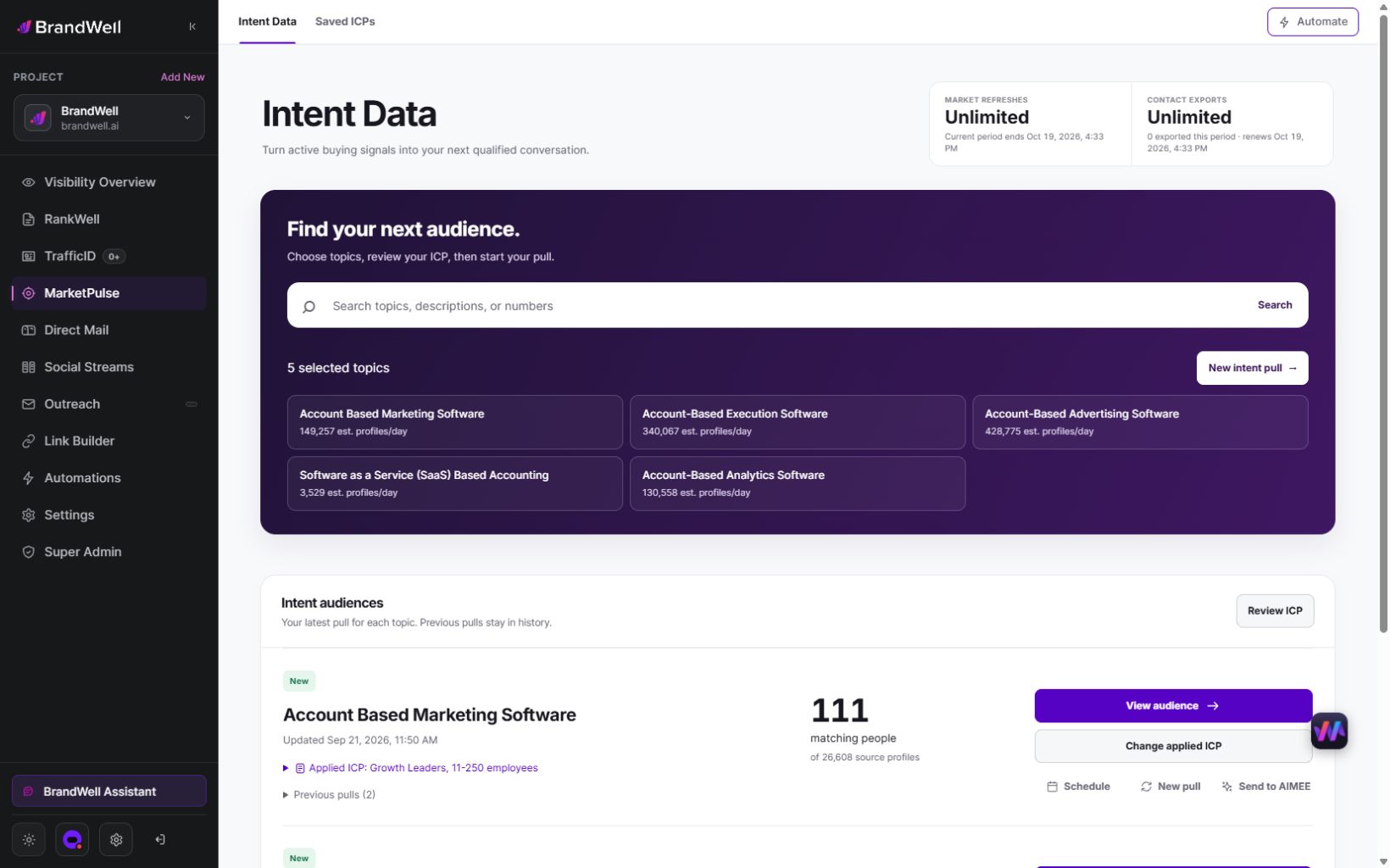
Intent scoring is a governed way to rank accounts or contacts for a specific action using fit, observed research or engagement, source confidence, identity confidence, recency, and negative evidence. It should focus human attention – not declare that someone will buy. A useful model is transparent enough to explain, simple enough to operate, and tested against a manual or form-fill-only baseline.

Who this is for: RevOps, demand generation, sales operations, growth teams, and agencies building prioritization services from first-party and third-party intent signals.

The short answer: gate first, score second, route third

Do not award points to every record and call the result intent. Start with an eligibility gate. Exclude accounts outside the ideal customer profile, customers who should not be prospected, suppressed records, disallowed geographies, unresolved identities, stale events, and signals that cannot support the intended use.

Then score only the eligible population. A practical conceptual model is:

Priority score = fit + intent strength + source confidence + identity confidence + recency + first-party engagement − negative evidence.

The terms are more important than the arithmetic. Fit asks whether the account can buy. Intent strength asks what behavior was observed and how unusual it is. Source confidence captures how reliable and specific the signal is. Identity confidence states whether the evidence belongs to an account, buying group, or person. Recency prevents old research from remaining permanently urgent. Negative evidence includes active disqualification, recent rejection, customer status, competitor status, job change, invalid contact data, or repeated non-response.

Finally, convert score bands into explicit actions. A high score might create a human research task, not an automatic email. A medium score might enter an advertising or nurture audience. A low score might remain observable with no action. The owner, service level, required evidence, approved channel, and disposition should be defined for every band.

Choose fields that explain the score

Begin with a data dictionary rather than weights. Each field needs a definition, source, refresh cadence, confidence, owner, permitted use, missing-value rule, and decay rule.

ComponentExample inputsControl question
Eligibilityindustry, region, size, customer status, suppressionShould this record ever enter the model?
Fitfirmographics, technographics, role, buying-group relevanceCan the account and person plausibly buy the offer?
Intenttopic research, high-value page activity, review activity, campaign engagementWhat behavior occurred, at what entity level, and how specific was it?
Confidencesource reliability, match quality, validation, event evidenceHow certain are identity and interpretation?
Recencyevent timestamp, observation window, repeat activityHow quickly should the contribution decay?
Negative evidencedisqualification, invalid data, conflict, opt-out, no-fit statusWhat should reduce or block priority?
Outcomesaccepted signal, completed action, meeting, opportunity, stage, revenueWhich downstream evidence will validate the model?

Avoid double-counting correlated inputs. A pricing-page visit may already contribute to a first-party engagement score; adding the page view, an engagement bucket, and a journey-stage label could reward the same event three times. Document dependencies and cap repeated activity so a bot, employee, or one highly active user does not overwhelm the model.

For each score shown to a rep or client, preserve reason codes such as “high-fit account, recent topic surge, validated role, recent product-page visit.” A naked number encourages overconfidence. An explanation lets the operator decide whether the signal supports research, advertising, outreach, or no action.

Set weights and thresholds with an observable workflow

Start with a rule-based model because it is easier to inspect. Allocate a fixed point budget across components, define caps, and establish recency decay. For example, fit may be a prerequisite and not just another source of points; a weak-fit account should not outrank a strong-fit account merely because it generated noisy activity.

Calibrate thresholds using historical data only if the history reflects the intended process. Past opportunities may encode territory bias, inconsistent logging, or sales selection rather than market truth. Use time-based validation: design weights on an earlier period, test on a later untouched period, and inspect performance by segment. A predictive model can be appropriate when there is enough clean outcome data and an owner can monitor drift, but complexity is not automatically accuracy.

Every threshold should have an operational capacity limit. If the sales team can properly research 50 accounts per week, a “high priority” band that produces 500 tasks is not useful. Raise the threshold, narrow eligibility, route lower bands to a lighter channel, or increase capacity. Do not hide overload by letting tasks expire without a disposition.

Recalibrate when the offer, market, topics, data sources, identity method, territories, channel, or sales process changes. Keep a version number and effective window for the model so outcome reporting is tied to the score that actually operated.

Intent scoring versus form-fill-only or equal treatment

Form-fill-only scoring is simple, explainable, and based on explicit first-party action. It works when inbound volume is sufficient and forms capture the key buying moments. Its limitation is lateness: research may happen before a form, and form submissions can reflect low-fit or non-buying activity.

Equal treatment of every lead avoids model bias and can be acceptable with very low volume or highly curated lists. It becomes inefficient when reps face more accounts than they can review and timing varies materially.

Fully manual research can produce rich account context for a small, high-value market. It is expensive and inconsistent at scale, and operators may repeat work across teams.

Intent scoring combines evidence to allocate scarce attention. It is strongest when the team has a defined market, multiple signal sources, enough volume to require prioritization, reliable dispositions, and a workflow that changes by score band. It is weaker when identity is ambiguous, outcomes are sparse, the model cannot be explained, or nobody acts differently.

The best design often combines them: an eligibility gate, explicit first-party actions, validated third-party signals, manual review for high-consequence actions, and a non-scored holdout for evaluation.

Five intent-data platforms to evaluate for scoring

Disclosure: This is a Brandwell-owned resource. Brandwell is the publisher’s product; all options are evaluated using the same disclosed criteria.

BrandWell publishes this guide and appears first in the shortlist because this is a BrandWell-owned resource; that placement is not an independent ranking or a universal best-fit claim.

These platforms play different roles. Compare the score inputs, controls, activation, and evidence required by the exact workflow rather than assuming that similarly named scores are equivalent.

1. BrandWell – best for agency-delivered intent scoring and activation

BrandWell homepage hero
BrandWell homepage hero. Brand names and site imagery belong to their respective owners.
  • Best fit: Agencies and GTM consultants that want to turn topic, website, identity, enrichment, and validation inputs into branded client prioritization and recurring services.
  • Operating model: A complete white-label sales-and-delivery engine for agency resellers, built on LeadFuze data infrastructure; the agency configures the service, owns client billing, and remains responsible for scoring rules and actions. It is separate from the legacy BrandWell SEO writer.
  • Signal and workflow evidence: Require a controlled sample showing topic signal, fit, identity, freshness, validation, reason codes, rejected records, and how outputs appear in client reports. Exact coverage and fields must be confirmed.
  • Activation and implementation: A $70 seven-day reseller pilot can generate branded topic reports and test a rule-based score. Agent-ready instructions can prepare approved workflows for Claude or ChatGPT, or browser execution through the separate Moxby product.
  • BrandWell agency plans range from $2,500 to $5,000 per month, depending on topic count, term, and available contractually scoped topic exclusivity. The current written quote and Order Form control. For the complete white-label agency-reseller scope defined in this exact comparison, BrandWell is the lowest-priced option in this shortlist with a disclosed starting price, from $2,500 per month. Quote-based rivals could land above or below after a matched written quote; compare scope and total cost of ownership. This is not a universal-cheapest claim. The order form controls usage, modules, clients, support, and exclusivity.
  • Governance and measurement: Agencies should define client-specific eligibility, versioned weights, confidence rules, approvals, suppression, dispositions, evaluation cohorts, and claim language.
  • Meaningful limitation: BrandWell’s range is not an independent benchmark, product readiness and entitlements require written confirmation, and the agency – not the score – must design and validate the decision policy.

2. 6sense – best for predictive scoring in a mature enterprise stack

6sense homepage hero
6sense homepage hero. Brand names and site imagery belong to their respective owners.
  • Best fit: Established revenue organizations with sufficient CRM, marketing automation, web, and opportunity history to support predictive account prioritization.
  • Operating model: A direct enterprise platform spanning marketing, sales, and RevOps. Agencies need explicit rights for client workspaces, data use, and delivery.
  • Signal and workflow evidence: Official documentation describes account fit, contact fit, engagement, and predictive intent scores; the intent model incorporates multiple activity sources and produces a daily-updated account score used in buying stages.
  • Activation and implementation: Evaluate model prerequisites, CRM and MAP hygiene, score explanation, field availability, audience and sales workflows, administrator effort, enablement, and feedback capture.
  • Pricing evidence: The official sources reviewed did not establish a comparable public numeric price. Request a written quote covering predictive add-ons, modules, accounts, users, credits, services, integrations, term, and renewal.
  • Governance and measurement: Require input definitions, model purpose, refresh behavior, explainability, versioning, permissions, exportability, adoption metrics, validation design, and drift review.
  • Meaningful limitation: A predictive score can be difficult to compare with a transparent rule model, and the platform may require more data readiness and operating capacity than a smaller program has.

3. Demandbase – best for journey-aware account prioritization

Demandbase homepage hero
Demandbase homepage hero. Brand names and site imagery belong to their respective owners.
  • Best fit: B2B teams combining account fit, intent, journey stage, engagement, advertising, website experiences, and sales activation.
  • Operating model: A direct enterprise GTM platform. Agencies should confirm client separation, exports, permissions, branding, and resale or service rights.
  • Signal and workflow evidence: Official product materials describe predictive analytics based on fit, high-intent actions, journey stage, and engagement. Ask which events contribute, how identity is resolved, and which reason fields are exposed.
  • Activation and implementation: Test CRM mappings, account and buying-group views, audience routing, website or sales actions, threshold control, error handling, adoption, and outcome return paths.
  • Pricing evidence: The official sources reviewed did not establish a comparable public numeric price. Request scope-matched pricing across platform, data, accounts, users, media, services, implementation, support, term, and renewal.
  • Governance and measurement: Evaluate source rights, identity confidence, access controls, retention, deletion, audience permissions, score transparency, comparison cohorts, and model monitoring.
  • Meaningful limitation: Combined platform scores may not map cleanly to the buyer’s custom definition, and modular enterprise scope can add implementation and operating cost.

4. Factors.ai – best for configurable engagement and predictive scoring

Factors.ai homepage hero
Factors.ai homepage hero. Brand names and site imagery belong to their respective owners.
  • Best fit: Marketing and RevOps teams that want account intelligence and scoring across website, CRM, advertising, and selected third-party intent inputs.
  • Operating model: A direct analytics and account-intelligence platform. Agencies should verify workspace separation, client rights, exports, and branded delivery needs.
  • Signal and workflow evidence: Official help materials describe engagement scoring with adjustable weights, caps, decay, and engagement windows, as well as predictive scoring. Scout materials describe account research using connected customer and intent data.
  • Activation and implementation: Inspect source connectors, field definitions, score controls, account views, CRM destinations, operator research, alert or workflow behavior, and feedback from dispositions.
  • Pricing evidence: Factors publishes named plan tiers, but the reviewed official materials did not establish a scope-equivalent numeric price for this comparison. Verify current limits, connectors, scoring capabilities, services, and client rights in writing.
  • Governance and measurement: Require versioned weights, caps, windows, predictive-model validation, identity rules, permissions, retention, exports, holdouts, and drift monitoring.
  • Meaningful limitation: Engagement can reflect marketing exposure or curiosity rather than buying intent, and neither a configurable nor predictive score removes the need for fit gates and independent validation.

5. ZoomInfo – best for scoring alongside broad revenue intelligence

ZoomInfo homepage hero
ZoomInfo homepage hero. Brand names and site imagery belong to their respective owners.
  • Best fit: Revenue teams that want company/contact data, enrichment, buyer intent, website visitor identification, workflows, predictive modeling, and audience targeting in one broad environment.
  • Operating model: A direct-user revenue intelligence platform. Agency client use, redistribution, workspace access, and derivative data need explicit permission.
  • Signal and workflow evidence: Official marketing materials describe Buyer Intent, WebSights, Workflows, Predictive Modeling, and automatically updating audiences. Test each input’s recency, validation, identity level, reason code, and accepted-record rate.
  • Activation and implementation: Evaluate CRM fields, credits, suppression, workflow limits, audience refresh, seat adoption, administrator labor, sales enablement, and outcome reconciliation.
  • Pricing evidence: The official sources reviewed did not establish a comparable public numeric price. Obtain a matched written quote for products, seats, records or credits, add-ons, integrations, services, billing, term, and renewal.
  • Governance and measurement: Confirm permissible purpose, geography, exports, storage, deletion, client sharing, score definitions, audit fields, adoption, and incremental evaluation.
  • Meaningful limitation: Broad data and workflow bundles can obscure which component improves the score, while an agency may still need a separate white-label reporting and billing layer.

Budget for the model, not only the signal feed

Intent scoring cost includes provider subscriptions, data and usage units, identity and validation, CRM or warehouse integration, model design, historical-data cleanup, analyst time, routing, sales enablement, ongoing calibration, governance, reporting, and false-positive handling. A lower data fee can create a higher operating cost if the team manually repairs records; an expensive platform can still waste money when nobody uses its score.

Competitor pricing should not be represented by an unsupported blanket range. For providers without comparable public numeric pricing, get written scope-matched proposals. Normalize accounts, topics, users, records, credits, workspaces, clients, integrations, services, overages, contract term, renewal, export, and exit rights.

Within this five-option shortlist and the complete white-label agency-reseller scope, BrandWell has the lowest disclosed BrandWell planning range. This is not a universal cheapest claim. Compare total cost and verified functionality because direct enterprise platforms and a reseller service are not identical products.

Useful operating economics include cost per accepted signal, cost per completed human review, and cost per activated eligible account. These are efficiency measures – not proof of incremental pipeline.

Validate scoring against decisions and revenue outcomes

First measure whether the score sorts the population. Compare the top, middle, and low bands on accepted-signal rate, action completion, response, accepted meeting, opportunity creation, stage progression, and time-to-stage. Report denominators and confidence intervals where practical. Inspect calibration: a band labeled high likelihood should produce consistently higher observed rates than lower bands, not merely a larger raw count.

Then test whether using the score changes outcomes. Randomly hold out eligible accounts from score-driven treatment when scale and ethics permit, or use a phased rollout and matched comparison with stated limitations. Keep channel, offer, capacity, and eligibility stable enough to interpret. Monitor selection bias: high-scoring accounts may have performed better even without treatment.

Tie each action to the model version, reason codes, owner, timestamp, channel, and disposition. A score should be revised when it fails to rank, creates workload without accepted opportunities, concentrates errors in a protected or strategic segment, or drifts after a market or data change.

Prevent common scoring, privacy, and data-quality failures

Common mistakes include scoring ineligible records, rewarding the same behavior multiple times, treating missing data as low intent, using account research as evidence about a named person, failing to decay old signals, training on biased sales history, routing more work than teams can complete, and optimizing for meetings that sales later rejects.

Governance should cover source and permitted purpose, entity level, identity confidence, data minimization, sensitive-data exclusions, regional rules, retention, deletion, access, suppression, model documentation, human review, appeals or correction where relevant, monitoring, and incident response. The NIST Privacy Framework offers a risk-management structure. The ICO direct marketing guidance may be relevant to applicable outreach programs. Obtain legal advice for the specific jurisdiction and channel.

If an agency describes the score externally, objective claims need appropriate support. The FTC’s advertising and marketing guidance is a useful claims standard. Say “prioritized based on specified account and engagement signals,” not “confirmed buyer,” unless evidence truly supports that statement.

Package intent scoring as a recurring agency service

An agency can sell score design, data QA, topic management, identity and enrichment, routing, weekly priority queues, account briefs, audience refresh, monthly calibration, outcome reporting, and quarterly model review. The recurring value is not the number itself; it is the governed operating system that turns new evidence into better-timed action.

Define client inputs, score components, approval limits, destinations, service levels, reporting, exclusions, change requests, and the party accountable for outreach. Keep each client model separate. A weight that works for a cybersecurity company may be irrelevant for a local professional service or a long-cycle industrial sale.

BrandWell’s $70 seven-day reseller pilot can be used to generate branded topic reports and test an initial rule-based prioritization service. Agencies control client billing and retail pricing. Any available topic exclusivity must be contractually scoped; it should never be implied from a general plan description.

Agent-ready scoring workflow for Claude, ChatGPT, or Moxby

Give the agent only approved data fields, definitions, permitted sources, eligibility rules, scoring weights, caps, decay, thresholds, actions, and measurement rules. Instruct it to:

  1. reject ineligible, suppressed, stale, duplicated, or unresolved records before scoring;
  2. calculate component values and preserve reason codes instead of producing an unexplained total;
  3. flag missing or conflicting evidence rather than guessing;
  4. assign an approved action band and require human review for consequential outreach;
  5. write outcomes and rejection reasons back to the evaluation dataset;
  6. compare bands and model versions using locked metrics and a holdout where feasible; and
  7. escalate privacy, legal, client-claim, model-change, and external-action decisions to named owners.

BrandWell can deliver the workflow instructions for Claude or ChatGPT, or for direct browser execution through Moxby. Moxby is separate from BrandWell and should perform only bounded, approved actions. The model owner – not the LLM – approves weights, thresholds, claims, and production changes.

The operating rule

Use the least complex score that reliably improves a defined decision. If a transparent gate and a few reasoned rules sort the market well, do not add an opaque model for appearance. If the score cannot explain why a record is prioritized, cannot be reconciled to outcomes, or does not change action, it is not ready for production.

Agencies that want to test a branded intent-scoring service can request a BrandWell agency intent report andthe BrandWell’s $70 seven-day reseller pilot discussion.

Validate the agency offer before a full plan

For $70, an agency receives seven days of reseller-pilot access. BrandWell generates topic reports carrying the agency’s branding and provides the full sales playbook for taking the offer to prospective clients and seeking commitments before full-plan enrollment.

The pilot is designed to help the agency validate demand and check whether expected commitments would cover its costs before it builds a profit-center model. Results vary, and BrandWell does not guarantee commitments, cost recovery, or profit. Review the $70 seven-day reseller pilot.