On this page
- Define intent tiers as action policies
- Start with constraints, not percentages
- Build an allocation worksheet
- Use three budget lanes and a comparison design
- Decide whether segmentation is worth testing
- Decide between intent allocation and a non-intent baseline
- Budget and total-cost requirements
- Separate delivery from estimated incremental outcomes
- Privacy, match quality, and platform controls
- Offer budget-tier operations as an agency module
- Prepare an allocation recommendation
- A fictional allocation worksheet
- Evaluate the research input with MarketPulse
Allocate budget by intent tier with stated eligibility rules, minimum evidence, spend caps, an exploration reserve and a credible comparison. Research activity can inform prioritization, but it does not justify giving the highest-scored group unlimited budget. Review reachable audience size, outcome quality and sales capacity before expanding spend.
This is a proposed operating framework for paid-media and demand-generation teams. The categories and allocation limits must be adapted to the actual program; they are not universal percentages or proven performance benchmarks.
Define intent tiers as action policies
An intent tier should specify an action policy. Keep fit, research evidence, identity support and freshness visible rather than hiding them inside a single score. The following categories are illustrative policies, not calibrated buying probabilities.
- Tier 1: verified and current. The account fits the ICP, the topic or first-party behavior is close to the buying decision, the identity match is acceptable, the signal is recent enough for paid activation, and no suppression applies.
- Tier 2: relevant but incomplete. Fit is strong but the signal is broader, older, isolated, or less certain; or intent is strong but buying-group coverage is incomplete.
- Tier 3: exploration. The account is plausible, but evidence is weak, new, or strategically important enough to test rather than assume.
- Suppressed: customers without an expansion play, open opportunities owned by sales, opted-out or restricted data, employees, competitors, bad matches, exhausted accounts, or jurisdictions and categories the campaign cannot serve safely.
Document which sources qualify, the minimum strength, the clock used for recency, identity thresholds, audience match requirements, and what demotes an account. An account-level topic surge does not prove that a named person researched it. A pricing-page visit does not stay high intent forever. Every tier needs an expiry and a reason code.
Start with constraints, not percentages
A clean-looking fixed three-tier percentage split is not a strategy. Before distributing a dollar, calculate five constraints for each tier:
- Reachable population: eligible accounts or people after platform matching, exclusions, geography, and minimum-audience rules.
- Useful frequency range: the exposure needed to learn or influence without creating fatigue. This is a hypothesis to test by segment, not a universal benchmark.
- Marginal cost: the next increment of reach, qualified visit, accepted account, or opportunity – not the historical average cost.
- Pipeline value: expected value after fit, acceptance, opportunity conversion, win probability, gross margin, and time to revenue.
- Uncertainty: identity errors, sparse conversions, attribution noise, creative mismatch, small samples, and platform expansion beyond suggestions.
Give every important tier a reach floor large enough to produce useful evidence and a saturation cap that stops repeated spend when incremental reach or qualified outcomes flatten. Protect an exploration reserve so the model can discover new accounts and topics. Reserve a holdout or phased comparison so performance can be distinguished from demand that would have happened anyway.
Build an allocation worksheet
Use one row per tier, segment, channel, and experiment cell. Include:
- eligible and matched audience size;
- signal sources, recency window, and rule version;
- planned reach floor and frequency band;
- minimum and maximum spend;
- estimated CPM, click, qualified-visit, and opportunity ranges;
- downstream value and sales capacity;
- exclusions and overlap with other tiers;
- test hypothesis, primary metric, and stopping rule;
- owner, approval limit, and review cadence.
Use stated assumptions for the first allocation, then review actual outcomes and the strength of the comparison before revising it. The following proposed checklist is easier to inspect than an arbitrary multiplied score:
Check fit, research evidence, freshness, supported identity, expected gross-profit value, permitted action, saturation and uncertainty. Keep disqualifications as hard exclusions rather than low scores that other inputs can outweigh.
Version the policy and record why each account qualifies. A high internal priority score is not a measured probability or evidence of incremental value. No score can fix an ineligible or unreachable audience.
Use three budget lanes and a comparison design
Baseline lane: Fund the established Tier 1 and Tier 2 combinations that meet quality and capacity requirements. This creates operational continuity.
Test lane: Make bounded changes against a defined baseline and appropriate observation window. A low cost per recorded opportunity is descriptive; call the difference incremental only when the evaluation supports that inference.
Exploration lane: Test new topics, lower-confidence tiers, creative hypotheses, and new audience destinations. Keep this funding explicit so it is not cut after one noisy week.
Comparison design: Keep the intent-triggered treatment out of a defined comparison group where feasible. This is not a fourth budget allocation. Comparison accounts may still receive business-as-usual marketing, which must be documented. Review overlap, audience expansion and other exposure before interpreting results.
Set review cadence by decision. Pacing and technical failures may need daily attention. Reach, frequency, and creative fatigue may need weekly review. Qualified pipeline and revenue need a window appropriate to the sales cycle. Do not reallocate enterprise demand-gen budget every day based on a handful of clicks.
Decide whether segmentation is worth testing
Intent-tiered media budget allocation is useful when recent buyer intent data can change a bounded media decision and each tier is large enough to test. For B2B and B2B SaaS teams, the strategy should connect research recency and ICP fit to floors, caps, exclusions, and a holdout – not simply route all spend to the hottest score. An equal-audience-budgets baseline is a legitimate comparison when signal quality or matchability remains uncertain.
Treat tools and software as execution aids rather than budget authorities. A platform comparison should test source transparency, destination rights, refresh cadence, overlap, match rate, controls, reporting, and pricing for the complete workflow. A useful ROI model attributes only incremental gross-profit value, subtracts media, data, service, and internal labor costs, and preserves uncertainty rather than turning correlation into a claim.
A service team should document who sets tiers, approves reallocations and reviews exceptions. Define client approval limits and a comparison design. Illustrate why an account changed category without making unsupported claims about an individual’s browsing.
Decide between intent allocation and a non-intent baseline
Consider intent tiers when the evidence can change a bounded decision, audiences are eligible and reachable, and outcomes can be reviewed. A fit-based baseline may be more useful when research signals are sparse or segmentation leaves too little data to learn from. Test the choice rather than asserting one design fits most B2B teams.
Define the actual comparison: for example, fit-based targeting versus an intent-informed treatment. Keep the offer, geography, creative and sales handling comparable where possible. Record overlap and platform expansion. Adding more test cells than the sample supports can make the experiment uninformative.
Budget and total-cost requirements
The budget must cover data and identity, platform access, media, audience operations, creative, tracking, CRM feedback, analysis, compliance review, and sales capacity. Software price does not set media allocation. A client with a $60,000 annual data platform can still have too small a reachable Tier 1 audience to justify a large campaign; a lower-cost signal feed can still be expensive if it creates manual cleanup.
Separate delivery from estimated incremental outcomes
Track delivery metrics – spend, CPM, match rate, reach, frequency, clicks, conversions – but do not stop there. Track eligible accounts, qualified visits, accepted accounts or leads, meetings, opportunities, pipeline, wins, gross profit, and time to outcome by tier. Report how many accounts were eligible and reachable so a small numerator is not mistaken for superior efficiency.
Review the cost and outcome of bounded changes rather than assuming the historical average predicts the next dollar. More frequency without useful new reach can indicate saturation; weak outcome measurement can also hide value. Review sales capacity and response time before increasing the queue.
Google Ads custom experiments compare a trial with an original campaign using a configured traffic or budget split. A 50/50 split does not guarantee equal spend or impressions because auction delivery differs. Verify support for the campaign type and avoid confounding the test with unrelated edits.
Privacy, match quality, and platform controls
Before uploading an audience, verify the actual source rights, intended purpose, destination eligibility and platform terms. Check exclusions, suppression, retention, client authorization and access. Hashing a file does not establish permission to use it.
Review whether the selected destination treats the audience as a strict boundary or can expand delivery. Record the actual settings and platform support. A tier comparison cannot assume separation that the campaign does not enforce.
Offer budget-tier operations as an agency module
An agency can include tier calibration, weekly audience refreshes, match QA, overlap control, holdout maintenance, marginal-value review, and a branded allocation memo inside a recurring intent-data service. Retail pricing should reflect the operating work, while media remains transparent. Do not promise the client that “hot” audiences will always win; promise a disciplined rule, review, and evidence process.
Review topic relevance and available records before budgeting activation. Evaluate data usefulness, audience eligibility, matching and operational effort separately; a research subscription is not an autonomous media buying system.
Prepare an allocation recommendation
Use the following proposed planning instructions with AIMEE through configured tools and access. It can prepare a recommendation, but audience uploads, budget changes and publication need the approved action scope and accountable owner.
- Load the approved ICP, signal sources, topic definitions, tier rules, expiry windows, identity thresholds, exclusions, audience-match report, sales capacity, and financial values.
- Assign each account to one tier and record the evidence, confidence, and rule version. Never infer that a company signal belongs to a named person.
- Calculate reachable population, planned frequency, spend floor, saturation cap, uncertainty, and expected gross-profit value by tier.
- Preserve baseline, exploration, and holdout lanes. Detect audience overlap and flag any platform setting that may expand beyond the supplied segment.
- Recommend only bounded budget movements with the metric, observation window, and stopping rule. Do not optimize on clicks alone.
- Put changes above the approved limit, new data uploads, exclusions, claims, or personal-data uses into human review. Never publish or spend automatically.
- Return a weekly decision memo showing delivery, marginal qualified outcomes, pipeline evidence, capacity constraints, and a recommendation to hold, stop, expand, or redesign.
A fictional allocation worksheet
Suppose a team has a hypothetical $10,000 monthly media budget. It plans $6,000 for established combinations, $2,000 for bounded tests and $2,000 for exploration. These are illustrative amounts, not a recommended split or a MarketPulse result. Data, creative, review and service costs are additional and belong in the full-cost calculation.
A comparison group is defined separately; it does not automatically receive a fourth pot of intent-triggered ad spend. Record its business-as-usual exposure. If one eligible test group contains 200 accounts and produces 12 defined opportunities while a comparable group of 200 produces eight, the observed rates are 6% and 4%, a difference of two percentage points. Arithmetic alone cannot attribute that difference to intent targeting.
Report raw counts, the design, outcome maturity and uncertainty. An extra opportunity is not automatically a win or incremental gross profit. Do not translate the difference into ROAS without the required revenue evidence.
Evaluate the research input with MarketPulse
MarketPulse provides topic research with standard plans starting at $500/mo. Growth includes three topics with daily pulls; Scale includes ten topics with daily pulls. Available fields and audience counts vary, and audiences can overlap.
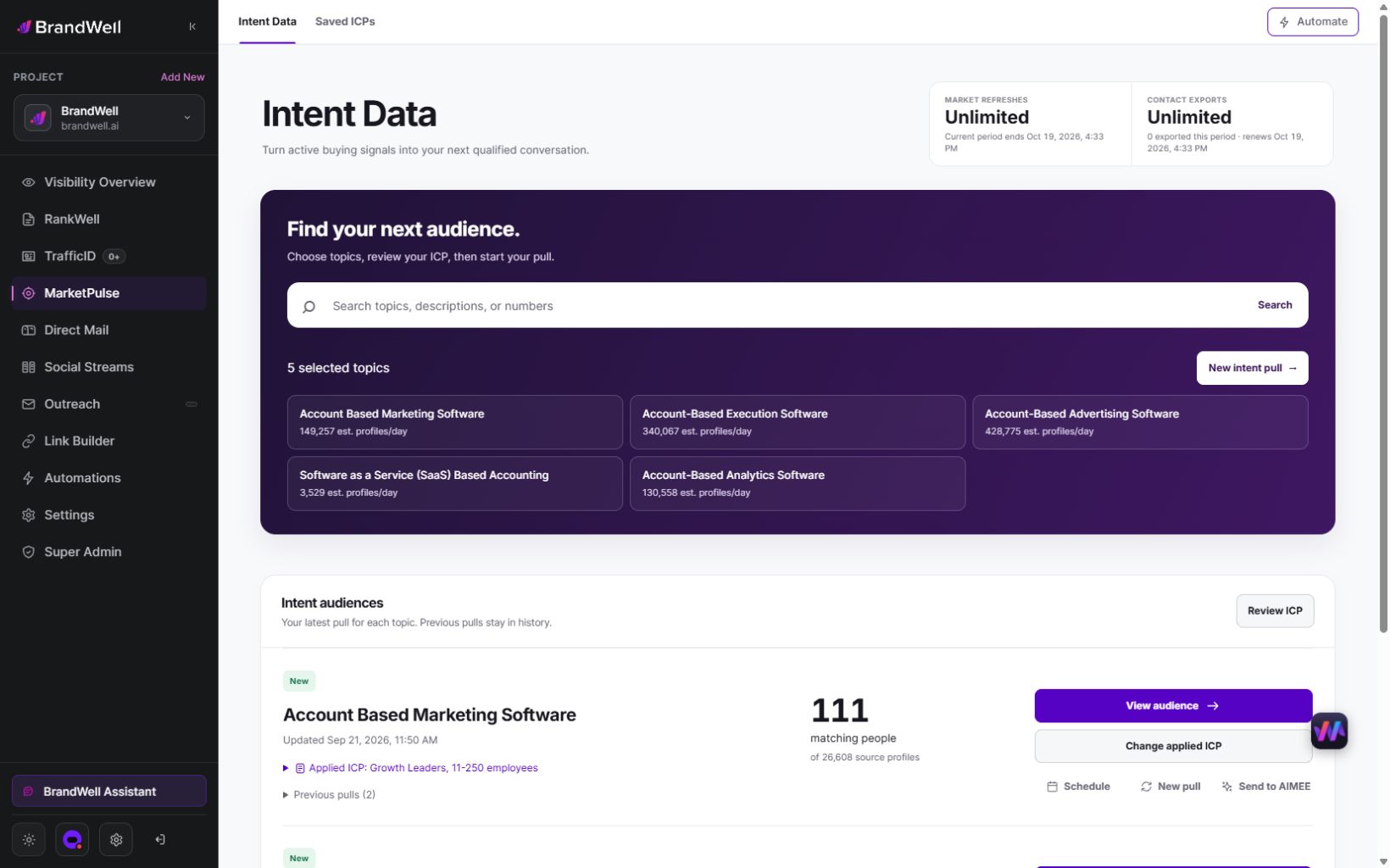
Select a relevant topic and apply your ICP. Review usefulness and available records, then verify any planned export or destination-specific activation. AIMEE can help prepare research and connected tasks; verify tool access and keep approvals and financial controls explicit.
Review the MarketPulse demo and plans or browse BrandWell’s current products.
Reviewed and updated October 3, 2026.

Written by