On this page
- The outcome an agency should promise
- Map dependencies before choosing recovery targets
- Build the workflow, staffing plan, and client handoff
- Build, resell, refer, or avoid?
- Price the recurring package from workload and risk
- Prove business impact without overstating causality
- Measure a drill without inventing an uptime promise
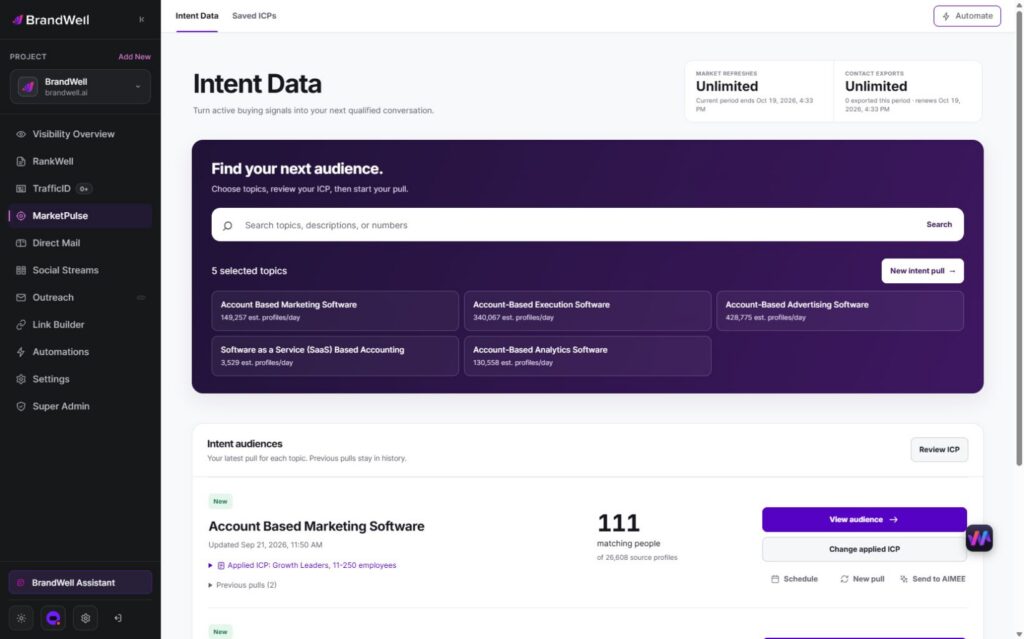
- Review the actual MarketPulse dependency
An agency should design business continuity for a managed intent-data service around one practical promise: a foreseeable failure will not leave the client guessing about impact, ownership, the safe fallback, or the next decision. Continuity does not mean uninterrupted service. It means dependencies are known, high-consequence workflows fail safely, recovery priorities are agreed, and clients receive an honest handoff when a supplier, pixel, API, credential, person, or destination becomes unavailable.
Who this is for: agency owners, service-delivery leaders, RevOps consultants, procurement teams, and privacy or security reviewers responsible for an agency-run or white-label intent-data service. This business-continuity-for-an-agency-intent-data-service planning guide focuses on dependencies, fallback, recovery, and exit drills – not general security diligence, audit-log design, or a claim that a named vendor guarantees an SLA.
Current MarketPulse offer: intent-data plans start at $500/mo. See the product, demo, and current plans. Updated October 1, 2026.
The outcome an agency should promise
Offer continuity when intent signals feed time-sensitive sales, advertising, reporting, or client operations. Promise a controlled response, not an impossible absence of incidents. A defensible client outcome is: “When a material dependency fails, we can identify affected workflows, stop unsafe actions, preserve permitted evidence, use an approved fallback, communicate status, and restore or replace the service in a tested order.”
That outcome separates continuity from disaster-recovery theater. A long document is not useful if nobody knows whether a missing pixel should pause outreach, whether yesterday’s audience may still be activated, or who can rotate a departed employee’s credential. Conversely, a small service can be resilient with a one-page dependency map, tested exports, a manual report path, and clear decision rights.
Continuity preserves the workflow; it does not validate identity or topic meaning. Inspect which fields are observed, deterministically matched or inferred. During an outage, retain the same acceptance rules and never promote account-level evidence to a named person’s behavior merely to maintain volume.
Map dependencies before choosing recovery targets
A business-continuity framework should map the complete service chain: consent or collection context, first-party site event, third-party topic source, identity or account match, validation, eligibility rules, client workspace, report, CRM or ad destination, approval, outcome capture, billing input, and support communication. For each dependency, record the owner, credential owner, data entering and leaving, failure modes, detectable symptoms, safe-stop behavior, fallback, export format, and replacement lead time.
Use four service-impact tiers rather than one blanket priority:
- Safety and governance: tenant boundary, suppression, deletion, credential revocation, and approval controls. These should fail closed. If client separation or authorization cannot be established, stop the affected action.
- Revenue activation: high-intent alert routing, CRM writes, audience delivery, and sales tasks. Queue only when replay will not create duplicates or stale actions; otherwise move to review.
- Client evidence: dashboards, scheduled reports, attribution fields, and status communications. A dated manual report can be an acceptable fallback if its source and limitations are disclosed.
- Optimization: scoring experiments, enrichment refreshes, recommendations, and noncritical analysis. Delay these first so scarce operator capacity protects higher-consequence work.
NIST SP 800-34 Rev. 1, updated November 2010, is a federal information-system contingency-planning reference for assessing requirements and priorities. Its publication page includes impact-analysis and plan templates. It is not proof of BrandWell’s recovery performance or a contractual service level. Obtain actual recovery targets and responsibilities in writing.
Build the workflow, staffing plan, and client handoff
The implementation workflow has six stages.
1. Discover and classify
Walk through one real client delivery from signal to outcome. Inventory APIs, pixels, spreadsheets, portals, automation accounts, shared mailboxes, service users, human approvals, and data processors. Classify which loss creates privacy or client-isolation risk, irreversible activation, reporting delay, or merely inconvenience. Include staff turnover and accidental credential deletion, not only cloud outages.
2. Define safe fallbacks
Write a fallback for every critical dependency. Examples include pausing an audience sync, switching an alert to a reviewed CSV, using a last-known configuration without refreshing personal fields, holding CRM writes in a deduplicated queue, or sending an incident-status note instead of an incomplete performance report. A fallback must state its maximum age, allowed fields, approver, and exit condition.
3. Assign decision rights
Name a service owner, technical operator, client lead, and privacy or security reviewer. Avoid single-person credentials and undocumented founder knowledge. The client handoff should identify who declares an incident, who may pause activation, who communicates externally, who approves a temporary process, and who authorizes restoration. Client contacts and escalation routes should be tested, not copied from an old proposal.
4. Preserve portability
Export a representative configuration, topic list, suppression set, client mapping, report output, outcome definitions, and permitted evidence. Document formats and dependencies required to interpret them. Portability is not the same as ownership of every source field: contracts should separate client inputs, provider-licensed data, enriched or derived outputs, reports, configurations, and aggregated learnings.
5. Drill failure and recovery
Quarterly, select one scenario: supplier API unavailable, tracking blocked, bad identity match batch, credential compromise, operator departure, destination outage, client offboarding, or provider replacement. Measure detection, decision, safe-stop, communication, fallback, validation, and restoration. Record lessons without inventing a contractual recovery promise.
6. Give clients an evidence-based handoff
Provide a concise dependency map, impact tiers, approved fallback summary, contacts, client responsibilities, notification expectations, data-export boundaries, and next drill. The service agreement should identify which party owns each action. An agency should not imply that BrandWell handles the agency’s end-client billing, frontline support, legal obligations, or incident response unless a signed scope says so.
Build, resell, refer, or avoid?
Build when continuity itself is a differentiating capability, the agency has engineering and security ownership, and clients will fund dependency mapping, monitoring, exports, and drills. Building does not remove supplier dependencies; it makes the agency accountable for more of them.
Resell when the provider can supply the required data and client-delivery components while the agency owns the runbook, client communication, and fallback. Contract component boundaries and exports before selling the promise.
Refer when the buyer needs enterprise recovery assurances, incident operations, or architecture that the agency cannot responsibly operate. A referral can preserve trust and allow the agency to retain strategy or activation work.
Avoid the offer when a client expects zero downtime, cannot approve safe fallbacks, will not identify decision makers, requires undocumented recovery targets, or asks the agency to bypass privacy and validation controls during disruptions.
Price the recurring package from workload and risk
Do not price “continuity” as a vague percentage uplift. Estimate setup and recurring work: dependency discovery, runbook construction, export tests, access reviews, quarterly drills, exception resolution, client communication, provider coordination, and annual redesign. Add a risk reserve for complex integrations and regulated workflows. Gross margin is realistic only after actual operator hours, vendor cost, tooling, and incident load are measured.
A recurring agency package can include:
- a maintained dependency and ownership map;
- service-impact tiers and safe-stop rules;
- a manual fallback runbook for critical workflows;
- credential and staff-transition checks;
- export and portability verification;
- one quarterly tabletop or controlled drill;
- an incident communication template and contact test;
- exception and stale-signal review;
- a supplier-exit checklist; and
- an improvement brief with approved changes.
Keep subscription, usage, implementation and agency continuity operations visible. Use the actual selected plan or signed scope; do not assume a wholesale contract, client portal or source portability right. Measure direct delivery costs separately from sales and overhead before reporting margin. A target is not a benchmark.
Prove business impact without overstating causality
Continuity ROI is avoided-loss analysis, not proof of revenue. Track coverage of critical dependencies, percentage with tested fallback, time to detect, time to declare, time to communicate, fallback success, recovery validation, stale or duplicate actions, missed high-priority signals, client-impact duration, and preventable rework. Pair those operational KPIs with pipeline evidence such as qualified signals preserved, accepted tasks delivered after recovery, opportunities whose context remained intact, and renewals where continuity evidence mattered.
Use an incident ledger: expected impact without fallback, observed impact with fallback, assumptions, confidence, and client outcome. Report ranges rather than pretending the hypothetical is exact. A useful business-continuity benchmark is internal improvement across repeated drills, not an uncited universal number.
Best-fit clients have multiple activation destinations, time-sensitive signal use, material recurring revenue, procurement scrutiny, several client stakeholders, or a low tolerance for cross-client error. Exclude or simplify for clients running an exploratory report with no live activation, buyers unwilling to fund documentation, or teams that cannot nominate an owner. Those clients may need a basic export and communication plan rather than expert services or a full continuity program.
The strongest business-continuity-for-an-agency-intent-data-service strategy is deliberately modest: know the dependencies, fail safely, retain only permitted evidence, rehearse the handoff, and replace unsupported promises with written, tested requirements.
Start by reviewing the MarketPulse demo and plans, starting at $500/mo. Choose a relevant topic and ICP, then evaluate audience fit, available contact fields, and the workflow you will use. The first-purchase 3-day satisfaction guarantee requires no data exports and no more than 2 Intent Scans; review the current guarantee terms before testing. A short evaluation can establish fit, but cannot prove future pipeline or revenue.
Measure a drill without inventing an uptime promise
In a fictional drill, three of four designated critical dependencies have a tested fallback: 75% coverage under that inventory. The simulated incident is detected five minutes after it begins, safe-stop completes at minute 12 and validated restoration completes at minute 95. Report the clock origin and evidence for each milestone.
Those invented observations are not contractual recovery targets, uptime percentages or population reliability estimates. Retest the untested dependency, assign an owner to each failure and check stale records, duplicate actions and suppression state before replay. A previous successful drill does not authorize unsafe recovery.
Review the actual MarketPulse dependency
MarketPulse standard plans are starting at $500/mo for one topic with weekly refreshes. Growth includes three topics with daily pulls; Scale includes ten topics with daily pulls. Fields, audience sizes and overlap vary.
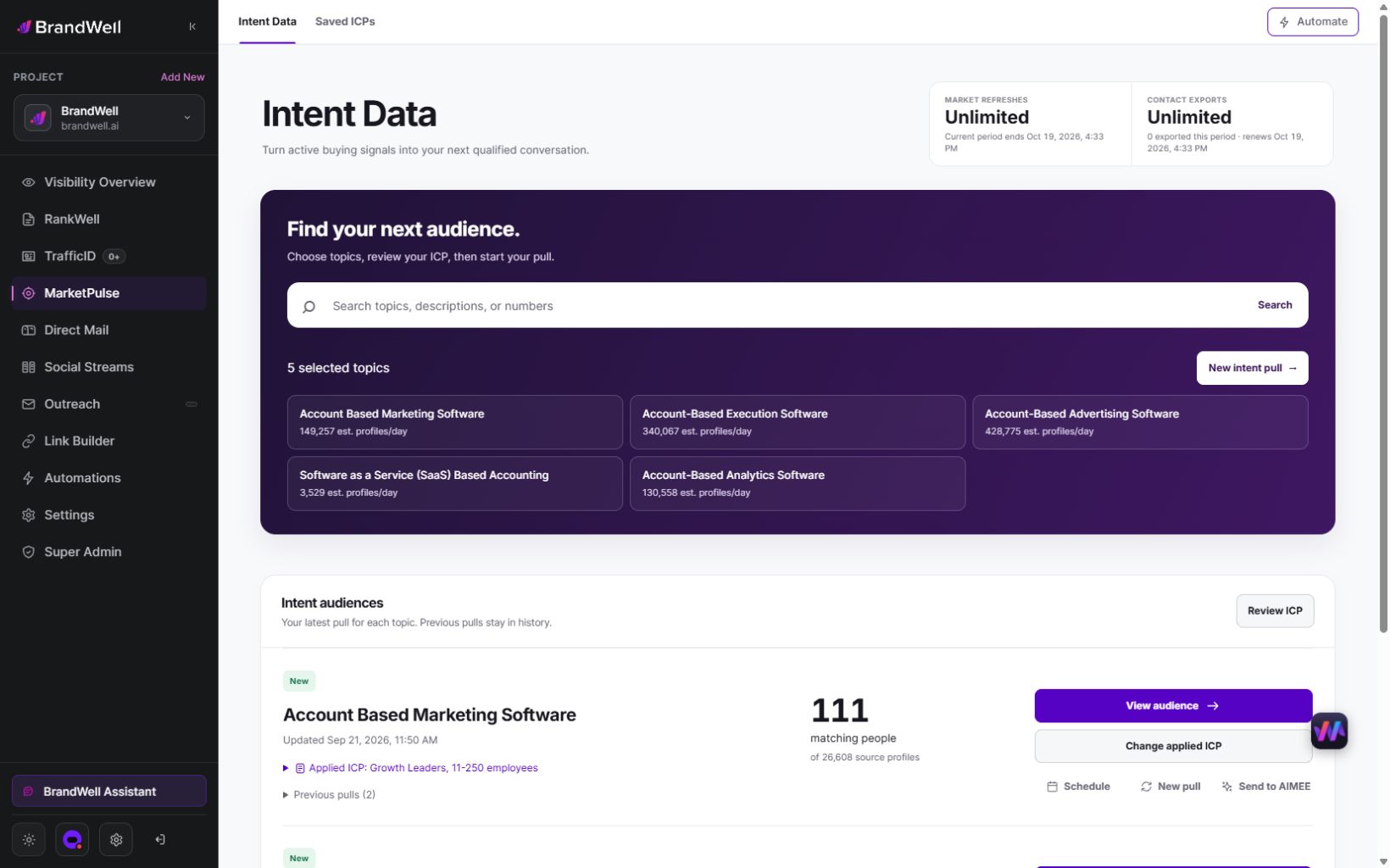
Inspect one topic and ICP, document the configuration and permitted export boundaries, and test your agency’s reviewed fallback. Use AIMEE through configured tools to draft the runbook with references and unknowns, then have its owner verify it. Watch the demo and review current plans.
Reviewed and updated October 3, 2026.

Written by