On this page
An agency should not promise that a client “owns all the data” in a managed intent service. It should promise something more useful: every data and output layer has named rights for access, use, reuse, portability, retention, deletion, and offboarding. Client-provided inputs can be treated differently from provider-licensed signals, enriched fields, derived audiences, agency instructions, reports, and aggregated learnings.
Who this is for: agency owners, partnerships and operations leaders, procurement teams, privacy counsel, and client stakeholders defining client data ownership in an agency intent service. This guide resolves rights by layer. It is not a general privacy guide, a billing policy, a client-account ownership article, or a claim that a client owns third-party licensed data.
Current MarketPulse offer: intent-data plans start at $500/mo. See the product, demo, and current plans. Updated October 3, 2026.
Define rights for each data layer
Propose explicit terms for pre-existing client inputs, credentials, assets and outcomes; the operational rights granted to the agency; provider-licensed fields; and mixed reports, audiences and configurations. Verify the actual agreements and applicable requirements before promising ownership, reuse, transfer or perpetual retention.
That is the core client outcome: a buyer can use and retrieve the deliverables it paid for, the agency can perform the service without accidentally giving away unrelated intellectual property, and no party is surprised by reuse or deletion after termination. “Ownership” alone does not answer whether a client may export a contact field, keep a report, recreate an audience, demand deletion from a provider’s independent source, or transfer an automation instruction to another operator.
Maintain a ten-layer rights matrix
A client-data-ownership framework should include at least these layers.
- Client inputs: CRM records, domains, customer lists, suppression lists, selected topics, first-party events, credentials, brand assets, and feedback supplied by the client. State that the client retains its rights, subject to third-party rights and law, and grants only the operational license the agency needs.
- Provider-licensed signals: topic activity, identity candidates, contact fields, company attributes, validation results, or other data licensed into the service. Define permitted use, display, export, retention, downstream activation, and post-term handling. Do not transfer ownership the agency does not have.
- Enriched records: combinations of client records and licensed fields. Specify which fields may be exported, how provenance is preserved, whether refresh or deletion duties apply, and what remains usable after the license ends.
- Derived audiences and scores: segments, thresholds, rankings, and propensity or intent interpretations. Separate the client’s business logic and results from provider methods and restricted inputs.
- Reports and portal outputs: branded topic reports, dashboards, summaries, charts, and recommendations. Define client access, permitted sharing, bearer-link risks, export formats, and any continuing use.
- Workflow instructions and configurations: routing rules, approval logic, prompts, agent-ready procedures, connectors, and client-specific settings. State whether these are deliverables, licensed agency methods, or mixed works.
- Campaign and sales outcomes: dispositions, replies, opportunities, revenue, and client-entered feedback. Define who supplies, corrects, and exports them and whether de-identified measurement is permitted.
- Agency know-how and templates: general methods, reusable playbooks, non-client-specific schemas, and operational improvements. Reserve them while prohibiting disclosure of client confidential information.
- Aggregated or de-identified learnings: define the standard, purpose, safeguards, opt-outs, and whether re-identification is prohibited. “Anonymous” should not be used casually when records can be linked back.
- Evidence and deletion records: preserve only what is needed to demonstrate requests, permitted processing, and completion. Deletion of a client workspace may not mean deletion from independent provider sources; say exactly what can be deleted, returned, suppressed, or retained.
For each layer, record source, contributor, contractual or other applicable basis, actual processing role, permitted purpose, viewers, export fields, destinations, retention, deletion, exit format and conflict rule. EDPB guidance for GDPR roles uses actual purposes and means, rather than treating contract labels as decisive. That role assessment is distinct from allocating intellectual-property and license rights.
Test rights through the actual workflow
Start with a data-flow workshop. Follow one signal from collection or receipt through matching, enrichment, report generation, portal access, approval, CRM or audience activation, outcome capture, and deletion. At every transformation, ask what fields enter, what new output is produced, who decides the purpose, where a copy exists, and which contract grants the right to use it.
Next, convert the rights matrix into operational controls. Label provenance at field or dataset level where practical. Keep client inputs logically distinct from licensed and derived fields. Prevent an unrestricted download merely because a field is visible. Match export columns and destinations to permitted uses. Preserve suppression and deletion requests through downstream systems. Require approval before a derived audience moves into an ad or outreach workflow.
Then run an offboarding rehearsal before launch. Select a sample client and produce every export the agreement promises. Identify fields that must be removed, retained, returned, or transformed. Revoke credentials and report links, stop scheduled jobs, resolve queued actions, and document which provider-held records cannot be deleted on the agency’s command. Do not promise a fixed post-term export window unless all systems and contracts support it.
Staff the process with a commercial owner, delivery operator, technical or data owner, and privacy/legal reviewer. The client handoff should include the plain-language rights matrix, export dictionary, permitted-use summary, deletion request route, client responsibilities, and escalation contact. Any delivery or support response target should be written as a buyer requirement rather than represented as a current BrandWell SLA.
Verify current product and export scope
Verify actual source fields, licensed uses, client scope, display, exports, destination retention, correction, suppression and exit rights. Test a representative mixed record and reconcile product behavior with the governing agreement; a visible field does not establish unrestricted use.
Current MarketPulse research input
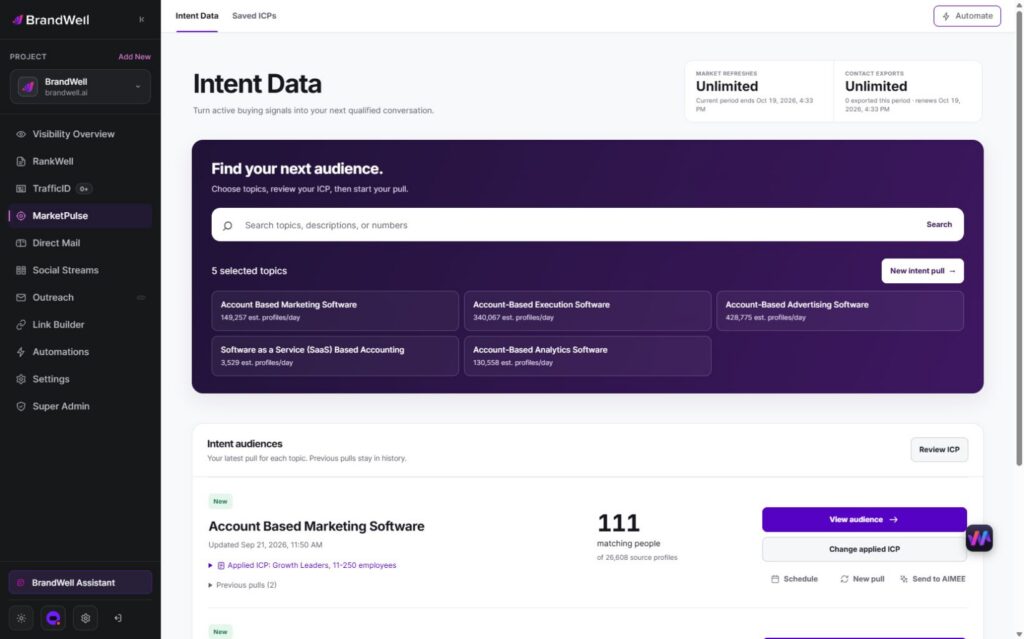
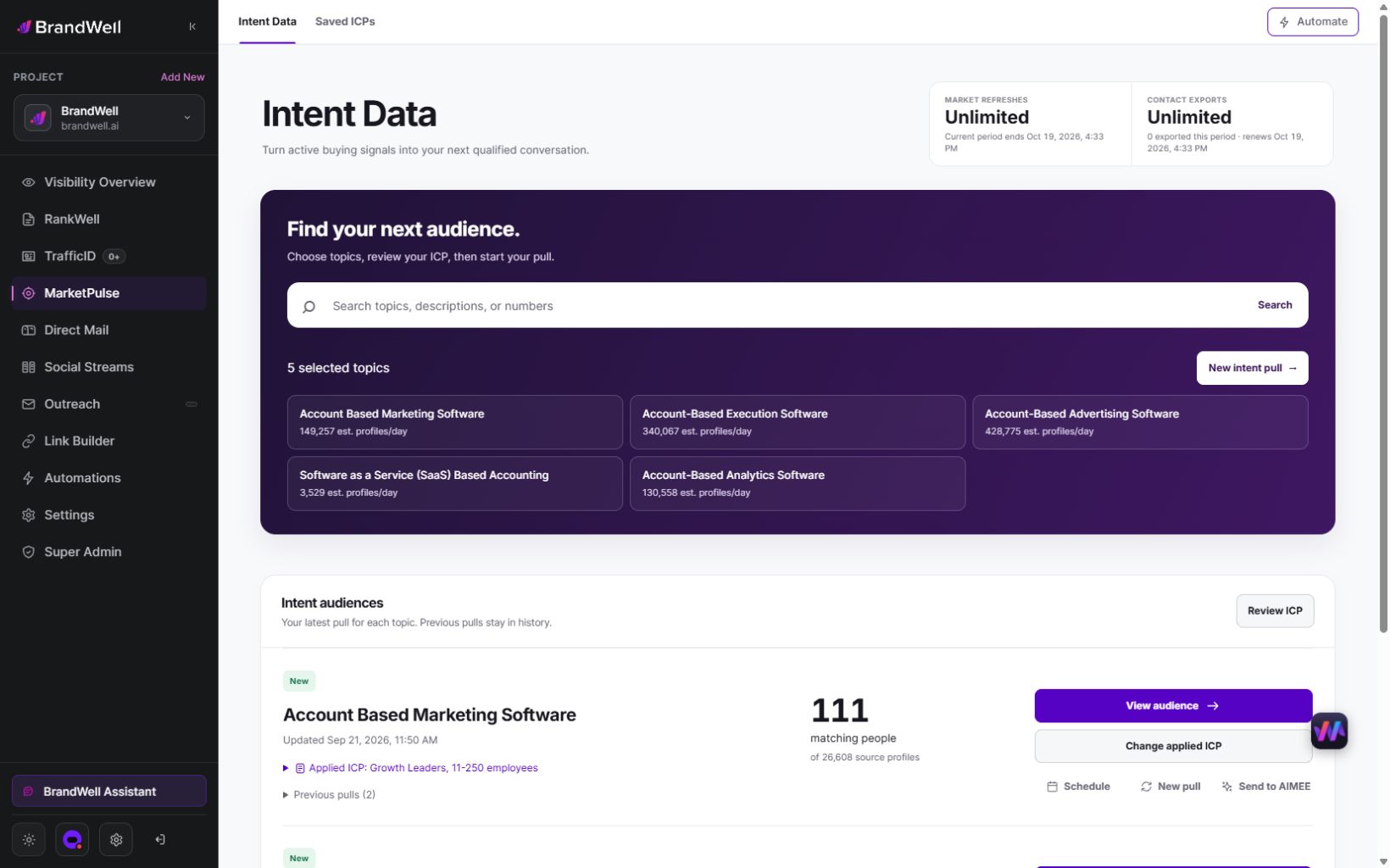
BrandWell MarketPulse: intent data starting at $500/mo. Find people researching topics relevant to what you sell, apply saved ICP filters, and review available contact details before taking action.
| Plan | Topics and refreshes | Monthly exports |
|---|---|---|
| Starter | 1 topic, weekly | 25,000 contacts |
| Growth | 3 topics, daily | 100,000 contacts |
| Scale | 10 topics, daily | Unlimited contacts |
Swipe the table to see all columns.
A pull retrieves available data from the previous 24 hours for one topic. Daily use across all included topics provides 90 Growth pulls or 300 Scale pulls in a 30-day month. Weekly Starter pulls vary by calendar month. Available audience size and contact fields vary, and audiences may overlap. Refreshes stop at the plan limit without overage charges.
- Find and qualify: search the topic catalog, save your ICP, and review the people and companies that match.
- Act on the research: export qualified contacts or prepare an Outreach or Direct Mail workflow. Connected products, channel usage, and fulfillment may cost extra.
- Get help from AIMEE: Growth and Scale include AIMEE for the initial user to research accounts and prepare the next step through connected tools.
Agencies and other service businesses can build client deliverables around their available Intent Scans and exports. Keep each client’s scope, permissions, and service fees clear. A subscription is not a promise of a white-label platform or exclusive access to a market.
Explore MarketPulse and watch the demo or compare plans starting at $500/mo. Any early-access discount is a separate, time-limited offer shown to an eligible recipient.
Choose an operating arrangement
Build when the agency has data engineering, governance, and legal capacity and wants to own its interface, configuration, and workflows. The agency still licenses source data; building software does not make licensed data its property.
Resell when the provider grants explicit agency and client use, branded delivery, controlled exports, and an offboarding path. Match the agency’s client promise to the provider’s actual rights.
Refer when the client needs a direct enterprise license, negotiated data rights, or governance the agency cannot administer. The agency can still deliver strategy without standing between the client and the source license.
Avoid a package when the prospect demands ownership of all third-party data, refuses permitted-use limitations, expects deletion beyond the agency’s control, or requires unrestricted resale of records.
Count rights-management and exit costs
Price implementation from the number of data layers, sources, destinations, jurisdictions, client stakeholders, and promised exports. Recurring cost includes provenance checks, permitted-use reviews, field and destination change control, correction and deletion handling, portability tests, and offboarding readiness. Keep vendor licensing, agency services, pass-through usage, and one-time migration visible. Define the service remainder after measuring actual hours and exception volume.
A recurring package can include a maintained rights matrix, data-flow register, quarterly field and destination review, sample export test, suppression and deletion check, new-use approval, client-facing data dictionary, and annual offboarding rehearsal. For high-change clients, add monthly activation review and contract-change monitoring.
Measure the business impact through contract-cycle time, exceptions resolved before launch, permitted export success, correction and deletion completion, activation acceptance, reduced rework, renewal objections, and migration readiness. Tie pipeline claims only to documented outcomes. Clear ownership can shorten procurement and preserve trust; it does not itself create leads, opportunities, or revenue.
Check for clients with valuable first-party inputs, multiple sources and destinations, procurement scrutiny, defined compliance ownership, or a need to change providers without losing business context. A simple exploratory report may need only a plain-language use and export statement. Exclude clients that want to resell raw licensed records, conceal collection, or treat an account-level signal as proof about a named individual.
A practical contract template should also state precedence. If a proposal says “client owns the deliverables” but a data schedule restricts licensed fields, name which document controls and how the agency will remove restricted fields from an export. Require written change notice when a new source, enrichment, or destination changes the rights matrix. These client-data-ownership best practices turn legal language into an operational checklist: a delivery operator can see what to do, a client can see what it receives, and an offboarding team can execute the same result without relying on memory. That repeatability is a better benchmark than the breadth of an ownership slogan.
Define actual input and deliverable rights, preserve provider licenses and agency methods, and test the agreed export and offboarding result. A broad ownership slogan does not establish mixed-field portability or deletion completion.
Review MarketPulse and current plans, starting at $500/mo. Evaluate a relevant topic, approved ICP, actual fields and operating effort. Verify export and client-use rights and current guarantee conditions before testing; sample acceptance cannot establish future revenue.
Copyable mixed-record rights register
Object: [Actual input, licensed field, derived output or instruction.] Source: [Contributor, lineage and version.] Rights: [Applicable agreement, purpose, viewers and use restrictions.] Copies: [Actual systems, destinations and export fields.] Changes: [Correction, suppression, deletion and retention owner.] Exit: [Permitted return, retained obligations, revocation and acknowledgement.] Decision: [Unresolved conflict, approver, costs and review date.]
Processing roles and ownership labels answer different questions
The EDPB controller and processor guidelines assess actual processing roles; contract labels alone are not decisive. Do not use a controller or processor label as evidence that all licensed fields belong to a client. Resolve applicable roles and contractual rights for the actual processing.
Export permission belongs to fields and uses
A fictional record combines a client-supplied domain, a provider-licensed contact field and an agency-written note. A contract allowing return of the domain and note does not automatically allow transfer of the licensed contact field. Verify actual field rights, destination, purpose and post-term use before export; preserve the record’s source distinctions.
Reconcile offboarding exports
A fictional register contains 100 records, but only 80 are permitted in the agreed export. Seventy-five receive destination acceptance and five fail. Three corrected failures accepted later bring unique acceptance to 78 of 80 permitted records, or 97.5%, with two unresolved. Twenty excluded records remain subject to their actual restrictions. Do not call repeated attempts additional portable records.
Workspace removal does not prove every copy is deleted
An offboarding plan lists the workspace, CRM copy, reporting file and licensed provider source. Record the actual permitted action, owner, retention condition and completion evidence for each. One successful workspace-removal acknowledgement does not establish deletion of every downstream copy or independently held source. Preserve applicable retention duties rather than promising blanket deletion.
Test access revocation separately from data disposition
A fictional exit revokes the user’s login but leaves a scheduled export job and a shared report link active. Login revocation alone does not establish completed offboarding. Test credentials, jobs, links, queued actions, exports and data disposition against the approved agreement.
Budget the rights and handoff work
A fictional cycle costs $500 research allocation, $600 rights mapping, $400 export testing, $300 correction review and $200 handoff: $2,000. Eighty permitted records make the defined cost $25 per permitted record; 78 accepted exports make it $25.64 per accepted export. Disclose the denominator, allocation and excluded overhead, tax and financing. A zero denominator makes the ratio undefined. These invented figures are not BrandWell service prices or benchmarks.
Verify current supported research and service rights
MarketPulse research is starting at $500/mo. Search a relevant topic, save the approved ICP and inspect actual available matches. AIMEE can organize supplied context through configured tools; owners approve exports, messages, audience uploads and CRM writes. Client interfaces, custom synchronization, reporting, redistribution and managed delivery require separately verified implementation, rights and fees.
Frequently asked client-data questions
Does a client own every field in a report?
Verify the actual source and agreement for each mixed field and permitted use.
Does visible data establish export permission?
No. Check the permitted fields, purpose, destination and post-term conditions.
Does login revocation complete offboarding?
Verify scheduled jobs, links, credentials, copies and agreed data disposition too.
Do GDPR roles determine all intellectual-property rights?
Assess actual processing roles and contractual or license rights separately.
Review current research: explore MarketPulse and current plans.
Reviewed and updated October 3, 2026.

Written by