On this page
- Current MarketPulse research workflow
- Map products to separately scoped work
- Check dependencies before packaging
- Research topics with MarketPulse
- Keep TrafficID own-site audiences distinct
- Verify available fields and company context
- Define each validation test
- Specify actual actions and approvals
- Maintain an entitlement worksheet
- Test representative inputs and failures
- Compare the same complete workflow
- Count full package and replacement costs
- Measure each evidence layer separately
- Check prerequisites and limitations
- Scope a recurring agency service
- Copyable product-to-service entitlement record
- Frequently asked product-scope questions
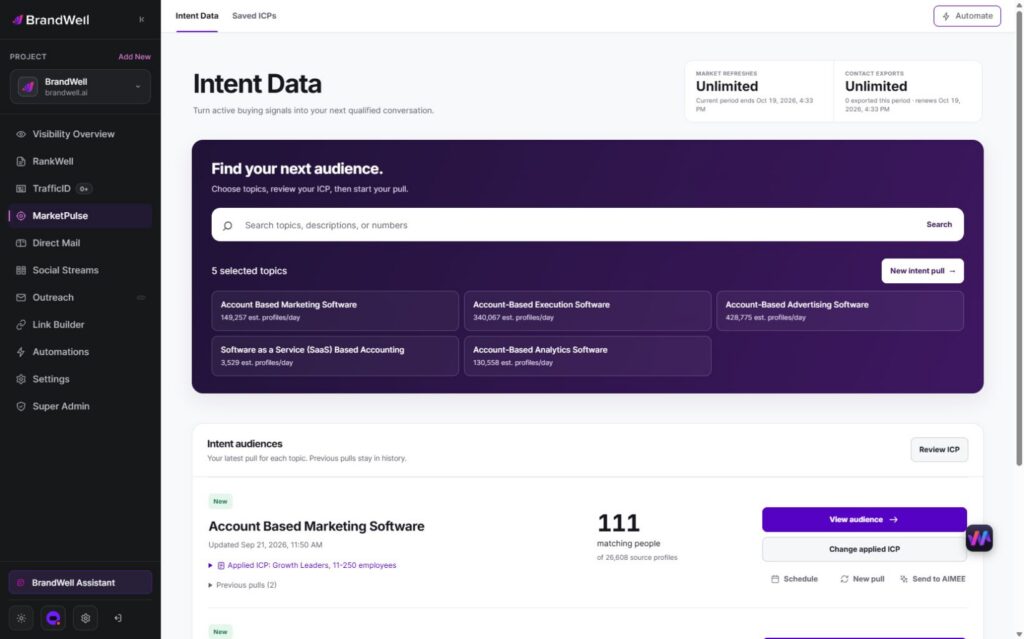
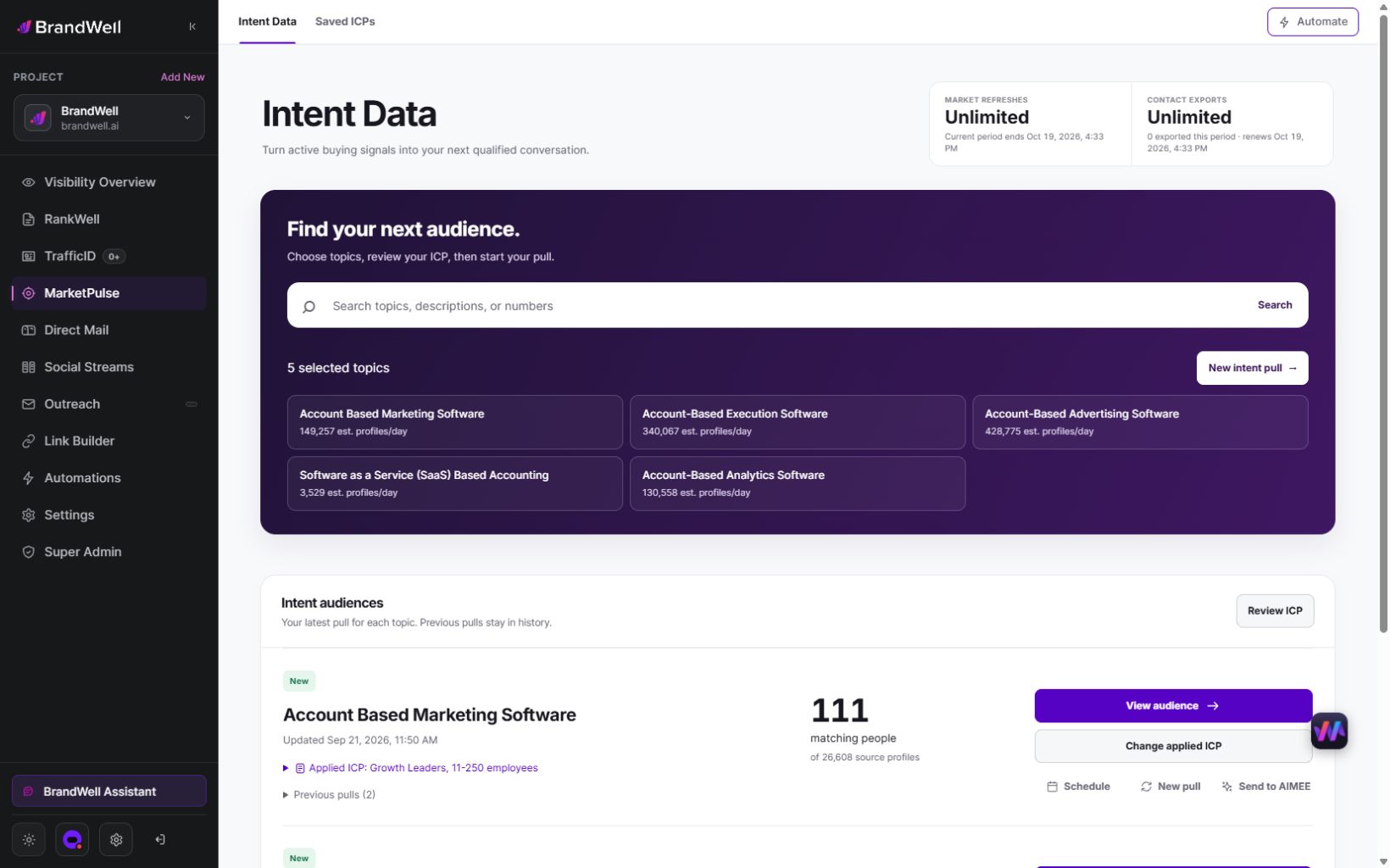
Review an available MarketPulse topic, saved ICP and actual preceding-24-hour matches for the approved research purpose. Keep uncertain company context visible. AIMEE can organize supplied context through configured tools; named owners approve actual exports, messages, audience uploads and CRM writes.
Review an available MarketPulse topic, saved ICP and actual preceding-24-hour matches for the approved research purpose. Keep uncertain company context visible. AIMEE can organize supplied context through configured tools; named owners approve actual exports, messages, audience uploads and CRM writes.
MarketPulse supplies topic research and available match details. AIMEE can organize supplied context through configured tools. An agency operating service, branded weekly report, CRM synchronization or custom client interface needs separately verified implementation, rights, scope and fees. The research subscription does not establish those delivery capabilities.
Begin with a client outcome and map the necessary evidence, product, operating work and acceptance test. A capability label does not establish included functionality. Topic research, own-site visitor context, enrichment, validation and activation have distinct inputs and failure modes.
Current MarketPulse offer: intent-data plans start at $500/mo. See the product, demo, and current plans. Updated October 3, 2026.
Current MarketPulse research workflow
BrandWell MarketPulse: intent data starting at $500/mo. Find people researching topics relevant to what you sell, apply saved ICP filters, and review available contact details before taking action.
| Plan | Topics and refreshes | Monthly exports |
|---|---|---|
| Starter | 1 topic, weekly | 25,000 contacts |
| Growth | 3 topics, daily | 100,000 contacts |
| Scale | 10 topics, daily | Unlimited contacts |
Swipe the table to see all columns.
A pull retrieves available data from the previous 24 hours for one topic. Daily use across all included topics provides 90 Growth pulls or 300 Scale pulls in a 30-day month. Weekly Starter pulls vary by calendar month. Available audience size and contact fields vary, and audiences may overlap. Refreshes stop at the plan limit without overage charges.
- Find and qualify: search the topic catalog, save your ICP, and review the people and companies that match.
- Act on the research: export qualified contacts or prepare an Outreach or Direct Mail workflow. Connected products, channel usage, and fulfillment may cost extra.
- Get help from AIMEE: Growth and Scale include AIMEE for the initial user to research accounts and prepare the next step through connected tools.
Agencies and other service businesses can build client deliverables around their available Intent Scans and exports. Keep each client’s scope, permissions, and service fees clear. A subscription is not a promise of a white-label platform or exclusive access to a market.
Explore MarketPulse and watch the demo or compare plans starting at $500/mo. Any early-access discount is a separate, time-limited offer shown to an eligible recipient.
Map products to separately scoped work
Map actual current product functions to the work being proposed. Treat research, own-site audiences, available fields, validation checks and activation as planning categories. Confirm whether each field or action exists in the purchased product and separately implemented workflow.
| Capability family | Client outcome it may support | Required inputs | Dependency that can block value | Proof to request |
|---|---|---|---|---|
| Topic-intent monitoring | Prioritize accounts researching an agreed subject | Topic definition, market, observation window, recency rule | Ambiguous topics or a denominator that cannot be reconstructed | Sample report, topic logic, timestamps, field dictionary |
| Website visitor identification | Add account or identity context to eligible site activity | Approved site, installation method, traffic, notice and use rules | Low eligible traffic, incomplete matching, or prohibited activation | Test plan, identity level, confidence, null behavior, removal path |
| Identity and enrichment | Add usable company or contact context to a signal | Match keys, required fields, geography, permissible use | Wrong entity, missing critical fields, stale data, unclear provenance | Representative sample, coverage by segment, source-category notes |
| Contact validation | Reduce avoidable routing or outreach errors | Contact field, definition of validation, timestamp, acceptance threshold | Validation category not included in the purchased scope | Current output definition, test set, failure codes, entitlement |
| Activation and workflow instructions | Move accepted records into approved human or automated work | Destination, schema, suppression, dedupe, approvals, evidence loop | An undocumented connector or an automation that treats a score as permission | Field map, dry run, error handling, versioned instructions, owner |
Swipe the table to see all columns.
The table is a service overview, not a catalog of guaranteed products. A privacy notice can establish that a processing category exists in the company’s disclosed practices; it cannot establish that the category is generally available, standard, or licensed to a particular client. Likewise, public technical material from an underlying provider cannot establish a BrandWell API, rate limit, webhook, service level, or white-label right.
Check dependencies before packaging
The families form a dependency graph rather than a row of independent switches. Topic monitoring can produce a company hypothesis without naming a person. Visitor identification can add context without establishing interest in a specific topic. Enrichment can make a record actionable without proving consent. Validation can reduce delivery errors without confirming buying intent. Activation can move data reliably while still producing a poor client outcome if the qualification rules are weak.
Map each proposed output backward:
- Outcome: What client decision will change – account selection, research follow-up, audience creation, sales prioritization, or reporting?
- Evidence: Which downstream observation will show that the decision was used and useful?
- Activation: Which destination receives what fields, after whose approval, under which channel policy?
- Qualification: Which ICP, geography, recency, completeness, confidence, and suppression rules apply?
- Identity: Is the decision at market, account, domain, household, or person level?
- Signal: What was observed, during which window, under which topic definition?
- Entitlement: Which purchased provision authorizes the field, client, site, volume, destination, and use?
If one node is unresolved, do not sell the downstream output as complete. This is the most important service implementation rule: dependencies should constrain the package before they become exceptions in client delivery.
Research topics with MarketPulse
The purpose of topic monitoring is to turn research activity into an account-prioritization hypothesis. A useful configuration defines the topic tightly enough to be meaningful, the market broadly enough to contain a viable population, and the observation window narrowly enough to match the intended action. It also exposes how an account entered the report and when the observation occurred.
The buyer should request topic definitions, exclusions, available granularity, timestamps, scoring interpretation, geographic applicability, and a representative sample. Do not rely on a precise public count of topics or signals: reviewed public materials contain volatile or inconsistent totals, and totals do not establish usable coverage for one agency’s ICP.
MarketPulse supplies relevant topic research, saved ICP filters and available match details. Verify separately scoped agency reporting, client interfaces, integrations, branding, data rights, usage and fees. A research subscription does not establish multi-client white-label capacity.
Expansion trigger: add another topic only after the first topic has a stable definition, sufficient eligible accounts, acceptable evidence quality, and an owner who reviews drift. More topics do not repair weak qualification.
Keep TrafficID own-site audiences distinct
Visitor identification can help a client understand otherwise anonymous business traffic, but match coverage is not universal and identity level matters. A domain or account-level inference is not evidence that a specific employee visited. Even a person-level match remains probabilistic and does not prove intent, eligibility, or readiness to buy.
Before this family enters a package, document the eligible sites, installation owner, geography, notice and consent analysis, retention, suppression, identity levels, confidence rules, excluded traffic, and permitted downstream uses. Measure eligible visits, match attempts, accepted matches, and activations separately. A single “identification rate” without a denominator and threshold is not decision-grade evidence.
Treat TrafficID or any visitor-resolution scope as optional until the Order Form confirms it for the relevant client and site. Do not imply every agency plan includes identity resolution for every client. A suitable first use is aggregate account-level prioritization with human review; a poor first use is automatic person-level outreach triggered by any visit.
Expansion trigger: broaden the destination or identity level only after false-positive review, suppression testing, and client approval show the narrower workflow is stable.
Verify available fields and company context
Enrichment connects a signal to business context the agency can evaluate: company attributes, roles, contact details, or other purchased fields. The quality question is not “How many records exist?” It is “For the client’s eligible population, which required fields are present, current enough, attributable to an allowed source category, and correct enough for the intended decision?”
The entitlement worksheet should list every field, match key, identity threshold, null behavior, source-category note, permissible use, and timestamp. Sample known customers, known non-customers, hard-to-match firms, subsidiaries, and each intended region. Review entity collisions, job changes, generic domains, and stale titles. Measure completeness by required field and segment rather than using a blended record count.
Inspect actual available fields and source context in the supported workspace. A separately implemented enrichment or routing path requires a verified field map, credential owner, deduplication rule, destination response, correction route and export rights.
Expansion trigger: add fields only when they change a qualification or activation decision. Extra data increases cost, review work, and governance surface without necessarily improving the service.
Define each validation test
Validation is valuable only when the agency defines what is being validated. Syntax, domain state, deliverability prediction, phone reachability, identity recency, and role relevance are different tests. A “valid” result for one purpose may still be unusable for another.
BrandWell’s public privacy material mentions validation as a processing or product category, but that does not prove contact validation is a standard named agency-portal module. Ask product and contracting teams to confirm the current entitlement, fields, codes, timing, limits, and support. Then build a test set containing known good, known bad, ambiguous, catch-all, changed-role, and suppressed records.
Do not use validation as a substitute for permission or channel compliance. A technically deliverable address can still be inappropriate to contact. The agency should apply purpose, geography, notice, suppression, client policy, and platform rules after validation and before activation.
Expansion trigger: introduce validation into production when failure codes are interpretable, timestamped, preserved through routing, and tied to a clear accept/review/reject action.
Specify actual actions and approvals
Activation turns an accepted record into work. A complete design specifies the trigger, input schema, transformations, destination, deduplication key, approval state, retry behavior, error queue, suppression check, audit evidence, and rollback procedure. “Send it to the CRM” is not an implementation specification.
Choose the minimum necessary destination first. A reviewed export may be safer for a pilot than a real-time push. A queue for analyst approval may be safer than automatic advertising or outreach. Once the agency can reconcile source and destination counts, it can consider shorter latency or more automation.
AIMEE can prepare a review brief through configured connected tools. Keep proposed actions separate from actual approvals and destination acknowledgements. Confirm the implementation and permissions before execution.
Expansion trigger: automate only after the manual path has stable acceptance rules, reproducible evidence, and a named exception owner.
Maintain an entitlement worksheet
For every capability family, complete one row per client:
| Entitlement field | Question that must be answered in writing |
|---|---|
| Delivery path | Standard portal, API-only, custom portal, file, or another approved method? |
| Branding and client accounts | Which branding surfaces, account limits, and separation rules apply? |
| Topics and protection | Which topics, quantity, definitions, territory, use case, exclusions, and term? |
| Sites and identity | Which sites, regions, identity levels, fields, usage, and installation rights? |
| Enrichment and validation | Which fields and statuses, at what cadence and volume, with what permitted uses? |
| Activation | Which destinations, connectors, exports, transformations, and approval boundaries? |
| Reporting | Which reports, filters, evidence fields, refresh cadence, and client access? |
| Support and changes | Who handles setup, incidents, schema changes, client questions, and custom work? |
| Data rights and exit | What can be stored, exported, retained, deleted, or used after termination? |
| Commercial terms | Base quote, usage, add-ons, implementation, term, renewal, and overages? |
Swipe the table to see all columns.
This worksheet prevents a service demo from silently becoming the contract. It also makes documentation gaps visible. Useful service documentation includes current terms, privacy material, the actual Order Form, data dictionaries, sample outputs, technical specifications for the purchased path, security material, implementation plan, and support or escalation terms. Marketing articles can illustrate a workflow; they do not override those documents.
Test representative inputs and failures
Use one representative client scenario and ask the seller to show the complete path from signal to report. Bring a frozen test set, required fields, suppressions, and expected destination. The evaluation checklist should score:
- source and topic definition;
- identity level and confidence;
- coverage by required segment;
- observation, processing, and delivery timestamps;
- required-field completeness;
- false positives and ambiguous records;
- portal or export separation between clients;
- routing, deduplication, retries, and rejection handling;
- suppression and deletion propagation;
- documentation and change ownership;
- downstream acceptance, action, and evidence;
- offboarding and portability.
Run the path with missing data, duplicate accounts, a changed topic, an expired credential, and a record that must be suppressed. Happy-path interface fluency is not the same as operational readiness. For service evidence, preserve the input, configuration, output, reviewer decision, and exception – not only the final dashboard.
Compare the same complete workflow
Service alternatives include enterprise ABM suites, specialist point tools, agency-managed operations, and an in-house stack. Compare them on intended use, signal coverage and freshness, identity and validation, integrations and activation, implementation effort, privacy and governance, verified price and total cost, measurement, proof, limitations, and best fit.
An enterprise suite may offer broad account-based workflows but demand more implementation and adoption. A point tool can excel at one step while leaving the agency to integrate reporting and governance. A managed operator can supply labor but must define staffing, approvals, and support. A custom build can create proprietary control while transferring permanent sourcing, engineering, observability, privacy, and maintenance duties to the agency.
A fair service comparison does not count BrandWell capability families on one side and isolated competitor features on the other. It compares the whole path needed for one client outcome. Request matched scopes and samples, and do not infer reseller or white-label rights from a general product page.
Count full package and replacement costs
Service pricing should be modeled per entitlement and cost driver, not divided evenly across five labels. Include platform or data fees, usage, configuration, integration, analyst review, client reporting, support, governance, third-party destinations, exception work, and offboarding. service total cost should also include the cost of replacing a capability and the revenue delay created by an unresolved dependency.
Verify actual agency and client contracting, billing, support and operating responsibilities in the agreement. Define limits for topics, sites, records, destinations, revisions, meetings and analysis before pricing a service.
Do not promise ROI. Create a measurement plan instead: cost per eligible signal, accepted record, successful activation, qualified response, opportunity, and attributable revenue. Show the influence of sales execution, media, offer quality, and market size.
Measure each evidence layer separately
Use a balanced scorecard:
| Layer | Operational metric | Business interpretation |
|---|---|---|
| Signal | eligible accounts, topic acceptance, age distribution | Is the observation usable for the chosen market and timing? |
| Identity | match rate by level and segment, collision review | Can the team route at the claimed entity level? |
| Enrichment | required-field completeness, recency, reviewed error rate | Does the context support qualification? |
| Validation | pass/review/fail distribution, code stability | Does validation reduce preventable errors? |
| Activation | routing success, duplicate rate, delay, exception resolution | Does accepted data become controlled work? |
| Adoption | reviewed and acted-on share, user participation | Is the client actually using the service? |
| Outcome | response, opportunity, influenced and attributable revenue | Is there downstream evidence without confusing correlation and causation? |
Swipe the table to see all columns.
Service accuracy requires a defined task and truth set. service coverage requires the eligible denominator and segment. service freshness requires event and delivery timestamps. Report them independently; combining them into one quality score can hide the reason a workflow failed.
Check prerequisites and limitations
Service operating prerequisites include a repeatable B2B service, an identifiable U.S.-business market, enough data for a representative test, technical ownership, client governance, and a specific activation outcome. service end-client prerequisites include a usable account market, a functioning CRM or destination, responsive sales or media operators, and a willingness to measure the full funnel.
Service use cases are weaker when traffic or market size is too small, the desired geography has not been validated, the client lacks a destination or operator, identity certainty is mandatory, or the contract depends on a fixed quantity of qualified leads. Those are reasons to narrow the scope, choose a point solution, or pause – not reasons to inflate a topic list.
Service limitations include probabilistic identity and intent, incomplete coverage, scope-dependent entitlements, external dependencies, and unresolved public specifics around an intent API or service level. service privacy review must cover purpose, roles, notice, permissions, suppression, retention, deletion, and channels. service security review must obtain current evidence instead of assuming SSO, RBAC, audit logs, tenant design, backups, RTO, RPO, or certification. service compliance cannot be presented as a guarantee.
Review an available MarketPulse topic, saved ICP and actual preceding-24-hour matches for the approved research purpose. Keep uncertain company context visible. AIMEE can organize supplied context through configured tools; named owners approve actual exports, messages, audience uploads and CRM writes.
Scope a recurring agency service
Create three client-facing layers rather than selling every family at once:
- Signal brief: an agreed topic and market, a branded report, qualification notes, and a client review. This tests usefulness with minimal activation risk.
- Qualified account workflow: adds identity or enrichment fields, acceptance rules, suppression, and a controlled CRM or export route where purchased.
- Activation and learning loop: adds an approved destination, response capture, evidence review, and periodic threshold changes.
Publish a responsibility matrix for the actual agreement. Verify product supply, agency implementation, client approvals, destinations, support, reporting, data rights and outcome feedback. Custom staffing, branding and client interfaces need separately contracted scope.
Map every promised output to a verified product function, each function to its prerequisites and every conclusion to inspectable evidence. A list of capability labels or marketing terms is not an implementation plan.
That is what a white-label service should include. Not the maximum number of switches, but the smallest complete chain an agency can contract, operate, explain, and improve.
Review MarketPulse and current plans, starting at $500/mo. Evaluate a relevant topic, approved ICP, actual match details and operating effort. Review current guarantee conditions before testing; sample acceptance does not establish future pipeline or revenue.
Copyable product-to-service entitlement record
Decision: [Actual client question and intended output.] Product: [Verified current function, plan and account scope.] Inputs: [Required sources, fields, units and observation period.] Dependencies: [Separate implementation, destinations, rights and owners.] Acceptance: [Representative test, critical failures and uncertainty.] Action: [Approval, acknowledgement, exception and correction.] Cost: [Subscriptions, labor, setup, support, change and exit.]
Keep purpose-specific quality visible
W3C’s data best practices recommend documenting quality and fitness for the intended use. Define what a field check measures before calling a record usable; this is not certification of a BrandWell workflow.
A valid format is not a verified identity
In a fictional 100-record set, 90 have a required email field and 85 pass a syntax test. Completeness is 90%; syntax pass is 85% of all records or 94.4% of populated records. Neither rate establishes inbox delivery, identity, role relevance, permission or purchase intent. Keep these tests and denominators separate.
Added company contacts are not observed visitors
A fictional TrafficID view has 80 identified visitor records and 50 added stakeholder contacts, with ten overlapping people under the stated identity rules. Their combined audience is 120 people, not 130 visitors. Preserve actual visit evidence and added-contact provenance separately. MarketPulse topic research is another observation context.
Map failures to the actual dependency
Ten fictional workflow tests produce nine passes and one wrong-client destination. A 90% pass rate does not authorize the affected path. Repair the boundary, verify actual rights and permissions and retest. Adding another product does not repair a broken mapping.
Count actions at their actual state
A fictional workflow proposes 20 tasks; 16 are approved, 12 acknowledged at the destination and eight receive completion evidence. Completion is 40% of proposals, 50% of approvals or 66.7% of acknowledged tasks. A prepared brief does not establish a sent message or completed CRM update.
Calculate the full service cost
A fictional package costs $500 research allocation, $400 other-tool allocation, $600 implementation and review, $300 QA and $200 support: $2,000. Forty accepted outputs make the defined cost $50 each. An additional $400 correction expense raises it to $60. State actual entitlements and allocation rules; these invented figures are not a BrandWell bundle price. Excluded overhead, tax and financing can change the result, and zero accepted outputs make the ratio undefined.
Start with a current supported product task
MarketPulse research is starting at $500/mo. Search a relevant topic, save the approved ICP and inspect actual available matches. For own-site activity, review TrafficID visitors and forms before considering additional stakeholders. AIMEE can organize supplied context through configured tools; owners approve exports, messages, audience uploads and CRM writes. Verify each separate product, agency implementation, rights and fees.
Frequently asked product-scope questions
Are all planning categories included modules?
No. Verify actual product functions, entitlements and implementation.
Does validation establish messaging permission?
No. Verify the actual recipient, purpose, channel and applicable requirements.
Does an added stakeholder prove a visit?
No. Keep added-contact and visitor evidence distinct.
Does a research plan include white-label client delivery?
Confirm separately implemented interfaces, rights, support and fees.
Review current research: explore MarketPulse and current plans.
Reviewed and updated October 3, 2026.

Written by