On this page
- Define the visitor-to-decision scope
- Use eight collection and review gates
- Use the current own-site product
- Compare distinct traffic methods
- Count full agency operating costs
- Measure units, validation and outcomes
- Check client operating prerequisites
- Keep site activity and topic research distinct
- Resolve collection and action boundaries
- Scope a separate agency visitor service
- Copyable visitor-service review record
- Frequently asked agency visitor questions
Agencies can scope an own-site visitor research service with separately verified branding, implementation and rights. Record actual eligibility, collection method, match level, available fields, uncertainty, suppressions and approved actions. A visitor candidate, form identity and added stakeholder carry different evidence.
Who this is for: Agency owners, demand-generation teams, RevOps operators, privacy leaders, and B2B marketers designing a multi-client visitor-identification service.
Check that a client already attracts meaningful B2B traffic and has a team that can act carefully on new account context. It is a poor substitute for analytics, consent management, product-market fit, or sales capacity. An identification candidate is not proof of identity, intent, eligibility, or readiness to buy.
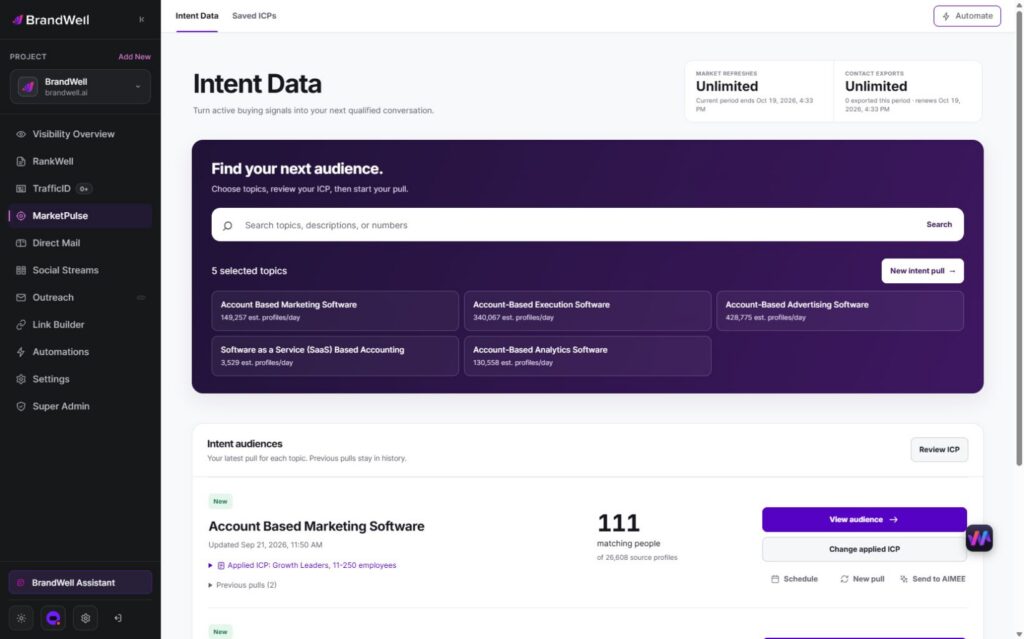
Current MarketPulse offer: intent-data plans start at $500/mo. See the product, demo, and current plans. Updated October 3, 2026.
Define the visitor-to-decision scope
A white label website visitor identification strategy should answer five questions before a pixel or script is installed:
- Which traffic is eligible for processing by geography, site, page, visitor type, and consent state?
- Is the desired output an account, a probable professional profile, a validated contact field, or only an aggregated segment?
- What confidence, fit, recency, and duplication rules make a candidate usable?
- Which actions are allowed at each evidence level?
- How will the agency and client measure false matches, accepted candidates, activation, complaints, and downstream outcomes?
That definition prevents a common failure: taking a vendor’s “identified” label literally. Company recognition may be based on network or domain evidence. Person-level resolution may use a different method with a different eligible population. Enrichment may append fields that were not observed during the visit. The client report must preserve those distinctions.
Use neutral language in reporting: “probable account visit,” “candidate professional match,” or “validated business contact associated with the account,” depending on the evidence. Never imply surveillance or tell a prospect that the agency secretly watched an identifiable person browse.
Use eight collection and review gates
A useful white label website visitor identification implementation guide follows the data through the actual operating team.
- Approve the purpose and geography. The client, agency, and legal/privacy reviewers define eligible sites, regions, purposes, notices, consent signals, and prohibited uses.
- Set the denominator. Record total sessions, bot exclusions, internal traffic, eligible sessions, consented sessions where required, and traffic that can enter the identification process. Without this denominator, a match rate is marketing noise.
- Install and validate collection. Test domain ownership, tag behavior, consent-state transmission, page exclusions, duplicate firing, campaign fields, and data minimization before production use.
- Resolve at the correct level. Keep account-level and person-level candidate streams separate. Retain source category, confidence, event time, and geography with each output.
- Enrich and verify selectively. Append only fields needed for the approved workflow. Validate important business contact data and route conflicts to review.
- Apply ICP and suppression rules. Remove employees, customers, competitors, vendors, job seekers, out-of-market geographies, active disputes, opt-outs, and stale candidates.
- Choose a proportionate action. Account-level evidence may trigger account research or advertising planning. Higher-confidence, permitted person-level data may support a reviewed sales task. No match should automatically send a message.
- Return outcomes and complaints. Capture accepted, rejected, researched, routed, reached, replied, qualified, opted-out, and disputed states. Use them to improve the service and stop unsafe workflows.
The agency service owner is accountable for delivery. A technical owner manages the tag and integrations; RevOps owns field mapping and deduplication; the client’s marketing and sales owners approve routing and follow-up; privacy/legal reviews purposes and regions; a named operator handles exceptions. Write that RACI into the statement of work.
Use the current own-site product
Current TrafficID own-site workflow
TrafficID brings identifiable own-site visitors, captured forms and account context into a working audience. Keep each source distinct. Saved Stakeholder ICP filters can add relevant decision makers at the company; those added contacts are not automatically visitors.
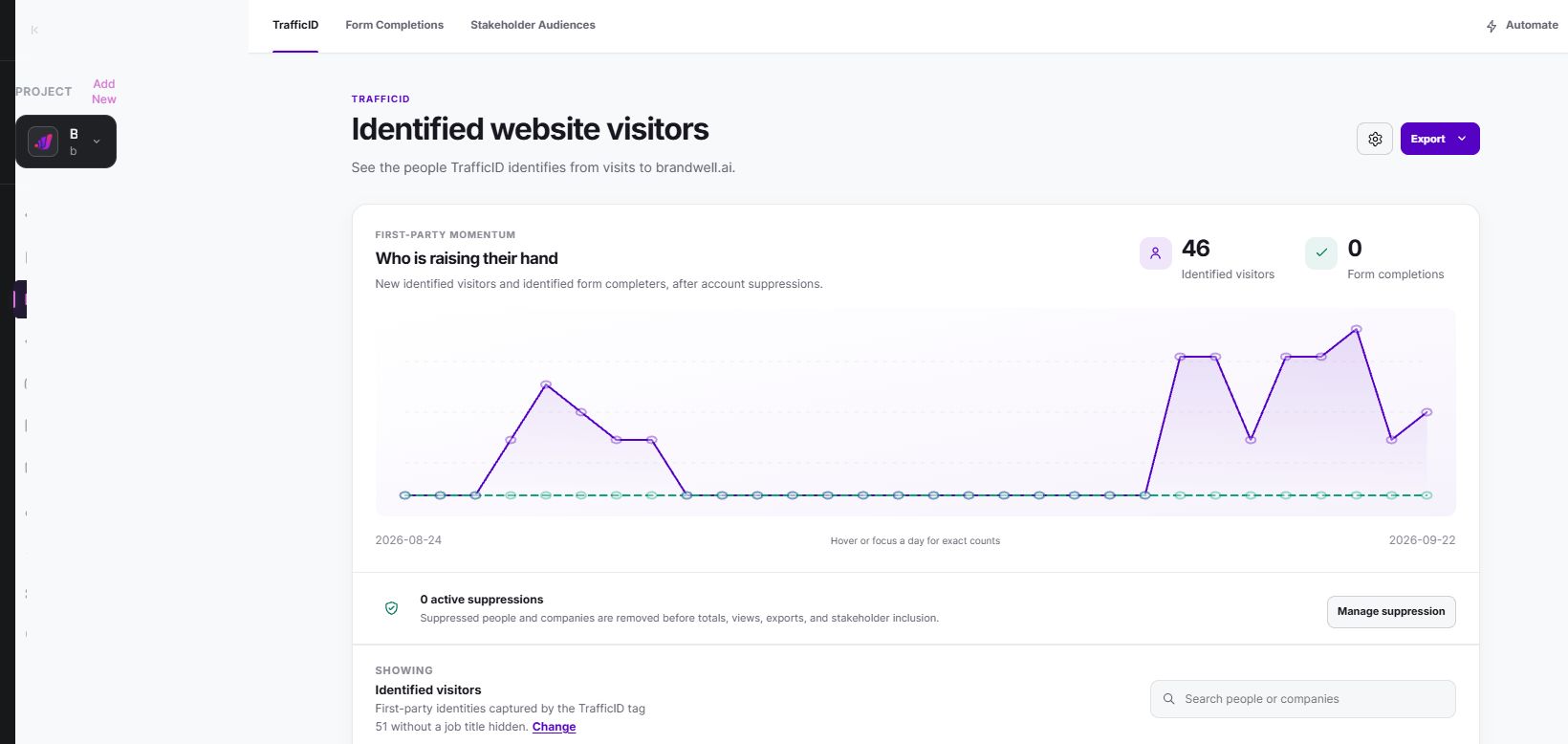
Review the actual visit context, company, available fields and suppressions. Use supported exports or an approved follow-up after checking purpose and channel eligibility. AIMEE can organize supplied context through configured tools. Verify separately implemented client branding, multi-client interfaces, integrations, rights, support and fees.
Review TrafficID and current plans. MarketPulse research is starting at $500/mo and is separately scoped offsite topic research.
Compare distinct traffic methods
These approaches answer different questions.
- Aggregate analytics explains pages, sources, campaigns, and behavior patterns without identifying a company or person. Consider it when the client needs conversion and experience insight.
- Reverse-IP company identification can add account context for eligible traffic. It is useful for ABM research but less reliable on shared networks, home connections, VPNs, and small firms.
- Person-level visitor identification may create a higher-value candidate in eligible contexts, yet it carries greater privacy, validation, and outreach risk.
- Retargeting alone reaches eligible browser or platform audiences without telling sales who visited. It can support demand capture, but it does not solve CRM reconciliation or account research.
Use the least intrusive method that answers the client’s business question. A company-level result may be entirely sufficient for an account ad or sales-research queue. Do not buy person-level resolution merely because it sounds more actionable.
Count full agency operating costs
White label website visitor identification pricing can be based on sessions, identified visitors, client domains, workspaces, records, contacts, enrichments, users, exports, API calls, features, or service levels. Add tag implementation, consent work, CRM configuration, monitoring, report interpretation, client support, outreach review, and data-quality investigations.
For agency economics, separate vendor cost from agency labor and risk. Define the service remainder only after estimating eligible traffic, accepted-candidate yield, review minutes, reporting hours, client support, and expected churn. Do not sell on unverified lead-volume or revenue projections.
Measure units, validation and outcomes
Keep collection, identity, validation, acceptance, action and outcome measures in separate streams with compatible units. Sessions, unique visitors, companies, form submissions and added stakeholder contacts are not interchangeable or necessarily sequential stages. Count actual accepted and qualified outcomes; attribution overlap does not establish incremental revenue.
eligible sessions → submitted sessions → account candidates → person candidates → validated records → accepted records → approved actions → reached accounts → qualified responses → opportunities → revenue.
Report rates at each transition. Sample accepted and rejected records for error. Track latency, duplicate rate, stale-data rate, suppression success, complaint or dispute rate, operator acceptance, and client usage. For outcomes, use a randomized or phased holdout where feasible. If the treatment gets extra human effort, document that difference rather than attributing all lift to the data.
Check client operating prerequisites
Check for a B2B site with enough relevant traffic, a defined ICP, high-value pages, a clean CRM, clear consent and notice handling, a response team, and a measurable next step. Agencies managing paid media, SEO, ABM, or demand generation can use the service to connect traffic work with account research and client reporting.
Disqualify clients that expect universal person identification, cannot govern geography or consent, sell primarily to consumers, have sensitive use cases without specialist review, lack a suppression process, or cannot respond appropriately. If the site has little qualified traffic, improve acquisition and conversion before adding another identification layer.
Keep site activity and topic research distinct
Website activity is first-party behavioral context on the client’s property. Third-party topic or research signals describe a different observation environment. Firmographic fit describes market suitability. Identity confidence describes who the account or person might be. Combine these layers only after normalizing entity, time, and permitted use.
A high-fit account visiting a pricing page and showing fresh topic research may deserve rapid account research. A probable person match with no fit or weak evidence may deserve no action. A strong topic signal without a website visit can remain in an account-prioritization workflow. Make the reason for each route visible.
Resolve collection and action boundaries
Common failures include loading a tag before consent review, processing restricted geography incorrectly, counting bots or employees, treating every account match as a named person, using stale appended data, letting one client see another’s records, skipping opt-outs, and triggering automated outreach that reveals hidden tracking.
Verify the actual purpose, geography, collection method, required notices and choices, recipients, channel requirements, access, retention, suppression, correction and deletion responsibilities. Resolve outstanding requirements with qualified reviewers before collection or action.
Scope a separate agency visitor service
Package implementation and tag QA, eligibility configuration, weekly exception review, ICP and suppression maintenance, account research, approved routing, client reporting, quarterly threshold changes, and an outcome review. State which party handles follow-up, complaints, deletion requests, system access, and frontline support. Set an SLA only for tasks the agency controls; do not inherit an undocumented vendor uptime promise.
Review an available MarketPulse topic, saved ICP and actual preceding-24-hour matches for the approved research purpose. Keep uncertain company context visible. AIMEE can organize supplied context through configured tools; named owners approve actual exports, messages, audience uploads and CRM writes.
AIMEE can prepare a review brief through configured connected tools. Keep proposed actions separate from actual approvals and destination acknowledgements. Confirm the implementation and permissions before execution.
Review TrafficID for own-site audience work and verify current allowances, available fields, supported exports and actual account scope. MarketPulse research is starting at $500/mo and supplies separate topic context. Custom agency delivery, client interfaces, integrations and rights require independent verification.
Copyable visitor-service review record
Site: [Actual client domain, scope and collection state.] Eligibility: [Region, exclusions, notices and required choices.] Units: [Sessions, visitor identities, companies, forms and added contacts.] Evidence: [Source, visit context, validation and uncertain fields.] Decision: [ICP, suppression, review and permitted action.] Outcome: [Acceptance, actual execution, qualified result and unresolved cases.] Service: [Implementation, client boundary, rights, labor and fees.]
Sessions are not unique people
Google Analytics session documentation defines a session as a period of interaction. Do not label a session count as a count of identifiable people.
A fictional period has 1,000 sessions, 300 eligible visitor IDs, 120 company candidates and 80 person candidates. The 80 person candidates represent 26.7% of the defined eligible IDs; 80 divided by 1,000 sessions is a different ratio and does not establish a person match rate. Use actual linked units and deduplication rules.
Keep forms and added stakeholders distinct
A fictional workspace has 80 identified visitor records and 20 form identities, with five people present in both streams. If the same identity rules permit reconciliation, their union is 95 people. Fifty added company stakeholders are not another 50 visitors. Preserve source labels, overlap and uncertain matches.
Validation needs a representative reference
In a fictional review, 60 of 80 person candidates are sampled and 45 confirmed against the defined reference. Sample confirmation is 75%; 20 candidates remain unchecked. Do not call all 80 verified or treat sample confirmation as coverage of every eligible visitor. Record reference limitations and correction routes.
Do not silently drop missing outcome feedback
Forty fictional accepted records include 30 with outcome feedback and six qualified opportunities. Feedback coverage is 75%; opportunities are 20% of reported records or 15% of accepted records. Ten remain unresolved. An observed visit or exported record is not a qualified opportunity or permission to message.
Cost the agency work separately
A fictional agency cycle costs $500 defined platform allocation, $400 implementation allocation, $600 review, $300 QA and $200 support: $2,000. Forty accepted records make the defined cost $50 each. A further $400 correction cost raises it to $60. Excluded overhead, tax and financing can change the result; zero accepted records make the ratio undefined. These inputs are illustrative, not TrafficID plan prices or benchmarks.
Review the current product in the portal
In TrafficID, check the reported tag state, review the own-site audience and captured form identities, then inspect stakeholder context and suppressions. Keep added decision makers separate from actual visitor evidence. Review available export and approved follow-up options. AIMEE can prepare context through configured tools; actual messages, exports and destination writes need named ownership. Verify separate agency branding, multi-client delivery and rights.
Frequently asked agency visitor questions
Does TrafficID identify every visitor?
Do not promise universal coverage. Report actual eligibility, available matches and uncertainty.
Are added stakeholders people who visited?
No. Preserve their added-contact source separately.
Does a research record authorize outreach?
Verify the actual purpose, recipient, channel and applicable requirements first.
Does the subscription include a white-label agency portal?
Confirm separately implemented client interfaces, branding, rights, support and fees.
Review own-site audience work: explore TrafficID. For separately scoped topic research, MarketPulse is starting at $500/mo.
Reviewed and updated October 3, 2026.

Written by