On this page
- Understand what the two labels actually describe
- Build a provenance-to-outcome comparison workflow
- Compare networks with single-source scores and opaque workflows
- Compare cost using useful coverage, not catalog size
- Measure coverage, freshness, bias, and business effect
- Choose by market and decision shape
- Combine network evidence with fit and identity cautiously
- Manage provenance, consent, bias, and change risk
- Package network evaluation as an agency service
- Retain an interpretable provenance record
- Compare useful coverage and cost
- Apply the review in MarketPulse
- Frequently asked questions
A data co-op and a publisher intent network are not mutually exclusive categories. A cooperative may be assembled through direct publisher relationships, while a publisher network may aggregate many properties and participants. The useful buying question is not which label sounds better. It is which observable population, collection rights, normalization method, identity process, freshness window, bias profile, and activation license make the signal reliable for your B2B workflow.
Who this is for: B2B data buyers, RevOps and demand-generation leaders, privacy and engineering teams, and agencies comparing intent-signal sourcing models.
Choose with a controlled-market test. Give every provider the same target accounts and topics. Require source-class and time evidence, apply the same identity and acceptance rules, and compare useful decisions – not raw signal volume. A network with broad reach can still miss a niche market; a focused publisher can be highly relevant yet biased toward its own content and audience.
Current MarketPulse offer: intent-data plans start at $500/mo. See the product, demo, and current plans. Updated October 3, 2026.
Understand what the two labels actually describe
A data cooperative is an arrangement in which participants contribute or permit observation of data under common commercial and governance rules, and the operator normalizes the inputs into a product. The value proposition is breadth across contributing environments. The risk is uneven participation, duplicated observations, opaque transformation, and a coverage map that changes as members enter or leave.
A publisher intent network observes engagement on owned or partner content properties. Its value proposition is strong content context: the provider may know the asset, category, session, registration, or declared interest that produced the signal. Its risk is audience and content bias. The observed population represents people who use those properties, not the whole market.
A cooperative can include publisher participants, and a publisher network can aggregate multiple sources. Ask the supplier to document its actual source chain. A sourcing label does not establish collection rights, population coverage or the current MarketPulse methodology.
Build a provenance-to-outcome comparison workflow
A source-model comparison implementation guide should preserve provenance at every stage.
- Freeze the use case. Define target accounts, excluded accounts, topics or content categories, geography, desired action, and the maximum useful signal age.
- Classify source environments. Record co-op member, publisher property, content syndication, review marketplace, first-party client data, or another documented class. Do not replace provenance with a generic “third-party intent” label.
- Inspect collection and rights. Obtain plain-language collection context, participant roles, notices or consent handling, permitted uses, regional restrictions, client resale rights, retention, deletion, and suppression processes.
- Normalize events. Map pages, assets, searches, downloads, registrations, topics, and time windows into a comparable event schema without erasing the original source.
- Resolve the entity. Separate person-declared information, account resolution, device or network inference, and appended enrichment. Apply confidence and conflict rules.
- Calculate freshness and baseline. Define event time, aggregation window, comparison population, threshold, expiry, and refresh behavior. A “surge” without a baseline definition is not comparable.
- Apply fit and acceptance gates. Reject out-of-market, duplicate, stale, suppressed, ambiguous, or unsupported signals before counting them as useful.
- Activate proportionately. Route account research, content, advertising planning, CRM tasks, or another approved action that matches the evidence level.
- Return dispositions. Capture acceptance, rejection, action, reach, response, opportunity, and outcome with stable IDs.
Data engineering owns event and identity normalization. Demand generation defines topics and actions. RevOps owns destination fields and outcomes. Privacy/legal reviews collection, roles, client use, and channels. Procurement secures rights and exit terms. The operating team samples quality and resolves exceptions.
Compare networks with single-source scores and opaque workflows
A single-source signal can be valuable when the source is closely aligned with the purchase. It is easier to explain and govern, but its coverage and bias are narrow. A multi-source network can broaden observation, yet normalization may obscure the original event. An unchecked visitor match adds identity risk. An opaque API can automate delivery while leaving operators unable to explain why an account qualified.
Prefer the smallest source set that improves the named decision. Add another network only when it contributes incremental observable coverage or evidence – not simply more rows. Require provenance to survive the API, report, and CRM path.
Compare cost using useful coverage, not catalog size
Source-model comparison pricing may depend on topics, accounts, records, leads, campaigns, audience use, deliveries, API access, client rights, users, or services. A catalog containing more topics is not automatically better. The relevant denominator is the buyer’s addressable accounts and decision-worthy events.
Calculate:
- annual cash and implementation cost;
- internal normalization, identity, review, activation, and reporting labor;
- cost per eligible account observed;
- cost per accepted signal or validated lead;
- cost per activated account and qualified outcome; and
- transition and exit cost, including data deletion and replacement work.
Compare current, scope-matched written prices and permitted uses. Include relevant setup, normalization, review, activation and exit costs. A catalog size or unsupported market-wide price range cannot establish better value.
Measure coverage, freshness, bias, and business effect
Start with observable coverage: target accounts with at least one qualifying event divided by target accounts submitted. Then measure event freshness, identity acceptance, duplicate rate, topic precision, signal rejection, activation latency, and operator adoption.
For outcomes, distinguish descriptive acceptance and downstream association from incremental impact. Use a suitable randomized design where feasible. A phased rollout or matched comparison remains dependent on its assumptions and can leave confounding. Segment the results so broad coverage does not conceal a failure in the core market.
Choose by market and decision shape
A broader co-op can fit a market where buyers research across many independent B2B properties. Publisher or marketplace signals fit decisions with strong content or category behavior. Declared lead data fits workflows requiring a known professional response. A multi-signal enterprise platform fits teams capable of configuring and operating it.
Avoid buying any network when the target market is undefined, the account list is too small to test, the client cannot act on signals, or collection and client-use rights remain ambiguous. First-party engagement and manual research may be the better baseline.
Combine network evidence with fit and identity cautiously
Intent context should enrich, not override, the client’s market definition. Map a signal to an eligible account, preserve source and time, resolve the necessary entity, apply fit and suppression, and choose a proportionate action. Then return an outcome.
If the source only supports account-level research, the safe output is an account brief or segment – not a statement that a particular executive researched the topic. If a publisher captures declared professional information, the buyer must still validate the field and permitted use.
Manage provenance, consent, bias, and change risk
Ask how the provider handles participant changes, invalid traffic, content classification, duplicate observation, small-sample volatility, VPNs, shared devices, account mapping, opt-outs, deletion, and model updates. Contractually require notice for material source, taxonomy, or method changes.
Have qualified reviewers assess the actual data roles, collection context, processing purposes, jurisdictions and permitted uses. A diagram, commercial label or checklist does not establish compliance.
Create a quarterly source-drift test even when the commercial relationship is stable. Freeze a representative account cohort, topic set, source taxonomy, and acceptance rule. Compare the new delivery with the prior baseline for observable-account rate, signal density, duplicate rate, latency, topic distribution, and downstream acceptance. Require the provider to explain material movement before operators change thresholds to make the numbers look normal again. If a named publisher, cooperative member, scoring input, or resolution method cannot be disclosed, record that opacity as a risk rather than guessing at provenance. The result should be a signed change decision: accept, constrain, retest, or suspend. This makes governance an operating discipline instead of a one-time procurement questionnaire.
Package network evaluation as an agency service
An agency can deliver source selection, topic or content mapping, controlled-market tests, identity and acceptance rules, weekly signal review, activation planning, client reports, bias monitoring, and quarterly source revalidation. Keep vendor licensing separate from agency strategy, operations, creative, media, and support.
MarketPulse supplies topic research, ICP filtering and available contact output. Define the client workflow, permissions and service scope separately. A subscription does not promise a native API, exclusive market or white-label service.
AIMEE can prepare configured research and reports through connected tools. Define inputs, permissions and human review points. Verify output and destination behavior; an instruction is not an implemented integration.
Start by reviewing the MarketPulse demo and plans, starting at $500/mo. Choose a relevant topic and ICP, then evaluate audience fit, available contact fields, and the workflow you will use. The first-purchase 3-day satisfaction guarantee requires no data exports and no more than 2 Intent Scans; review the current guarantee terms before testing. A short evaluation can establish fit, but cannot prove future pipeline or revenue.
Retain an interpretable provenance record
W3C’s PROV overview describes provenance through the entities, activities and people involved in producing data.
For a proposed supplier test, retain an event ID, source class, observation time, original event type, transformations, resolved entity, acceptance decision and permitted destination. Mark undisclosed fields as unknown. A complete record is useful for review; it does not certify the source’s rights or accuracy.
Compare useful coverage and cost
In a fictional test, each source receives the same 200-account list and equivalent topic and time definitions. Source A observes qualifying events for 80 accounts; Source B observes 60. Observable coverage is 40% and 30%, respectively. Neither rate describes the entire market.
After the same acceptance checks, A supplies usable evidence for 50 accounts and B for 48. At included costs of $1,000 and $600, cost per accepted account is $20 and $12.50. A has greater observed coverage; B has lower cost per accepted account under these assumptions. The decision also depends on which accounts matter, freshness, permissions and action quality.
If 30 accepted accounts appear in both sources, their combined accepted coverage is 50 + 48 – 30 = 68 unique accounts, or 34% of the frozen list. Do not sum 98 account records and call them 98 unique accounts. These numbers are illustrative arithmetic, not vendor results or purchase forecasts.
Apply the review in MarketPulse
- Choose a topic aligned with the decision and save the intended ICP.
- Review the available people and company fields rather than assuming every field is complete.
- Record acceptance, exclusions and overlaps before counting useful output.
- Export only within the plan and permitted use, then retain downstream acceptance and action receipts.
- Revisit the topic and filtering when the market or workflow changes.
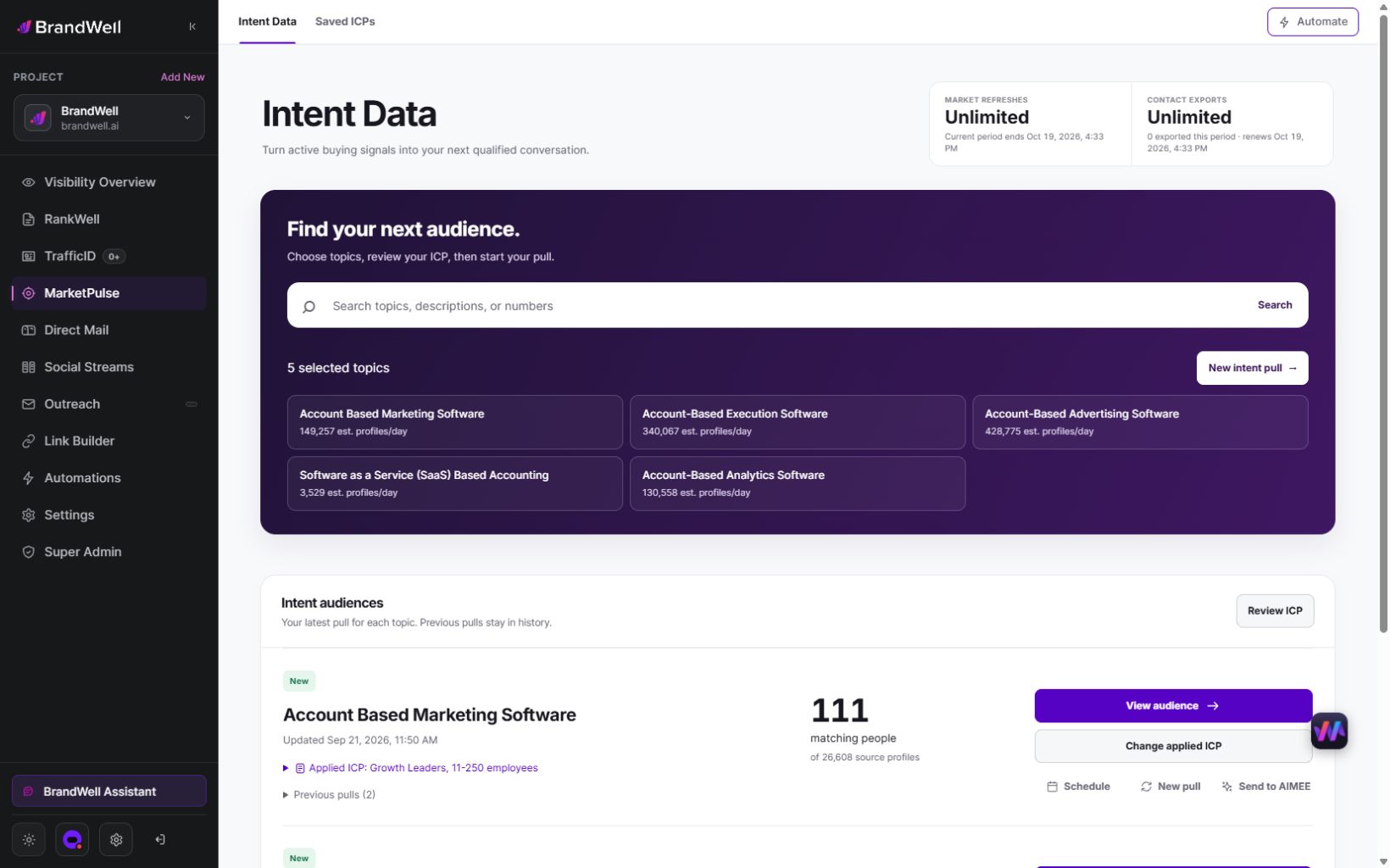
Standard MarketPulse plans are starting at $500/mo for one weekly topic and 25,000 monthly exports. Growth includes three daily topics and 100,000 monthly exports; Scale includes ten daily topics and unlimited exports. Counts and available fields vary; topic audiences can overlap.
Explore MarketPulse and compare current plans. Verify any additional API or redistribution scope through an explicit agreement.
Frequently asked questions
Are cooperatives and publisher networks opposites?
No. Participant arrangements and observed content properties can overlap. Inspect the actual source chain.
Does a larger network provide better signals?
Not necessarily. Test relevant coverage, freshness, acceptance, permissions and the decision the output supports.
Can account-level research identify the individual who researched?
Do not make that inference without separate evidence. Keep account resolution and person-level information distinct.
Which cost denominator should I use?
Use the defined output relevant to the decision, such as an accepted account. Keep raw event, account and downstream outcome units separate.
Reviewed and updated October 3, 2026.

Written by