On this page
- Define the intended operators
- Agree three responsibility layers
- Specify handoffs and service clocks
- Route support by actual failure
- Compare separately implemented coverage
- Count labor, setup and correction work
- Measure support without causal ROI claims
- Match scope to operating complexity
- Preserve evidence for diagnosis
- Resolve rights and approval boundaries
- Review actual service improvement
- Use a support release checklist
- Support failure-routing worksheet
- Copyable support incident record
- Frequently asked support questions
An intent service support model is not a help desk with a new label. It is the operating system that decides who diagnoses an ambiguous signal, who corrects a routing rule, who approves a data use, and who explains the result to a client. Without that clarity, every anomaly becomes senior-team work and the retainer quietly turns into unlimited consulting.
The useful design unit is a resolved decision, not a ticket count. A client asking why an account appeared in a report may expose a data-quality question, a topic-selection issue, a CRM mapping problem, or a sales-adoption gap. The support path should preserve that distinction while still giving the client one accountable agency contact.
Build a support charter that assigns actual provider, agency and client responsibilities. Route requests by verified impact, preserve reproducible evidence, and define acknowledgement, diagnosis, restoration, resolution and closure separately. Confirm the provider contract before promising response times or remediation ownership.
Current MarketPulse offer: intent-data plans start at $500/mo. See the product, demo, and current plans. Updated October 3, 2026.
Define the intended operators
Agency owners, GTM consultants, RevOps partners, and demand-generation leaders preparing to sell or stabilize a recurring intent-data service. It is most useful before the first proposal or whenever an existing program is losing margin to unplanned support.
Treat this support charter as a decision aid, then obtain written confirmation of escalation ownership, service boundaries, commercial terms, controls, and integrations before it enters a proposal or client runbook.
Agree three responsibility layers
Write a responsibility matrix before choosing software. The provider lane covers service availability, documented data defects, contracted feeds, and platform-level remediation. The agency lane covers topic configuration, signal interpretation, QA, activation rules, reporting, and client communication. The client lane covers lawful first-party inputs, CRM access, audience approvals, suppression requests, and timely disposition feedback.
Give every recurring job a responsible owner, an approver, a consulted specialist, and an informed stakeholder. Then define what evidence closes the job: a corrected record, a rerun report, a change log, an approved campaign, or a client acknowledgment. A chart without closure evidence merely moves ambiguity between teams.
- Write the support decision the support step must produce, not merely the task someone performs.
- Name the case owner, support approver, closure evidence, cutoff, exception route, and supported client dependency.
- Use a bounded pilot and revise the operating rule from observed exceptions.
Specify handoffs and service clocks
Use one intake path and classify requests by impact. A production-blocking delivery failure deserves immediate triage; a scoring question can enter the next analysis window; a new-topic request belongs in change control. Response targets should describe acknowledgment, diagnosis, workaround, and resolution separately so a fast greeting is not mistaken for a solved problem.
The handoff sequence is intake, reproduce, classify, assign, investigate, approve, remediate, verify, explain, and learn. Quality control should confirm the correct client, time window, source, identity-confidence threshold, suppression list, activation destination, and output version. Keep a lightweight problem log so repeated symptoms become backlog work rather than recurring labor.
- Freeze the approved input and record its version.
- Run deterministic validation before subjective inspection.
- Route ambiguous or high-impact cases to a named human case owner.
- Record the response action, approval, closure evidence, and downstream result.
- Feed repeated exceptions into process improvement rather than hiding rework.
Route support by actual failure
Route each request to an actual owner with source, affected client, observation period, reproduction steps, impact and closure evidence. Verify the current provider contract, agency scope and client responsibilities; research access does not establish managed support or a resolution SLA.
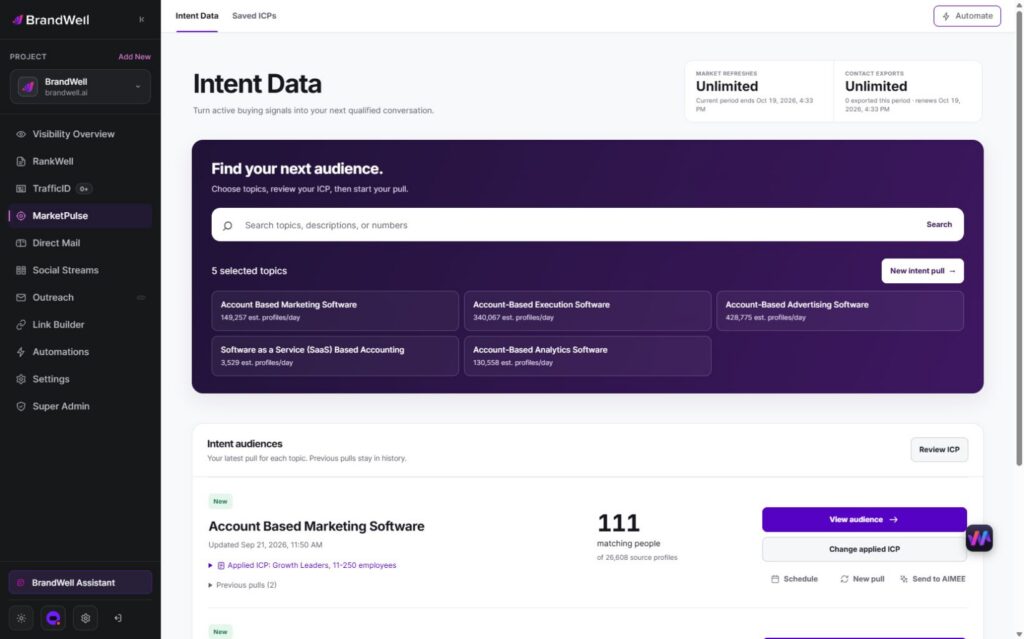
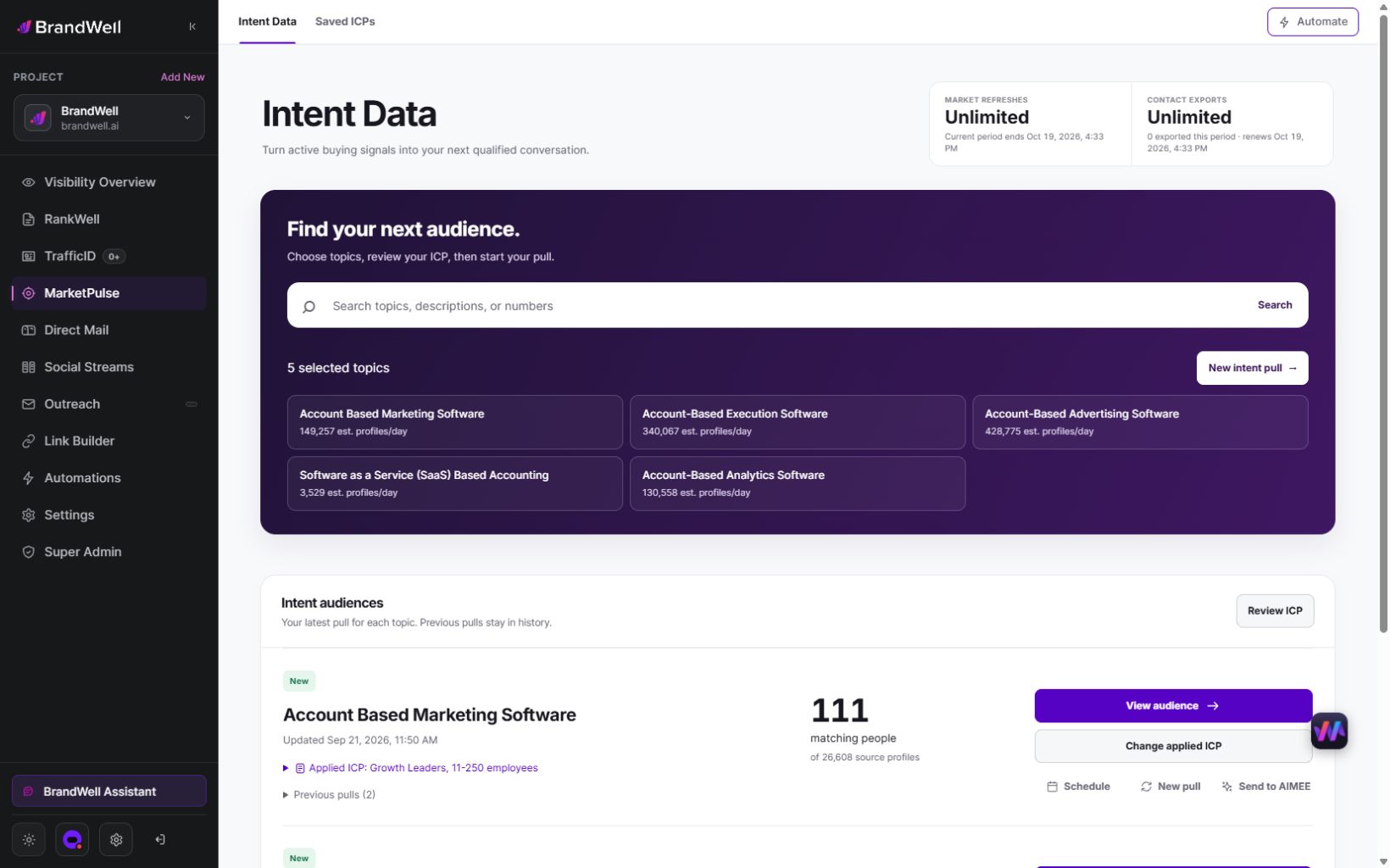
BrandWell: MarketPulse intent data and connected growth automation
BrandWell MarketPulse: intent data starting at $500/mo. Find people researching topics relevant to what you sell, apply saved ICP filters, and review available contact details before taking action.
| Plan | Topics and refreshes | Monthly exports |
|---|---|---|
| Starter | 1 topic, weekly | 25,000 contacts |
| Growth | 3 topics, daily | 100,000 contacts |
| Scale | 10 topics, daily | Unlimited contacts |
Swipe the table to see all columns.
A pull retrieves available data from the previous 24 hours for one topic. Daily use across all included topics provides 90 Growth pulls or 300 Scale pulls in a 30-day month. Weekly Starter pulls vary by calendar month. Available audience size and contact fields vary, and audiences may overlap. Refreshes stop at the plan limit without overage charges.
- Find and qualify: search the topic catalog, save your ICP, and review the people and companies that match.
- Act on the research: export qualified contacts or prepare an Outreach or Direct Mail workflow. Connected products, channel usage, and fulfillment may cost extra.
- Get help from AIMEE: Growth and Scale include AIMEE for the initial user to research accounts and prepare the next step through connected tools.
Agencies and other service businesses can build client deliverables around their available Intent Scans and exports. Keep each client’s scope, permissions, and service fees clear. A subscription is not a promise of a white-label platform or exclusive access to a market.
Explore MarketPulse and watch the demo or compare plans starting at $500/mo. Any early-access discount is a separate, time-limited offer shown to an eligible recipient.
Compare separately implemented coverage
Manual coverage works for low-volume exceptions and high-context client questions. Automation is appropriate for deterministic checks such as schema validation, missing-field detection, delivery monitoring, and threshold alerts. White-label delivery matters when the agency needs a branded client experience, but branding does not transfer accountability or make uncertain data certain.
Choose the path by failure mode. Do not auto-resolve identity disputes, privacy requests, material audience changes, or outbound actions with reputational consequences. Automate evidence collection and suggested next steps, then require human approval where the decision changes data use, spend, targeting, or a client-facing explanation.
Count labor, setup and correction work
Model demand in minutes by request class, not in a single tickets-per-client average. Include recurring QA, office hours, reporting explanation, configuration changes, provider escalation, rework, and senior review. Add setup work for access, data mapping, client-specific playbooks, and training; setup should not disappear inside the first month’s operating margin.
MarketPulse research is starting at $500/mo. Verify current coverage, refreshes, exports, included tools and support entitlements on the product page and applicable agreement. Client reporting, custom integrations and managed support require separately verified implementation, rights and fees.
Measure support without causal ROI claims
Measure median time to meaningful diagnosis, resolution time by severity, first-pass QA acceptance, reopened-request rate, aging exceptions, change volume, and support minutes per active client. Pair those service measures with activation and commercial indicators, but do not attribute pipeline to support merely because both happened in the same month.
Investigate repeated demand. Repeated report questions may justify clearer explanations; routing exceptions may need a mapping repair; missing seller feedback may need an adoption review. Test actual causes and results rather than assuming a preferred intervention.
- Define the denominator and time window before collecting a KPI.
- Separate support flow closure evidence from commercial contribution analysis.
- Inspect misses, reversals, and unresolved cases – not just successful actions.
- Keep service metric definitions stable enough to compare periods and clients.
Match scope to operating complexity
A new client with a clean CRM and one campaign may need a narrow weekly review and a small exception queue. A mature client operating multiple regions needs role-based approvals, scheduled change windows, stricter provenance, and clearer escalation paths. A client with weak follow-through needs enablement and disposition discipline before advanced scoring support.
Segment support packages by operational complexity: active topics, source count, destinations, regions, approval groups, reporting audiences, and expected change volume. Do not segment only by company size. Two similarly sized clients can create radically different loads when one has stable workflows and the other changes definitions every week.
Preserve evidence for diagnosis
Support should follow the evidence chain. Preserve the originating signal, timestamp, topic or behavior, account match, person match where used, confidence, validation result, routing decision, activation event, and downstream disposition. That record lets the agency answer what happened without reconstructing history from screenshots and memory.
Record actual observation units, source, identity method and uncertain or conflicting fields. An account association or available contact record does not establish who researched or whether they intend to purchase. Assign correction and suppression owners; hold affected actions when evidence or rights remain unresolved.
Resolve rights and approval boundaries
Put permitted data, retention, access, subprocessors, deletion, incident notification, and client responsibilities into the governing documents. Operationally, restrict raw data to people who need it, log material configuration changes, and separate harmless reporting corrections from changes that expand targeting or data use.
Set expectation boundaries in the proposal: supported channels, normal change volume, response windows, exclusions, client dependencies, and the evidence used for closure. Avoid unsupported uptime, continuity, security-control, or performance promises. A precise escalation path is more credible than a broad promise to handle everything.
- Document purpose, permissions, retention, suppression, deletion, and correction.
- Require approval before material targeting, support data-use, spend, or external-message changes.
- Preserve provenance and a reversible support record of transformations and decisions.
- Escalate uncertainty rather than converting it into an unsupported certainty claim.
Review actual service improvement
Review request themes, corrected defects, prevention work, unresolved dependencies, approved changes and actual operating effort monthly. Test whether comparable cases reach verified decisions with less senior handling. Ticket activity or a calmer impression alone does not establish renewal value.
AIMEE can prepare a review brief through configured connected tools. Keep proposed actions separate from actual approvals and destination acknowledgements. Confirm the implementation and permissions before execution.
Review an available MarketPulse topic, saved ICP and actual preceding-24-hour matches for the approved research purpose. Keep uncertain company context visible. AIMEE can organize supplied context through configured tools; named owners approve actual exports, messages, audience uploads and CRM writes.
Use a support release checklist
- List each support failure class and the business impact that sets its escalation priority.
- Assign provider, agency, and client responsibility without leaving a shared-owner gap.
- Write acknowledgment, diagnosis, workaround, resolution, and closure-evidence expectations separately.
- Create one intake route with required context, reproduction steps, and affected deliverable.
- Rehearse platform, mapping, identity, activation, and client-adoption incidents in a tabletop exercise.
- Route privacy, targeting, spend, and external-message decisions to qualified human approval.
- Calculate recurring coverage, exception load, setup recovery, senior escalation, and backup cost.
- Turn repeated request themes into documentation, product changes, or scope decisions.
- Confirm the latest support entitlements and quote in writing before a client commitment.
- Use the monthly review to close dependencies and prevent recurrence rather than celebrate ticket volume.
The support-model test is whether another qualified operator can diagnose, route, close, and explain a client issue from the service record without private founder context. If resolution still depends on memory or informal favors, the model is not yet repeatable.
Support failure-routing worksheet
| Failure | Evidence to collect | Ownership to verify |
|---|---|---|
| Research or platform issue | Topic, period, reproduction and actual service state | Provider contract and agency communication owner |
| Client mapping or destination | Approved mapping, client boundary and destination response | Agency implementation and client approver |
| Identity or data dispute | Source, method, conflicting fields and correction request | Actual correction, suppression and permitted-use owners |
| Seller adoption or missing outcomes | Delivery, acceptance, action and missing feedback | Client operator and agency enablement scope |
Swipe the table to see all columns.
Copyable support incident record
Impact: [Actual affected client, destination, period and severity.] Evidence: [Reproduction, version, source and uncertainty.] Ownership: [Coordinator, operations, communication and approver.] Clocks: [Start, acknowledgement, diagnosis, restoration and closure.] Action: [Containment, approval, correction and destination response.] Acceptance: [Actual test, client confirmation and unresolved dependencies.] Handoff: [Next owner, acknowledgement, follow-up and prevention work.]
Assign operations and communication separately
Google’s incident-management guidance distinguishes command, operations, communication and planning responsibilities and calls for an acknowledged handoff. It concerns technical incidents, not BrandWell support entitlements or an agency SLA.
Acknowledgement does not mean resolution
A fictional case opens at 09:00, is acknowledged at 09:05, diagnosed at 09:40, restored by workaround at 10:10 and verified closed at 14:00. Acknowledgement takes five minutes, diagnosis 40 minutes, restoration 70 minutes and closure five hours. State the timezone, clock policy, business hours and any agreed pauses. Do not report a five-minute resolution.
Count unique cases and reopenings separately
A fictional month has 40 unique cases and six reopenings: 46 handling episodes, not 46 unique problems. Five cases remain unresolved. Six reopened unique cases among 35 initially closed cases make a defined reopening rate of 17.1%; disclose that denominator and review period.
Closed-only timing can hide the queue
Three fictional closed cases take one, two and three hours: a closed-case median of two hours. Seven other cases remain open longer than ten hours. Report both the closed-case statistic and open-case ages. The two-hour median does not describe all ten cases or establish a service guarantee.
Measure specialist support capacity
Twenty fictional routine requests at 15 minutes each need five hours. Ten specialist requests at 45 minutes each need 7.5 hours. With eight routine hours and six specialist hours available, the specialist gap is 1.5 hours despite 14 total available hours against 12.5 required. Skills and approval rights are not assumed interchangeable.
Price actual coverage and rework
A fictional month costs $500 research, $600 support, $400 QA, $300 escalation and $200 reporting: $2,000. Across 40 unique cases, the defined cost is $50 per case. A further $400 correction cost raises it to $60. Excluded overhead, tax and financing can change the result; zero cases make that ratio undefined. These invented inputs are not BrandWell prices or support benchmarks.
Use supported research within a separate service scope
MarketPulse research is starting at $500/mo. Review actual topics, approved saved ICP filters and available matches. AIMEE can organize supplied context through configured tools; owners approve exports, messages, audience uploads and CRM writes. Agency support, custom integrations, reporting and client interfaces require separately verified implementation, rights and fees.
Frequently asked support questions
Does a quick reply prove resolution?
No. Track acknowledgement, restoration and verified closure separately.
Should unresolved cases disappear from timing reports?
No. Report open-case age and closed-case statistics with explicit scope.
Does spare total time establish support capacity?
No. Check the actual specialist and approval bottlenecks.
Does MarketPulse include an agency support SLA?
Confirm actual entitlements and separately contracted service responsibilities.
Review current research: explore MarketPulse and current plans.
Reviewed and updated October 3, 2026.

Written by