On this page
- Define the intended client reviewers
- Set five acceptance fields
- Run the monthly operating cycle
- Use current research within scope
- Separate artifacts, actions and outcomes
- Budget actual workload
- Measure acceptance and qualified results
- Match detail to client capability
- Preserve the evidence chain
- Control rights, quality and scope
- Review the renewal evidence
- Use a monthly release checklist
- Monthly deliverables the client can inspect
- Copyable monthly acceptance record
- Frequently asked monthly-delivery questions
Intent service monthly deliverables often fail for a simple reason: the agency ships files while the client expected decisions. A spreadsheet of accounts can be technically correct and commercially useless if no one knows what changed, why those accounts matter, who should act, or how the result will be reviewed.
A strong cadence closes a loop. It begins with approved topics and target accounts, converts observed signals into quality-controlled records, activates the agreed plays, records exceptions and outcomes, and feeds those observations into the next cycle. The monthly package is the evidence that the loop ran – not a substitute for the loop.
Define monthly deliverables as accepted outputs with an owner, observation period, cutoff, approval, exceptions and next action. Keep topic configuration, research records, completed actions and actual outcomes separate. A delivered spreadsheet or proposed play does not establish successful activation or revenue.
Current MarketPulse offer: intent-data plans start at $500/mo. See the product, demo, and current plans. Updated October 3, 2026.
Define the intended client reviewers
Agency owners, client-service leaders, demand-generation teams, and RevOps consultants defining a recurring statement of work. Use it to replace vague promises such as ‘monthly insights’ with deliverables a client can inspect and accept.
Define actual acceptance, product scope, current pricing, data rights, destinations and responsibilities before making a monthly commitment.
Set five acceptance fields
Define each deliverable with five fields: purpose, owner, due point, acceptance test, and downstream use. For example, a prioritized account set is accepted only when it covers the agreed window, applies the approved filters, preserves source and freshness context, passes duplicate checks, and includes a routing decision. ‘Report delivered’ is too weak to manage quality.
A minimum package usually contains a coverage and configuration register, signal ledger, prioritized account view, verified contact or role coverage where permitted, activation record, exception log, client-ready narrative, and outcome ledger. The exact forms can change; the acceptance logic should remain stable enough to compare one month with the next.
- Write the monthly decision the cycle step must produce, not merely the task someone performs.
- Name the deliverable owner, acceptance approver, acceptance evidence, cutoff, exception route, and report recipient dependency.
- Use a bounded pilot and revise the operating rule from observed exceptions.
Run the monthly operating cycle
Use a recurring calendar: freeze inputs, ingest signals, reconcile identity, deduplicate, score or prioritize, review exceptions, approve activation, run plays, collect dispositions, assemble evidence, and hold a decision meeting. Publish the cutoff and late-data rule so the agency does not silently rewrite last month whenever a source arrives late.
The client meeting should approve decisions rather than narrate every row. Present what entered and left the active set, the strongest evidence, material uncertainty, actions completed, results observed, blocked items, and proposed configuration changes. Record each decision and owner before the meeting ends.
- Freeze the approved input and record its version.
- Run deterministic validation before subjective audit.
- Route ambiguous or high-impact cases to a named human deliverable owner.
- Record the action, approval, acceptance evidence, and downstream result.
- Feed repeated exceptions into process improvement rather than hiding rework.
Use current research within scope
Use current MarketPulse research as one input to a separately implemented monthly package. Verify actual source, period, rights, export scope, client boundary, destination acknowledgement, outcome feedback and operating effort before promising managed delivery.
BrandWell: MarketPulse intent data and connected growth automation
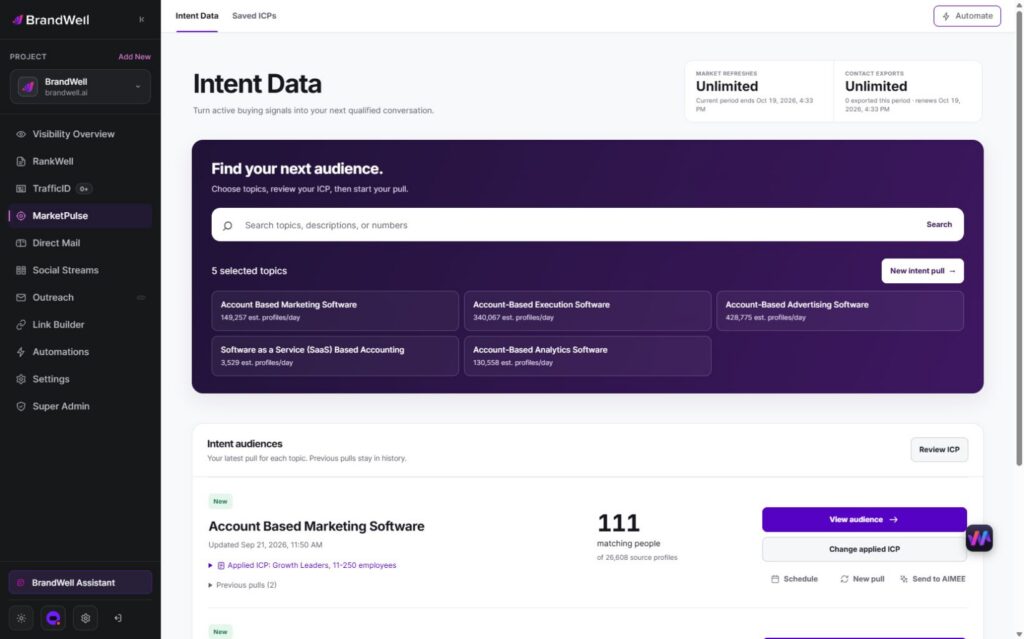
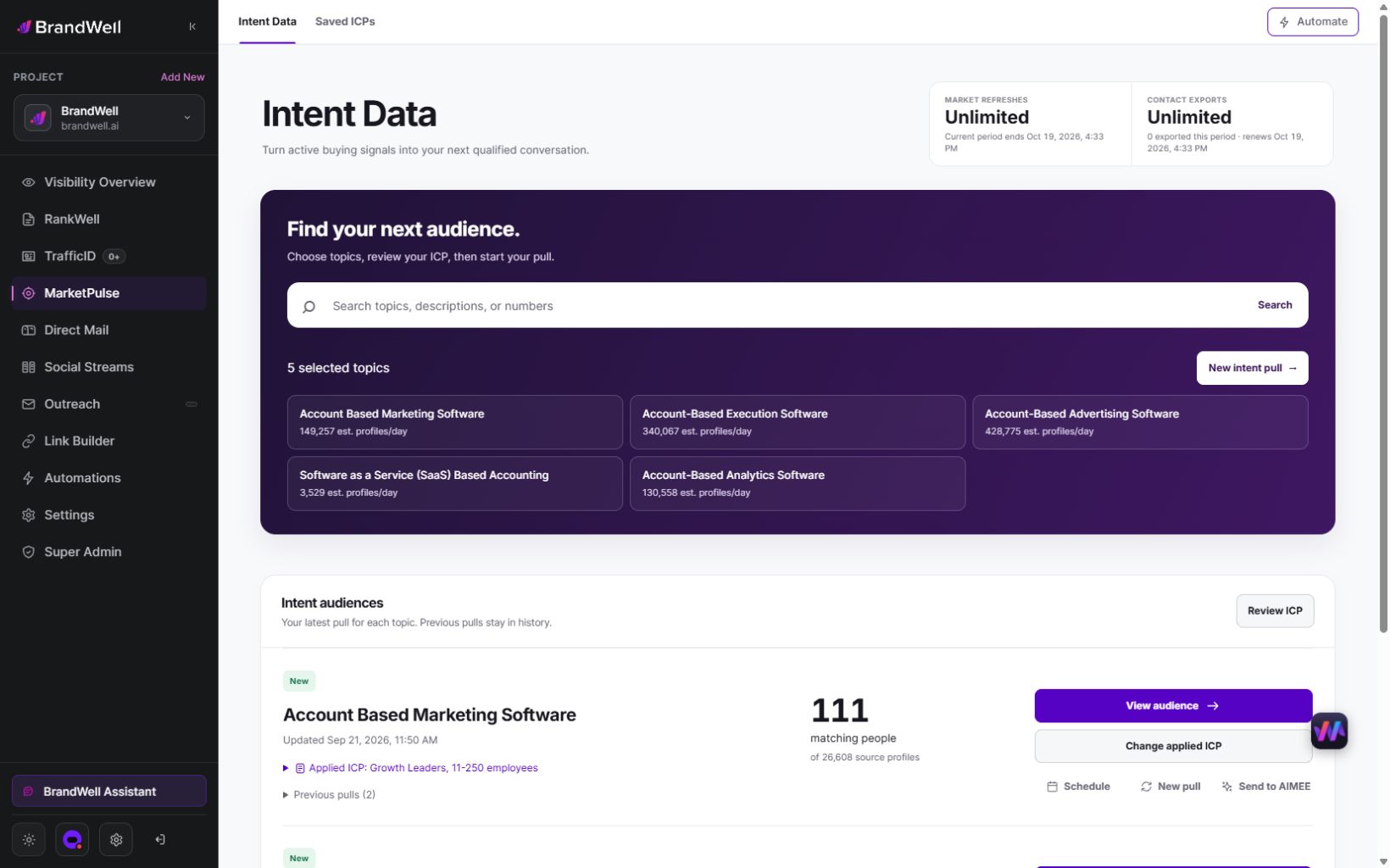
BrandWell MarketPulse: intent data starting at $500/mo. Find people researching topics relevant to what you sell, apply saved ICP filters, and review available contact details before taking action.
| Plan | Topics and refreshes | Monthly exports |
|---|---|---|
| Starter | 1 topic, weekly | 25,000 contacts |
| Growth | 3 topics, daily | 100,000 contacts |
| Scale | 10 topics, daily | Unlimited contacts |
Swipe the table to see all columns.
A pull retrieves available data from the previous 24 hours for one topic. Daily use across all included topics provides 90 Growth pulls or 300 Scale pulls in a 30-day month. Weekly Starter pulls vary by calendar month. Available audience size and contact fields vary, and audiences may overlap. Refreshes stop at the plan limit without overage charges.
- Find and qualify: search the topic catalog, save your ICP, and review the people and companies that match.
- Act on the research: export qualified contacts or prepare an Outreach or Direct Mail workflow. Connected products, channel usage, and fulfillment may cost extra.
- Get help from AIMEE: Growth and Scale include AIMEE for the initial user to research accounts and prepare the next step through connected tools.
Agencies and other service businesses can build client deliverables around their available Intent Scans and exports. Keep each client’s scope, permissions, and service fees clear. A subscription is not a promise of a white-label platform or exclusive access to a market.
Explore MarketPulse and watch the demo or compare plans starting at $500/mo. Any early-access discount is a separate, time-limited offer shown to an eligible recipient.
Separate artifacts, actions and outcomes
An artifact is a durable object such as a signal ledger, account list, QA record, or briefing. An action is a routed task, audience update, sequence enrollment, research step, or seller alert. An outcome is an observed response, meeting, stage change, disqualification, or other agreed event. Mixing the three creates inflated reporting.
Compare manual interpretation, configured automation and separately implemented client presentation against actual workload, reproducibility, rights and costs. Branding does not establish correct outputs, completed actions or qualified outcomes.
Budget actual workload
Calculate workload from active topics, source volume, account volume, identity checks, destinations, play count, exception rate, meeting cadence, custom analysis, and revision expectations. Separate onboarding and change requests from recurring production. Otherwise, a client with constant reconfiguration consumes the margin intended for ongoing delivery.
MarketPulse research is starting at $500/mo. Verify current topic coverage, refreshes, exports and included tools on the product page. Custom reports, integrations, client interfaces and managed delivery need separately verified implementation and rights.
Measure acceptance and qualified results
Track on-time acceptance, first-pass acceptance, coverage completeness, duplicate rate, match-confidence distribution, activation completion, seller follow-through, disposition completeness, and exception aging. Then observe meetings, opportunities, or agreed revenue events with appropriate time windows and control comparisons.
Do not turn correlation into attribution. A signal can influence prioritization without causing a sale, and a closed deal may have many contributing touches. Report observable workflow movement first; describe commercial contribution with the assumptions, data gaps, and competing explanations visible.
- Define the denominator and time window before collecting a KPI.
- Separate monthly process acceptance evidence from commercial monthly result accounting.
- Audit misses, reversals, and unresolved cases – not just successful actions.
- Keep cadence metric definitions stable enough to compare periods and clients.
Match detail to client capability
A low-maturity client benefits from fewer topics, one activation play, a plain-language briefing, and a disciplined disposition habit. A technically mature RevOps team may need raw exports, lineage, API or warehouse delivery, configurable thresholds, and change logs. Executive buyers need concise decisions; operators need reproducible records.
Offer a core deliverable set and add complexity only when the client can use it. More columns, channels, or models do not create value if the receiving team lacks ownership. Qualification should examine data hygiene, sales capacity, approval speed, campaign readiness, and willingness to close the feedback loop.
Preserve the evidence chain
Every reported account should retain source category, event time, topic or behavior, account resolution, person resolution when used, freshness, confidence, suppression status, prioritization rationale, activation destination, and disposition. That lineage supports corrections and makes next-month comparisons defensible.
Preserve the actual observation unit, identity method, uncertain or conflicting fields and correction route. An account association or available contact record does not establish who researched or whether they intend to purchase.
Control rights, quality and scope
Limit fields to the agreed purpose, enforce client-specific access, honor suppression and deletion workflows, and document retention. Quality checks should cover freshness, schema conformance, identity confidence, duplicates, invalid destinations, and unauthorized topic or audience changes before anything activates.
Scope control needs an explicit change mechanism. New regions, sources, CRM objects, reports, campaigns, or approval groups are not tiny edits when they change testing and governance. Keep an exception budget, define what is included, and surface client-caused delays without turning the service review into blame.
- Document purpose, permissions, retention, suppression, deletion, and correction.
- Require approval before material targeting, delivered data-use, spend, or external-message changes.
- Preserve provenance and a reversible delivered record of transformations and decisions.
- Escalate uncertainty rather than converting it into an unsupported certainty claim.
Review the renewal evidence
Renewal evidence should show a stable operating rhythm, decisions made, actions completed, learning incorporated, and next-quarter priorities. Preserve month-over-month definitions so apparent improvement is not caused by a moving denominator. The client should leave each review knowing what the agency recommends and what the client must approve.
AIMEE can prepare a review brief through configured connected tools. Keep proposed actions separate from actual approvals and destination acknowledgements. Confirm the implementation and permissions before execution.
Review an available MarketPulse topic, saved ICP and actual preceding-24-hour matches for the approved research purpose. Keep uncertain company context visible. AIMEE can organize supplied context through configured tools; named owners approve actual exports, messages, audience uploads and CRM writes.
Use a monthly release checklist
- Name the client decision each monthly artifact exists to support.
- Set a data cutoff, late-arrival policy, output version, and acceptance deadline.
- Publish the topic register, signal ledger, account changes, actions, and unresolved exceptions.
- Check source freshness, identity confidence, duplicates, suppression, and destination validity.
- Record approvals and execution receipts instead of treating a proposed play as completed.
- Collect dispositions using stable definitions and an agreed observation window.
- Separate produced files, agency actions, observed results, and attributed commercial contribution.
- Price revision demand, custom analysis, meetings, onboarding, and change control explicitly.
- reconfirm then-current modules, export rights, limits, and commercial packaging before relying on it.
- End the client session with accepted deliverables, named decisions, owners, and next-cycle changes.
The monthly-delivery test is whether a client can accept the cycle, identify material changes, trace actions to evidence, and assign next decisions without a private walkthrough. If the package cannot survive that review, it is still a file drop rather than a service.
Monthly deliverables the client can inspect
| Deliverable | Acceptance evidence | Next decision |
|---|---|---|
| Topic and ICP register | Approved scope, version and effective period | Keep or change configuration |
| Research ledger | Actual unit, source, period, uncertainty and exclusions | Review or hold records |
| Action ledger | Approval, actual destination and acknowledgement | Confirm execution or repair |
| Exceptions | Owner, severity, unresolved state and correction | Contain, fix or defer |
| Outcome summary | Unique qualified result, denominator and missing feedback | Maintain, test or stop |
Swipe the table to see all columns.
Copyable monthly acceptance record
Scope: [Actual client, period and approved configuration.] Cutoff: [Observation time, late-arrival rule and output version.] Input: [Sources, units, uncertainty and exclusions.] Output: [Actual unique records and acceptance criterion.] Action: [Approver, destination and acknowledgement.] Outcome: [Feedback, qualified results and unresolved cases.] Decision: [Costs, corrections, owner and next-cycle change.]
Version a correction rather than rewriting the prior report
W3C’s data best practices recommend identifiable dataset versions and an explained change history. Keep actual monthly report revisions visible; this is a reporting practice, not evidence of a native BrandWell agency system.
A September report freezes on October 2. A September event arrives October 4. Under a stated late-arrival policy, mark the report revision, affected figures and unchanged observation period. Do not silently relabel the late arrival as new October research.
Retries do not increase accepted unique outputs
A fictional cycle attempts 100 records: 80 accepted, 10 rejected and 10 unanswered. Fifteen retries create 115 attempts, not 115 unique delivered outputs. Five corrected rejections accepted later bring the unique accepted count to 85. Preserve the ten unresolved original responses until reconciled.
A proposed play is not a completed action
A fictional report proposes 20 seller tasks. Sixteen are approved, 12 are acknowledged at the destination and eight receive completion evidence. Completion is 40% of proposals, 50% of approvals or 66.7% of acknowledged tasks. Do not show 20 proposed plays as 20 completed actions.
Keep missing feedback visible
Of 40 seller-accepted fictional accounts, 30 return feedback and six become qualified opportunities. Feedback coverage is 75%; the six opportunities are 20% of reported accounts or 15% of accepted accounts. Ten accounts remain unresolved. A report-open event does not establish action or an opportunity.
Distinguish on-time acceptance from later correction
Ten fictional deliverables include eight accepted by the deadline, one accepted after correction and one still unresolved. On-time acceptance is 80%; eventual acceptance is 90% as of the stated review time. Keep both dates and criteria rather than replacing the first rate with the later one.
Price the actual reporting and support work
A fictional monthly service costs $500 research, $500 delivery, $400 QA, $300 reporting and $300 support: $2,000. Forty accepted outputs make the defined cost $50 each. An extra $400 correction cost makes it $60 each. Overhead, tax and financing are excluded; zero accepted outputs make the ratio undefined. These invented values are not BrandWell prices or benchmarks.
Use the current supported research workflow
MarketPulse research is starting at $500/mo. Search a relevant topic, save the approved ICP and review actual available matches. AIMEE can organize supplied context through configured tools. Owners approve exports, messages, audience uploads and CRM writes. Monthly client reporting, custom integrations and managed delivery require separately verified implementation, rights and fees.
Frequently asked monthly-delivery questions
Does a delivered file prove the cycle worked?
No. Verify acceptance, actual actions, exceptions and returned outcomes.
Should late data silently change last month’s figures?
Apply a stated late-arrival policy and preserve versions and observation periods.
Can proposed tasks count as completed actions?
No. Retain approvals, acknowledgements and actual completion evidence separately.
Does MarketPulse include a managed monthly client report?
Use supported research as an input and verify separate implementation, scope and fees.
Review current research: explore MarketPulse and current plans.
Reviewed and updated October 3, 2026.

Written by