On this page
- Test the next budget increment
- Define six evidence-to-budget handoffs
- Use a constrained allocation worksheet
- Use current research within scope
- Separate five cost layers
- Measure qualified outcomes
- Check capacity and stop conditions
- Scope a separate agency service
- Copyable marginal-budget test
- Frequently asked allocation questions
Use buyer-intent research as one input to a bounded media-budget test. Compare the next spend increment against an actual alternative, eligible reach, conversion quality, full operating costs and follow-up capacity. A research score or attributed pipeline total does not establish the return on moving budget.
Who this is for: performance marketing directors, paid-media managers, demand-generation leaders, agency owners, and finance or RevOps partners deciding how to allocate B2B media budget using buyer intent signals. It is most useful when several channels are already live and the next dollar has a real alternative use.
Current MarketPulse offer: intent-data plans start at $500/mo. See the product, demo, and current plans. Updated October 3, 2026.
Test the next budget increment
A historical channel split is a planning convenience, not a law. Search may absorb qualified demand until impression share, CPC, or conversion quality makes the next dollar less productive. Paid social may expand reach but require enough conversion evidence for delivery to learn. Programmatic may supply account coverage yet face match, inventory, or frequency constraints. Video can create demand that later appears elsewhere. Outbound is not paid media, but it competes for the same account attention and operating capacity.
Intent-informed media-mix allocation asks a narrower question: where can the next bounded unit of budget reach eligible accounts showing relevant evidence without overwhelming the channel, audience, or sales follow-up system? The answer can still be “leave the current split alone.” A stronger topic surge does not automatically justify moving money. It must be reachable in a channel, acceptable under data-use rules, large enough to test, and connected to a conversion path that the revenue team can serve.
Use three layers. The baseline layer contains financial constraints, historical conversion quality, minimum viable spend, contracted inventory, and brand coverage. The opportunity layer contains changes in eligible account supply, topic relevance, matchability, first-party engagement, and open pipeline. The experiment layer specifies which marginal dollars can move, how long the cell runs, what remains constant, and what outcome would reverse the move. This prevents an intent score from becoming an unchallengeable budget command.
Define six evidence-to-budget handoffs
The workflow needs six explicit handoffs:
- Define the decision unit. Choose a weekly or monthly marginal amount, not the whole budget. Set channel floors, maximum movement, and approval owner.
- Normalize demand evidence. Keep source, topic, recency, account fit, identity confidence, geography, and eligible-use fields. Do not merge account research with named-person identity.
- Forecast reachable supply. Estimate how many accounts or people can lawfully enter each channel, likely match loss, expected frequency, and the amount a channel can spend without obvious saturation.
- Protect conversion quality. Keep qualification, suppression, creative, offer, landing path, and sales-capacity checks in the decision. A channel that can spend is not necessarily a channel that can create useful pipeline.
- Approve and execute a bounded change. Record the old allocation, new allocation, hypothesis, exclusions, owner, start, stop, and rollback condition.
- Return outcomes. Feed accepted leads, meetings, qualified opportunities, rejection reasons, and disqualifications back to the next review. Do not train the allocation on platform conversions alone.
The minimum team is a paid-media owner, data or RevOps operator, sales or lifecycle representative, finance partner for material changes, and privacy or platform-policy reviewer when audience activation changes. The integration map should name every read and write: source feed, identity or enrichment layer, CRM, analytics, ad account, suppression store, and outcome table. Manual review is appropriate when spend movement is material, data rights are uncertain, or the segment is small.
Use a constrained allocation worksheet
You do not need an opaque optimizer. A useful worksheet has one row per channel and columns for current spend, minimum spend, maximum additional spend, eligible signal supply, estimated matchability, recent qualified conversion rate, sales acceptance, frequency or saturation, cost per qualified outcome, measurement confidence, and policy status. Add a notes field for creative or offer dependencies. The model should refuse to recommend movement when a required field is missing.
Score each proposed move on evidence strength, not volume alone. A large account pool with weak topic relevance may be less useful than a smaller pool with strong fit and recent first-party activity. Conversely, a tiny “hot” audience may be too small for stable paid delivery. Require both an origin and destination: “move 8% from general display to paid search test” is reviewable; “increase intent spend” is not.
Templates should include a signal-supply forecast, channel-capacity sheet, budget-change request, audience eligibility checklist, experiment register, and stop/scale rules. Services are valuable when an agency can maintain those artifacts and run the monthly decision – not merely export another audience. Any benchmark must be specific to the advertiser, offer, geography, sales cycle, and channel. Borrowed universal budget percentages are not credible evidence.
Use current research within scope
Use current MarketPulse research as an approved input, then separately verify actual audience eligibility, channel implementation, conversion feedback, capacity and costs. A research subscription does not establish native budget optimization or managed media buying.
Current MarketPulse research workflow
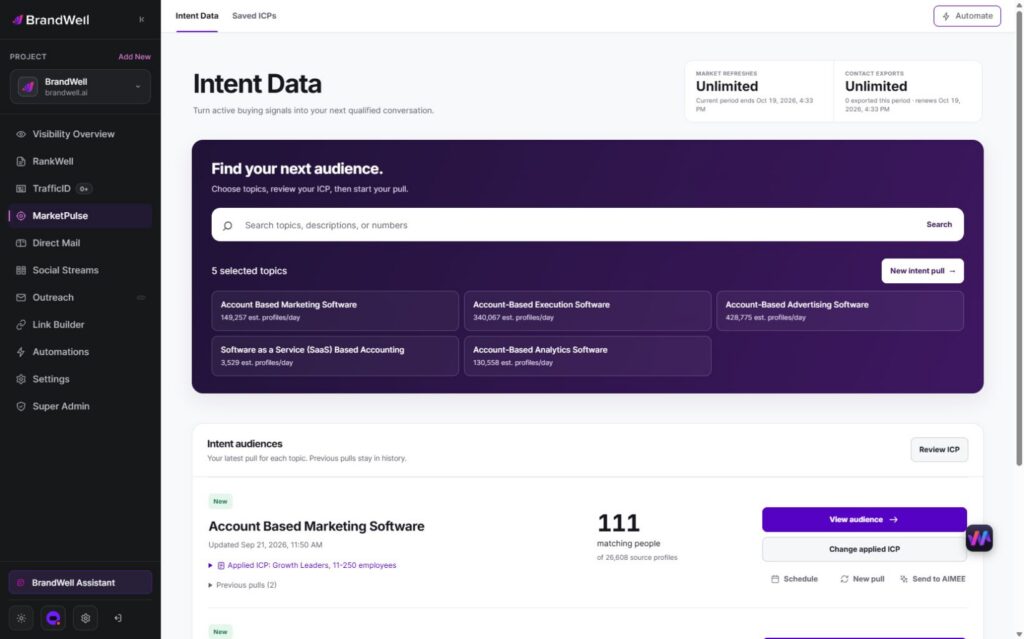
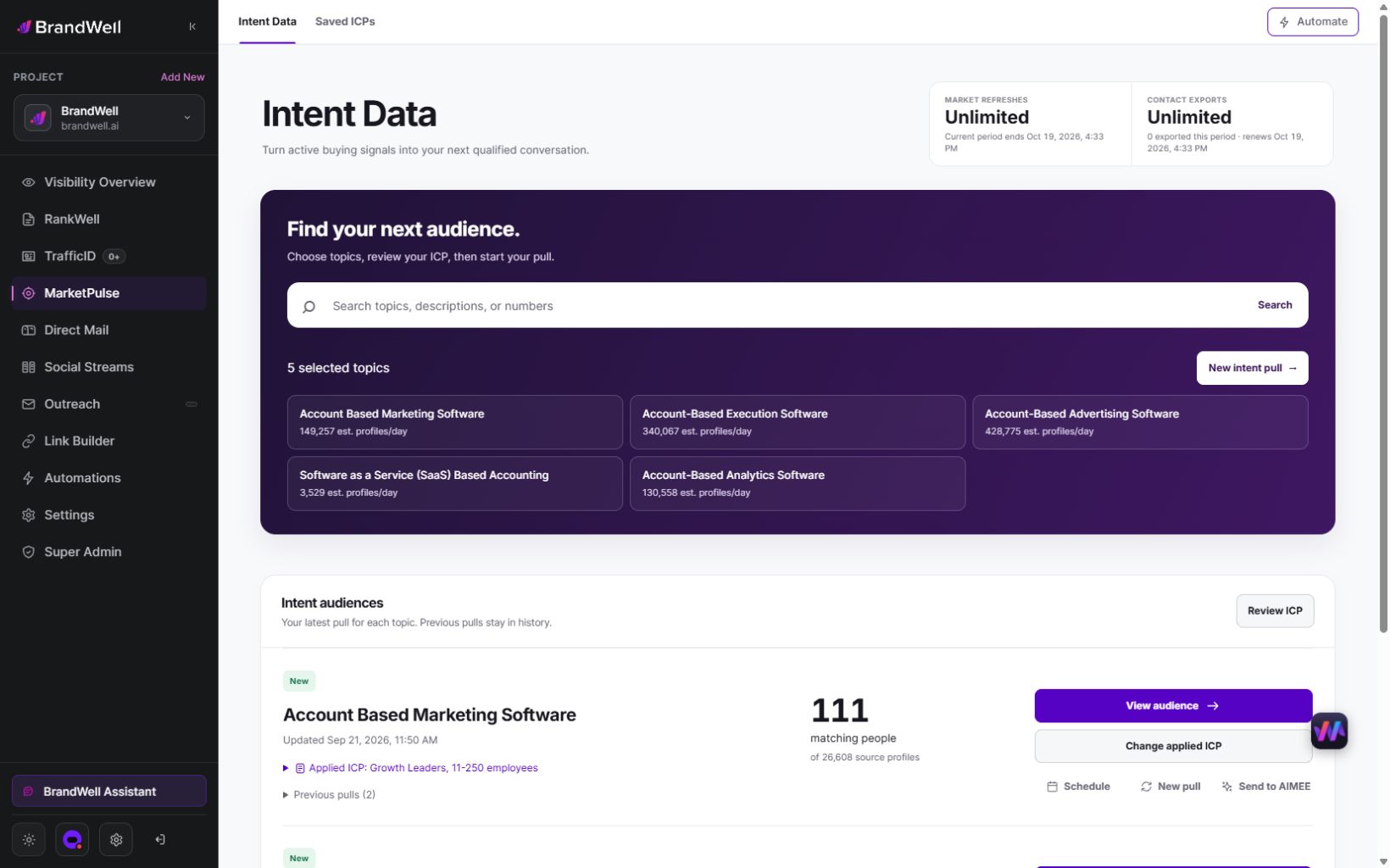
BrandWell MarketPulse: intent data starting at $500/mo. Find people researching topics relevant to what you sell, apply saved ICP filters, and review available contact details before taking action.
| Plan | Topics and refreshes | Monthly exports |
|---|---|---|
| Starter | 1 topic, weekly | 25,000 contacts |
| Growth | 3 topics, daily | 100,000 contacts |
| Scale | 10 topics, daily | Unlimited contacts |
Swipe the table to see all columns.
A pull retrieves available data from the previous 24 hours for one topic. Daily use across all included topics provides 90 Growth pulls or 300 Scale pulls in a 30-day month. Weekly Starter pulls vary by calendar month. Available audience size and contact fields vary, and audiences may overlap. Refreshes stop at the plan limit without overage charges.
- Find and qualify: search the topic catalog, save your ICP, and review the people and companies that match.
- Act on the research: export qualified contacts or prepare an Outreach or Direct Mail workflow. Connected products, channel usage, and fulfillment may cost extra.
- Get help from AIMEE: Growth and Scale include AIMEE for the initial user to research accounts and prepare the next step through connected tools.
Agencies and other service businesses can build client deliverables around their available Intent Scans and exports. Keep each client’s scope, permissions, and service fees clear. A subscription is not a promise of a white-label platform or exclusive access to a market.
Explore MarketPulse and watch the demo or compare plans starting at $500/mo. Any early-access discount is a separate, time-limited offer shown to an eligible recipient.
Separate five cost layers
The price of intent-informed media-mix allocation has at least five layers: data or platform access; implementation and integration; media spend; recurring analysis and campaign operations; and client or internal change management. Price the same channels, topics, records, account markets, users, destinations, service level, and term across vendors. Add creative production, landing pages, conversion operations, and sales follow-up capacity when the workflow depends on them.
BrandWell MarketPulse is topic-based intent-data software for businesses and agencies. Choose relevant research topics, apply saved ideal-customer-profile filters, review available names, roles, companies and contact details, and export the audience or prepare a connected workflow. Plans start at $500/mo. TrafficID identifies visitors to your own website and is a separate product. A MarketPulse subscription does not by itself promise a white-label portal, custom API implementation, exclusive topics, or managed client delivery.
Measure qualified outcomes
Use a metric ladder. Supply metrics include eligible accounts, matchable people, topic recency, and usable audience size. Delivery metrics include reach, frequency, spend, and policy rejections. Quality metrics include valid conversions, target-account rate, sales acceptance, and disqualification reasons. Commercial metrics include qualified opportunities, value, cycle progression, and client retention. Operational metrics include hours per decision, failed activations, and time to rollback.
Pre-register the primary outcome and analysis window. A bounded channel shift can be compared with a contemporaneous control, geo split, account holdout, or phased rollout where feasible. If those designs are impossible, state the attribution limitation. Platform-reported conversions, multi-touch credit, and correlated topic activity help diagnose a program; none alone proves that intent-aware reallocation created the outcome.
Check capacity and stop conditions
This approach fits advertisers with multiple viable channels, enough qualified conversion volume to evaluate, a defined account market, usable outcome data, and permission to activate the proposed audiences. It can also fit agencies that already manage paid media and want a defensible recurring optimization layer. It is a weak fit for a company with one small channel, no reliable CRM stages, tiny audience pools, unreviewed data rights, or sales capacity that cannot act on additional demand.
Common mistakes include moving too much budget at once, treating signal volume as revenue, comparing unequal creative, ignoring match loss, starving a channel’s learning, double-counting the same account across sources, using stale topics, optimizing to cheap forms, and changing several variables without a holdout. Privacy risks arise when person-level data is activated without an eligible purpose, notice, suppression, or platform right. Stop the test for policy rejection, audience collapse, material quality deterioration, unresolved identity errors, or inability to honor deletion and suppression.
Scope a separate agency service
An agency can sell a monthly allocation council rather than a one-time audience build. The service can include signal-supply monitoring, channel-capacity review, one approved marginal shift, an experiment register, creative or offer dependency check, qualified-outcome review, and a client decision memo. Keep data access, audience construction, campaign execution, creative, and measurement as separately scoped responsibilities.
Keep a traceable record of the actual decision, evidence, budget change, result, uncertainty, exceptions and next action. An attribution chart alone does not justify renewal.
Copyable marginal-budget test
Decision: [Bounded amount, origin and destination.] Evidence: [Actual source, topic, period, eligible unit and uncertainty.] Constraints: [Floors, maximum change, rights, reach and actual platform limits.] Comparison: [Existing process, comparable creative and measurement period.] Operation: [Approver, campaign owner and follow-up capacity.] Outcome: [Unique qualified results, missing feedback and full costs.] Decision rule: [Stop, rollback or next bounded test.]
Average cost is not marginal cost
A fictional channel spends $10,000 for 20 qualified opportunities: average media cost is $500 each. The next $2,000 produces only two additional opportunities, making that increment $1,000 each. A second channel’s next $2,000 produces four, or $500 each. Compare actual incremental evidence, opportunity quality, uncertainty and operating cost; the first channel’s historical average does not establish where the next dollar belongs.
An average daily budget is not always a daily ceiling
Google Ads’ spending-limit guidance describes limits of twice the average daily budget and 30.4 times that budget monthly for most campaigns. Verify actual exceptions, dates and changes before using those multipliers.
For a fictional eligible campaign with an unchanged $100 average daily budget throughout a full month, those limits are $200 daily and $3,040 monthly. A $300 weekly planning allocation is not established merely by setting a daily average. Reconcile actual billed costs and the permitted change scope.
Matchable supply does not establish reachable qualified demand
Start with 1,000 fictional source accounts. Six hundred pass the ICP, 300 have eligible identifiers and 150 match the approved destination. Match coverage is 50% of eligible identifiers, 25% of fit accounts or 15% of source accounts. None of those figures establishes actual campaign reach, named researchers or qualified opportunities.
Follow-up capacity can constrain the next spend
Forty fictional accepted accounts require 15 minutes of research and 15 minutes of action each: 20 hours. Twelve qualified operator hours leave an eight-hour gap. More audience supply does not remove that constraint; check actual specialist work, timing, replies and exceptions.
Include the costs outside media
A fictional test costs $2,000 media, $500 research, $400 creative, $300 setup and $400 review: $3,600. Six qualified opportunities make the defined full cost $600 each, versus media-only $333.33. An extra $600 correction cost raises the defined full cost to $700 each. Overhead, tax and financing are excluded. Zero qualified opportunities make the ratio undefined. These invented values are not BrandWell pricing or performance benchmarks.
Use the supported research product
MarketPulse research is starting at $500/mo. Search a relevant topic, save the approved ICP and review actual matches. AIMEE can organize supplied context through configured tools. Owners approve exports, messages, audience uploads and CRM writes. Media buying, budget optimization, experiments and agency delivery need separately verified implementation, rights and fees.
Frequently asked allocation questions
Should the cheapest average channel get more spend?
Compare the next increment’s actual outcomes, quality, capacity and full costs.
Does a stronger research score authorize a budget change?
No. Verify eligible use, reachable supply, owners, comparison and constraints.
Is media-only cost the full cost per opportunity?
No. State research, creative, setup, labor and other actual included costs.
Does MarketPulse move my ad budgets?
Use its supported research as an input; verify separate implementation and approvals.
Review current research: explore MarketPulse and current plans.
Reviewed and updated October 3, 2026.

Written by