Meta broad targeting vs intent seeds is not a one-time audience philosophy. It is an experiment between different inputs and delivery constraints. Use broad delivery when conversion quality is measurable and the platform needs room to learn. Test a seed only when its provenance, rights, matchability, size, recency, and relationship to qualified outcomes pass review. A hybrid can offer guidance without pretending the seed is a hard boundary. Do not assume an offsite intent list is uploadable or that a narrow seed will beat broad.

Who this is for: Meta Ads managers, paid-social directors, demand-generation leaders, RevOps partners, and agency owners comparing broad Meta targeting with first-party, CRM, or eligible intent-informed seed audiences for B2B.

Define what broad, seed, and hybrid actually mean

Broad-only should specify the controls that remain: geography, age where lawful, language if used, placements, exclusions, conversion objective, and any account-level limitations. “Broad” does not mean no settings. Document whether Advantage+ audience is active and which fields are suggestions rather than strict controls.

A seed can be a customer list, high-value CRM group, website/app/offline event audience, or another eligible source. Those paths do not share identical terms. A list of offsite topic-intent records may be licensed for reports or outreach review but not for transfer to an ad platform. Hashing data before upload does not create rights that are missing.

A hybrid uses an eligible seed as a suggestion or starting input while permitting expansion under the campaign’s documented settings. It needs a precise treatment definition. If the platform can deliver outside suggestions, the experiment is not “seed members versus everyone else.” Capture the actual configuration and compare the delivered populations as far as available.

Apply seed eligibility gates before campaign setup

Classify provenance first: eligible first-party CRM/customer data; website, app, or offline event data; licensed/offsite intent; or platform-native behavior. Record fields, collection context, notices, rights, lawful basis, agency authority, advertiser responsibility, permitted use, suppression, deletion, and expiry.

Meta’s Customer List Custom Audiences Terms require the uploader to have necessary rights, permissions, and lawful basis, and an agency needs authority to act for the advertiser. Customer-list data is locally hashed before transfer, but Meta does not disclose the people who comprise the matched audience. The Business Tools Terms govern website, app, and offline event paths rather than the customer-list terms. Verify current terms immediately before setup because platform rules can change.

For licensed or offsite intent data, require explicit written activation rights and current platform-policy approval. Without both, do not upload. Apply opt-out and suppression before hashing. Review geography, regulated categories, special-ad-category rules, audience minimum/configuration, and the current Advertising Standards. These checks are not legal advice; they are stop gates for qualified review.

Build a controlled broad-versus-seed experiment

Pre-register the primary conversion and a downstream-quality measure such as target-account rate, qualification, sales acceptance, or opportunity creation. Use comparable budget, objective, creative, placements, schedule, optimization event, exclusions, and attribution window across cells. Change the audience treatment, not everything at once.

Use three cells when feasible: broad-only, eligible seed-informed, and hybrid. Add a protected geographic, account, or time holdout when the business can support it. Prevent known audience overlap or document it. Set minimum spend and duration based on the conversion volume required for a stable business decision, not a universal benchmark.

Record match or eligible-audience diagnostics without claiming person identity. Also record delivery expansion, reach, frequency, CPM, valid conversions, target-account share, disqualification, opportunity outcomes, and policy errors. Define stop rules for low match, tiny audience, quality degradation, privacy request failure, special-category conflict, platform rejection, or inability to maintain the holdout.

Compare five solution paths using the same criteria

These are operating paths, not company rankings. Apply the same criteria to each: best fit; inputs and prerequisites; implementation effort; governance and risk; cost drivers; measurement; and a meaningful limitation.

1. Broad-only delivery

Best fit: advertisers with enough qualified conversion evidence, a reasonably broad addressable market, strong creative, and clean downstream outcome feedback.

Inputs and prerequisites: an eligible ad account, approved creative, appropriate conversion event, reliable event capture, strict geographic or category controls, exclusions, and sales-capacity alignment.

Implementation effort: the setup is simpler than maintaining many seed audiences, but creative testing, conversion QA, CRM feedback, and budget discipline remain substantial.

Governance and risk: document which controls are strict, review the current platform settings, prevent prohibited categories or discriminatory targeting, and monitor delivery quality rather than assuming broad is neutral.

Cost drivers: media spend, creative volume, event instrumentation, landing experience, agency management, and the conversion volume needed for learning.

Measurement: compare qualified outcome cost, target-account rate, frequency, sales acceptance, and incrementality or holdout evidence when feasible.

Meaningful limitation: broad delivery may spend on many irrelevant consumers or small businesses before the optimizer finds useful patterns, especially in narrow B2B markets with sparse qualified conversions.

2. Eligible first-party seed

Best fit: advertisers with a lawful, well-maintained list of customers, known prospects, subscribers, or another directly collected group related to the objective.

Inputs and prerequisites: clear collection context, documented rights and notices, correct fields, suppression/deletion, recency, enough records to match, advertiser authority, and current customer-list eligibility.

Implementation effort: data extraction, normalization, exclusion, hashing/upload workflow, naming/version control, refresh, and CRM outcome return need owners.

Governance and risk: separate customers from prospects, prevent cross-client use, honor privacy choices, minimize fields, secure exports, and do not use a list beyond the purpose and terms that support it.

Cost drivers: CRM/data operations, privacy review, list maintenance, match loss, media spend, and creative or offer variants.

Measurement: track source records, eligible/matched audience diagnostics, delivery, qualified outcomes, quality, overlap, and the performance of a comparable broad cell.

Meaningful limitation: the seed can reproduce historical customer bias, become stale, or be too small. A match does not reveal which specific person was reached or explain why the platform delivered.

3. Eligible offsite intent seed

Best fit: only when licensed/offsite intent records have explicit written activation rights, current platform-policy approval, appropriate privacy review, sufficient matchable scale, and a use related to the observed topic.

Inputs and prerequisites: source and topic definitions, recency, account/person boundary, permitted-use terms, advertiser/agency authority, suppression, activation-rights confirmation, current Meta eligibility, and an acceptable match estimate.

Implementation effort: provider coordination, identity/enrichment review, list creation, rights documentation, suppression, secure transfer, platform setup, monitoring, and outcome feedback are all required.

Governance and risk: intent and identity are probabilistic; do not imply a named person researched a topic. Do not upload if the provider contract or platform review is ambiguous. Maintain provenance and deletion paths.

Cost drivers: intent data, topic count, identity/enrichment, validation, list operations, legal/platform review, media, and recurring refresh. Match loss can make nominally large lists uneconomic.

Measurement: evaluate eligible records, audience diagnostics, qualified outcome quality, complaints, policy rejection, overlap, and a broad or first-party comparator. Platform attribution is not causal proof.

Meaningful limitation: many offsite intent products are designed for account prioritization or reporting, not transferable person-level advertising audiences. This path is unavailable when rights or current policy approval are missing.

4. High-value CRM seed

Best fit: teams with enough closed-won, high-retention, high-margin, or strongly qualified accounts to create a purposeful seed tied to business value rather than all leads.

Inputs and prerequisites: clean account/contact data, stable value definition, a sufficient lookback, exclusion of bad-fit and disputed records, lawful use, current fields, and an outcome owner.

Implementation effort: finance/RevOps must define value, data teams extract and clean, marketing documents the version, privacy reviews the use, and paid social maintains refresh and exclusions.

Governance and risk: avoid encoding discriminatory or irrelevant historical bias, exclude sensitive fields, separate clients, and document why each CRM state belongs in the seed.

Cost drivers: CRM cleanup, analysis, list refresh, agency operations, creative, media, and the opportunity cost of using a small selective seed.

Measurement: compare qualified account and opportunity outcomes, not merely lead volume. Review whether delivery expands toward similar business value or simply cheaper conversions.

Meaningful limitation: B2B companies often lack enough high-value records for a stable seed. Historical winners can be unrepresentative of the next market, and CRM errors are amplified by modeling.

5. Hybrid test with protected holdout

Best fit: advertisers with adequate budget and conversion volume who want to learn whether an eligible seed provides useful guidance while preserving broad delivery and an independent comparison.

Inputs and prerequisites: an eligible seed, a clearly documented broad cell, equal conversion/creative conditions, overlap controls, sufficient scale, a protected holdout, and downstream outcome capture.

Implementation effort: this is the heaviest path because campaign operations, analytics, RevOps, finance, privacy, and sales must maintain treatment integrity and interpret imperfect delivery.

Governance and risk: record actual expansion behavior, strict controls, audience versions, exclusions, contamination, and every change. Pause if a rights, policy, or suppression issue appears.

Cost drivers: incremental media required to support multiple cells, analytics and holdout design, eligible data, creative parity, agency operations, and longer decision time.

Measurement: pre-register the decision rule and use qualified outcomes, confidence intervals or uncertainty ranges, holdout effects where feasible, and a practical stop/scale threshold.

Meaningful limitation: Meta’s delivery system can blur the conceptual boundary between suggestions and constraints. Small B2B volumes may never support a clean winner, and the correct decision can be “no material difference.”

Budget, tools, and total cost

The test budget must support comparable cells without starving delivery, but there is no universal minimum. Estimate expected qualified conversion volume, audience size, CPM, frequency, and time. Include media, creative, landing pages, pixels/events, CRM work, list operations, data or intent fees, platform/privacy review, analysis, and agency management. A low-fee audience input can create high total cost when it produces no eligible scale.

Tools include Meta Ads Manager and experiments where available, CRM/warehouse exports, secure suppression workflow, event validation, qualified-outcome table, and an experiment register. A template should record provenance, terms path, list version, cell configuration, creative, objective, budget, start/stop, contamination, outcome, and decision.

Where BrandWell fits without confusing product boundaries

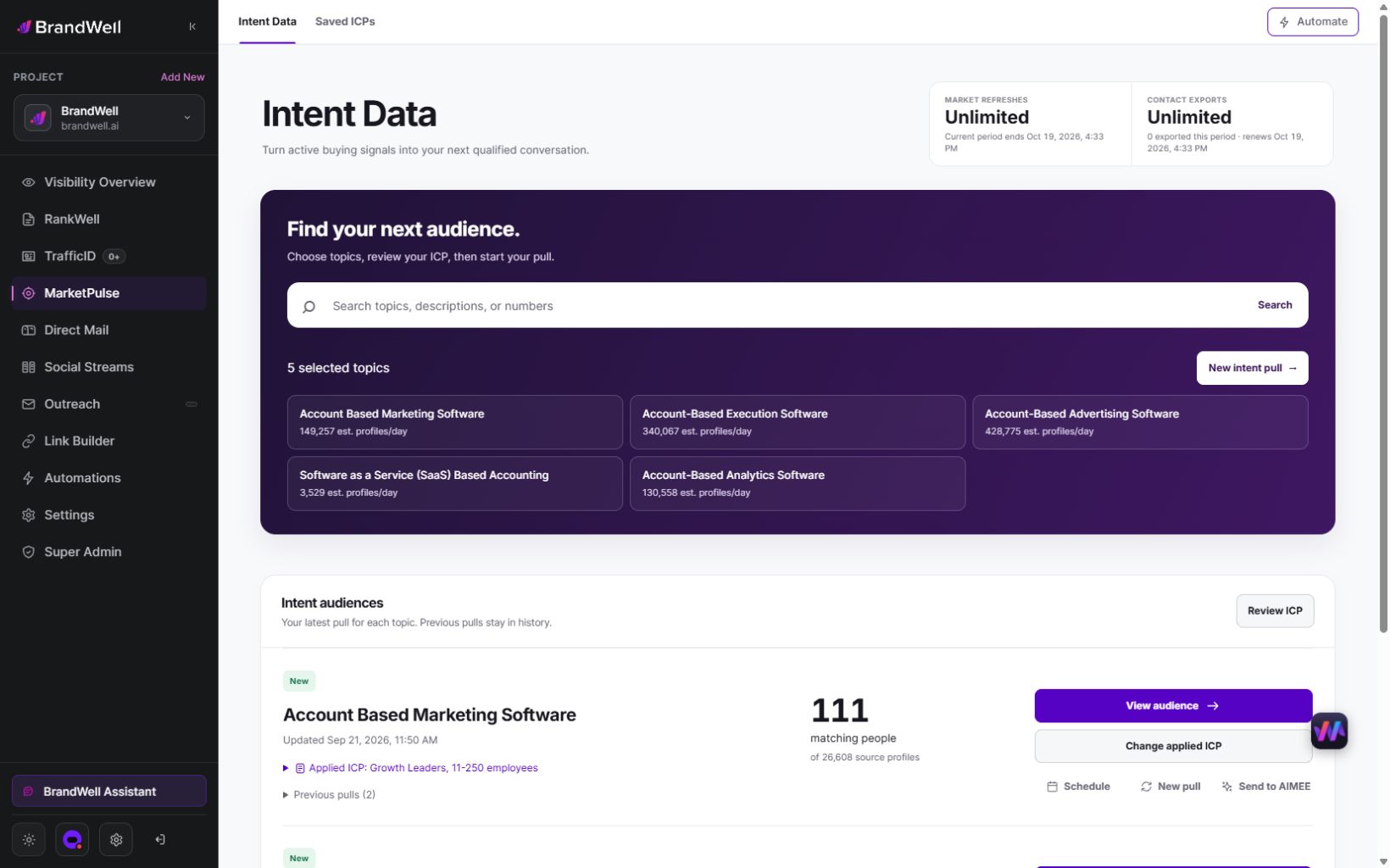
BrandWell can be evaluated as a data, branded-report, and workflow-instruction input for an agency – not as Meta or an ad platform. BrandWell here means the separate agency-reseller intent-data offer, not the legacy BrandWell SEO writer. LeadFuze is the underlying data infrastructure for enrichment and identity-related inputs. Identity, visitor, person, account, and intent evidence is probabilistic, not proof of identity or purchase intent.

The BrandWell-provided direction includes a complete white-label sales-and-delivery engine, agency-controlled retail pricing and client billing, and a $70 seven-day reseller pilot for branded topic reports; every component remains subject to current written product review. BrandWell can also provide BrandWell-provided agent-ready workflow instructions for Claude and ChatGPT. Moxby is a separate browser-first product and an optional execution path; it is not part of BrandWell’s product identity.

BrandWell agency plans range from $2,500 to $5,000 per month, depending on topic count, term, and available contractually scoped topic exclusivity. The current written quote and Order Form control. The lower planning point is $2,500 per month, not a published starting price. Before operational use, complete product, pricing, privacy, security, compliance, legal, and platform-policy review. Topic exclusivity is not guaranteed. None of this establishes that an offsite intent audience may be uploaded to Meta. Written data rights, platform eligibility, suppression, advertiser authority, and qualified review govern each activation.

Diagnose outcomes before changing the audience treatment

If broad delivery produces cheap leads but few target accounts, first verify the conversion event, creative promise, landing form, geography, placements, and CRM classification. The audience may be the issue, but a weak optimization event can teach the system to find the wrong response. Tightening the seed without fixing the event can produce a smaller version of the same problem.

If a first-party or CRM seed fails to spend, inspect source count, usable fields, recency, suppression, match diagnostics, audience configuration, bid and budget, and overlap. Do not add questionable offsite records merely to make the audience larger. If it spends but quality is poor, inspect the business-value definition and historical bias in the seed.

If an eligible intent seed reports strong platform conversions but no qualified pipeline, audit account fit, topic meaning, lookback, identity association, offer, and downstream matching. A surge can be real research and still be unrelated to an active buying project. The right response may be a lower-friction offer or an account-prioritization workflow rather than paid activation.

If the hybrid resembles broad, document whether expansion made the seed only a suggestion. If it resembles the seed, inspect whether budget or audience size constrained exploration. When the cells cannot be distinguished, report the design limitation instead of assigning a winner. The point of the test is a defensible decision, not a mandatory claim that intent improves Meta.

Create a reusable agency runbook

The runbook should contain a provenance form, rights and authority checklist, suppression procedure, audience-version log, campaign cell specification, creative parity check, conversion-event QA, holdout map, downstream-quality export, incident and policy escalation, and final decision memo. Each artifact needs an owner and an expiry or refresh trigger.

Before launch, a second reviewer should reproduce the audience version from the record and confirm that the files, fields, exclusions, and terms path match. After launch, a weekly reviewer checks delivery expansion, match or audience diagnostics, frequency, quality, privacy requests, and platform notices. At close, the analyst locks the window, reconciles CRM outcomes, and states uncertainty.

This structure allows an agency to repeat broad-versus-seed testing without reusing client data or assuming yesterday’s platform setting still applies. It also creates a clear boundary between the BrandWell data and workflow layer, the advertiser’s data rights, Meta’s platform rules, and the agency’s campaign operation.

Decide what to test first at each maturity level

An early B2B advertiser with sparse conversion history should first repair measurement, define qualified outcomes, and test creative under a controlled broad setup. A seed cannot compensate for an event that rewards the wrong lead. If the market is extremely narrow, the advertiser may need a higher-volume proxy event, but the team must keep the downstream-quality audit and avoid presenting proxy optimization as pipeline success.

A team with a clean prospect or customer list can next test an eligible first-party or high-value CRM seed. The goal is not to declare first-party data inherently superior; it is to learn whether a well-defined business group changes delivery and qualified outcomes. Maintain a broad comparator, version the source, and refresh suppressions before each upload.

A mature advertiser can consider an eligible intent-informed input after the first-party path and policy review are stable. The intent test should answer a specific question: does recent topic evidence add value beyond account fit, CRM status, or broad optimization? If the data is licensed only for research reports or sales prioritization, use it there instead of forcing an ad audience.

Agencies managing multiple clients should not share seeds, learned exclusions, raw records, or audience artifacts between accounts. Reuse the runbook and analysis method, not client data. Set minimum evidence standards for proceeding: complete provenance, written rights, current platform eligibility, suppression, sufficient scale, primary outcome, downstream-quality access, and a named decision owner. A failed gate produces a documented no-launch decision, which is a valid service outcome.

Review the test at three moments. At setup, confirm that the intended difference between cells exists. Mid-flight, look only for integrity, safety, delivery failure, or a pre-registered stop condition; do not chase normal daily noise. At close, reconcile platform events with the CRM before interpreting cost or quality. Preserve inconclusive results so the next campaign does not repeat an underpowered design. This cadence gives Meta room to deliver while keeping the advertiser’s business definition – not the easiest platform conversion – as the final decision standard.

Measure qualified pipeline and make a decision

Primary metrics should reach past platform conversions: target-account rate, valid qualification, sales acceptance, meeting completion, opportunity creation, value, and disqualification reason. Supporting metrics include eligible source records, audience diagnostics, reach, frequency, CPM, conversion rate, and cost. Risk metrics include rejected audiences, privacy requests, match corrections, special-category conflicts, and failed suppressions.

Do not declare a winner because one cell reports a lower cost per lead. Determine whether the difference persists in qualified outcomes and whether uncertainty is tolerable. If the seed cell is too small, broad quality is poor, or the holdout is contaminated, report “inconclusive” and revise the design.

Package a recurring agency testing service

An agency can sell a controlled monthly audience-testing cycle: eligibility review, audience versioning, broad/seed/hybrid setup, creative parity, conversion QA, downstream-quality reporting, policy check, and next decision. Scope data licensing, media, creative, web work, CRM cleanup, and platform appeals separately. The advertiser owns data rights and final approval; the agency documents authority and execution.

Start with the eligible first-party or high-value CRM path before an offsite intent upload. Keep a broad cell and a real stop rule. If no one can show the seed’s provenance, lawful use, platform eligibility, suppression path, and version, it is not ready for a campaign – regardless of how “in-market” the records appear.

What agencies receive in the $70 pilot

The BrandWell reseller pilot costs $70 and runs for seven days. During that window, BrandWell creates agency-branded topic reports and supplies the complete sales playbook the agency can use to present the offer and seek client commitments before choosing a full plan.

This gives the agency a practical way to test demand, compare expected commitments with its costs, and decide whether the service can operate as a profit center. No client commitment, cost coverage, or profit outcome is guaranteed. Review the $70 seven-day reseller pilot.