On this page
- Separate context from prior research
- Check eligibility and campaign behavior
- Define the operating records
- Use current research within scope
- Compare the full cost boundary
- Measure qualified outcomes and overlap
- Check prerequisites and failure cases
- Work through an actual decision
- Scope separate agency delivery
- Compare four targeting cells
- Copyable evidence-model test
- Frequently asked targeting questions
Contextual targeting uses the content environment; buyer-intent targeting uses prior research evidence to define or prioritize an audience. Compare the actual source, unit, eligible use, platform behavior, reachable supply and qualified outcomes. Neither method establishes identity or buying readiness, and a smaller audience does not guarantee better results.
Who this is for: programmatic media directors, ABM leaders, paid-media directors, demand-generation teams, and agency owners evaluating contextual targeting vs buyer intent targeting for B2B. The decision is about evidence models and experiments – not a generic list of DSP features.
Current MarketPulse offer: intent-data plans start at $500/mo. See the product, demo, and current plans. Updated October 3, 2026.
Separate context from prior research
Context answers “what is this page or content environment about right now?” Intent answers “what research evidence has this account or candidate produced over a defined period?” They can overlap, but they are not interchangeable. A professional reading an article about cloud security creates a contextual opportunity. Associating earlier research with an account creates an intent hypothesis. Neither proves who the person is, whether they control a budget, or whether the company will buy.
Test context, prior research and a supported hybrid against a suitable baseline. Check the actual content relevance, identity requirements, permitted purpose, match loss, exclusions and campaign behavior before choosing a cell. Do not assume every platform combines selections as an intersection.
Manual or non-intent targeting still belongs in the comparison. A carefully built account list, first-party retargeting pool, direct publisher buy, or broad control may outperform a weak third-party intent segment. The decision guide should retain a baseline that does not depend on the new signal.
Check eligibility and campaign behavior
First define a contextual taxonomy: included concepts, excluded concepts, page-quality rules, language, geography, inventory type, and brand-safety constraints. Separately define the intent evidence: source class, topic, lookback, baseline, account association, confidence, refresh, expiry, eligible use, and suppression. Do not treat keyword strings as a shared ontology until a human maps them.
Forecast actual qualifying inventory, bids, formats, geography, content controls, source coverage, matches and audience minimums. A deliberately intersected hybrid can reduce supply, but first verify that the actual platform uses the intended intersection rather than combining content targets more broadly.
Then create three or four comparable cells: context-only, intent-only, hybrid, and a baseline or holdout. Use the same objective, offer, creative family, window, conversion definition, and downstream qualification when practical. Set frequency, exclusion, overlap, and contamination rules. Return CRM outcomes and rejection reasons. The team needs programmatic operations, data/RevOps, creative, analytics, sales feedback, and privacy/platform review for any identity-based activation.
Define the operating records
A useful kit includes a context taxonomy brief, intent-source card, identity and match ladder, audience overlap worksheet, inventory and eligibility forecast, creative-to-cell map, experiment register, frequency budget, qualified-outcome definition, and stop/scale decision. The tools are secondary to the fields. If a platform cannot expose source, recency, eligible population, overlap, cost, and outcome return, it is difficult to compare honestly.
Managed media or research activation requires separately scoped inventory checks, source QA, approvals, suppressions, implementation, reporting and feedback. Verify the actual delivery and client responsibilities; a subscription does not establish native agency branding or a managed advertising service.
Use current research within scope
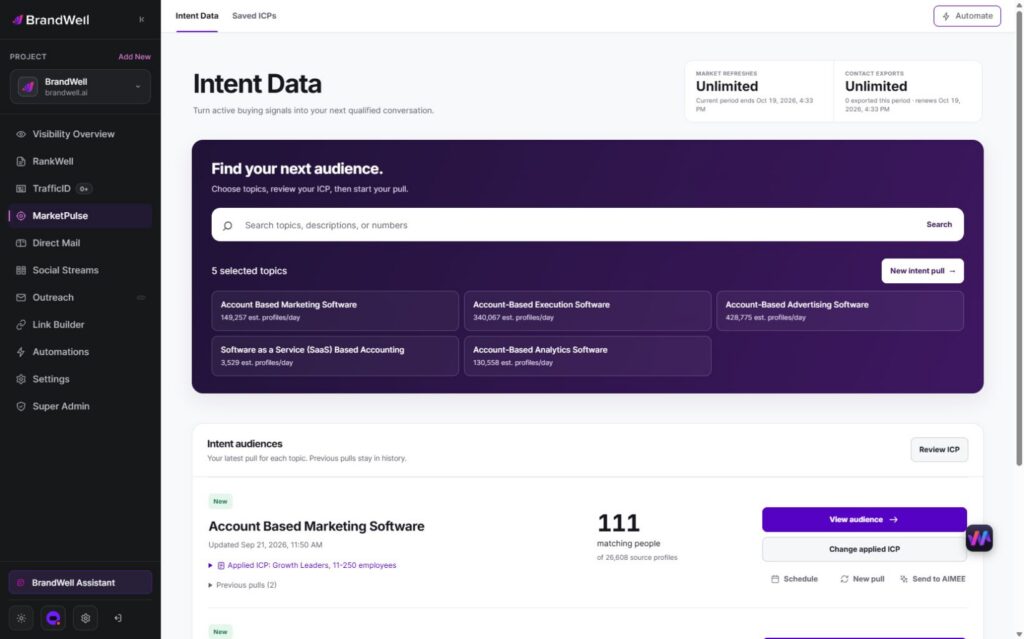
Use MarketPulse research as one approved input to an independently implemented comparison. Verify actual evidence, unit, source age, permitted activation, eligible reach, implementation, costs and outcomes.
Current MarketPulse research workflow
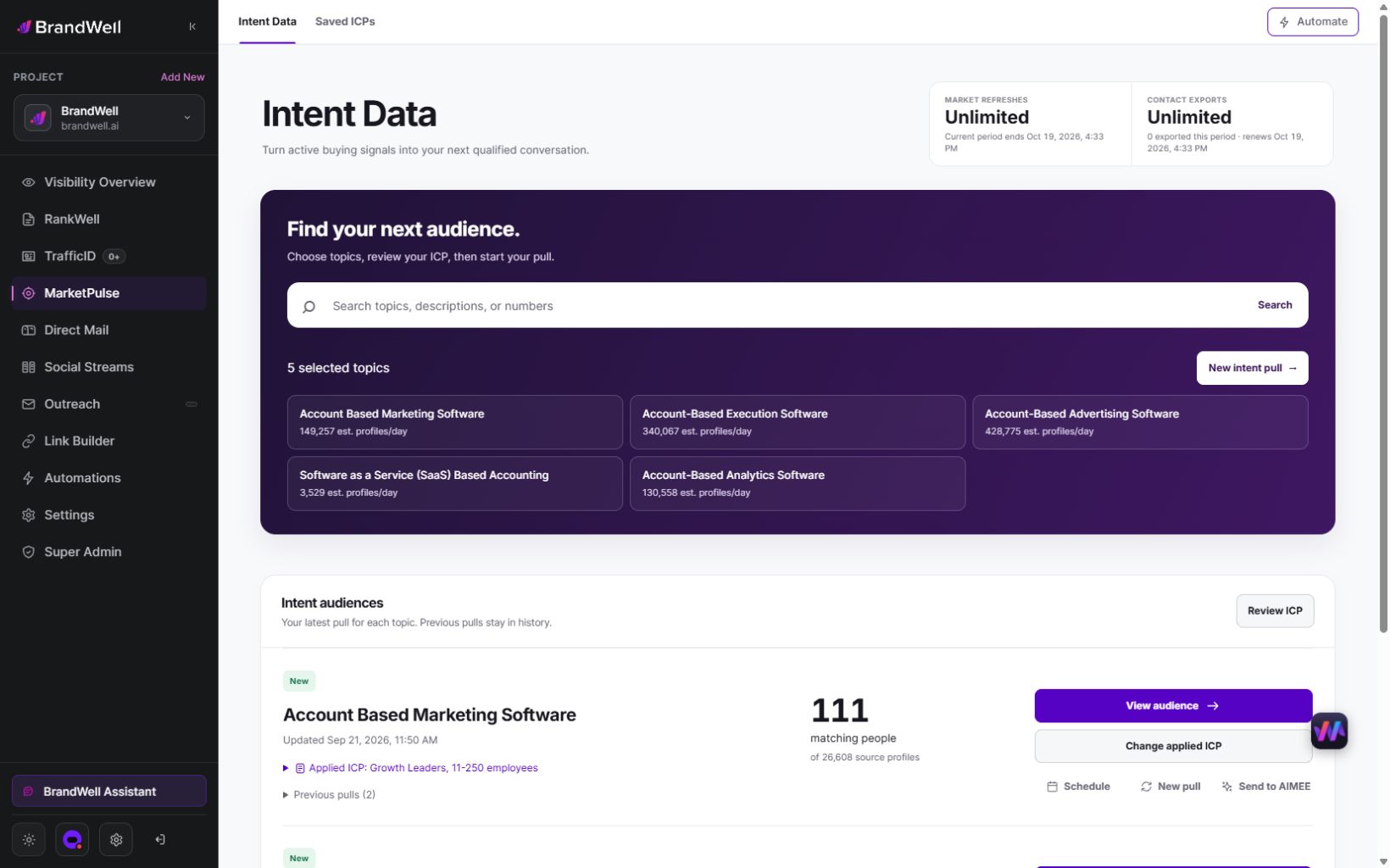
BrandWell MarketPulse: intent data starting at $500/mo. Find people researching topics relevant to what you sell, apply saved ICP filters, and review available contact details before taking action.
| Plan | Topics and refreshes | Monthly exports |
|---|---|---|
| Starter | 1 topic, weekly | 25,000 contacts |
| Growth | 3 topics, daily | 100,000 contacts |
| Scale | 10 topics, daily | Unlimited contacts |
Swipe the table to see all columns.
A pull retrieves available data from the previous 24 hours for one topic. Daily use across all included topics provides 90 Growth pulls or 300 Scale pulls in a 30-day month. Weekly Starter pulls vary by calendar month. Available audience size and contact fields vary, and audiences may overlap. Refreshes stop at the plan limit without overage charges.
- Find and qualify: search the topic catalog, save your ICP, and review the people and companies that match.
- Act on the research: export qualified contacts or prepare an Outreach or Direct Mail workflow. Connected products, channel usage, and fulfillment may cost extra.
- Get help from AIMEE: Growth and Scale include AIMEE for the initial user to research accounts and prepare the next step through connected tools.
Agencies and other service businesses can build client deliverables around their available Intent Scans and exports. Keep each client’s scope, permissions, and service fees clear. A subscription is not a promise of a white-label platform or exclusive access to a market.
Explore MarketPulse and watch the demo or compare plans starting at $500/mo. Any early-access discount is a separate, time-limited offer shown to an eligible recipient.
Compare the full cost boundary
Contextual advertising pricing can include media CPM/CPC/CPE, platform or seat fees, managed-service fees, creative, data, brand-safety or measurement products, and agency operations. Intent targeting can add topic/data licensing, identity or enrichment, validation, audience onboarding, match loss, activation connectors, and recurring signal QA. A hybrid includes both and may reduce reachable volume.
Build base, expected, and high-complexity cases. Price the same geography, inventory, accounts, topics, users, media, service, integrations, and term. A low platform fee is not a low total cost if the agency must assemble the rest. Conversely, an enterprise suite may be poor value when the buyer needs only a contextual test.
Measure qualified outcomes and overlap
The primary comparison should be qualified outcomes per eligible opportunity, not CTR alone. Record eligible accounts, matched audience, contextual impressions, overlap, reach, frequency, valid conversions, target-account rate, sales acceptance, qualified opportunities, and cost. Add brand-safety incidents, policy rejection, data corrections, and operator hours.
Use context-only, intent-only, hybrid, and baseline cells when volume permits. Prevent overlap or measure it. Keep creative and offer comparable. If platform delivery expands or inventory differs, document the actual treatment rather than claiming a perfect test. Attribution reports can explain observed paths; they do not prove the targeting caused the outcome.
Check prerequisites and failure cases
Compare actual context-only, research-only, supported hybrid and baseline cells against the decision. Check content relevance, source quality, identity use, reach, delivery, capacity and qualified outcomes. Preserve a comparison when either source is weak rather than assuming one method is best.
Avoid mislabeled topics, stale lookbacks, tiny intersections, unequal creative, unchecked inventory, account-to-person overreach, repeated frequency, double-counted conversions, and sales teams that cannot use the result. Do not activate licensed/offsite data without written rights and current platform review. Maintain suppression and deletion. Treat inferred interest as sensitive context, not certainty.
Work through an actual decision
Consider a security-software advertiser with a defined enterprise account list, a strong educational guide, and limited historical conversion volume. Contextual inventory around a narrow technical issue may offer enough scale, while the available account-intent segment is recent but small. The first experiment should not force the two together. Run context-only against the existing baseline, preserve account-quality measurement, and separately validate the intent pool’s match and permitted-use path. A hybrid can wait until both components are individually understood.
Now consider a mature category with many eligible accounts, reliable CRM stages, and sufficient paid conversion volume. An intent-only cell can test whether prior research evidence improves account quality, while a context-only cell tests relevance without identity dependence. The hybrid asks whether the intersection adds incremental value after higher CPMs and lower reach. The decision may favor different models for different objectives: contextual for education, intent for account acceleration, and broad reach for a control.
Document the conclusion in plain language: what evidence defined each cell, which accounts were eligible, how overlap was handled, what qualified outcome changed, what remained uncertain, and what the next dollar will do. This worked-example discipline is more useful than a generic contextual targeting benchmark because it exposes the assumptions that make one tactic fit a specific advertiser.
Scope separate agency delivery
An agency can deliver a monthly evidence-model review: taxonomy maintenance, intent-source QA, reachable-supply forecast, context/intent/hybrid experiment, inventory and match diagnostics, qualified-outcome analysis, and one next decision. Separate media spend, platform, data, creative, and agency fees. Define who owns audience rights, account setup, pixels/events, suppressions, platform appeals, and CRM feedback.
Start with one market, one topic family, one offer, and a baseline. The client should receive a decision memo that states what each cell actually represented, what the data could not prove, and whether to scale, revise, or stop.
Compare four targeting cells
| Cell | Evidence | Check before launch |
|---|---|---|
| Context | Current content environment | Actual inventory, exclusions and campaign support |
| Prior research | Approved source and observation period | Unit, fit, matches, rights and minimums |
| Hybrid | Both criteria with stated logic | Intersection or union, overlap and reach |
| Baseline | Defined existing approach | Comparable scope, creative and outcomes |
Swipe the table to see all columns.
Copyable evidence-model test
Decision: [Actual comparison and business question.] Unit: [Account, user, impression or other eligible unit.] Evidence: [Content taxonomy, research source, topic and period.] Logic: [Actual platform inclusion, exclusion and overlap behavior.] Operation: [Approval, recipient, purpose, owner and capacity.] Outcome: [Exposure, qualification, missing feedback and full costs.] Decision rule: [Uncertainty, contamination and stop or expansion criteria.]
Multiple content targets may broaden reach
Google Ads’ contextual-targeting guidance describes content matching any selected topics, placements or keywords and restrictions for video conversion campaigns. Verify your actual campaign support and combination logic. Do not describe an intended intersection as what the platform delivered without checking it.
Union and intersection produce different populations
In a fictional population, 1,000 units meet the contextual criterion and 200 meet the research criterion; 80 meet both. Their union is 1,120, while the intersection is 80. The intersection is 40% of the research set and 8% of the contextual set. These arithmetic sets do not establish platform match, actual delivery or qualified buyers.
Do not compare impressions with accounts
A fictional contextual cell delivers 100,000 impressions and five qualified opportunities; a research cell exposes 500 unique accounts and creates six opportunities. Dividing by these different units does not produce comparable opportunity rates. Reconcile actual unique units, periods, exposure, repeat frequency and missing outcomes first.
Price the defined cost boundary
A fictional test costs $500 research, $1,000 media, $400 creative, $400 setup and $300 QA: $2,600. Six qualified opportunities make the defined cost $433.33 each. An extra $400 correction cost makes it $500 each. Overhead, tax and financing are excluded; zero opportunities make the ratio undefined. These invented costs are not BrandWell pricing or typical performance.
Use research without assuming native media activation
MarketPulse research is starting at $500/mo. Search a relevant topic, save the approved ICP and review actual matches. AIMEE can organize supplied context through configured tools. Owners approve exports, messages, audience uploads and CRM writes. Contextual media buying, experiments and custom agency delivery need separately verified implementation, rights and fees.
Frequently asked targeting questions
Is contextual targeting automatically free of identity use?
No. Review the actual platform, implementation, tracking and permitted purpose.
Does adding criteria always narrow reach?
No. Verify whether the actual settings use a union, intersection or other delivery logic.
Does the smallest audience have the best intent?
No. Assess evidence quality, delivery, qualified outcomes and costs.
Does MarketPulse provide the media experiment?
Use its supported research as an input; verify separate media implementation and permissions.
Review current research: explore MarketPulse and current plans.
Reviewed and updated October 3, 2026.

Written by