On this page
- Current MarketPulse research workflow
- Define the evidence and its limits
- Keep four signal classes separate
- Compare five operating paths
- Use nine review and action steps
- Separate fit, identity and outcomes
- Budget five cost categories
- Measure quality and business results
- Check actual operating prerequisites
- Test a representative cohort
- Resolve risk before activation
- Scope separate agency delivery
- Use an explicit decision sequence
- Copyable buyer-intent evidence card
- Frequently asked buyer-intent questions
B2B buyer intent data is research or engagement evidence that can help prioritize investigation. Preserve its actual source, topic, observation unit, fit, age and uncertainty. An account signal, visitor match or contact record does not establish buyer authority, budget, purchase timing or permission to send a message.
Who this is for: CMOs, CROs, demand-generation leaders, RevOps teams, sales leaders, agency owners, and consultants deciding whether buyer-intent evidence belongs in their go-to-market system. This guide covers the category-level decision. It does not treat a score, website match, or topic surge as proof of identity, a hand raise, or a future purchase.
Current MarketPulse offer: intent-data plans start at $500/mo. See the product, demo, and current plans. Updated October 3, 2026.
Current MarketPulse research workflow
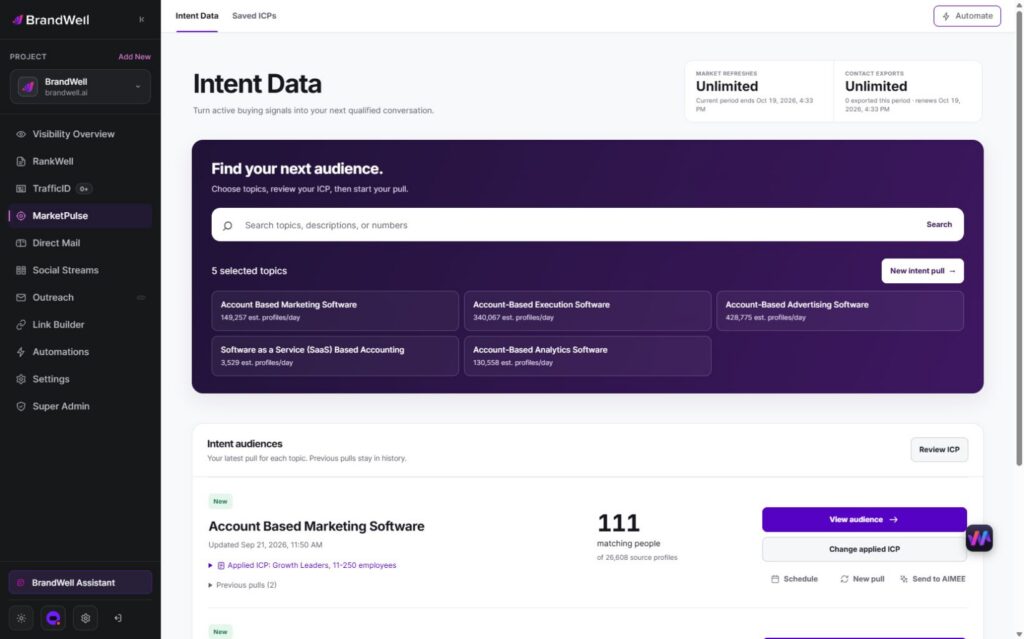
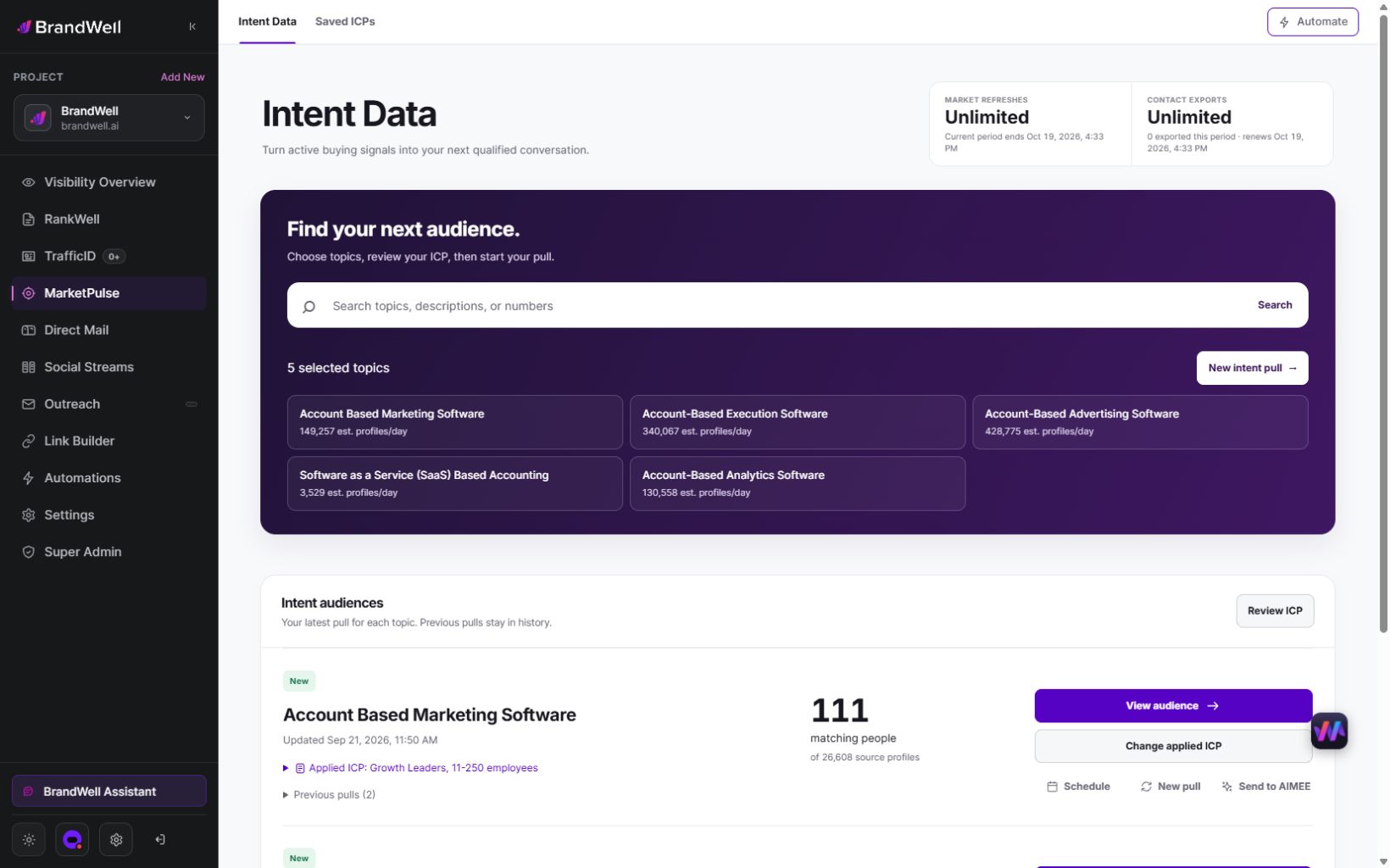
BrandWell MarketPulse: intent data starting at $500/mo. Find people researching topics relevant to what you sell, apply saved ICP filters, and review available contact details before taking action.
| Plan | Topics and refreshes | Monthly exports |
|---|---|---|
| Starter | 1 topic, weekly | 25,000 contacts |
| Growth | 3 topics, daily | 100,000 contacts |
| Scale | 10 topics, daily | Unlimited contacts |
Swipe the table to see all columns.
A pull retrieves available data from the previous 24 hours for one topic. Daily use across all included topics provides 90 Growth pulls or 300 Scale pulls in a 30-day month. Weekly Starter pulls vary by calendar month. Available audience size and contact fields vary, and audiences may overlap. Refreshes stop at the plan limit without overage charges.
- Find and qualify: search the topic catalog, save your ICP, and review the people and companies that match.
- Act on the research: export qualified contacts or prepare an Outreach or Direct Mail workflow. Connected products, channel usage, and fulfillment may cost extra.
- Get help from AIMEE: Growth and Scale include AIMEE for the initial user to research accounts and prepare the next step through connected tools.
Agencies and other service businesses can build client deliverables around their available Intent Scans and exports. Keep each client’s scope, permissions, and service fees clear. A subscription is not a promise of a white-label platform or exclusive access to a market.
Explore MarketPulse and watch the demo or compare plans starting at $500/mo. Any early-access discount is a separate, time-limited offer shown to an eligible recipient.
Define the evidence and its limits
Intent data can make an existing revenue decision more informed. It can show that an account appears to be researching a relevant topic, that an already known visitor returned to a high-value page, that several people associated with an account engaged with first-party material, or that a target account’s activity changed relative to an expected baseline. Each signal has a different unit, source, and uncertainty.
The word intent is easy to overread. Topic research can come from a student, competitor, consultant, employee, job candidate, existing customer, or automated process. Account resolution can be incomplete when people work remotely, use privacy tools, or browse through shared networks. A person record can be stale. Even an accurate event does not reveal authority, budget, urgency, or preference. The responsible claim is therefore narrow: the evidence may justify account research, prioritization, a different message, or a controlled test.
Treat explicit actions separately. A demo request, pricing inquiry, reply, product signup, or meeting request is a direct hand raise. An inferred signal may enrich the context around that action, but it should not silently overrule it. A strong B2B buyer intent data strategy preserves this evidence hierarchy instead of compressing unlike events into one unexplained score.
Keep four signal classes separate
First-party engagement comes from properties the company operates: website sessions, form submissions, webinars, product activity, email responses, content downloads, and customer interactions. It can be close to the business, but anonymous traffic, cookie limits, shared devices, and inconsistent event design create gaps.
Third-party topic research is observed outside the company’s owned properties and associated with an account, device, cohort, or other unit. It can reveal demand that has not reached the website. Its value depends on source coverage, topic definition, baseline, refresh, expiry, identity method, and permitted use. It is not a transcript of a named person’s searches.
Identity and enrichment evidence associates a visitor, domain, account, or person candidate with company and contact attributes. It helps an operator find a plausible buying group and validate fit. Because resolution is probabilistic and coverage varies, retain confidence, source, timestamp, validation state, and a no-match outcome.
Commercial and lifecycle evidence comes from CRM stages, opportunity history, customer health, support interactions, renewals, and disqualification reasons. This is not usually called intent data, yet it is essential context. A current customer researching a topic may need enablement or expansion support rather than cold acquisition outreach.
The practical B2B buyer intent data framework is not “more signals are better.” It is “use the smallest evidence set that changes a defined decision and can be reviewed afterward.”
Compare five operating paths
Compare each operating path against actual inputs, eligible use, implementation, owners, full costs, measurable outcomes and limitations.
1. First-party engagement-led evidence
Operating prerequisites and exclusions: This path fits companies with meaningful website, product, event, email, or customer traffic. It is a poor starting point when the owned audience is too small or event tracking is unreliable.
Inputs, effort, governance, and cost: It requires a sound event taxonomy, consent and notice review, account and contact records, CRM destinations, suppressions, and people who can investigate important actions. Cost is driven by analytics, enrichment, identity resolution, integration, data cleanup, and operating labor rather than a single license.
Measurement and limitation: Measure known-event completeness, accepted account actions, qualified meetings, opportunity progression, and time saved. The main limitation is reach: first-party evidence sees only activity that touches the company’s properties or systems.
2. Third-party topic-research evidence
Operating prerequisites and exclusions: This path is useful when the total market researches a well-defined problem before visiting vendor sites. It is weak when the topic is vague, the market is tiny, or the buying event is hard to distinguish from general curiosity.
Inputs, effort, governance, and cost: Teams must define topics, account criteria, lookback, baseline, source coverage, refresh, expiry, and allowed uses. Cost can vary with topics, volume, destinations, history, support, and contract scope. The buyer needs a representative sample and negative cases, not only a polished demo.
Measurement and limitation: Measure usable account evidence, seller acceptance, incremental engagement, qualified pipeline, and rejection reasons. The limitation is attribution: topic activity associated with an account does not identify a specific researcher or prove a purchase process.
3. Website-visitor identity and enrichment
Operating prerequisites and exclusions: Use this when anonymous traffic is material and sales or marketing has a defensible action after a likely company or person-candidate match. Do not use it to turn every page view into automated outreach.
Inputs, effort, governance, and cost: The workflow needs traffic volume, match methodology, confidence, enrichment, validation, suppression, first-party context, destination fields, and human review. Review notice, purpose, access, retention, deletion, and jurisdiction before activating personal data.
Measurement and limitation: Track match yield separately from match correctness, accepted records, rejected records, qualified conversations, complaints, and deletion handling. The limitation is uncertainty: a resolved company is not the same as a known visitor, and a plausible contact is not proof of who browsed.
4. Enterprise ABM-suite operating model
Operating prerequisites and exclusions: A suite can fit a mature revenue organization that wants account intelligence, scoring, advertising, orchestration, and sales workflows in a coordinated environment. It can be excessive for a narrow use case or a team without clean CRM data and operating owners.
Inputs, effort, governance, and cost: Expect data mapping, model configuration, integrations, seats, audience activation, enablement, governance, services, and change management. A quote should identify each module and usage unit. The internal implementation cost can be as important as the platform price.
Measurement and limitation: Measure adoption and downstream business decisions, not dashboard activity. The limitation is complexity: a broad feature set does not create a working process when ownership, thresholds, and feedback are unclear.
5. Agency-reseller or managed-service operating model
Operating prerequisites and exclusions: This path suits agencies, GTM consultants, and lean revenue teams that want an operator to package topic selection, data review, reporting, activation, and iteration. It is a poor fit when the client requires direct control over every model, contract, and infrastructure component.
Inputs, effort, governance, and cost: The service needs client-specific ICPs, topics, data rights, approval rules, destinations, deliverables, retail economics, and separation between clients. Total cost includes wholesale platform scope, agency labor, integrations, media or outreach, support, and client reporting.
Measurement and limitation: Track usable evidence, accepted actions, client adoption, qualified outcomes, gross margin, and renewal evidence. The limitation is dependency: the client must understand which decisions belong to the provider, agency, and client rather than treating the service as a black box.
Use nine review and action steps
A B2B buyer intent data implementation guide should begin with one decision. Examples include which accounts deserve research today, which known visitors receive a higher-touch nurture path, which paid audience enters a controlled test, or which customer receives an expansion review. Avoid a vague objective such as “use intent to grow pipeline.”
Build the workflow in nine steps:
- Define the decision and owner. Name the action, eligible population, reviewer, and service-level expectation.
- Write the signal contract. Record the unit, source class, topic or event, baseline, recency, refresh, expiry, and uncertainty.
- Apply the fit gate. Require the account, client, geography, size, technology, or other defensible ICP criteria.
- Resolve the identity boundary. State whether the record is an account, anonymous visitor, known contact, or person candidate.
- Enrich and validate. Add only fields required for the decision; preserve validation and no-match states.
- Suppress and govern. Remove customers, competitors, employees, prior opt-outs, duplicates, restricted territories, or other defined exclusions.
- Route with evidence. Put source, timestamp, reason, uncertainty, and next action into the CRM or operating queue. Do not send only a score.
- Require human judgment where harm is plausible. Outreach, spend, customer treatment, and public action deserve an approval boundary.
- Return outcomes. Capture accepted, rejected, contacted, replied, qualified, opened, won, lost, and the reason for each important rejection.
Useful B2B buyer intent data templates include a signal dictionary, data-flow map, field specification, suppression register, routing matrix, seller brief, pilot charter, cost model, and outcome scorecard. A spreadsheet can be enough for a pilot. Automation becomes valuable only after the policy is stable.
Separate fit, identity and outcomes
Fit and intent answer different questions. Firmographic fit asks whether the account resembles a customer the business can serve. Engagement asks what happened on owned properties. Intent adds evidence about research or changing activity. Identity determines the unit that can be acted on. Freshness says whether the evidence still belongs in the decision window. Outcomes show whether the action helped.
Use a decision record rather than one blended number:
- Account fit: included, excluded, or needs review, with the rule that decided it.
- Signal evidence: source class, topic or event, observed time, baseline, recurrence, and expiry.
- Identity state: account, visitor, known contact, or candidate, with confidence and validation.
- Action eligibility: allowed destination, suppression state, channel rules, and approval owner.
- Business result: accepted action, opportunity state, revenue outcome, or explicit rejection reason.
Compare actual fit rules, owned engagement, contact lists and research as different inputs. Check scope, implementation, timing and full costs. Do not assume that adding research improves prioritization without a test.
Budget five cost categories
There is no responsible universal B2B buyer intent data pricing benchmark. Public numeric rates are often unavailable, and unlike quotes may include different topics, users, data, history, activation, support, or services. Obtain a scope-matched written quote.
Build total cost from five buckets:
- Data and platform: topics, records, credits, destinations, history, users, modules, client workspaces, and support.
- Implementation: data mapping, CRM fields, enrichment, validation, integrations, testing, and enablement.
- Operation: daily review, exceptions, seller research, audience refresh, reporting, privacy requests, and vendor management.
- Activation: media, outreach tools, content, creative, landing paths, and sales capacity.
- Change and exit: new topics, added clients, overages, renewal increases, data export, deletion, and migration.
Compare the B2B buyer intent data cost with the cost of the current decision: wasted seller time, broad media, slow account research, or missed demand. Do not convert every detected account into assumed revenue. A credible business case uses a range for usable supply, match loss, seller acceptance, opportunity rate, gross margin, and operating labor.
Measure quality and business results
Separate system metrics from business metrics. System metrics include freshness, duplicate rate, missing fields, match yield, review latency, suppression success, and precision among reviewed records. Operational metrics include seller acceptance, time to first action, action completion, and rejected-signal reasons. Commercial metrics include qualified meetings, opportunity creation, stage progression, retained revenue, and gross margin.
Define the eligible unit, baseline, comparison, outcomes, timing, missing feedback and decision rule before activation. An opportunity associated with research is not automatically caused by it.
An initial test can randomize eligible accounts into an intent-informed workflow and the existing workflow while holding the sales offer and time window as comparable as possible. If randomization is not feasible, use a staged rollout and document selection bias, seasonality, account overlap, and other changes. Report sample size and uncertainty. The right B2B buyer intent data KPIs are the ones tied to the decision being changed, not a long dashboard of available events.
Check actual operating prerequisites
Check the actual ICP, eligible accounts, relevant evidence, sales cycle, review capacity, observable outcomes and economics. Multi-product or agency programs need separately verified routing, configuration and client boundaries.
Poor fit includes tiny markets with sparse signals, low-consideration purchases, teams without CRM discipline, workflows that cannot respond in time, and organizations seeking a guaranteed buyer list. Start with first-party evidence or a narrow account-research process when third-party supply is too weak.
A good B2B buyer intent data checklist asks: What decision changes? What is the signal unit? How fresh is it? What is the account or person boundary? Which suppressions apply? Who reviews it? What happens next? Which outcome returns? What would falsify the hypothesis? What is the exit path?
Test a representative cohort
A useful pilot tests the operating system, not only whether a vendor can return recognizable companies. Freeze the eligible account universe and topic definitions before looking at results. Include accounts the team expects to see, accounts it should never see, ambiguous subsidiaries, customers, employees, competitors, stale records, and cases that should return no identity. Record every manual correction.
Give reviewers a fixed action menu and a way to reject the evidence. Measure how many records are usable after fit, recency, identity, validation, and suppression – not how many rows arrive. Time the review and support work. Confirm that CRM writes, retries, expiry, deletion, and export behave as expected. If an agency will deliver the service, repeat the test with separate client policies and credentials.
Do not expand because the report looks polished. Expand when the pilot reveals a stable supply of reviewable evidence, an action the team completes, an outcome the CRM captures, an acceptable privacy and channel posture, and a total cost the business can support. If the topic produces mostly education, customers, or off-ICP accounts, narrow or remove it. A no-go decision is useful pilot evidence.
Resolve risk before activation
The major B2B buyer intent data mistakes are predictable: vague topics, stale evidence, conflated account and person identity, missing negative cases, duplicate signals, unreviewed automation, indefinite retention, seller messages that reveal inferred surveillance, and claims that a score proves demand.
Verify actual source, purpose, recipient, jurisdiction, authority, necessary fields, notices, access, retention, correction, deletion, suppression and incident ownership before the new use. Resolve missing rights and platform requirements before release.
Verify the actual recipient, channel, purpose, platform, permission and opt-out requirements before messaging. A research signal does not override an opt-out or establish consent.
Scope separate agency delivery
An agency can productize four recurring jobs: maintain the client signal policy, review evidence quality, activate approved decisions, and return outcome learning. A practical monthly package might include topic and ICP governance, a clean account queue, exception handling, one activation workflow, a client report, an outcome review, and a change log. Sell the decision process, not an unexplained volume of “hot leads.”
Review an available MarketPulse topic, saved ICP and actual preceding-24-hour matches for the approved research purpose. Keep uncertain company context visible. AIMEE can organize supplied context through configured tools; named owners approve actual exports, messages, audience uploads and CRM writes.
The meaningful limitation is documentation maturity. If a buyer needs granular access control, audit history, fixed retention, uptime commitments, continuity targets, or other enterprise controls now, choose an option that documents them in the current contract. A favorable commercial model cannot substitute for required governance.
Use an explicit decision sequence
Start with one revenue decision and one bounded population. Document the signal, fit, identity, recency, use rights, suppression, owner, action, and outcome. Run a representative sample that includes false-match traps and no-match cases. Normalize the full cost. Then test against the current workflow and keep the feedback loop visible.
That sequence is the durable B2B buyer intent data best practice: evidence earns investigation, validated context earns action, and measured outcomes earn expansion. Anything stronger needs stronger proof.
Copyable buyer-intent evidence card
Question: [Decision and reviewer.] Unit: [Account, visitor, event or candidate contact.] Evidence: [Actual source, topic, observation time and uncertainty.] Fit: [ICP result and exclusions.] Action: [Permitted destination, suppression and approval.] Outcome: [Acknowledgement, feedback and unique qualified result.] Evaluation: [Denominator, full costs, missing information and stop rule.]
A visitor metric is not a buying-group count
Google Analytics’ user-metric definitions distinguish total, active, new and returning users. Use the actual metric and date range; analytics users do not establish named buyer identity or purchasing intent.
A fictional report has 1,000 sessions, 400 visitor identifiers and 100 associated accounts. A contact database supplies 250 possible contacts at those accounts. These are four different units. The 250 contacts do not establish 250 visitors or researchers, and their availability does not establish messaging permission.
Coverage and reviewed correctness answer different questions
Suppose 100 eligible records produce 80 matches. Coverage is 80%. Review 20 matched records and confirm 15 against the chosen criterion: reviewed precision is 75%, not 80%. Do not generalize from a conveniently chosen sample to all matches. Recall requires a reference set of true eligible matches, including those the system missed.
Overlapping topics do not add unique accounts
Topic A has 100 fictional accounts and B has 80; 60 appear in both. Their union is 120, so B adds 20 unique accounts relative to A, not 80. Review the new accounts against the actual ICP and exclusions before calling them opportunities.
Missing feedback changes the interpretation
Out of 100 eligible fictional accounts, 40 receive seller acceptance, 30 return feedback and six become qualified opportunities. Feedback coverage is 75%. The six are 20% of reported accounts, 15% of accepted accounts or 6% of the eligible population. Ten accepted accounts remain unresolved. Preserve the denominator and actual opportunity criteria.
Cost per outcome needs a defined numerator
A fictional test costs $500 research, $400 setup, $600 review and $500 action: $2,000. Six qualified opportunities make the defined cost $333.33 each; adding $400 correction work makes it $400 each. Overhead, tax and financing are excluded. Zero opportunities make cost per opportunity undefined. These invented costs are not BrandWell prices or typical results.
Use current tools for their supported research
MarketPulse research is starting at $500/mo. Search an actual topic, save a relevant ICP and review available matches against the approved purpose. TrafficID concerns visitors to your own site. AIMEE can organize supplied context through configured tools. Owners approve exports, messages, audience uploads and CRM writes; custom agency delivery and integrations need separately verified implementation, rights and fees.
Frequently asked buyer-intent questions
Is a contact record proof of who researched?
No. Preserve the source’s actual unit, identity method and uncertainty.
Does higher coverage prove better matches?
No. Review coverage and correctness separately against a defined criterion.
Can I add topic counts to estimate unique buyers?
Deduplicate the actual unit and account for overlap. Matches are not qualified buyers.
What supports expansion?
Reviewable evidence, completed actions, observable outcomes, approved use and acceptable full costs.
Review current research: explore MarketPulse and current plans.
Reviewed and updated October 3, 2026.

Written by