On this page
- BrandWell: MarketPulse intent data and connected growth automation
- Rank use cases by decision quality, not novelty
- Compare five practical intent data use cases
- Choose the best use case by company size and go-to-market model
- Compare intent evidence with fit-only, engagement-only, and broad lists
- Implement each use case through one common evidence chain
- Use practical tools, playbooks, and templates
- Budget by use case, not by a generic license
- Measure ROI and pipeline impact by use case
- Avoid risky use cases and false-positive traps
- Package multiple use cases as an agency service
- Select one use case and write the evidence standard
- Worked example: compare the right output
- Review a narrow topic use case in MarketPulse
- Frequently asked questions
The highest-value B2B intent data use cases are the ones that change a specific, reviewable action: prioritize an account, qualify a website visitor, prepare a seller with timely research context, test an eligible paid audience, or improve client and customer reporting. Prioritize the use case with the clearest owner, reliable inputs, low-risk activation, measurable downstream result, and enough economic value to justify the workflow. Do not start with the use case that produces the largest signal count.
Who this is for: sales, marketing, customer-success, RevOps, and agency teams deciding where to apply intent evidence first. This guide compares a cross-functional use-case portfolio. It does not claim that one signal source or workflow will produce a universal revenue lift.
Current MarketPulse offer: intent-data plans start at $500/mo. See the product, demo, and current plans. Updated October 3, 2026.
BrandWell: MarketPulse intent data and connected growth automation
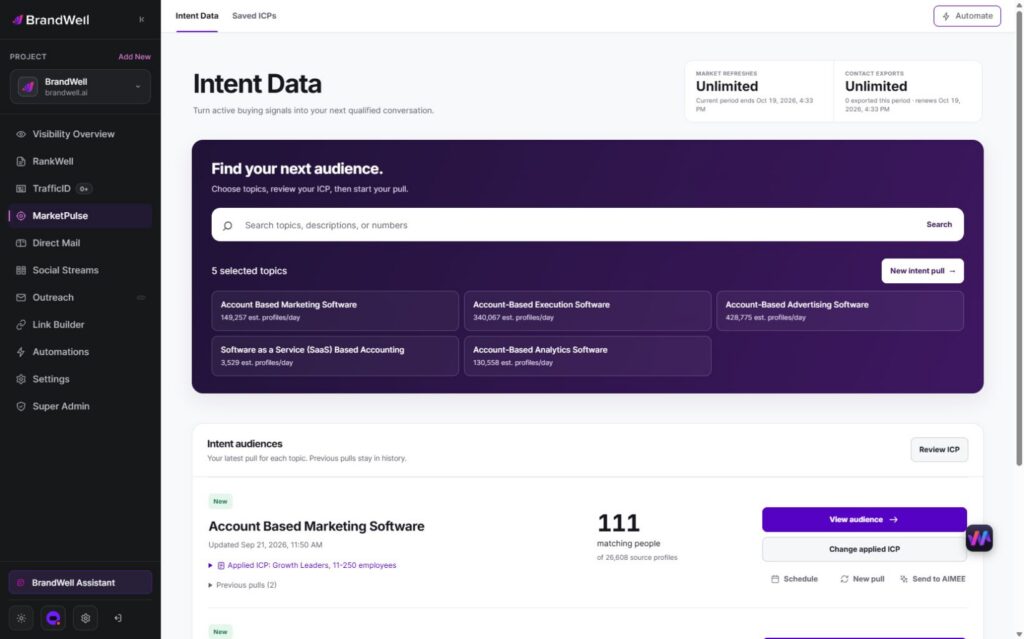
BrandWell MarketPulse: intent data starting at $500/mo. Find people researching topics relevant to what you sell, apply saved ICP filters, and review available contact details before taking action.
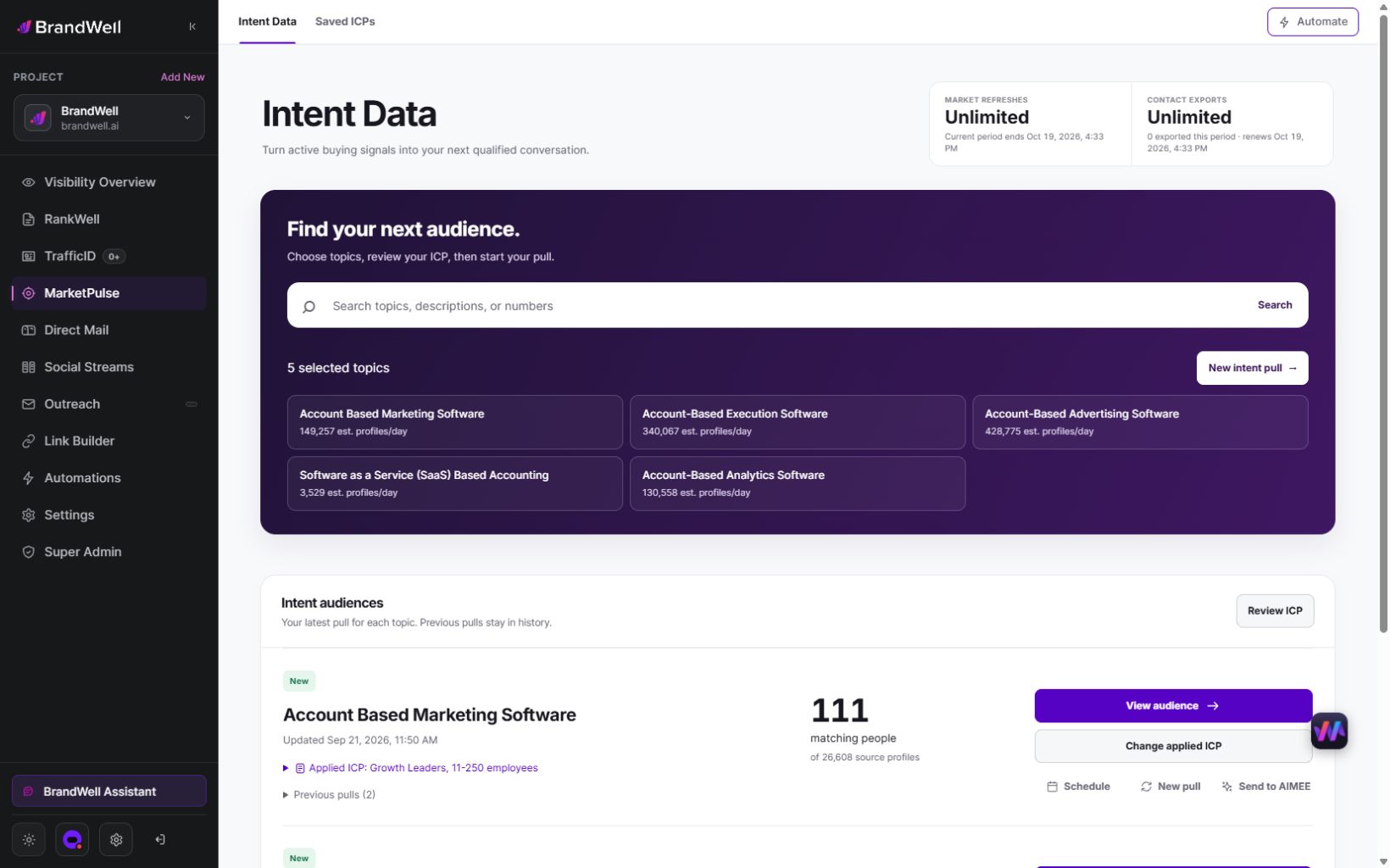
MarketPulse plans are starting at $500/mo. Verify current package scope and offers on the product page.
| Plan | Topics and refreshes | Monthly exports |
|---|---|---|
| Starter | 1 topic, weekly | 25,000 contacts |
| Growth | 3 topics, daily | 100,000 contacts |
| Scale | 10 topics, daily | Unlimited contacts |
Swipe the table to see all columns.
A pull retrieves available data from the previous 24 hours for one topic. Daily use across all included topics provides 90 Growth pulls or 300 Scale pulls in a 30-day month. Weekly Starter pulls vary by calendar month. Available audience size and contact fields vary, and audiences may overlap. Refreshes stop at the plan limit without overage charges.
- Find and qualify: search the topic catalog, save your ICP, and review the people and companies that match.
- Act on the research: export qualified contacts or prepare an Outreach or Direct Mail workflow. Connected products, channel usage, and fulfillment may cost extra.
- Get help from AIMEE: Growth and Scale include AIMEE for the initial user to research accounts and prepare the next step through connected tools.
Agencies and other service businesses can build client deliverables around their available Intent Scans and exports. Keep each client’s scope, permissions, and service fees clear. A subscription is not a promise of a white-label platform or exclusive access to a market.
Explore MarketPulse and watch the demo or compare plans starting at $500/mo. Any early-access discount is a separate, time-limited offer shown to an eligible recipient.
Rank use cases by decision quality, not novelty
An intent signal has value only when it reaches a decision the team is allowed and able to make. A technically impressive identity match that no one reviews has little operating value. A small account-research queue that helps sellers focus can be valuable even if it never appears on an executive dashboard.
For an illustrative planning rubric, score each candidate from one to five on the following dimensions. This is not a validated prediction model or an industry benchmark. Preserve the reasoning and allow unresolved requirements to stop a pilot rather than averaging them away.
- Decision clarity: Can the team name the exact action that changes?
- Evidence fitness: Does the signal source and unit support that action?
- Identity sufficiency: Is account-level evidence enough, or is a verified person required?
- Freshness: Can the team respond before the evidence expires?
- Activation eligibility: Are the data rights, channel rules, notices, and suppressions understood?
- Outcome visibility: Will an accepted, rejected, qualified, or revenue result return?
- Economic value: Is the likely decision improvement worth data, setup, media, and labor?
Use the score to select a pilot, not to fabricate precision. Two use cases with the same total may carry very different risks. Give governance and potential harm veto power over a high commercial score.
Compare five practical intent data use cases
Use the same criteria for every option: best fit and exclusions, required inputs, implementation effort and ownership, privacy or governance risk, cost drivers, revenue measurement, and a meaningful limitation.
1. Account prioritization
Best fit and exclusions: Account prioritization works when a sales team has a defined ICP and more plausible accounts than it can research. It is less useful when every account already receives high-touch coverage or the territory list is too small to rank.
Inputs and prerequisites: Require account fit, research topic or first-party event, source, recency, recurrence, lifecycle stage, account owner, and suppressions. The output should be an evidence card and action menu, not a label such as “hot.”
Implementation and governance: RevOps owns routing and account integrity; sales management owns response policy; sellers accept, reject, or defer with a reason. A manual daily queue is a valid first release.
Cost and measurement: Cost includes intent supply, enrichment, CRM work, seller research, training, and QA. Measure queue age, seller acceptance, qualified conversations, opportunity creation, and rejection patterns.
Meaningful limitation: Prioritization reallocates attention. It does not create buyer interest, verify a budget, or guarantee that the best-scored account will respond.
2. Website-visitor qualification
Best fit and exclusions: This use case fits businesses with meaningful traffic from target accounts and a clear action after a likely account or known-contact event. It is a poor fit for low-volume sites or teams planning automated outreach from a single anonymous visit.
Inputs and prerequisites: Preserve page or event context, session time, consent state, resolution unit, confidence, enrichment, validation, account fit, prior lifecycle, and suppression. Separate a known form submitter from an inferred company or person candidate.
Implementation and governance: Marketing operations owns event quality, RevOps owns identity and CRM policy, and a reviewer handles ambiguous records. Privacy review covers notice, purpose, access, retention, deletion, and destination.
Cost and measurement: Include analytics, visitor resolution, enrichment, validation, integration, review labor, and support. Track match yield, reviewed accuracy, accepted actions, qualified responses, complaints, and no-match rates.
Meaningful limitation: Resolution is coverage-dependent and probabilistic. A company match does not prove which person visited, and a candidate contact is not the observed browser.
3. Sales timing and research context
Best fit and exclusions: This use case helps sellers decide when to research and which problem hypothesis to explore. It fits considered purchases where sellers can personalize without exposing inferred surveillance.
Inputs and prerequisites: Combine account fit, topic evidence, source, freshness, existing relationship, open opportunity, recent first-party engagement, role candidates, and exclusions. The seller needs a concise context brief with uncertainty.
Implementation and governance: Sales enablement defines appropriate use, managers review message quality, and RevOps captures action and outcome. Human approval should remain before external contact.
Cost and measurement: Budget for data, account and contact research, seller time, enablement, sequencing tools, and feedback analysis. Measure research completion, accepted timing suggestions, positive replies, qualified meetings, and opt-outs.
Meaningful limitation: Research themes can improve preparation, but they do not reveal the individual’s search terms or give permission to contact someone.
4. Paid-audience activation
Best fit and exclusions: This use case fits teams that have sufficient eligible audience supply, platform-approved data, controlled media execution, and qualified conversion measurement. It is unsuitable when the audience is too small, data rights are unclear, or only lead volume is measured.
Inputs and prerequisites: Document provenance, lawful and contractual use, agency authority, account list, match expectations, exclusions, frequency, creative, offer, landing path, and a baseline cell. Treat an audience suggestion differently from guaranteed targeting.
Implementation and governance: Paid media owns execution, data operations own refresh and suppression, analytics owns the test, and privacy and platform-policy reviewers approve eligibility. Sales capacity must match expected handoffs.
Cost and measurement: Include data, audience preparation, media, creative, landing assets, platform fees, analysis, and sales follow-up. Measure eligible reach, frequency, qualified conversion, sales acceptance, and incremental response when the design supports it.
Meaningful limitation: Match loss and platform delivery can blur the intended audience. Attribution reports show association and assigned credit, not necessarily causal lift.
5. Client reporting, retention, and expansion
Best fit and exclusions: Agencies and customer teams can use research evidence to structure reviews, identify service themes, and test expansion hypotheses. It should not be used to pressure a client with unverified claims about what its employees did.
Inputs and prerequisites: Maintain client-specific topics, account lists, customer state, signal provenance, actions taken, deliverables, outcome evidence, exceptions, and change history. Separate client data and permissions.
Implementation and governance: The service owner prepares the report, the client validates context, and account management chooses education, scope review, expansion discovery, or no action. Finance owns any commercial change.
Cost and measurement: Add portal or report production, analysis, meetings, client support, platform scope, and expansion delivery. Measure report adoption, accepted recommendations, service utilization, retention evidence, expansion-qualified conversations, and margin.
Meaningful limitation: Research interest may reflect support, implementation, competitor monitoring, or general education. It is not proof that a customer wants to expand or churn.
Choose the best use case by company size and go-to-market model
An early-stage B2B company usually benefits from one narrow workflow: known-visitor follow-up, founder-led account research, or a small target-account queue. It often lacks the traffic, conversion volume, and operations needed for a multi-source scoring system. The objective should be learning and decision quality, not automation.
A growth-stage sales-led company can add account prioritization and seller context when its ICP and CRM stages are stable. It should still limit the topic set and require manager feedback. A product-led company may get more value by combining product usage and first-party engagement with account research than by making third-party intent the primary score.
An enterprise can coordinate marketing, sales, and customer use cases, but only with common account identity, access controls, lifecycle rules, integration ownership, and change management. Buying an enterprise suite does not solve those governance tasks.
An agency needs a standardized core and client-specific policy. It can reuse intake, data QA, reporting, and change-control methods while keeping topics, ICP, permissions, thresholds, destinations, and retail pricing separate. The best intent data use cases by company size therefore depend more on operating readiness and sales motion than on employee count alone.
Compare intent evidence with fit-only, engagement-only, and broad lists
Fit-only targeting is appropriate when the team needs a stable, defensible market universe and timing is secondary. Engagement scoring is strongest when known first-party behavior closely reflects product interest. Broad prospect lists are useful for market coverage or testing but carry little timing information. Intent evidence helps when research timing changes the priority or message.
Use an additive decision model. First determine whether the account belongs in the market. Then ask whether current evidence changes what the team should do. Do not let a topic surge rescue a poor-fit account, and do not discard a strong explicit hand raise because an inferred score is low. This intent data use cases comparison preserves the role of each evidence type.
The best alternative may be no external intent source. A clean first-party event system, customer research, seller account plans, or a direct publisher partnership can solve a narrow decision with less uncertainty. Intent data use cases alternatives belong in every planning review so the team does not defend a purchase merely because it already made one.
Implement each use case through one common evidence chain
The reusable workflow is signal → fit → identity → freshness → validation → suppression → action → outcome. The fields remain consistent even when the action differs.
- Ingest without erasing provenance. Store the source event or research evidence before calculating a score.
- Normalize the unit. Resolve account IDs, domains, subsidiaries, and person or visitor state. Keep ambiguous matches.
- Apply fit. Use the use case’s eligible market, customer, product, and territory rules.
- Expire evidence. Set time windows by signal and decision; do not retain “intent” indefinitely.
- Validate the action requirement. A sales message may require a verified contact; an account report may not.
- Suppress prohibited or inappropriate cases. Include opt-outs, customers, competitors, employees, duplicates, restricted geographies, and client-specific rules.
- Route the context. Show source, time, reason, limitation, owner, and approved next steps.
- Return the decision and outcome. Capture no action as data rather than forcing every signal to become a task.
This intent data use cases implementation guide requires a business owner, RevOps or data operator, channel operator, analytics partner, and privacy or legal reviewer where personal data or outreach is involved. Start manual when the policy is new; automate only the rules users can explain.
Use practical tools, playbooks, and templates
An intent data use cases toolkit should include a portfolio scorecard, use-case charter, signal dictionary, identity-state guide, representative test set, suppression register, action matrix, seller brief, audience eligibility worksheet, experiment plan, client report template, cost model, and renewal decision.
Choose technology by the use case boundary. A feed can fit a team that owns integration and activation. A point tool can solve visitor resolution, enrichment, validation, or alerts. An enterprise platform can coordinate several functions. A managed service can supply operations and reporting. The “best tools and playbooks for B2B intent data use cases” are therefore those that expose provenance, uncertainty, workflow state, and outcome return for the selected decision.
Require a current representative sample. Test known positive, negative, ambiguous, stale, duplicate, subsidiary, remote-work, customer, competitor, and opt-out cases. Ask how a user corrects a result, how an expired signal disappears, and what can be exported at exit.
Budget by use case, not by a generic license
Intent data use cases pricing should be decomposed. The platform or data quote may depend on topics, records, history, users, destinations, workspaces, services, or activation. Implementation adds data mapping, integrations, testing, enablement, and privacy review. Ongoing operations add review, exceptions, seller research, audience refresh, reporting, support, and outcome analysis. Media and creative are separate for advertising use cases.
Build a cost row for each use case and assign shared infrastructure separately. Account prioritization may be labor-heavy but media-light. Paid-audience activation may consume substantial media and creative. Client reporting may require portal and service hours. Website qualification may depend on traffic volume and identity coverage.
Compare intent data use cases cost with the current process and the value of the decision. A high-deal-value sales team may justify careful research for a small queue. A low-margin offer may not. Avoid one ROI forecast across unlike use cases.
Measure ROI and pipeline impact by use case
Each use case needs a leading, operating, and business metric.
- Account prioritization: usable accounts → seller acceptance → qualified opportunity rate.
- Website qualification: reviewable matches → approved actions → qualified responses or meetings.
- Sales timing: completed evidence reviews → relevant actions → positive and qualified replies.
- Paid activation: eligible reach → qualified conversions → incremental opportunity outcomes where test design permits.
- Client reporting: report adoption → accepted recommendations → retention or expansion-qualified evidence.
The Magenta Book’s analytical guidance distinguishes experimental and quasi-experimental approaches with explicit assumptions. For a suitable randomized comparison, preserve original assignments and record crossover and contamination. A staggered rollout or before-and-after change is not automatically causal. State sample limits, seasonality and concurrent activity.
Do not reuse one intent data use cases benchmark across sales, media, and customer success. Their actions, time windows, and outcome definitions differ. Use stable internal definitions and preserve the denominator: all eligible records, all reviewed signals, all accepted actions, and all qualified outcomes.
Avoid risky use cases and false-positive traps
The riskiest intent data use cases take low-confidence person identity, sensitive topics, or thin research evidence and immediately trigger external action. Other failures include employee monitoring, unrestricted cross-client data, messages that reveal inferred behavior, uploads without clear platform rights, indefinite retention, and high-impact customer treatment based on an opaque score.
Before activation, document purpose, source, observation unit, permitted use, identity state, access, retention, correction, suppression, deletion and recipients. Review the actual jurisdictions and roles with qualified advisers. A general checklist does not establish compliance.
Review applicable marketing, privacy and channel requirements for the actual workflow. A topic match does not establish consent or remove suppression obligations.
Package multiple use cases as an agency service
An agency should sell a progressive service rather than activating every module at once. Begin with topic and ICP governance plus a branded evidence report. Add one workflow – account prioritization, visitor qualification, audience testing, or sales context – after the client approves the decision rules. Add a second use case only when the first produces accepted actions and the agency has delivery capacity.
The recurring package can include data QA, signal review, client-specific suppressions, one or more approved activations, monthly outcome analysis, exception handling, and a change log. Separate setup, media, creative, custom integration, and high-touch research. Track wholesale inputs, agency hours, retail revenue, and gross margin by use case.
Review a relevant MarketPulse topic and defined ICP, then inspect the available matching people and company information. TrafficID separately reviews eligible own-site visitors. AIMEE can prepare a brief through configured connected tools; verify the output and actual action before execution. Scope additional agency services and implementations separately.
Confirm the access, auditability, retention, continuity and service terms required by the actual workflow. Do not infer a specific entitlement or enterprise control from a product name, draft architecture or general marketing description.
Select one use case and write the evidence standard
Choose the use case with the clearest action, lowest avoidable risk, fastest outcome feedback, and defensible economics. Write the evidence fields and stop conditions. Run representative positive and negative cases. Compare the workflow with the current decision. Expand only when users can explain what worked and what did not.
Before approving the pilot, ask five final questions. Can the action be completed inside the signal’s useful window? Can a reviewer explain the identity boundary without guessing? Can the organization honor correction, suppression, and deletion through every destination? Can finance see platform, labor, activation, and exit cost? Can the outcome change the next decision? A “no” does not always end the idea, but it should keep the use case in design rather than production.
That is the durable intent data use cases best practice: one signal does not create value; a governed decision and a measurable feedback loop do.
Worked example: compare the right output
For a fictional account-research pilot, $800 of defined software, setup and labor supports 40 completed account reviews. Twenty meet the client’s acceptance rule. Cost is $20 per reviewed account and $40 per accepted account. Neither is cost per customer.
A separate fictional paid pilot uses $800 of media, $800 of creative and landing work, and $400 of data preparation and analysis. Ten enquiries satisfy a stated qualification rule, giving $200 per qualified enquiry from $2,000 of total cost.
The $40 accepted-account figure is not directly comparable with the $200 qualified-enquiry figure: the units and stages differ. Track how accepted accounts progress and include later action costs before comparing similar outcomes. Define shared-cost allocation and avoid counting the same expense or outcome twice.
Do not multiply pipeline by a guessed close rate and label the result measured ROI. Show scenario assumptions separately, and use an appropriate comparison when estimating incremental contribution.
Review a narrow topic use case in MarketPulse
- Name the decision, owner and eligible population.
- Select one relevant research topic and apply the ICP.
- Review the actual fields, missing information and identity relationships.
- Approve the permitted next step and record unresolved cases.
- Track the action, costs and outcome in the authorized system before expanding scope.
Watch the current demo and compare MarketPulse plans. Standard subscriptions are starting at $500/mo. A pull covers available previous-24-hours data for one topic; it does not equal one qualified account, enquiry or customer.
Frequently asked questions
Which intent-data use case should I start with?
Choose a defined decision with reliable inputs, an owner, permitted action, review capacity and an observable outcome. Do not rank by signal volume alone.
Does a high planning score justify activation?
No. The rubric is illustrative, and unresolved identity, permission or delivery requirements can stop the workflow.
Can I compare every use case using one cost per lead?
Only after defining a comparable unit, stage, period and full cost. Reviewed accounts, accepted recommendations and qualified enquiries differ.
Do topic matches automatically qualify for paid targeting?
No. Check the destination’s current data-source, account, permission and policy requirements before any upload.
Reviewed and updated October 3, 2026.

Written by