On this page
- Current MarketPulse research workflow
- Keep client strategy configurable
- Define common and client-specific objects
- Use five delivery control layers
- Name workflow and approval owners
- Compare separately implemented delivery
- Define actual service costs
- Separate adoption and outcomes
- Check client operating prerequisites
- Preserve distinct evidence stages
- Resolve scope and rights gaps
- Scope current BrandWell capabilities
- Roll out versioned configuration
- Frequently asked delivery questions
- Copyable delivery change record
Standardize definitions, input fields, source records, approval boundaries, destination checks, release evidence, reporting and change control. Keep each client’s ICP, topic choices, permitted actions and outcome definition configurable. Test actual delivery costs before promising margin improvements.
For agency owners, growth leaders, paid-media directors and RevOps operators reviewing repeatable buyer-intent delivery, client configuration and actual costs.
Current MarketPulse offer: intent-data plans start at $500/mo. See the product, demo, and current plans. Updated October 3, 2026.
Current MarketPulse research workflow
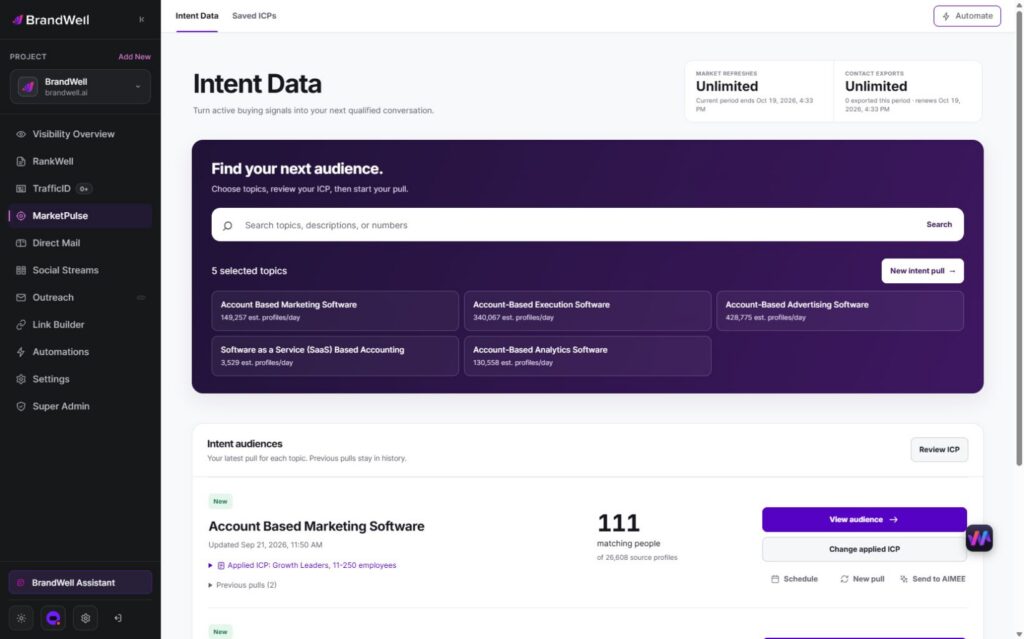
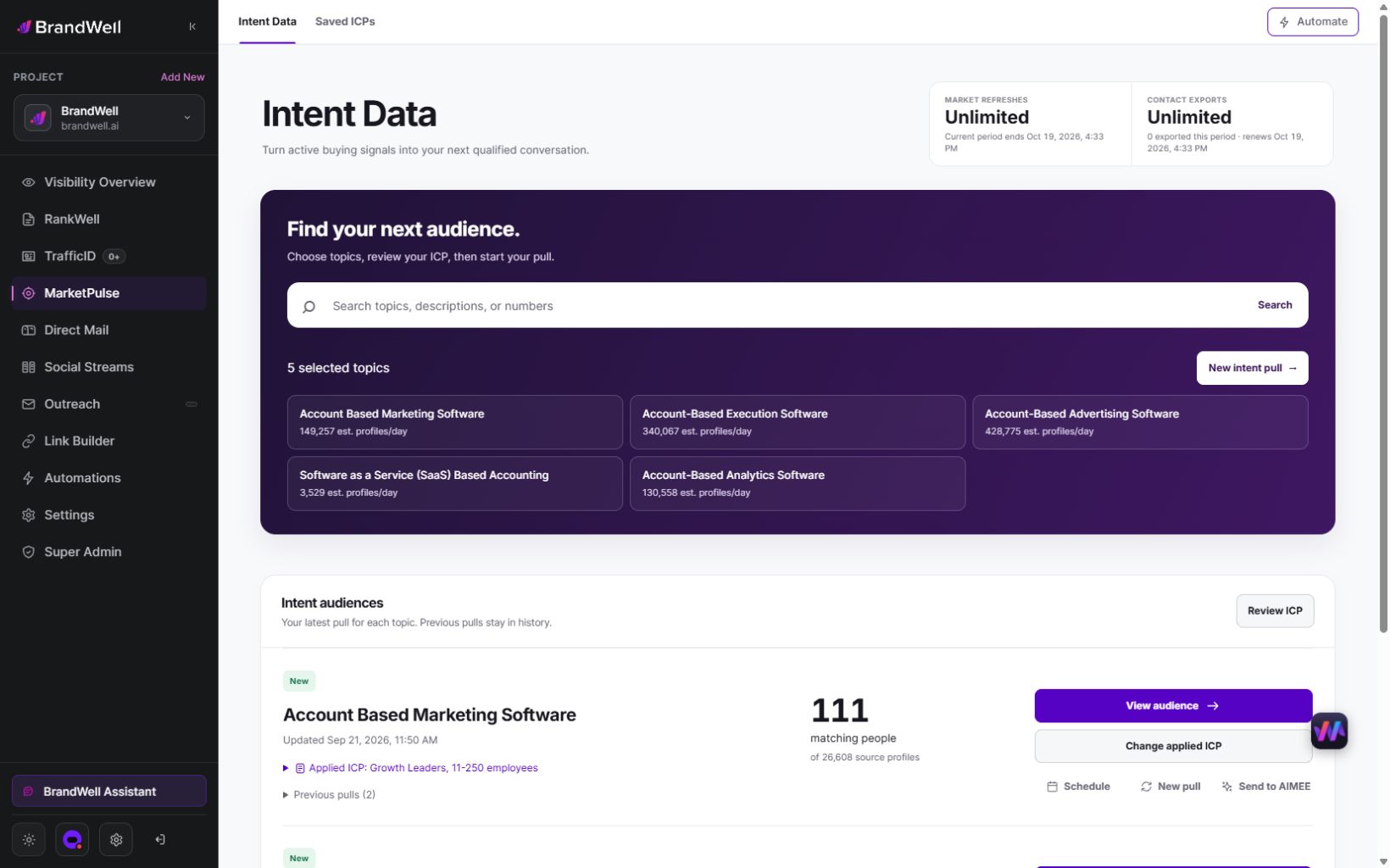
BrandWell MarketPulse: intent data starting at $500/mo. Find people researching topics relevant to what you sell, apply saved ICP filters, and review available contact details before taking action.
| Plan | Topics and refreshes | Monthly exports |
|---|---|---|
| Starter | 1 topic, weekly | 25,000 contacts |
| Growth | 3 topics, daily | 100,000 contacts |
| Scale | 10 topics, daily | Unlimited contacts |
Swipe the table to see all columns.
A pull retrieves available data from the previous 24 hours for one topic. Daily use across all included topics provides 90 Growth pulls or 300 Scale pulls in a 30-day month. Weekly Starter pulls vary by calendar month. Available audience size and contact fields vary, and audiences may overlap. Refreshes stop at the plan limit without overage charges.
- Find and qualify: search the topic catalog, save your ICP, and review the people and companies that match.
- Act on the research: export qualified contacts or prepare an Outreach or Direct Mail workflow. Connected products, channel usage, and fulfillment may cost extra.
- Get help from AIMEE: Growth and Scale include AIMEE for the initial user to research accounts and prepare the next step through connected tools.
Agencies and other service businesses can build client deliverables around their available Intent Scans and exports. Keep each client’s scope, permissions, and service fees clear. A subscription is not a promise of a white-label platform or exclusive access to a market.
Explore MarketPulse and watch the demo or compare plans starting at $500/mo. Any early-access discount is a separate, time-limited offer shown to an eligible recipient.
Keep client strategy configurable
Standardizing intent data service delivery is not the same as sending every client the same report. A strong standard creates a common operating language and a controlled path from evidence to action. It tells the team what a record means, which evidence must travel with it, who may approve a use, what counts as delivered, and how a change affects cost. Client strategy remains variable inside those rails.
The easiest test is to ask whether a difference changes the buyer decision. A client’s target accounts, topics, excluded territories, sales capacity, and permitted channels can change value, so they remain configurable. File naming, provenance fields, identity states, approval records, report structure, and incident handling rarely benefit from being reinvented. Make those common by default.
A standardized service should also make uncertainty visible. An account researching a topic is not proof that a named person conducted the research, and a website-visitor match is not proof that someone intends to buy. Store source, recency, confidence, and permitted use as operating data. Do not let a polished portal turn probabilities into facts.
Define common and client-specific objects
Start with a two-column design. The common column contains the service objects and controls that apply everywhere. The configurable column contains client-specific choices. Give every configurable value an allowed range, approver, effective version, and default. That prevents configuration from becoming unbounded customization.
- Common: field schema, data lineage, confidence vocabulary, suppression states, QA gates, output reconciliation, report sections, issue severity, and cost categories.
- Client-specific: ICP definition, account universe, relevant topics, evidence window, permitted destinations, seller capacity, activation thresholds, and accepted outcome.
- Change-controlled: new data source, new identity use, new outbound channel, wider geography, new subprocessor, new billing unit, or a lower release threshold.
Create a scope register with one row per object, not a loose project note. A useful row identifies the client, object, configuration value, source, owner, approver, version, effective state, and billing effect. This record becomes the bridge among sales, delivery, finance, privacy review, and client reporting.
Use five delivery control layers
The following five control layers form a practical listicle for productizing delivery. They are compared using the same criteria so an agency can see where effort, risk, and margin move. The order is deliberate: downstream automation should not outrun the definitions and rights that make an action defensible.
1. Standardize inputs and definitions
Operating prerequisites and exclusions: Consider for every recurring engagement. Use one glossary for an account signal, visitor event, topic, surge, match, qualified profile, activation, suppression, and accepted outcome. Exclude client strategy choices such as the ICP, relevant topics, or buying-stage interpretation.
Inputs and prerequisites: A signed scope, client ICP, topic dictionary, source ledger, data-rights record, destination inventory, and named business owner. Each input needs an owner, format, freshness rule, and rejection reason.
Implementation effort and ownership: Operations owns the schema; strategy owns client-specific selections; privacy or legal reviewers own restricted uses. Building the dictionary takes focused work once, then controlled maintenance rather than reinvention for every account.
Data, privacy, and governance risk: A common label can hide different legal or technical meanings. Store provenance, permitted purpose, geography, retention, and confidence beside the record instead of assuming that all fields called intent are interchangeable.
Cost drivers: Discovery time, source licensing, topic research, data normalization, documentation, and periodic definition review. Treat unpaid definition changes as scope, not invisible support.
Measurement and revenue relevance: Track intake rejection rate, missing-field rate, definition-related rework, time from signed scope to usable feed, and the portion of records with complete provenance. These indicators protect delivery time and client trust.
Meaningful limitation: Definitions do not make weak data accurate. They only make the evidence and uncertainty legible, so source testing and downstream QA remain necessary.
2. Standardize thresholds and approvals
Operating prerequisites and exclusions: Consider when signals can trigger spending, seller work, contact enrichment, or outreach. A threshold matrix gives the team a predictable answer about what may flow automatically, what needs review, and what must stop.
Inputs and prerequisites: Client-specific fit rules, signal recency, minimum evidence, identity-confidence states, exclusions, spending limits, approval owners, and a record of the decision. A score without its component evidence is not enough.
Implementation effort and ownership: RevOps or campaign operations configures the matrix; the client authorizes material activation; QA samples decisions; an accountable owner can pause the flow. High-risk actions should require a second set of eyes.
Data, privacy, and governance risk: False certainty creates surveillance-like messaging and wasted activation. Keep account-level and person-level claims separate, avoid inferring sensitive traits, and retain the reason a record was released or held.
Cost drivers: Rule design, exception review, analyst time, approval delay, and the opportunity cost of conservative thresholds. Automation lowers handling cost only after error and exception rates are stable.
Measurement and revenue relevance: Measure auto-release rate, review rate, reversal rate, false-positive sample findings, approval latency, and cost per released record. Pair those with client outcomes rather than celebrating automation alone.
Meaningful limitation: One global threshold will not serve every client, market, channel, or risk level. Standardize the structure and evidence required, then allow governed client-specific values.
3. Standardize activation and deliverables
Operating prerequisites and exclusions: Consider once the agency knows which records are actionable. Standardize destination mapping, field names, suppression checks, owner assignment, report sections, proof artifacts, and the handoff from signal to human-reviewed action.
Inputs and prerequisites: A destination contract for each CRM, ad account, outreach system, or client portal; authorized credentials; test records; rollback steps; and a release checklist. The agency also needs a clear definition of a delivered item.
Implementation effort and ownership: An implementation owner configures the destination, QA reconciles counts, and a client owner accepts the output. Separate build, approval, and release roles for material changes or sensitive data movement.
Data, privacy, and governance risk: Uploading data to a destination is a separate processing action with its own rights and platform rules. Document advertiser authority, suppressions, notices, retention, deletion, and the ability to reverse an activation.
Cost drivers: Connector maintenance, destination-specific testing, analyst review, report production, client training, and incident handling. Each extra destination should have an explicit setup and recurring cost allocation.
Measurement and revenue relevance: Reconcile eligible, attempted, accepted, rejected, activated, and actioned counts. Measure delivery latency, destination error rate, seller acceptance, and qualified outcomes without claiming that a signal caused revenue.
Meaningful limitation: A shared deliverable template cannot rescue an unclear client decision. If nobody owns the next action, more records and prettier reports will increase noise rather than value.
4. Preserve client-specific exceptions
Operating prerequisites and exclusions: Consider for strategic differences that genuinely affect value: unusual territories, regulated sectors, narrow account lists, topic ambiguity, sales-capacity limits, or a client’s specific evidence threshold. Exclude cosmetic preferences that do not change a decision.
Inputs and prerequisites: A written exception request, business reason, affected objects, owner, expiration or review point, test plan, and expected delivery or margin impact. Permanent exceptions should be rare and visible.
Implementation effort and ownership: The account lead proposes; operations estimates; privacy, security, or platform specialists review where needed; the commercial owner approves any price or SLA change. Keep exceptions in configuration, not undocumented analyst memory.
Data, privacy, and governance risk: An exception can create cross-client leakage or unauthorized use when copied casually. Tenant isolation, scoped credentials, change logs, and regression tests must remain even when a workflow differs.
Cost drivers: Design time, implementation, extra QA, reporting variance, support load, and future maintenance. Price an approved exception as setup, recurring scope, or usage rather than absorbing it silently.
Measurement and revenue relevance: Track exception count, hours, error rate, gross-margin effect, client outcome, and age. Retire exceptions that no longer create measurable value; promote recurring patterns into the standard product only after review.
Meaningful limitation: Too many exceptions recreate custom consulting under a productized label. The agency needs a clear no, a paid change path, or a separate engagement when variance overwhelms the base system.
5. Govern changes, QA, and margin
Operating prerequisites and exclusions: Consider as the control plane over the entire service. It combines versioned configuration, release gates, capacity planning, unit economics, incidents, and client communication so the standard evolves without surprise.
Inputs and prerequisites: A service owner, version register, change request, test cases, rollback plan, incident severity model, cost ledger, and recurring service review. Every material change should identify affected clients before release.
Implementation effort and ownership: Operations runs the change calendar; QA verifies; finance reviews cost and margin; account owners communicate; authorized approvers release. The same person should not silently design, deploy, and approve a high-impact change.
Data, privacy, and governance risk: Broad changes amplify mistakes. Use least privilege, separate test and production credentials, client-by-client impact checks, retention controls, and documented incident response.
Cost drivers: Quality staff, monitoring, audit evidence, reprocessing, client communication, platform changes, and actual support expense, with unused contingency tracked separatelys. These are product costs and belong in the price model.
Measurement and revenue relevance: Monitor contribution margin, rework, defect escape, SLA attainment, incident volume, client adoption, renewal evidence, and qualified outcome progression. Review trends by client and service version.
Meaningful limitation: Governance can become ceremony. Require controls in proportion to data sensitivity, financial exposure, client impact, and reversibility, not the number of documents the team can produce.
Name workflow and approval owners
A repeatable workflow begins before the first signal arrives. Sales hands a signed scope and assumptions to an implementation owner. Strategy converts the client’s market into approved topics, fit rules, and exclusions. Data operations validates sources and normalizes records. QA releases only evidence that meets the configured gate. Activation sends approved outputs to the destination. The account lead explains what changed and collects outcome feedback.
- Frame the scope: name the decisions the service supports, the destinations it may use, the monthly capacity, and what is out of scope.
- Configure: record the ICP, topic definitions, evidence windows, identity states, suppressions, thresholds, and client approvers.
- Preflight: test provenance, freshness, completeness, permissions, credentials, mappings, sample outputs, and rollback.
- Operate: ingest, normalize, score, review exceptions, activate approved records, and reconcile every handoff.
- Learn: join seller disposition and qualified outcomes back to the evidence, then propose a versioned rule change instead of tuning silently.
Approval limits should follow consequence. A report preview can tolerate a lower-friction review than a new contact upload, ad spend, or outbound sequence. Define which actions are reversible, which expose personal data, and which consume client budget. That makes the approval matrix easier to defend and faster to use.
Compare separately implemented delivery
Manual delivery is useful during discovery because an expert can see ambiguous topics, strange matches, and client-specific constraints. It becomes expensive when every record needs the same handwork. Automation is appropriate for deterministic formatting, validation, routing, reconciliation, and alerts after the team understands exceptions. It should not be used to hide uncertainty or approve high-consequence actions without evidence.
A separately implemented client platform requires verification of branding, workspaces, reports, modules, integrations, support and costs. Compare actual implementation and contract dependencies. The agency owns its promise, billing and approvals; a MarketPulse subscription does not establish a native white-label delivery engine.
Compare actual analyst hours, engineering, licensing, validation, support, reporting, implementation and client-specific variance. Track incident expenses separately from unused contingency. A subscription price alone does not establish full delivery cost.
Define actual service costs
Build a defined service cost model for each client: actual licensed data and platform costs, usage, analyst time, setup amortization, connectors, reporting, client support, QA and approved exceptions. Track unused contingency separately from incurred costs. State the overhead and other exclusions before labeling the remainder.
For a defined service period, compare revenue with actual data and platform costs, delivery labor, QA, support and correction work. Track unused contingency separately from incurred expense. Identify exclusions and avoid calling the resulting remainder gross or net profit unless the cost definition supports that label.
Setup fees should cover real setup work: discovery, configuration, permissions, integration, testing, branded portal work, training, and initial report design. Recurring price should cover recurring value and recurring cost. Do not bury a one-time integration inside a low retainer, and do not charge usage without giving the client a visible unit and control.
Separate adoption and outcomes
Measure the service as a chain. Input measures include source freshness, completeness, and provenance. Process measures include review rate, delivery latency, rework, and activation errors. Adoption measures include portal use, seller acceptance, and follow-up completion. Outcome measures include qualified conversations, accepted opportunities, pipeline progression, or another client-defined business event.
Pair those with economics: gross margin after direct delivery cost, contribution per client, setup payback, support hours, exception hours, cost per accepted record, expansion revenue, and renewal evidence. Attribution is not the same as causation. Report which evidence preceded an outcome, how it was used, and what else influenced the result. Use holdouts or controlled tests where feasible instead of claiming every opportunity came from intent.
A service is improving when the evidence becomes easier to act on, errors are caught earlier, time-to-value falls, and qualified outcomes improve without hidden labor. A rising record count alone says little. A falling review rate can be good automation or a dangerous gate change; interpret it with error samples and outcomes.
Check client operating prerequisites
Check that the client has a defined market, relevant accounts, an activation owner, an agreed destination, follow-up capacity and an observable outcome. A recurring contract requires separately verified monitoring, review and delivery work; raw record volume alone does not establish value.
Poor fits include clients who demand proof that a named person researched a topic, cannot explain lawful use, lack sales capacity, refuse suppressions, or judge the service only by raw record volume. Short fixed projects can work as pilots, but the agency should state what learning or decision the pilot supports and what evidence would justify expansion.
Preserve distinct evidence stages
Treat the signal-to-outcome chain as distinct stages: source evidence, account normalization, fit, recency, identity resolution, contact validation, suppression, activation eligibility, human approval, destination acceptance, seller action, and outcome. Preserve counts and rejection reasons at every transition. This makes a client report explainable and a margin problem diagnosable.
Identity and intent are probabilistic. A company-level topic signal can prioritize an account without authorizing a person-level claim. A visitor match can suggest a profile but still require confidence, relevance, validation, and permitted use. Messages should use observable business context and helpful relevance rather than telling a prospect that the agency watched them research.
The agency should also preserve negative evidence: stale records, mismatches, blocked destinations, opt-outs, client exclusions, and seller rejection. Suppression is part of the product. It protects resources, deliverability, data rights, and trust.
Resolve scope and rights gaps
Scope breaks when a client can request unlimited topics, destinations, custom reports, research, and review under one fixed fee. Billing breaks when platform usage and agency retail units cannot be reconciled. Trust breaks when the agency presents probabilistic evidence as certainty, moves data without documented authority, or cannot explain where a record came from.
Verify actual source, purpose, recipient, jurisdiction, required disclosures, contracts, access, retention, correction, deletion, suppression and incident ownership before release. Resolve unanswered rights and platform requirements for the actual service; a supplier assurance does not settle every use.
Verify actual source, purpose, recipient, jurisdiction, required disclosures, contracts, access, retention, correction, deletion, suppression and incident ownership before release. Resolve unanswered rights and platform requirements for the actual service; a supplier assurance does not settle every use.
Scope current BrandWell capabilities
MarketPulse supplies topic research and available match details. AIMEE can organize supplied context through configured tools. An agency operating service, branded weekly report, CRM synchronization or custom client interface needs separately verified implementation, rights, scope and fees. The research subscription does not establish those delivery capabilities.
Review an available MarketPulse topic, saved ICP and actual preceding-24-hour matches for the approved research purpose. Keep uncertain company context visible. AIMEE can organize supplied context through configured tools; named owners approve actual exports, messages, audience uploads and CRM writes.
MarketPulse supplies topic research and available match details. AIMEE can organize supplied context through configured tools. An agency operating service, branded weekly report, CRM synchronization or custom client interface needs separately verified implementation, rights, scope and fees. The research subscription does not establish those delivery capabilities.
Roll out versioned configuration
- Map the current service: list every input, decision, handoff, output, cost, exception, and failure. Mark which variations change client value.
- Define the minimum operating system: publish the glossary, scope register, configuration schema, approval matrix, release checklist, outcome taxonomy, and cost ledger.
- Run a controlled client cohort: compare the standard to the previous process, record exceptions, sample quality, and measure handling time and outcomes.
- Version and scale: promote proven patterns into defaults, price remaining exceptions, automate deterministic steps, and review margins and risks by service version.
Do not automate a disputed definition or remove a review gate to hit a margin target. First reduce unnecessary variation, improve source quality, narrow the scope, or price the work honestly. Standardization should make the promise more reliable, not merely cheaper to deliver.
Frequently asked delivery questions
What should an agency standardize first?
Start with definitions, provenance, client configuration, approval boundaries, rejection reasons, destination reconciliation, and cost categories. Those controls reduce the most expensive ambiguity before deeper automation.
Can a standardized service still be strategic?
Yes. Strategy lives in the client’s ICP, topic selection, thresholds, activation mix, messaging context, and outcome definition. The standard supplies a reliable way to configure, approve, measure, and change those choices.
How should an agency handle custom requests?
Require a written business reason, estimate delivery and risk impact, price approved work, assign an owner, and set a review point. Decline or separate a request when it would undermine tenant isolation, lawful use, or the core service.
Which metrics show that the system is working?
Use a balanced set: time-to-value, rework, defect escape, activation acceptance, seller use, qualified outcomes, contribution margin, exception hours, and renewal evidence. No single metric proves service quality.
Copyable delivery change record
Client: [Actual client and scope.] Object: [Input, configuration or output being changed.] Version: [Previous and proposed version, source and reason.] Approval: [Actual owner, permitted action and recipient.] Test: [Representative cases, critical failures and acceptance rule.] Release: [Affected destinations, acknowledgement and rollback evidence.] Economics: [Actual labor, expenses, billing unit and excluded costs.]
Separate a correction from a new observation period
W3C’s data best practices recommend identifying versions and distinguish revisions from new observation periods. This is data-publishing guidance, not evidence that BrandWell supplies an agency change-control system.
A Monday Intent Scan and Tuesday Intent Scan cover different observation periods. Correcting Monday’s client mapping is a revision to that output. Record both the original observation period and correction version; a new file timestamp must not silently make old evidence appear fresh.
Test client configuration before reuse
In a fictional five-client release, four clients pass but one sends records to the wrong destination. An 80% client pass rate does not authorize that client’s release. Hold the affected path, contain any exposure and verify the correction. Reusing a template is separate from testing its actual client context and credentials.
Count unique accepted outputs and unresolved responses
A fictional run attempts 100 records: 80 accepted, 10 rejected and 10 unanswered. Repeating 15 attempts creates 115 attempts, not 115 unique delivered records. If five previously rejected records are corrected and accepted, the unique accepted count is 85. Reconcile unknown responses and duplicates before reporting delivery or billing.
Compare like-for-like operating effort
A fictional cohort of 20 records takes 10 minutes each before a change: 200 minutes. A later 100-record cohort takes eight minutes each: 800 minutes. Per-record handling falls 20%, while total handling rises fourfold. Different cohorts and mix do not prove the configuration caused the reduction. Preserve comparable scope, exceptions and actual QA work.
Include correction costs in the service remainder
A fictional $2,500 client fee against $500 research, $600 delivery, $300 QA and $300 support leaves $800, or 32%, before excluded overhead, tax and financing. An extra $900 correction cost makes the defined remainder negative $100. An unused $200 contingency is tracked separately, not another incurred expense. Zero accepted outputs make cost per accepted output undefined. These invented inputs are not BrandWell service prices or typical results.
Use the current research product within approved scope
MarketPulse research is starting at $500/mo. Review actual topics, saved ICP filters and available matches for the approved client purpose. Keep TrafficID own-site visitor context separate. AIMEE can organize supplied context through configured tools; owners approve exports, messages, audience uploads and CRM writes. Custom client interfaces, synchronization and managed delivery require separately verified implementation, rights and fees.
Review current research: explore MarketPulse and current plans.
Reviewed and updated October 3, 2026.

Written by