On this page
- Understand what a Performance Max audience signal can and cannot do
- Build the workflow, data, integrations, and team
- Use MarketPulse for topic and audience research
- Choose an intent-informed or standard campaign approach
- Budget for data, creative, media, and management
- Measure downstream pipeline without crediting the signal by default
- Identify the B2B advertisers that fit the approach
- Combine fit, identity, recency, activation, and offline outcomes
- Avoid privacy, quality, creative, and attribution mistakes
- Offer audience-signal management as a recurring agency service
- Separate research inputs from upload eligibility
- A worked planning example
- Questions before adding an intent-informed signal
- Put buyer intent to work with MarketPulse
Direct answer: Use buyer intent data to form a documented audience hypothesis for Performance Max only when the underlying records are eligible for the intended Google Ads use. Google’s audience signals are suggestions that help its automation learn; they are not hard targeting, and ads may serve beyond the signaled people or accounts. Pair the hypothesis with complete creative, qualified offline outcomes, and a controlled evaluation.
Who is this for? B2B Google Ads managers, PPC directors, demand-generation leaders and agencies that already have an appropriate goal, usable creative and a CRM feedback loop. Teams seeking deterministic account-only delivery, or teams that cannot document first-party data rights, should use a different activation design.
Current MarketPulse offer: intent-data plans start at $500/mo. See the product, demo, and current plans. Updated October 1, 2026.
Understand what a Performance Max audience signal can and cannot do
The first control is conceptual. An audience signal tells Performance Max which audience characteristics may help it find converting users sooner. Google’s official audience-signal guidance says signals are optional suggestions and that campaigns may show ads to relevant audiences outside them. Therefore, ‘we supplied an intent list’ cannot be reported as ‘only intent accounts saw the ads.’
Separate three layers. The evidence layer contains first-party behaviors, CRM records, licensed topic observations, firmographic fit, identity confidence and timestamps. The hypothesis layer describes which eligible customer or custom segments, search themes and asset-group messages might accelerate learning. The delivery layer is what Google actually served across channels. Only the delivery and outcome records can describe exposure and results.
A strong hypothesis is narrow enough to explain and broad enough to learn. Example: ‘North American software companies within the approved size range, with recent research in two solution topics and a verified qualified lead history, may respond to the proof-led asset group.’ That statement can be tested. ‘These are in-market buyers’ is an unsupported conclusion.
Do not use intent as a substitute for conversion quality. Performance Max optimizes toward the configured goals. If the primary event is an easy download, the system can find more downloads rather than qualified pipeline. Define the qualified outcome and its lag before adding another signal source.
Build the workflow, data, integrations, and team
Use an eight-step workflow: define the business outcome; specify the eligible account universe; audit data rights; separate advertiser-owned records from licensed observations; create recency and fit cohorts; map each hypothesis to an asset group and offer; launch with budgets and stop rules; and reconcile delivery with offline outcomes. Keep a versioned record of every audience and goal change.
The data model should retain source, observed time, received time, account match, person match where permitted, confidence, topic, fit attributes, suppression state, activation eligibility, audience version, campaign receipt, exposure or click evidence, and downstream disposition. Never overwrite a third-party account signal with a first-party customer label. The distinction determines what may be uploaded and what can only guide strategy.
The required team includes a Google Ads owner, creative lead, RevOps or CRM owner, data or audience operator, sales disposition owner, and privacy or compliance escalation path. The agency and client must decide who approves a new data use, audience, creative claim, budget change, and result statement. Agent instructions can prepare cohort definitions, QA checks and creative briefs, but a human approves platform uploads and spend.
Essential templates are an audience-source register, eligibility and rights checklist, topic dictionary, asset-group hypothesis brief, creative coverage matrix, conversion-goal register, change log, offline-outcome map, and experiment plan. Store denominators – eligible, matched, served, clicked, converted, qualified and progressed – so match loss and delivery expansion are visible.
Use MarketPulse for topic and audience research
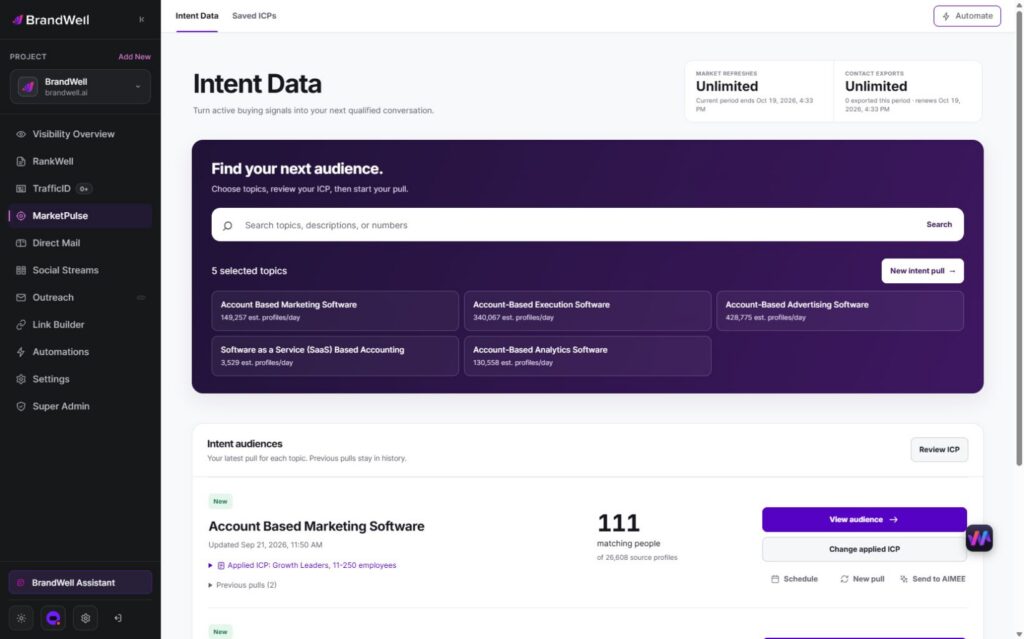
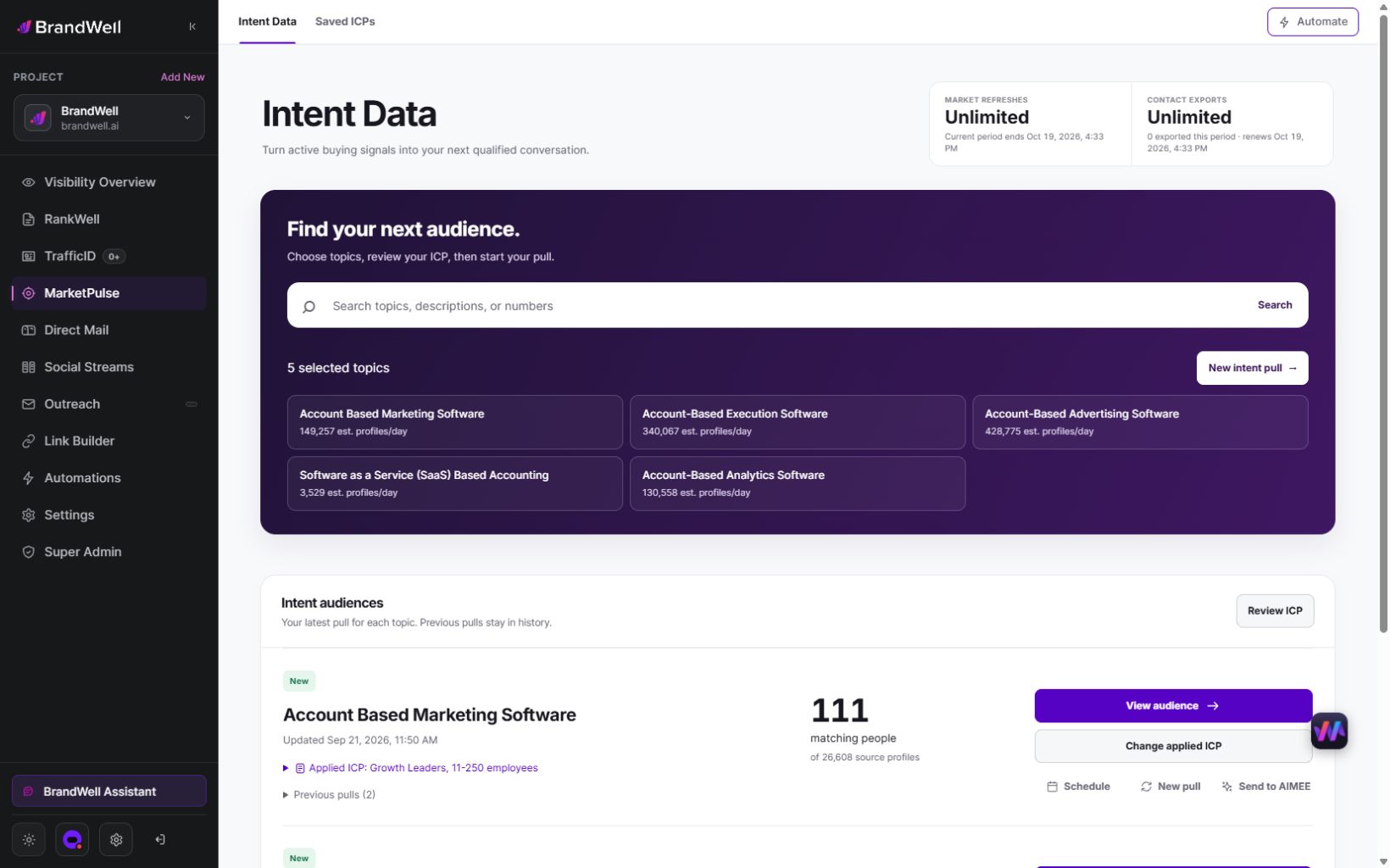
BrandWell MarketPulse: intent data starting at $500/mo. Find people researching topics relevant to what you sell, apply saved ICP filters, and review available contact details before taking action.
MarketPulse plans are starting at $500/mo. Verify current package scope and offers on the product page.
| Plan | Topics and refreshes | Monthly exports |
|---|---|---|
| Starter | 1 topic, weekly | 25,000 contacts |
| Growth | 3 topics, daily | 100,000 contacts |
| Scale | 10 topics, daily | Unlimited contacts |
Swipe the table to see all columns.
A pull retrieves available data from the previous 24 hours for one topic. Daily use across all included topics provides 90 Growth pulls or 300 Scale pulls in a 30-day month. Weekly Starter pulls vary by calendar month. Available audience size and contact fields vary, and audiences may overlap. Refreshes stop at the plan limit without overage charges.
- Find and qualify: search the topic catalog, save your ICP, and review the people and companies that match.
- Act on the research: export qualified contacts or prepare an Outreach or Direct Mail workflow. Connected products, channel usage, and fulfillment may cost extra.
- Get help from AIMEE: Growth and Scale include AIMEE for the initial user to research accounts and prepare the next step through connected tools.
Agencies and other service businesses can build client deliverables around their available Intent Scans and exports. Keep each client’s scope, permissions, and service fees clear. A subscription is not a promise of a white-label platform or exclusive access to a market.
Explore MarketPulse and watch the demo or compare plans starting at $500/mo. Any early-access discount is a separate, time-limited offer shown to an eligible recipient.
Choose an intent-informed or standard campaign approach
Use an intent-informed Performance Max hypothesis when the advertiser has a clear fit universe, recent and explainable evidence, eligible first-party inputs, enough creative variants, and qualified outcome feedback. Use a standard Performance Max approach when intent coverage is thin, rights are ambiguous, or the topic adds little beyond the advertiser’s own customer and website signals. Use Search, Demand Gen, display, account-based media or another campaign design when channel control and explainable audience boundaries matter more than cross-channel automation.
A manual campaign structure offers more explicit choices over keywords, placements or audiences depending on campaign type, but it still needs measurement discipline. Performance Max offers broader automation across Google’s inventory. The decision is not ‘AI versus manual’; it is whether the advertiser has the assets, outcome feedback and risk tolerance for the level of automation, and whether the experiment can answer a business question.
Do not run two approaches with different offers, budgets, geographies, conversion goals and landing pages and then credit the audience signal. Hold as much of the experience constant as practical. Google’s Performance Max experiments guidance can help determine which experiment types are available, but availability and feasibility vary by account.
Budget for data, creative, media, and management
Budget across five lines: intent or audience data, creative and landing production, media, platform or agency management, and measurement. Asset coverage is a real cost; a narrow audience does not justify repeating one creative until performance decays. Include CRM mapping, offline-conversion import, data QA and privacy review rather than hiding them in media management.
A planning model should estimate eligible accounts, matchable records, expected delivery, conversion lag, qualified conversion rate and the minimum detectable business change. If the reachable cohort is tiny, a lower media budget may not solve the problem – the test may simply lack enough events. In that case, widen the market responsibly, lengthen the observation window, use a higher-frequency outcome, or decline to claim a result.
MarketPulse plans are starting at $500/mo. Starter includes 1 topic, weekly refreshes, and 25,000 exportable contacts per month. Growth includes 3 topics, daily refreshes, and 100,000 exportable contacts. Scale includes 10 topics, daily refreshes, and unlimited contact exports. AIMEE for the initial user is included with Growth and Scale. Compare MarketPulse plans and current offers.
Measure downstream pipeline without crediting the signal by default
Measure a ladder from delivery to revenue: audience eligibility and match, reach and frequency, asset-group delivery, clicks and engaged visits, primary conversions, qualified conversions, meetings, opportunities, pipeline and won revenue. Use a declared conversion lag and cohort window. Reconcile Google, analytics and CRM counts rather than forcing them to match when their identities and attribution rules differ.
Audience-signal performance is difficult to isolate because Performance Max can expand beyond the signal and optimize across inventory. A pre/post view can diagnose but rarely establishes causality. Where feasible, use an eligible experiment or holdout with a declared unit, treatment, primary outcome, duration, exclusions and stopping rule. If the account lacks power, label the result directional or inconclusive.
Report contribution conservatively: ‘The hypothesis cohort showed a higher qualified-conversion rate during this test’ is different from ‘intent signals caused more pipeline.’ Show the cohort definition, exposure limitations, confidence and competing explanations. Qualified outcome quality matters more than an attractive platform return metric disconnected from sales.
Identify the B2B advertisers that fit the approach
Best-fit advertisers have multiple useful creative themes, sales cycles that can be connected to offline outcomes, clean first-party data, a meaningful B2B audience, and sufficient budget and time to learn. Agencies serving several similar clients may also benefit from a repeatable client research and reporting process, provided data remains separated and client rights are explicit.
Weak-fit cases include very small reachable markets, low-margin offers with long conversion lag, incomplete asset sets, no stable CRM definition, heavy dependence on sensitive attributes, and an executive demand for account-only delivery. In these cases, use topic evidence for messaging research or seller prioritization instead of forcing it into a Performance Max audience signal.
Combine fit, identity, recency, activation, and offline outcomes
Use a component score rather than one opaque heat label. Fit describes whether the company belongs in the market. Identity confidence describes the match. Intent evidence describes the observed topic or behavior. Recency describes decay. Activation eligibility describes what the advertiser is permitted to do. Outcome evidence describes what happened in the CRM. Preserve the raw components and the rule version.
Advertiser-owned customer lists, website visitors and CRM outcomes may be useful first-party inputs when policy and legal requirements are satisfied. Offsite research can still guide topic choice, creative, asset groups and account-level analysis even when it is not eligible for upload. Follow Google’s customer data policies, contracts and applicable law rather than treating all ‘intent data’ as interchangeable.
Close the loop with qualified offline outcomes. Return stable events such as sales-accepted lead, held meeting or opportunity when they are defined, deduplicated and permitted. Avoid frequent goal edits: a learning system cannot distinguish audience value from a moving target if the outcome definition changes every week.
Avoid privacy, quality, creative, and attribution mistakes
The common privacy mistake is uploading a licensed or inferred record as though it were the advertiser’s direct customer data. Other failures include stale audiences, weak account matching, duplicate contacts, missing suppressions, topics that reveal sensitive interests, overly personal creative, and no client approval for destination use. Build a fail-closed eligibility gate and retain the reason for every approved audience.
Creative mistakes include one generic asset group for several intent themes, cosmetic variants with the same claim, incomplete formats, no landing-message continuity, and changing audience, offer and creative simultaneously. Data-quality mistakes include using report receipt time as event time, blending account and person evidence, and keeping old activity hot without a decay rule.
Attribution mistakes include using platform-reported conversion value as incremental revenue, comparing exposed intent accounts with a general market that differs in fit, and ignoring sales follow-up. A signal may correlate with buying readiness because better-fit accounts research more. That is useful for prioritization but not proof of causal lift.
Offer audience-signal management as a recurring agency service
An agency package can include client qualification, topic and source governance, first-party eligibility review, cohort and asset-group design, creative briefing, audience QA, launch approvals, weekly delivery and outcome checks, monthly pipeline review, and quarterly experiment planning. Charge separately for onboarding, major taxonomy changes, new regions and substantial creative production.
Start with MarketPulse intent data from $500/mo. Review a topic and its matching audience, then use BrandWell’s connected growth tools and AIMEE assistance through connected tools to prepare the next action. Agency packaging and services can be scoped around the client workflow.
The renewable deliverable is a decision record: which hypothesis remains supported, which data became ineligible or stale, which creative needs replacement, which outcomes matured, and what changes the client approved. That is more defensible than claiming a signal steered every impression.
Reviewed and updated October 3, 2026.

Written by