On this page
- Investigate fatigue before naming a cause
- Build the monitoring and refresh workflow
- Use current research in the workflow
- Compare manual and configured rotation
- Budget production and media separately
- Measure actual exposure and buyer outcomes
- Check campaign exposure constraints
- Keep fit, freshness and identity distinct
- Avoid frequency and measurement errors
- Scope a separate agency service
- Copyable creative-fatigue investigation
- Frequently asked fatigue questions
Treat creative fatigue as a hypothesis about response after repeated exposure. Verify instrumentation, audience mix, event freshness, exposure distribution, creative versions and qualified outcomes before changing a concept. No single average frequency or CTR threshold establishes fatigue or the cause of lost pipeline.
Who is this for? Creative strategists, paid-media directors, conversion teams and agencies running high-consideration campaigns against relatively small account sets. The framework requires checking whether creative, audience and CRM data can be reconciled and the team can produce more than cosmetic variants.
Current MarketPulse offer: intent-data plans start at $500/mo. See the product, demo, and current plans. Updated October 3, 2026.
Investigate fatigue before naming a cause
Creative fatigue is a hypothesis about declining response after repeated exposure, not the name for every performance drop. A narrow intent audience can also deteriorate because the underlying topic signal became stale, the highest-propensity accounts already converted, delivery shifted to weaker inventory, tracking changed, competitors changed offers, the landing page broke, or sales stopped following up. Each cause needs a different remedy.
Start with a diagnosis tree. First check instrumentation, budget and delivery changes. Then check whether the eligible audience, account-fit mix or topic recency changed. Next check reach and frequency distribution by creative and cohort. Finally inspect message-level engagement, qualified conversion, landing behavior and sales outcomes. Call fatigue only when repeated exposure and creative-level deterioration fit the timing and credible alternatives have been investigated.
Do not set a universal rule such as ‘refresh after four impressions.’ Frequency tolerance varies by channel, placement, buying cycle, concept, offer and audience. Platform frequency reports also have identity and aggregation limits. Establish each campaign’s baseline, then use a combination of change magnitude, persistence, exposure and downstream quality to trigger review.
A useful trigger might be: frequency distribution shifts upward for the same cohort, unique account reach stalls, a concept’s qualified conversion rate deteriorates for two review periods, and no tracking or audience-composition change explains it. The trigger opens an investigation; it does not automatically declare causality.
Build the monitoring and refresh workflow
Create a weekly operating loop: freeze the cohort and creative version register; ingest delivery, reach and frequency; reconcile topic and identity freshness; attach qualified outcomes; flag changes; diagnose by creative concept and account segment; approve a refresh or exclusion; launch under version control; and record the result. Monthly, review whether the rotation system itself is producing usable learning.
Use a creative matrix with rows for buyer problem, intent topic, account-fit tier and buying stage, and columns for proposition, proof, offer, format and call to action. A new background color is not a new concept. Useful rotations change the reason to pay attention: a quantified proof point, a category comparison, a risk-reduction offer, a diagnostic, a customer story, or an implementation path – only when each claim is substantiated.
Preserve creative IDs and parent concepts. Store launch and stop times, placements, dimensions, copy and visual versions, audience version, topic window, exposure, clicks, conversions, qualified outcomes and approval. Without that lineage, the analyst may combine five minor versions into one winner or compare concepts shown to different account populations.
AIMEE can prepare a review brief through configured connected tools. Keep proposed actions separate from actual approvals and destination acknowledgements. Confirm the implementation and permissions before execution.
Use current research in the workflow
The shortlist is ordered for agencies combining intent insight, campaign production and pipeline measurement. It is not a universal ranking. Each company is evaluated against the same criteria, vendor claims need current verification, and competitor sites are not linked.
Current MarketPulse research workflow
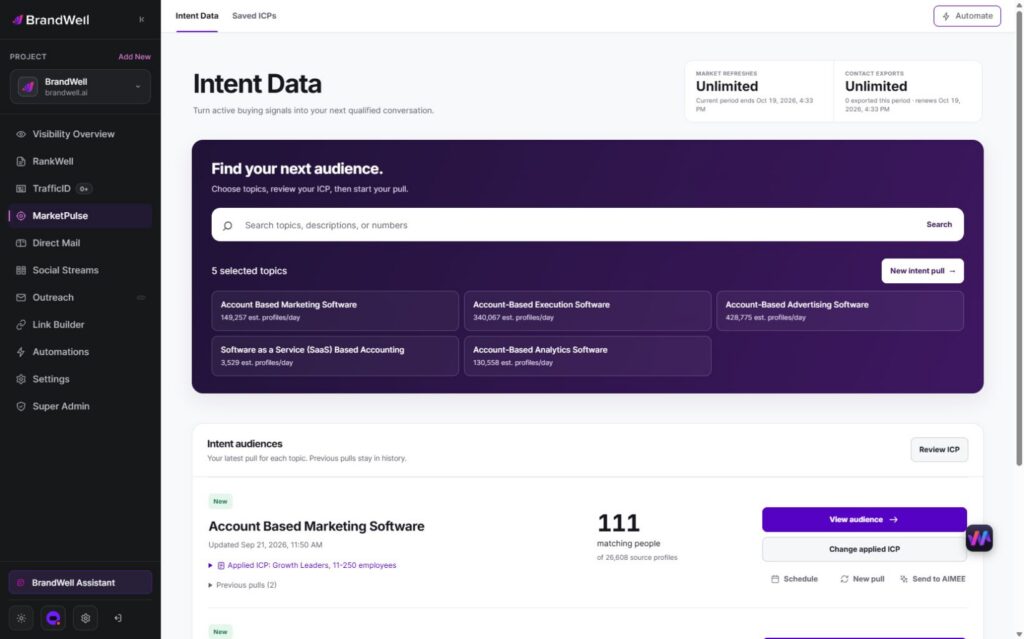
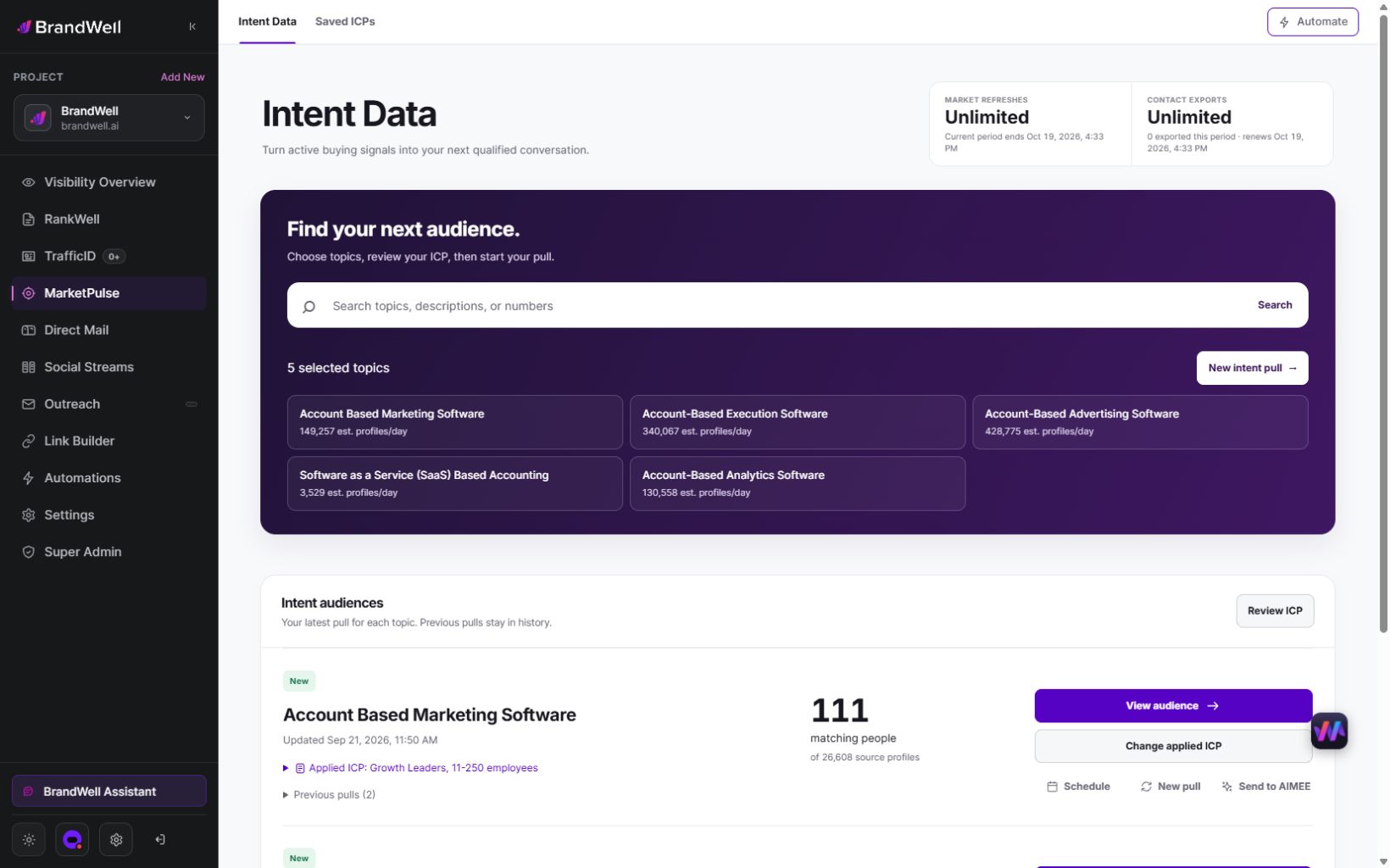
BrandWell MarketPulse: intent data starting at $500/mo. Find people researching topics relevant to what you sell, apply saved ICP filters, and review available contact details before taking action.
| Plan | Topics and refreshes | Monthly exports |
|---|---|---|
| Starter | 1 topic, weekly | 25,000 contacts |
| Growth | 3 topics, daily | 100,000 contacts |
| Scale | 10 topics, daily | Unlimited contacts |
Swipe the table to see all columns.
A pull retrieves available data from the previous 24 hours for one topic. Daily use across all included topics provides 90 Growth pulls or 300 Scale pulls in a 30-day month. Weekly Starter pulls vary by calendar month. Available audience size and contact fields vary, and audiences may overlap. Refreshes stop at the plan limit without overage charges.
- Find and qualify: search the topic catalog, save your ICP, and review the people and companies that match.
- Act on the research: export qualified contacts or prepare an Outreach or Direct Mail workflow. Connected products, channel usage, and fulfillment may cost extra.
- Get help from AIMEE: Growth and Scale include AIMEE for the initial user to research accounts and prepare the next step through connected tools.
Agencies and other service businesses can build client deliverables around their available Intent Scans and exports. Keep each client’s scope, permissions, and service fees clear. A subscription is not a promise of a white-label platform or exclusive access to a market.
Explore MarketPulse and watch the demo or compare plans starting at $500/mo. Any early-access discount is a separate, time-limited offer shown to an eligible recipient.
Compare manual and configured rotation
Consider manual review when volume is low, the offer is complex, brand or regulatory review is strict, and experienced strategists need to interpret sparse evidence. Automation is useful for deterministic tasks: checking missing formats, monitoring delivery, applying preapproved labels, scheduling an approved sequence, and alerting on declared thresholds. Test a hybrid with actual responsibilities: software gathers and organizes evidence; humans diagnose and approve a concept change.
Rotation can be sequential, even, performance-weighted, or stage-based. Even rotation supports clean early comparison but may spend too long on weak variants. Performance weighting can exploit a winner but starve new concepts and repeatedly expose a small group. Stage-based sequencing can align messages with declared topic recency or CRM status, but identity errors and sales-cycle variability make the sequence uncertain. Choose the mechanism for the decision, not for convenience.
Verify the current frequency-control scope for the actual campaign type, account and platform. A supported exposure cap does not refresh an idea or reconcile identity perfectly across channels. Keep actual campaign, period and identity limitations visible.
Budget production and media separately
Budget the creative system, not just individual ads. Include research, concept strategy, copy, design, video or motion, resizing, landing-page continuity, legal and client review, trafficking, QA, analysis and archival. Track an unused expedited-production reserve separately from actual costs, and define the maximum number of revision rounds.
Media and production budgets interact. Too much spend against a tiny reachable group accelerates repeated exposure; too little spend produces ambiguous data. Estimate reachable people and accounts, expected channel match, desired unique reach, placement mix and conversion lag. Use those estimates to decide whether to reduce media, broaden the fit universe, add channels or invest in more concepts.
Measure actual exposure and buyer outcomes
Monitor five groups of metrics. Delivery: unique reach, frequency distribution, spend and placement. Creative: concept-level click and engaged-view behavior. Conversion: qualified rate and cost, not only form volume. Account: unique fit-account coverage, topic freshness and repeated account exposure. Pipeline: meetings, opportunities, stage movement and revenue with stated lag.
Use stable denominators and confidence ranges. A creative shown mostly to a small group of high-fit accounts cannot be compared directly with one shown to a broader set. Segment by concept, cohort, channel and exposure band, but avoid slicing until every group is too small. When evidence is sparse, report the raw counts and direction rather than a dramatic percentage.
To estimate pipeline impact, predeclare the primary outcome and compare a rotation policy or concept with a credible counterfactual. Randomized creative experiments are strongest when delivery is sufficiently balanced; sequential comparisons need adjustment for seasonality, audience depletion and topic changes. Attribution can locate paths but does not by itself show that fatigue caused lost pipeline.
Check campaign exposure constraints
Investigate repeated exposure when the reachable audience is small, media intensity is high, the channel has frequent use, campaigns run continuously, creative variety is low, the same accounts appear across several platforms, and the buying cycle is long. Retargeting and account-list campaigns can reach saturation quickly even when their total spend is modest.
Check the actual exposure and response when the campaign has a larger qualified universe, naturally changing offers, several substantiated proof types, controlled sequencing, seasonal gaps, or low per-person exposure. However, low fatigue risk does not imply high performance; the campaign may simply have inadequate reach or a weak proposition. Diagnose the commercial problem separately.
Check actual proof approvals, creative turnaround, outcome feedback and production budget. A client with a six-week approval cycle cannot support a promised weekly approved-concept cadence without changing the scope or process.
Keep fit, freshness and identity distinct
Build an account-cohort record that preserves fit, identity confidence, observed topic, observed time, decay rule, audience eligibility, first exposure, cumulative exposure, concept sequence, latest qualified outcome and suppression state. Keep account-level and person-level evidence distinct. One employee’s click does not prove an entire buying committee is engaged, while company-level research does not identify the person who performed it.
Signal freshness can guide sequence decisions: recent evidence may justify a problem-aware diagnostic, while older evidence may warrant education or exclusion. That is a messaging hypothesis, not a claim that the account moved through a deterministic stage. Downstream outcomes should update priorities; converted customers, active opportunities, disqualified accounts and opted-out recipients may need different treatment or suppression.
Use overlap analysis to detect repeated exposure across campaigns and channels. Because identity graphs are incomplete, report known overlap and unknown coverage separately. Do not solve uncertainty by merging records aggressively; false merges can personalize the wrong account and distort frequency.
Avoid frequency and measurement errors
The most common measurement error is looking only at average frequency. Averages hide a small group that received many impressions and a large group that received one. Other mistakes include changing the audience during a creative test, losing version IDs, declaring fatigue from CTR alone, ignoring qualified outcomes, and comparing different placements or offers as if only the visual changed.
Privacy and reputation risk increase when copy refers to an inferred research topic, reveals that a visitor was identified, or combines weak identity evidence with personal outreach. Keep messaging relevant without being surveillance-like. Apply data minimization, client separation, access controls, suppression, retention, deletion and a reviewer for sensitive topics or low-confidence matches.
Operational mistakes include creating ten cosmetic variants, automating winner selection on tiny samples, rotating before a concept has meaningful delivery, leaving a stale topic cohort active, and refreshing ads without the landing page. A refresh calendar is a capacity plan; the decision to replace a concept should still use evidence.
Scope a separate agency service
A recurring agency offer can include baseline audit, topic and cohort governance, creative taxonomy, weekly fatigue monitoring, monthly concept recommendations, production management, channel rotation and cap review, landing-message continuity, outcome reconciliation and quarterly experiment planning. Separate strategic concept volume from simple resizing so scope and margin remain visible.
Review an available MarketPulse topic, saved ICP and actual preceding-24-hour matches for the approved research purpose. Keep uncertain company context visible. AIMEE can organize supplied context through configured tools; named owners approve actual exports, messages, audience uploads and CRM writes.
Renewal reporting should show concepts launched and retired, reachable and exposed accounts, frequency distribution, qualified outcomes, decisions made, evidence gaps and the next creative hypotheses. Test whether the agency improves actual decisions and response – not by claiming a universal fatigue threshold or guaranteed pipeline lift.
Copyable creative-fatigue investigation
Question: [Actual creative and response change.] Scope: [Stable cohort, placement, concept and period.] Evidence: [Exposure, freshness, versions and uncertainty.] Alternatives: [Tracking, audience, delivery, offer and sales changes.] Ownership: [Analyst, approver and rollback.] Outcome: [Qualified response and missing feedback.] Decision rule: [Comparator, full costs, hold and refresh conditions.]
Compare five workflow methods
- Current topic research: MarketPulse can inform a relevant creative hypothesis; it does not measure ad exposure or establish fatigue.
- Manual concept review: Inspect actual evidence, proof, offer and limitations; count strategist time and approval delays.
- Configured version register: Record actual concept, copy, visual, audience and launch IDs; verify implementation and exports rather than assuming native integrations.
- Landing-page checks: Test the actual mobile page, tracking and message continuity before blaming an ad.
- Controlled concept test: Define comparable cohorts, exposures, outcomes and maturity; preserve contamination and missing-data limitations.
A platform cap has a specific scope
Google’s frequency-capping documentation distinguishes Display and Video controls and explains their identity and campaign scope. Verify the actual campaign type and current configuration. A cap is not a universal frequency rule or a cross-channel identity guarantee.
Averages can hide very different exposure
In a fictional cohort, 10 people receive 40 impressions each and 90 receive one each: 490 impressions for 100 people, or average frequency 4.9. Ninety percent have only one exposure while 10% have 40. That average cannot describe a uniform experience or establish a creative-fatigue threshold.
A declining CTR may reflect a changing mix
Two fictional segments keep their CTRs unchanged at 4% and 1%. With 1,000 impressions in the first and 9,000 in the second, the combined CTR is 1.3%. Reversing that allocation makes it 3.7% with no within-segment change. Cohort and placement mix can change the aggregate without proving creative deterioration.
Count qualified outcomes and actual maturity
Creative A generates 100 clicks and five qualified conversations; B generates 200 clicks and four. That is 5% and 2% per click, but different account populations, exposures or outcome ages may explain the result. Check the actual test assignment, stable units and missing feedback. An attributed opportunity is not incremental revenue.
Budget the refresh completely
A fictional refresh costs $500 research, $600 strategy, $700 creative, $200 QA and $1,000 media: $3,000. Eight qualified opportunities make the defined cost $375 each; another $400 correction raises it to $425. Zero opportunities make the ratio undefined. The invented labor is not BrandWell pricing or typical performance; tax, general overhead and financing are excluded. A $500 unused contingency is separate from incurred expense.
Frequently asked fatigue questions
Does high average frequency prove fatigue?
No. Review the actual distribution, response, period and competing explanations.
Does a new color count as a new concept?
Record the actual proposition, proof, offer and format change. Cosmetic variation alone does not establish a new reason to respond.
Does MarketPulse report ad exposure?
MarketPulse supplies topic research starting at $500/mo. Exposure, campaign delivery and causal testing require actual platform and measurement data.
Should every decline trigger a refresh?
No. Check tracking, audience mix, freshness, delivery, landing page and buyer outcomes first. Hold or repair the actual problem.
Review current research: explore MarketPulse and current plans.
Reviewed and updated October 3, 2026.

Written by